Studying in Aachen: universities, housing and student life
A practical, honest guide to Aachen's two universities, where students find rooms, what they pay, and how to get around a compact city wedged against the Belgian and Dutch borders.
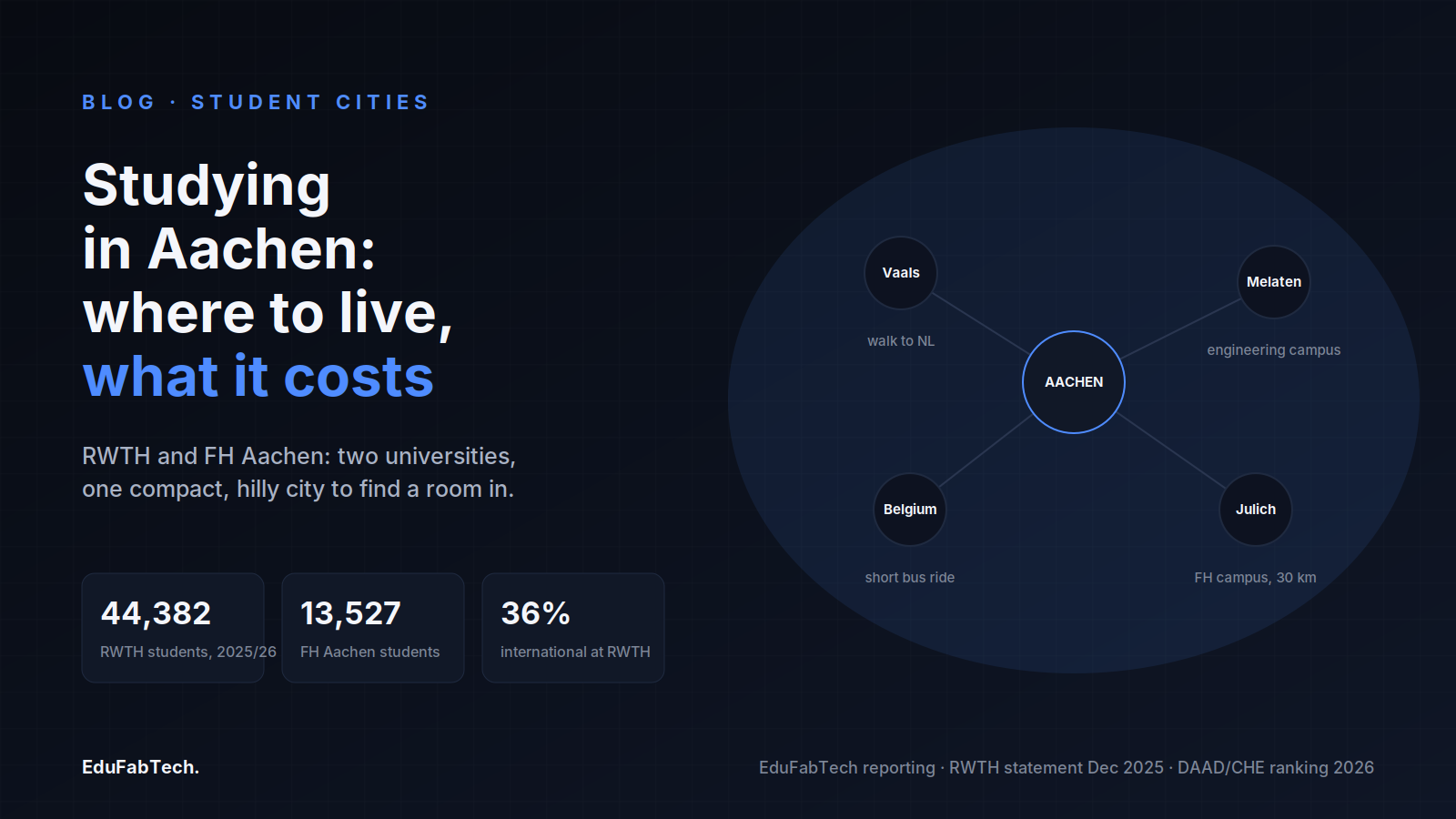
Aachen sits in the far west of Germany, pressed so hard against the frontier that the Dutch town of Vaals is a walk away and the Belgian border a short bus ride. It is the old coronation city of Charlemagne, whose cathedral is a UNESCO World Heritage site, and a spa town whose hot springs gave districts like Burtscheid their name. For students, though, the defining fact is simpler: this is an engineering town. A very large technical university and a large university of applied sciences dominate its economy, its rhythm and its housing market, and together they give a city of roughly a quarter of a million residents a student population out of all proportion to its size.
The geography shapes daily life more than in most German cities. Aachen is hilly — the edge of the Eifel uplands begins at the city limits — so cycling is real exercise, and the climate is notably wet and grey for much of the year. The centre is compact and walkable, wrapped inside a ring road that follows the line of the medieval walls, with the cathedral, the town hall and the Markt square at its heart. Because three countries meet at the nearby Dreiländereck, a day trip can take you shopping in the Netherlands or hiking in Belgium.
Two institutions anchor everything. RWTH Aachen University is one of Germany's largest technical universities; FH Aachen is a separate university of applied sciences with its own campuses and admissions. They are not rivals so much as different routes — one research-heavy and academic, the other applied and hands-on — and knowing which one you are joining determines where you will spend your days.
Two universities, two kinds of campus
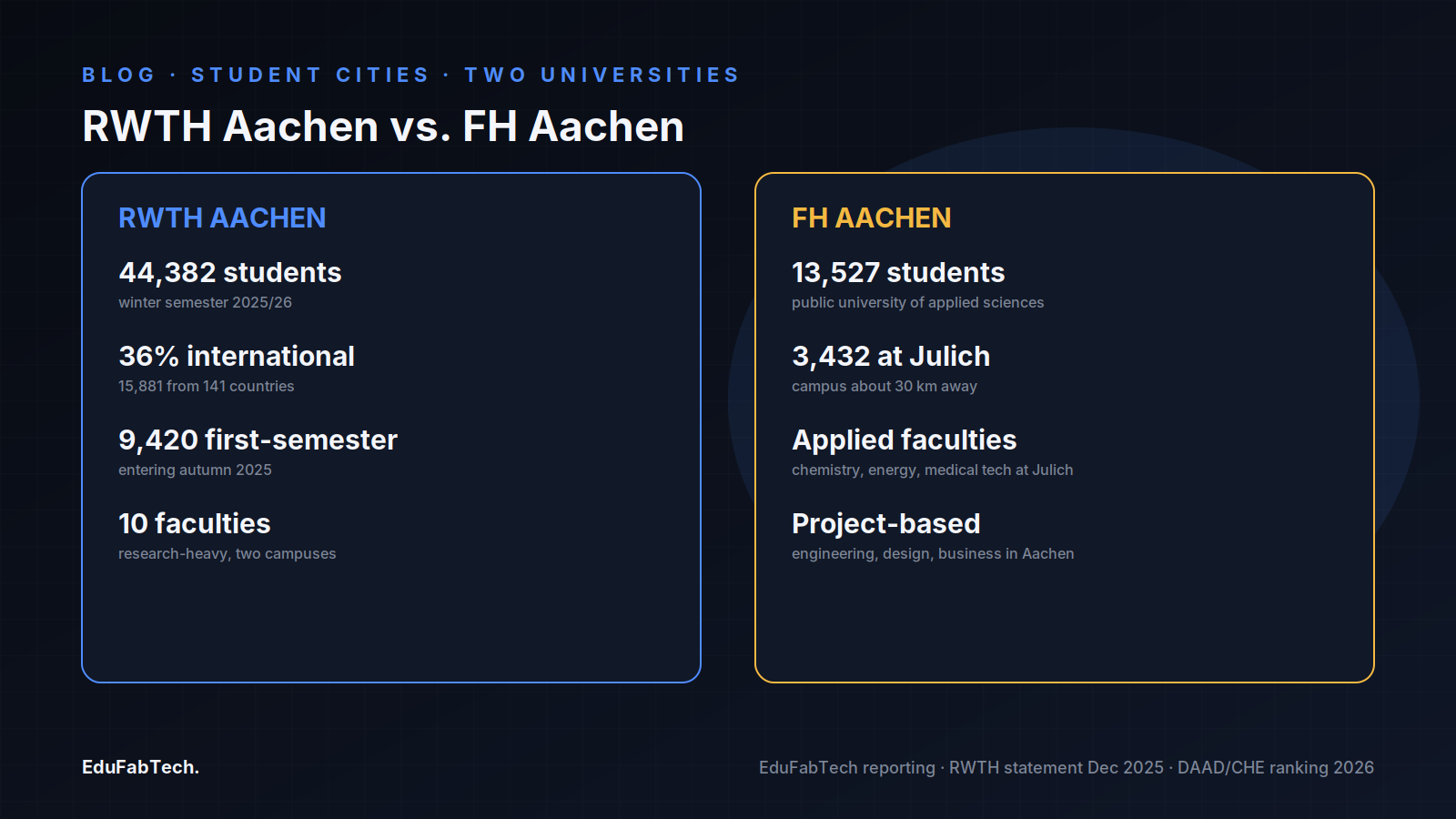
RWTH Aachen University reported 44,382 enrolled students in the 2025/26 winter semester, according to a December 2025 statement from the university. The same statement put the share of students with foreign citizenship at 36 percent — 15,881 people from 141 countries, the largest groups being from China, India and Turkey — and counted 9,420 first-semester students. RWTH is organised into ten faculties; mechanical engineering is by far the biggest, and a new Faculty of Computer Science, established that same winter semester, already held 4,425 students. If you study here, expect strong engineering and natural-science departments and large cohorts.
The teaching is spread across two clusters. RWTH Campus Mitte is the historic core around Templergraben, woven into the city centre near the cathedral, where the main lecture halls and the University Library stand. Campus Melaten, to the north-west, is the newer research campus where institutes and industry-linked clusters have been built out on former open land; much of the engineering research base sits there rather than downtown. You can filter EduFabTech's listings near RWTH Aachen University and specifically near Campus Melaten if your timetable pulls you toward one or the other.
FH Aachen is the second institution students mean when they say they study "in Aachen." The CHE university-ranking profile hosted by the DAAD (2026) records it as a public university of applied sciences with 13,527 students, of whom 3,432 are based at its Jülich campus rather than in Aachen itself. Jülich lies about 30 kilometres away and houses the applied-science faculties — chemistry and biotechnology, energy technology, medical technology and technomathematics among them — while the engineering, design, business and architecture faculties remain in Aachen. FH Aachen is the applied, project-based option; its listings sit near FH Aachen on EduFabTech.
Which part of Aachen to live in
The student heart of the city is the Pontviertel, the quarter strung along Pontstraße running north from the Markt toward the medieval Ponttor gate. This is where the cheap eats, the bars and much of the shared-flat (Wohngemeinschaft, or "WG") stock concentrate, within walking distance of Campus Mitte. It is lively and loud — a plus if you want to be in the thick of things, a minus if you need quiet. East of the centre, the Frankenberger Viertel is calmer, with handsome older apartment buildings and a more residential feel, still cyclable to the centre. Toward Campus Melaten and the Hörn area in the north-west, newer and purpose-built housing clusters nearer the engineering institutes.
Two local quirks are worth planning around. First, because Aachen is so close to the border, a meaningful number of students live in Vaals (Netherlands) or in Belgian villages and commute in — rents can differ and you take on a cross-border life and a longer, weather-exposed trip. Second, the hills matter: a cheap room in the upper districts can mean a daily climb, so look at the contour as well as the rent.
Most student rooms come through shared flats or through the Studierendenwerk Aachen, the public body that runs the halls of residence for students in both Aachen and Jülich. You can browse what is currently on offer in the city through EduFabTech's pages for Aachen as a whole and for rooms and places to stay, and it is worth starting that search early: with tens of thousands of students arriving each autumn and a limited public housing stock, the squeeze around the September–October start is real.
Renting without losing your deposit
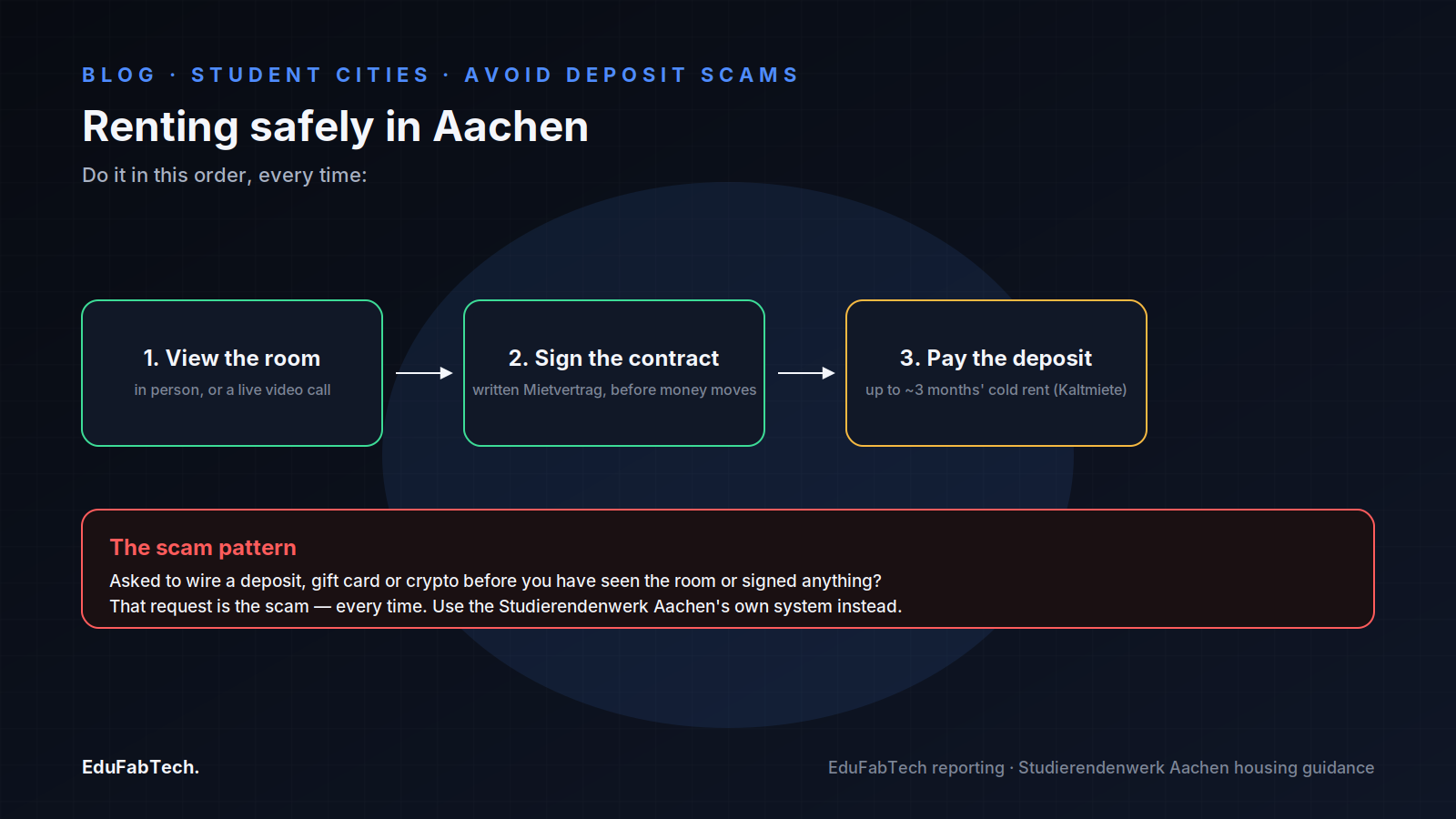
The scams that hit Aachen students follow a pattern, and it targets exactly the people who can least verify a listing: incoming internationals who cannot view a room in person. A too-good room appears in a WG or private-listing feed, the supposed landlord explains they are abroad and cannot show it, and you are asked to wire a deposit — or send money by gift card or cryptocurrency — to "hold" the room or "prove you are serious" before any contract. That request is the scam, every time. No legitimate landlord or hall in Aachen needs a deposit transferred before you have seen the place and signed a contract.
Protect yourself with a few habits. View the room in person, or at the very least on a live video call where you can ask the current tenants questions; meet whoever lives there now. Insist on a written contract (Mietvertrag) before any money moves. Deposits in Germany are normally paid only after signing and are commonly up to about three months' cold rent (Kaltmiete, the rent before utilities) — a figure far higher than that, demanded up front, is a warning sign. Never send a deposit by bank transfer, gift card or crypto to secure a place you have not seen. Using the Studierendenwerk Aachen's own application system and the university's housing channels removes much of this risk because the counterparty is an institution, not an anonymous account.
Kitting out a room: markets and second-hand
A room in Aachen usually arrives empty, and furnishing it from new is the fastest way to blow a budget. The city's weekly food market is the obvious anchor for cheap fresh groceries: the City of Aachen lists the weekly market at the Elisenbrunnen as running Tuesday and Thursday from 7:00 to 14:00 at Friedrich-Wilhelm-Platz, a few minutes from the Markt. For furniture, kitchen kit and bikes, the student move-in and move-out cycle each semester means a steady flow of second-hand goods changing hands, and flea markets run around the city through the year.
Rather than pay retail, start with what other students are discarding. EduFabTech keeps running local listings for second-hand things, second-hand furniture and things given away free in Aachen — the last of these fills up near the end of each semester, when departing students leave behind desks, lamps and crockery they cannot take with them. A borrowed trailer or a friend with a bike and panniers will get most of it home, since the centre is small.
Working alongside your degree
Many students here take a part-time job, and the rules depend heavily on your nationality. For non-EU international students, the DAAD's guidance on side jobs states that they may work 140 full days or 280 half days per year, and that working as an academic assistant at the university is treated separately and is not capped the same way. This is a summary, not legal advice: the precise conditions attached to your residence permit are set by the local immigration authority (the Ausländerbehörde, part of the City of Aachen), and the official Make it in Germany portal and your residence-permit papers are the documents that govern your case. Check them before signing any work contract, and keep track of your days.
Student jobs in Aachen cluster where you would expect — research and teaching assistant posts (often called HiWi roles) at RWTH and FH institutes, hospitality in the Pontviertel, and work with the many engineering firms around the city. Current openings are collected on EduFabTech's Aachen jobs page. A research-assistant post near your own department is usually the best-paid and most CV-relevant of the options.
Libraries, desks and getting around
RWTH's University Library (Universitätsbibliothek) on Templergraben is the main study hub, with reading rooms, individual desks and group study rooms in its two central buildings, Bib1 and Bib2. The library has extended its opening into the late evening and across weekends in agreement with student representatives, so seats are available well beyond office hours — though in exam season they fill fast, and arriving early is the only reliable tactic. Beyond the main library there are faculty and institute libraries across both campuses, and EduFabTech tracks additional study spaces and desks in the city for when the central reading rooms are full.
Local transport is run by ASEAG, the Aachen bus operator, within the regional AVV network; Aachen has no tram or U-Bahn, so buses and regional trains do the work. ASEAG's page on the Deutschlandticket gives the standard fare as €63 per month from 1 January 2026 for second-class travel on all local and regional buses and trains across Germany. Enrolled students do not pay that full price: ASEAG confirms a discounted Deutschlandsemesterticket for students, which RWTH and FH students receive through their semester contribution and now access digitally via the naveo app. In practice that pass, plus a bike for the flat stretches, covers almost all student travel across the region.
The honest balance: costs, climate and crowding
The clearest advantage of Aachen is institutional: as in the rest of Germany's public system, there are no tuition fees for most programmes at RWTH or FH Aachen, and you pay a semester contribution instead — which, importantly, bundles in the transport pass. On housing, the Studierendenwerk Aachen's residence-halls page (accessed November 2026) lists monthly rents ranging from €223 for a single room up to €998 for a family apartment, with shared-flat rooms and studios in between, across 24 halls in Aachen and Jülich — among the cheaper ways to live, when you can get a place. The catch is supply: a public housing stock of that kind cannot cover a student body the size of RWTH's and FH's combined, so the halls carry waiting lists and the private market absorbs the overflow.
The honest downsides are the housing squeeze at the start of the year, the hills that make some cheaper districts a daily climb, and the weather — Aachen is one of the wetter corners of Germany, and the grey can wear on you over a long winter. Against that, the city is compact, genuinely international, strong in exactly the engineering and science fields it is known for, and sits at a border that puts Belgium and the Netherlands within a day trip. Nightlife is concentrated and student-driven rather than metropolitan; if you want a big-city scene, Köln is close by train, but Aachen itself is a studenty town, not a cosmopolis.
First weeks: a short checklist
- Start the room search before you arrive, and apply to the Studierendenwerk Aachen early — the halls have waiting lists.
- Never transfer a deposit before you have seen the room (in person or by live video) and signed a written contract; refuse any request to pay by gift card or crypto.
- Register your address at the city's residents' office (Bürgeramt) within the deadline after moving in — you need the registration (Anmeldung) for almost everything else.
- Activate your Deutschlandsemesterticket in the naveo app once enrolled, and borrow or buy a second-hand bike for the flatter routes.
- If you are a non-EU student, read the DAAD side-jobs rules and confirm the work conditions on your own residence permit with the Ausländerbehörde before taking a job.
- Furnish from the end-of-semester free and second-hand listings rather than buying new, and use the Elisenbrunnen weekly market for cheap fresh food.
- Scout the University Library and your faculty library in week one, before exam season turns every seat into a contest.
Browse everything for the city — rooms, second-hand goods, jobs, study spaces and events — through EduFabTech's Aachen hub as you settle in.
A quick question for readers
Do you work part-time while you study?
Many students work to pay the bills. See how common it is — and how many hours people really do.
Pick an answer, create a free account in a minute, and your vote counts. Already a member? Sign in
Comments 0
CommentNo comments yet. Members start the conversation.
Source: RWTH Aachen University
Sources (5)
- RWTH Aachen University. Currently 44,382 Students Enrolled at RWTH. RWTH Aachen University, 2025. rwth-aachen.de ↗ · checked 15 Nov 2026
- DAAD / CHE. FH Aachen, Campus Jülich — CHE University Ranking 2026/2027. DAAD, 2026. daad.de ↗ · checked 15 Nov 2026
- Studierendenwerk Aachen. Residence halls. Studierendenwerk Aachen, 2026. studierendenwerk-aachen.de ↗ · checked 15 Nov 2026
- DAAD. Side jobs. DAAD, 2026. daad.de ↗ · checked 15 Nov 2026
- ASEAG. Deutschlandticket. ASEAG, 2026. aseag.de ↗ · checked 15 Nov 2026