Studying in Aberdeen, United Kingdom: universities, housing and student life
A practical guide to Aberdeen's two universities, where students live, what a room costs in 2026/27, getting around, and the honest trade-offs of studying in the Granite City.
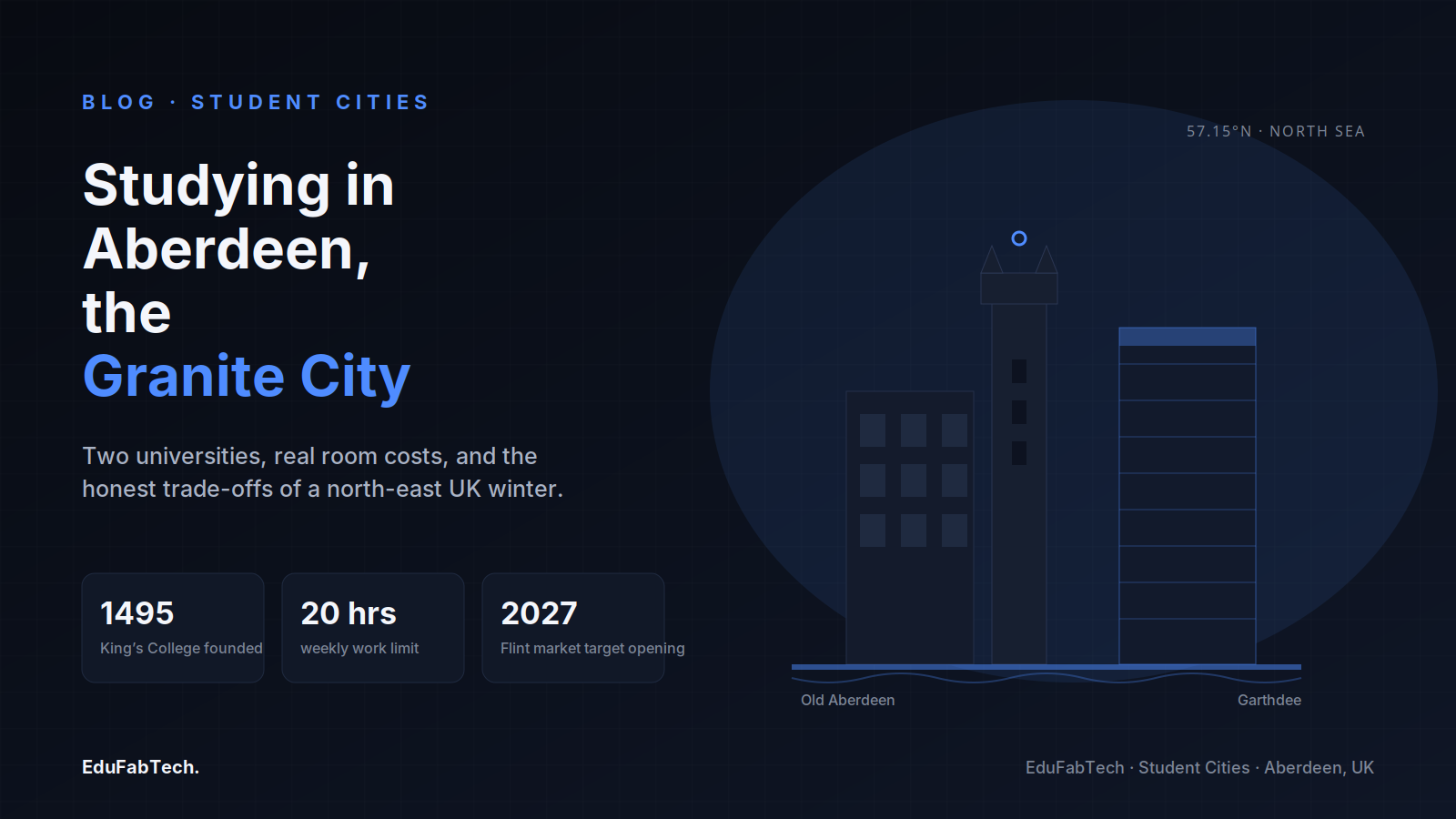
Aberdeen sits on the north-east shoulder of Scotland, where the rivers Dee and Don meet the North Sea, and it is built almost entirely from the pale grey granite that gives it the nickname the Granite City. For decades it has been the onshore base for North Sea oil and gas, and its working harbour runs right up to the edge of the city centre — a rare thing in a university town. That industrial weight shapes student life in ways a visitor notices quickly: a rental market that rises and falls with the energy sector, a strong pull towards engineering, geoscience, medicine and business, and a city that empties of oil workers on weekends but fills again with students during term.
Two universities anchor the student population, and they could hardly be more different in character: the ancient, quadrangle-and-cobbles University of Aberdeen in the medieval burgh of Old Aberdeen, and the modern, riverside Robert Gordon University out at Garthdee. This guide covers both, then the things that decide whether a year here works — where to live and how to rent safely, furnishing a room cheaply, part-time work rules, study spaces, transport, real costs with sources, and the honest pros and cons of a northern city that gets dark early in winter.
Two universities, two very different campuses
The University of Aberdeen is one of Scotland's ancient universities. Its own history pages record that King's College was founded in 1495 by William Elphinstone, Bishop of Aberdeen, and welcomed its first students in 1505; a second institution, Marischal College, was founded in 1593; and the two merged in 1860 to form the University of Aberdeen (abdn.ac.uk/about/history). The university says most of its teaching happens across two main campuses — the historic King's College site in Old Aberdeen, where buildings date back to the 15th century, and Foresterhill, shared with the hospital complex to the west (abdn.ac.uk/about). Studying at King's means days spent among a working medieval quad, the crown-tower chapel and the Sir Duncan Rice Library, a short walk from the sea.
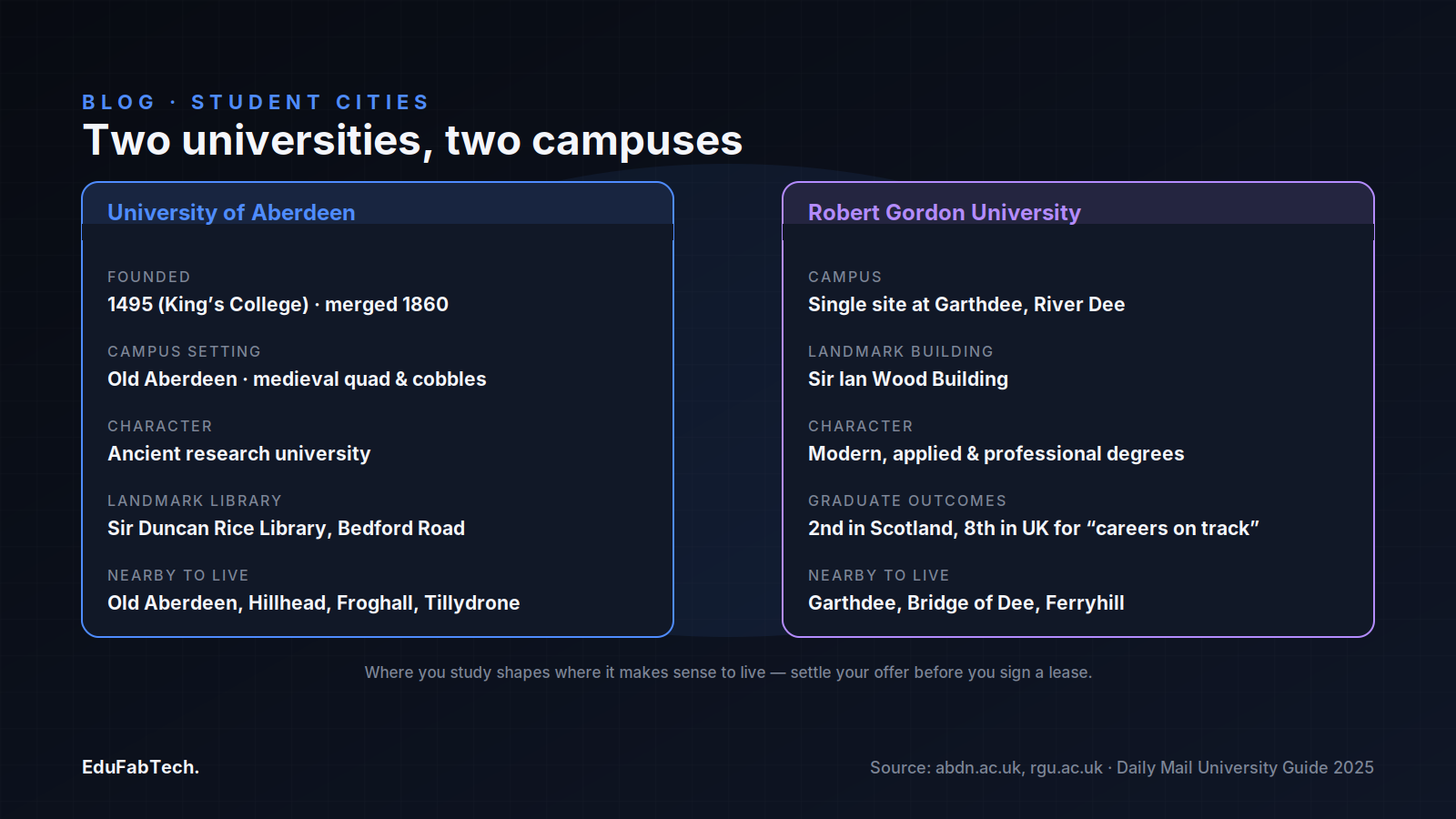
Robert Gordon University is the city's modern university, built around a single campus at Garthdee on the banks of the River Dee in the south-west of the city, with the green-towered Sir Ian Wood Building at its centre. RGU leans hard into applied and professional subjects — architecture, engineering, computing, nursing and the health professions, business and law — and markets itself on graduate outcomes. On its own news pages the university reports that the Daily Mail University Guide 2025 placed it second in Scotland and eighth in the UK for "careers on track", and that around four in five of its graduates are in high-skilled jobs within 15 months of leaving (rgu.ac.uk). For many applicants the choice between the two comes down to exactly this split: a traditional research university in a historic setting, or a vocational campus with strong employer links in energy and health.
The two campuses also pull students to opposite ends of the city. University of Aberdeen life clusters in the north, around Old Aberdeen, Hillhead and the city centre; RGU life sits to the south-west around Garthdee and the Bridge of Dee. Where you study strongly shapes where it makes sense to live, so it is worth settling your offer before signing anything.
Where students settle across the city
Old Aberdeen is the obvious base for University of Aberdeen students: a conservation area of cobbled lanes right beside King's College, within walking distance of the Sir Duncan Rice Library. Just north of it, Hillhead is the university's largest cluster of halls, set among woodland a short walk or bus ride from campus. Between Old Aberdeen and the centre lie Froghall and Tillydrone, close-in and cheaper; further west, Rosemount and the West End are tenement-flat neighbourhoods popular with second- and third-years who want independent shops, pubs and a 15-to-20-minute walk to town. RGU students tend to look at Garthdee itself, the nearby Bridge of Dee and Ferryhill, or the city centre with a bus down Holburn Street.
First-year international students and most freshers start in university-managed halls, which remove the hardest parts of renting in a new country — no deposit disputes with a private landlord, bills bundled in, and a guaranteed room before you arrive. After first year, many students move into shared private flats in the granite tenements that make up much of Aberdeen's housing. The rhythm of the search matters: halls applications open months ahead and the best-value rooms go first, while the private flat-share market for a September start really gets going from late spring. You can browse current rooms and flatshares in the city on EduFabTech's Aberdeen rooms listings, and filter by campus near University of Aberdeen or Robert Gordon University.
Renting without losing a deposit
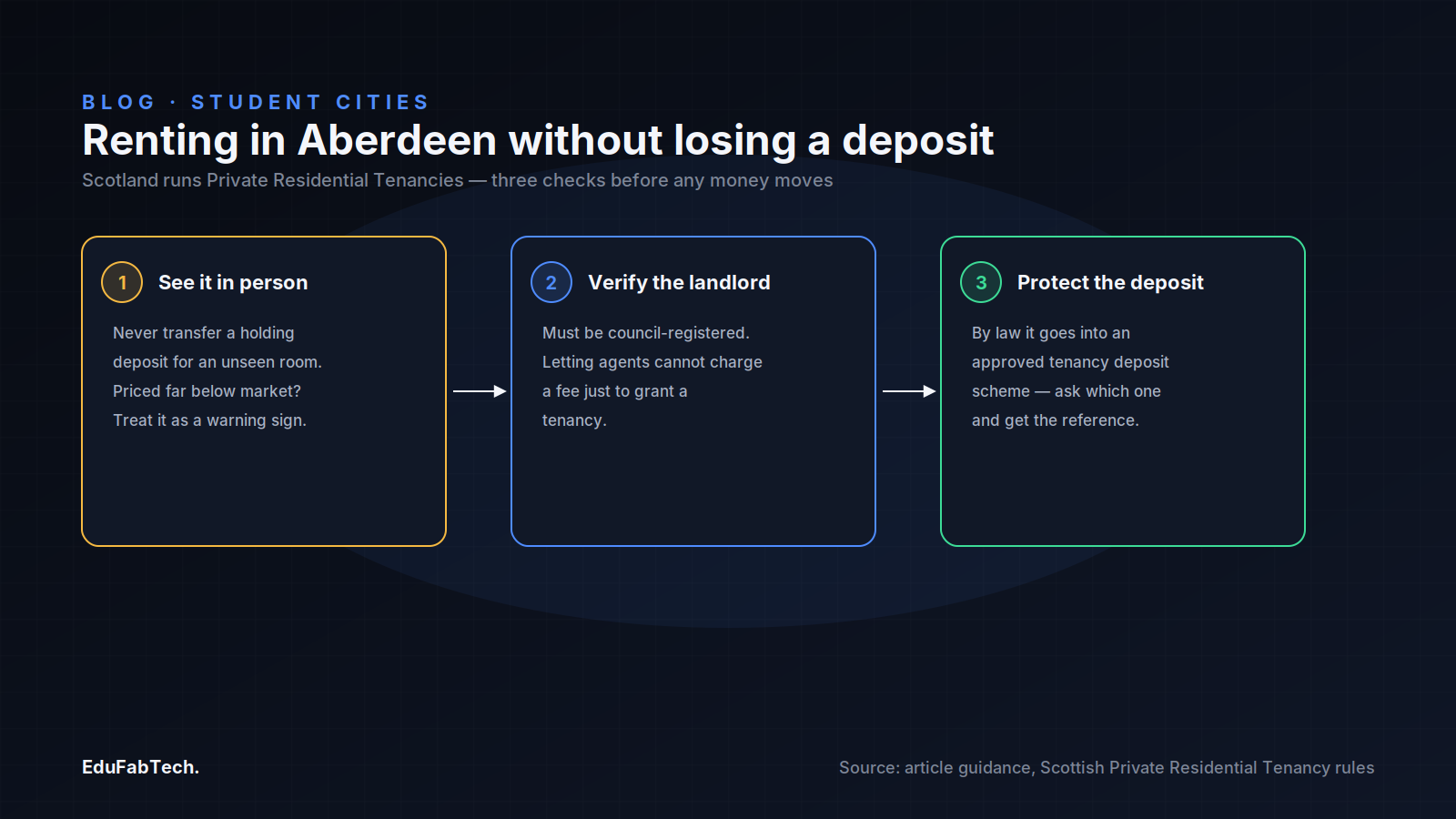
The most common way students get cheated in Aberdeen is the same one that works in every student city: a too-good-to-be-true flat advertised online, a "landlord" who is conveniently offshore or abroad — plausible in an oil city — and a request to transfer a holding deposit before you can view. Treat any such request as a warning sign. Never send money by bank transfer, gift card or cryptocurrency to "hold" a room you have not seen, and be especially wary of a listing priced well below the going rate for its area. See the place in person, or have someone you trust see it, before any money changes hands.
A few things are specific to Scotland and worth knowing before you sign. Private tenancies here are almost always Private Residential Tenancies, which are open-ended rather than fixed to a year. A landlord letting a property must be registered with the council, and any deposit must by law be placed in a government-approved tenancy deposit scheme — ask which one and get the reference. Letting agents cannot charge you a fee simply to grant a tenancy. If you are renting privately, EduFabTech's Aberdeen rooms page is a place to start, but verify the landlord and view the property regardless of where you found it.
Furnishing a room without overspending
A private flat in Aberdeen often comes part-furnished, which leaves the usual gaps — a desk, a lamp, kitchen things, bedding. The cheapest routes are second-hand. Charity shops are dense along George Street, Rosemount Place and Holburn Street, and the end-of-term weeks see a flood of furniture and kitchenware given away or sold cheaply as leases turn over. On EduFabTech you can look through second-hand things in Aberdeen before buying anything new.
For food and local produce rather than furniture, the Aberdeen Country Fair sets up on Belmont Street in the city centre on the last Saturday of most months, with farm stalls from the north-east's agricultural hinterland — strong on Aberdeenshire beef, baking and preserves. The city's long-promised covered market is not yet an option: Aberdeen City Council is rebuilding the former indoor market off Union Street as a food-and-retail hall branded Flint, and the council's most recent timetable points to an opening in 2027 rather than now, so do not plan around it for a 2026 arrival.
Part-time work and the visa rules
Many students work part-time around their studies, and in Aberdeen the obvious sectors are hospitality, retail and campus jobs. If you are an international student, how much you may work is a condition of your immigration permission, not something an employer decides. UKCISA, the UK Council for International Student Affairs, summarises the standard conditions: up to 20 hours a week in term time if you are studying for a qualification at degree level or above, and up to 10 hours a week in term time below degree level, with the exact restriction printed on your visa or eVisa (ukcisa.org.uk). The Home Office's own overview confirms that whether and how much you can work depends on your course and whether it is term time (gov.uk/student-visa/work). This is general information, not legal advice — always check the conditions on your own document, and if it says no work, do not work. Current student jobs in the city are listed on EduFabTech's Aberdeen jobs page.
Libraries and places to study
The University of Aberdeen's Sir Duncan Rice Library, on Bedford Road in Old Aberdeen, is the city's landmark study building — a glass box whose floors are zoned by noise, with collaborative study on floors 1 to 3, quiet study on floors 4, 6 and 7, a silent floor on floor 5 and dedicated silent study rooms, and it moves to 24/7 opening during assessment and exam periods (abdn.ac.uk). RGU's library sits inside the Sir Ian Wood Building at Garthdee, overlooking the campus, with group and individual study space alongside the main collection. Beyond the universities, Aberdeen City Council runs public libraries across the city for those who want a quiet desk off campus. You can also find bookable desks and informal study spots through EduFabTech's Aberdeen study spaces page.
Getting around
Aberdeen is compact enough that students living in Old Aberdeen or the West End often walk to campus, and the city is largely flat near the centre. For everything else there are the buses: First Aberdeen is the main operator. On its student travel page, First lists a FirstDay ticket at £4.95, a FirstWeek at £23.50 and a FirstMonth at £81.00 for 2026, plus flexible bundles such as 5 days of travel in any 7 for £20.00 (firstbus.co.uk). The single most valuable fact for younger students: if you are under 22 and live in Scotland, bus travel is free. Transport Scotland states that everyone aged 5 to 21 can travel for free on the bus in Scotland, which includes students, once you hold a National Entitlement Card or Young Scot NEC (transport.gov.scot). Aberdeen also has a mainline rail station and an airport with UK and some European links, which matters because the city is a long way from the rest of Britain.
What a year actually costs
Housing is the biggest line in any student budget, and here Aberdeen's figures are unusually easy to pin down because both universities publish them. For 2026/27 the University of Aberdeen lists self-catered hall rooms from £111 a week — for example Adam Smith House and Fyfe House — rising to £191 a week for ensuite rooms such as those at Elphinstone Road Flats and Kings Hall, typically on 40-week leases with WiFi included (abdn.ac.uk). Robert Gordon University's 2026/27 rates run from £101.92 a week for a standard single room at Woolmanhill on a 49-week lease (11 September 2026 to 20 August 2027) up to £189.56 a week for an ensuite room at Crathie Student Village on a 42-week lease (11 September 2026 to 2 July 2027) (rgu.ac.uk).
Private renting can work out cheaper per head in a shared flat, and Aberdeen is cheaper than it was. The Office for National Statistics reports that average private rent in the Aberdeen and Shire area was £844 a month in September 2026, a 1.2% fall from £854 a year earlier — a decrease at a time when rents across most of the UK were still rising. The same release puts a one-bedroom property at £602 and a two-bedroom at £777 a month (ons.gov.uk). Those are whole-property figures covering a wide market area rather than a single student room, so split a two- or three-bed between flatmates to estimate your own share. The reason behind the softness is local: the energy-sector downturn of recent years loosened a rental market that the oil boom had once made very tight.
The honest pros and cons
The good: by UK standards Aberdeen is affordable for students right now, with falling private rents and the rare bonus of free buses for under-22s. It is compact and walkable, close to beach, river and the Cairngorms, and the job and placement links in energy, engineering and health are genuinely strong — RGU's graduate-outcomes figures are built on them. Two universities of very different character in one small city give you real choice.
The hard: this is one of Britain's most northerly cities, and the winters are long, grey, windy and dark, with short daylight hours that catch many newcomers off guard. The granite architecture is handsome but can feel austere under cloud. Aberdeen is far from the rest of the UK, so cheap weekend trips south are not really a thing, and the oil-linked economy means the rental market and the local job scene can swing with the energy price. And while rents are down, hall ensuites at either university still top £180 a week, so budgeting carefully matters.
A checklist for the first weeks
- Register with a local GP practice near where you live as soon as you arrive — do not wait until you are ill.
- If you are under 22 and living in Scotland, apply for a National Entitlement Card or Young Scot NEC so your bus travel is free.
- If you are not eligible for free travel, compare a FirstMonth pass against pay-as-you-go before committing.
- Check your Student visa conditions for the exact weekly work limit before taking any part-time job.
- Get your student ID and library access set up, and learn the noise zones of your main library before deadlines hit.
- If you rent privately, confirm the landlord is council-registered and your deposit is in an approved scheme — and never pay to hold an unseen room.
- Furnish from charity shops and end-of-term giveaways rather than buying everything new.
A quick question for readers
Rate these parts of student life this term
Rate each one from 1 (very poor) to 5 (very good). Together the results show where students struggle most.
Rate 5 things →Comments 2
Comment-
The one number in this piece that isn't actually a number is the explanation for the rent drop. Every other claim here has a source attached…
-
The free bus for under-22s is the one line in here that's actually actionable money saved, not just a nice-to-know - get the National Entitl…
Join free to read the full comments and reply Comments are between members; an account takes a minute.
Source: University of Aberdeen
Sources (5)
- University of Aberdeen. Accommodation Costs 2026/27. University of Aberdeen, 2026. abdn.ac.uk ↗ · checked 7 Nov 2026
- Robert Gordon University. Costs of Accommodation. Robert Gordon University, 2026. rgu.ac.uk ↗ · checked 7 Nov 2026
- Office for National Statistics. Private rent and house prices, Aberdeen and Shire. Office for National Statistics, 2026. ons.gov.uk ↗ · checked 7 Nov 2026
- First Aberdeen. Student Travel. FirstGroup, 2026. firstbus.co.uk ↗ · checked 7 Nov 2026
- Transport Scotland. Under 22s free bus travel. Transport Scotland, 2026. transport.gov.scot ↗ · checked 7 Nov 2026