Studying in Adana: universities, housing and student life
A practical, sourced guide to the universities of Adana and its neighbours, where students live, how to rent safely, and what daily life on the Çukurova plain actually costs.
A city on the Çukurova plain
Adana sits inland from the north-eastern corner of the Mediterranean, on the flat, fertile Çukurova plain that has grown cotton and citrus for generations. It is one of the larger cities in the country, and it does not feel like a quiet university town: it is a working city with a long river, wide boulevards, and a summer that shapes almost everything about daily life. The Seyhan River runs through the middle, splitting the older, denser western side from the broad eastern districts, and much of the city's public life happens along its banks and in the shaded streets of the old centre.
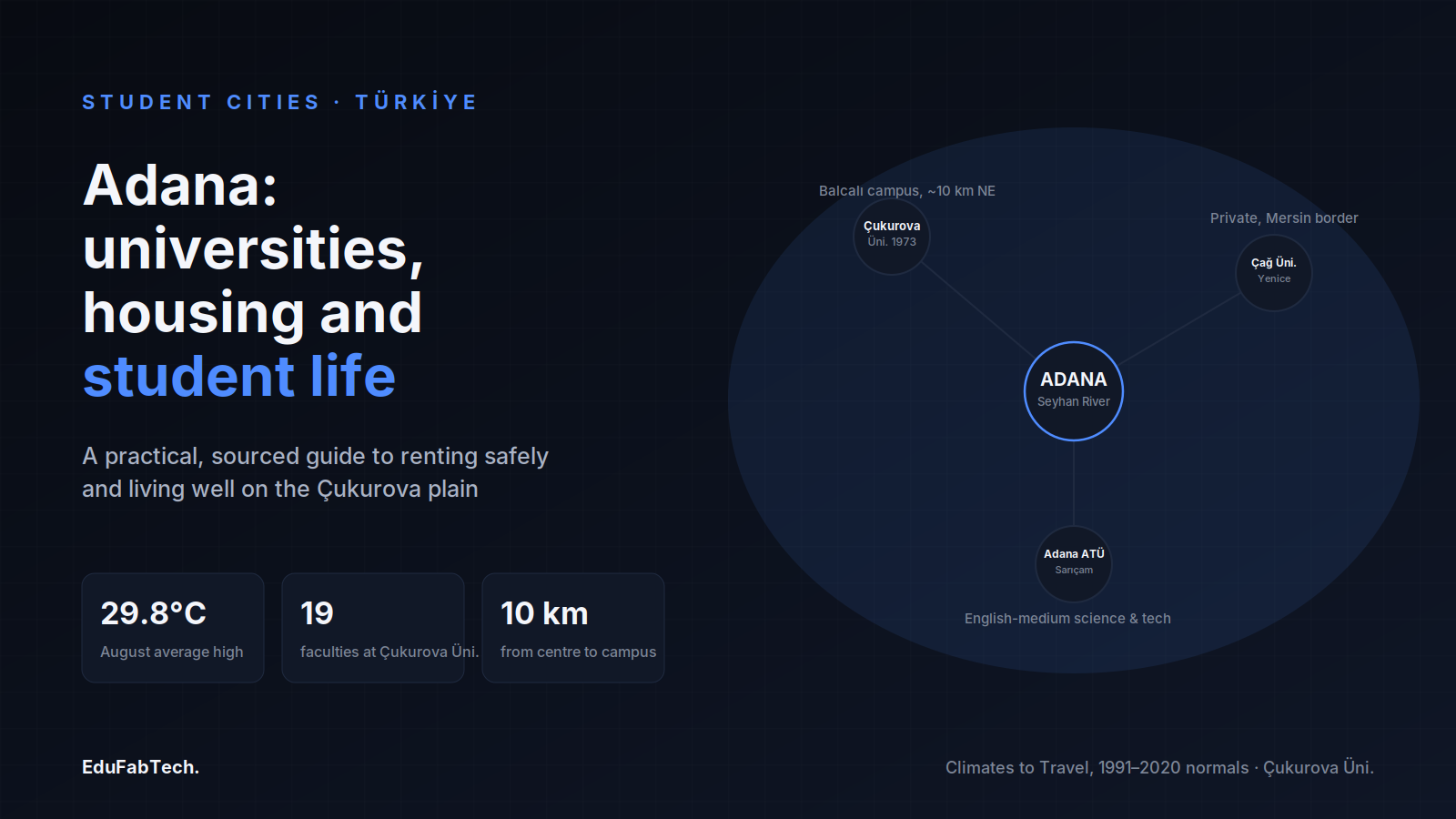
The climate is the first thing any newcomer notices. Adana is classified Csa — hot-summer Mediterranean — and using 1991–2020 normals the warmest month, August, averages around 29.8 °C while the coldest, January, averages around 10.3 °C, according to Climates to Travel's summary of Adana's 1991–2020 normals. In practice that means daily highs in July and August routinely sit in the mid-thirties with high humidity, and mild, rainy winters when you rarely need heavy clothing. Term time overlaps the two most pleasant stretches — autumn and spring — but the tail of September and the start of the summer break can be punishing outdoors.
Adana's character is unpretentious and famously food-proud. The old centre around the Great Clock Tower (Büyük Saat) and the historic Kazancılar Bazaar — an Ottoman-era covered market once known for copper and tin work — still functions as a real bazaar, not a museum. Newer, planned neighbourhoods spread north and east toward the universities, where most student life actually concentrates. If you are arriving from abroad, browsing the local student listings for Adana before you land will give you a feel for where rooms, jobs and second-hand goods cluster.
The universities in and around Adana
Çukurova University is the anchor institution. Founded in 1973, it is a large public research university whose main Balcalı campus stands on the east side of the Seyhan Dam Lake, about 10 km from the city centre, in the Boynuyoğun–Balcalı area of the Sarıçam district. The university's own general-information page lists 19 faculties along with vocational schools, institutes and dozens of research centres, and it describes a central library with capacity for 800 readers. The campus is effectively a small town: it houses the large Balcalı teaching hospital, and the university is best known for medicine, agriculture and engineering — a natural fit for a region built on farming and industry.
Adana Alparslan Türkeş Science and Technology University is the city's younger public university, established by law in 2011 and given its present name in 2019. Its campus is also on the Sarıçam side, near Balcalı and Boynuyoğun, close to Çukurova University. It concentrates on engineering, the natural sciences and aviation and space sciences, keeps a smaller student body, and runs a substantial share of its programmes in English — worth knowing if your Turkish is limited and you want a science or technology degree taught in an international language.
Çağ University is a private, non-profit foundation university founded in 1997, strong in business, law, education and English-medium teaching. One honest point of geography: its Yaşar Bayboğan campus is at Yenice, on the Adana–Mersin highway, and Yenice is administratively within neighbouring Mersin province rather than Adana itself. It sits close to the boundary and draws students from both cities, so many people treat it as part of the wider Adana study region even though the address is technically over the provincial line. Check the exact travel time from wherever you plan to live before committing.
Studying at any of the three has a common rhythm: lectures on campuses set slightly apart from the centre, a daily commute for most students, and a social life that splits between the campus and the cafés of the newer western districts. Public universities admit most domestic students through the national university entrance and placement examination; international applicants generally apply directly to each university under its own foreign-student procedure, so read the admissions pages on the sites linked above rather than relying on second-hand summaries.
Where students live
Because the campuses are north-east of the centre, student housing forms a rough arc between the universities and the newer parts of town. Many undergraduates at Çukurova and Adana Alparslan Türkeş live close to Balcalı and the Sarıçam side, cutting the commute to a short bus ride. Others prefer the planned neighbourhoods of the western Çukurova district — areas such as 100. Yıl, Belediye Evleri and Kurttepe — which are livelier in the evenings, better for cafés and shops, and connected to campus by bus. The eastern Yüreğir side and the older central Seyhan neighbourhoods are generally cheaper, but the trade-off is a longer daily journey.
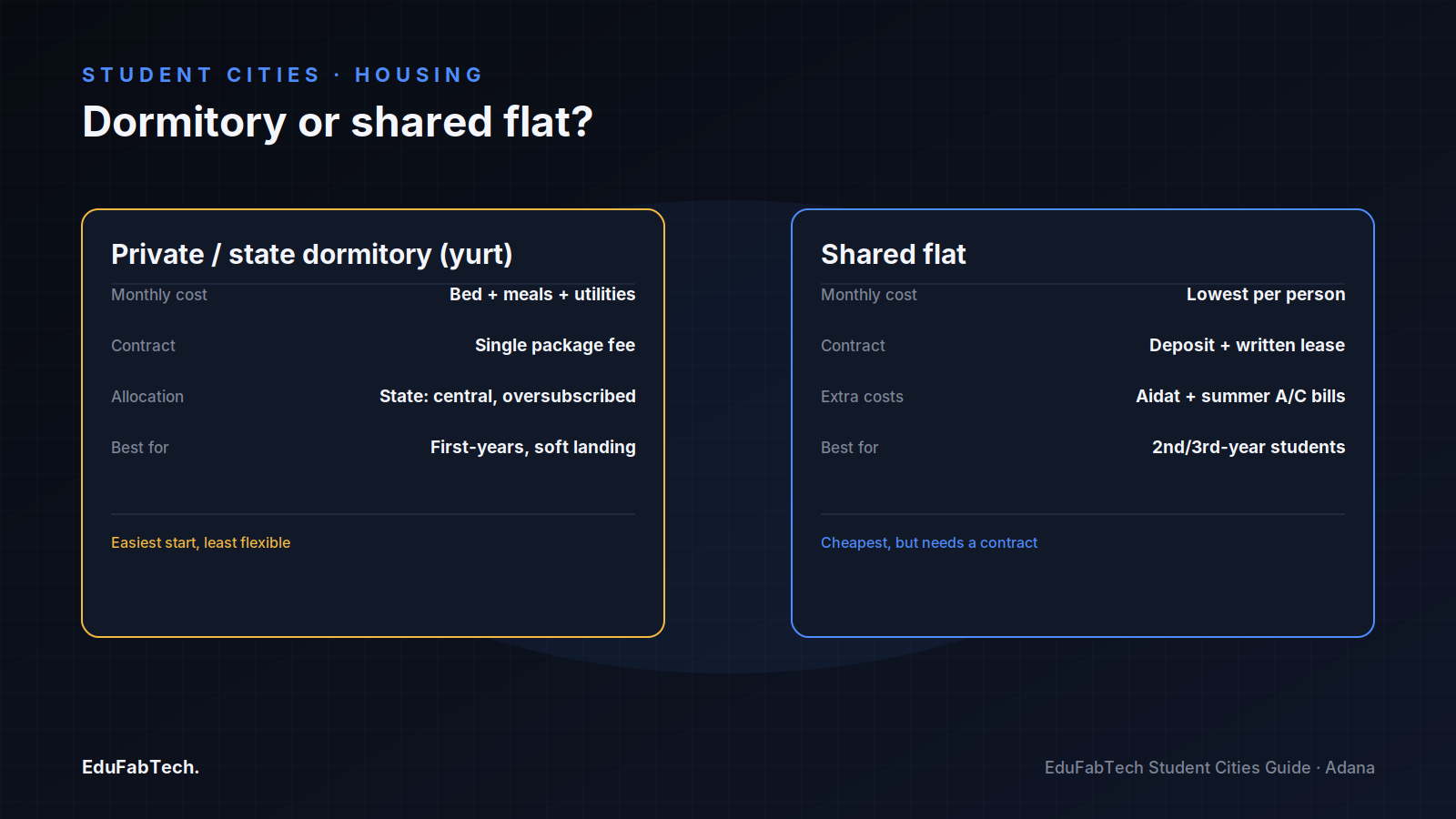
Three kinds of housing dominate. There are private student dormitories (yurt), which package a bed, meals and utilities into one monthly fee and suit first-years who want a soft landing; there is the state dormitory system, which is lower-cost but allocated through a central process and often oversubscribed; and there are shared flats, which is where most second- and third-year students end up. A shared flat is usually the cheapest per person and the most flexible, but it means signing a contract, paying a deposit, and splitting building dues (aidat) and summer electricity — which, given the air-conditioning bills, is not a small line in Adana. Start looking in August for an autumn start; the best rooms near the campuses go early, and prices firm up as term approaches. You can begin from the rooms listings for Adana or filter for places near Çukurova University.
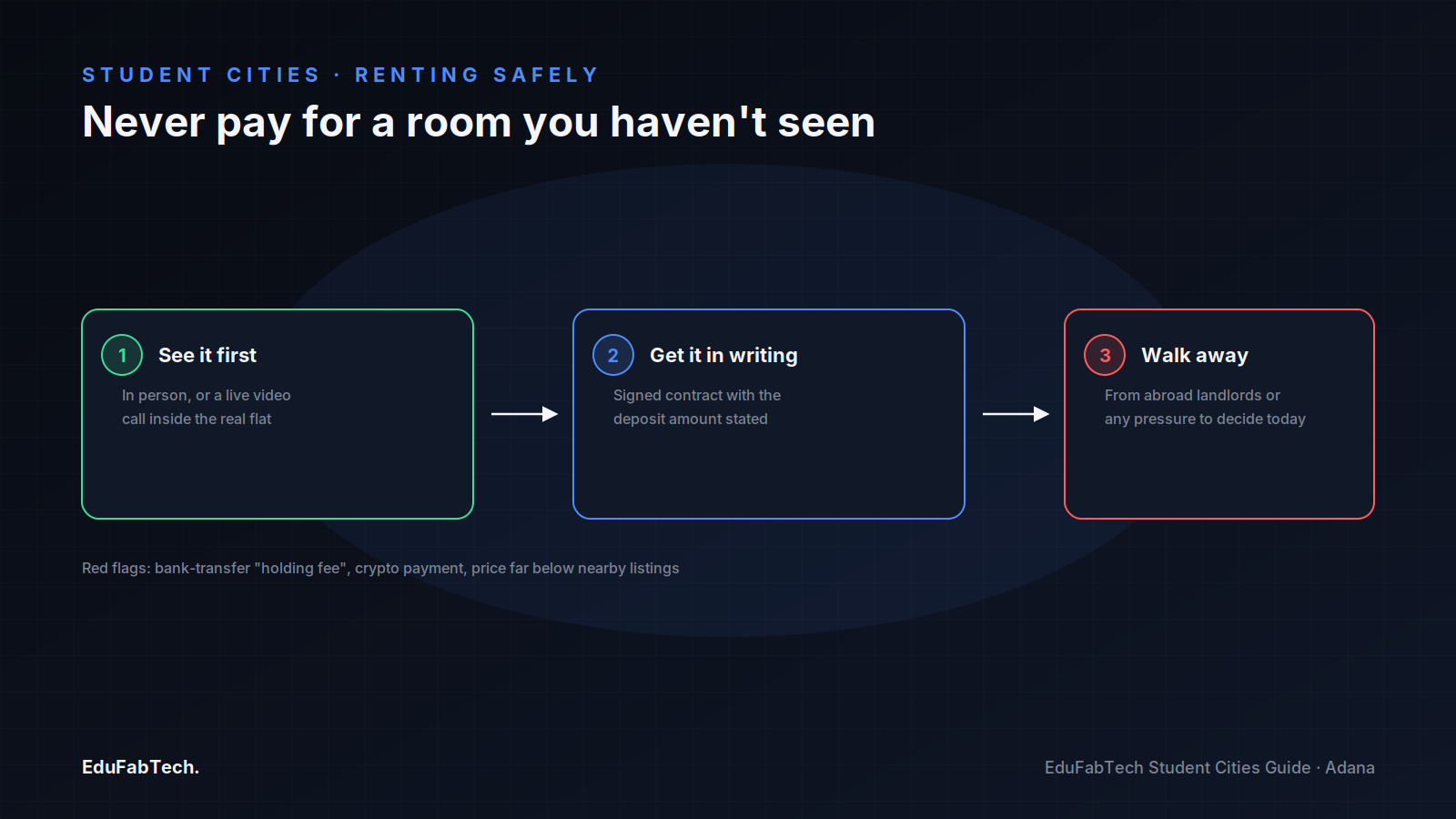
Before you pay anything, see the room. Check the water pressure and that the air conditioning actually works — this matters more here than almost anywhere — look for damp, ask what the aidat covers, confirm who pays for what, and get a written contract with the deposit amount stated. Ask how far the nearest bus stop is and how long the ride to your faculty takes at 8 a.m., not at noon.
Renting without getting scammed
Rental fraud follows a predictable script, and students new to a city are the usual targets. The rule that protects you is simple: never send money for a room you have not seen. See the place in person, or at the very least on a live video call where the person can move around the actual flat on request. Do not pay a deposit or "holding fee" by bank transfer, gift card or cryptocurrency to someone you have not met, and be wary of any listing priced well below the others nearby, of a "landlord" who is conveniently abroad, and of pressure to decide today. A genuine landlord will let you visit, will provide a written contract, and will not need to be paid to "reserve" a room before you have seen it. If something feels engineered to rush you, walk away.
Furnishing a room on a budget
A shared flat is often let unfurnished or half-furnished, so budget for a bed, a desk and the basics. You do not need to buy new. Adana's weekly neighbourhood markets (semt pazarı) rotate through different districts on set days and are the everyday source for cheap kitchenware, textiles and household goods; the second-hand (bit pazarı) markets are where used furniture and appliances turn up at a fraction of retail. The historic Kazancılar Bazaar in the old centre is more for craft and copperware than for a cheap desk, but it is worth a walk and useful for one-off pieces. For the fastest results, students trade furniture directly among themselves — check the wider second-hand listings for Adana, where departing students also give away or sell off what they cannot carry home. Buying at the end of an academic year, when leases end, gets you the best prices.
Working while you study
Rules here differ depending on whether you are a domestic or an international student, and they change, so treat the following as orientation and verify before you act. In Türkiye, holding a residence permit does not by itself grant the right to work: an international student needs a separate work permit, and the application is generally made by the employer rather than the student once the paperwork conditions are met — this is set out in the official work-permit guidance published by the national labour authority. Some categories of student face restrictions on when and how many hours they may work, and on-campus roles can follow a simpler route, so the precise rules depend on your level of study and your situation. Working without the correct permit carries real penalties. Read the official guidance, and confirm the details that apply to you with your university's international office, because none of this is legal advice. When you are ready to look, the Adana jobs and part-time work listings are a starting point.
Libraries, study spaces and getting around
The single largest study resource in the city is Çukurova University's central library at Balcalı, which the university states seats 800 readers and which extends its hours around exam periods. Faculty libraries and the smaller campuses at Adana Alparslan Türkeş and Çağ add reading rooms of their own. Off campus, students fall back on the cafés of the Çukurova district and on quieter public and municipal reading spaces; if you need a desk away from home in a crunch, the study-spaces listings collect what is available. During Adana's hot months, an air-conditioned library is not a luxury but a survival strategy for getting work done.
Getting around leans on buses and shared minibuses (dolmuş), supplemented by a single metro line. The Adana Metro opened to the public in 2010 and runs about 13.5 km with 13 stations along a central corridor, and is operated by the metropolitan municipality; it does not reach every faculty, so most trips to the Balcalı campuses still involve a municipal bus. The city uses a rechargeable smart card (Kentkart), and enrolled students can usually obtain a discounted student card after registration — apply early with your student certificate and ID, and check the current tariff at the point of sale rather than trusting an old figure, since fares are revised periodically.
What is good, and what is hard
The good: living costs in Adana are noticeably gentler than in the largest coastal and capital cities, so the same budget stretches further on rent and food; the food culture is genuinely excellent and cheap; winters are mild enough that heating is a minor concern; and a large anchor university means a real student population, active campuses and a steady second-hand market. The hard: the summer heat and humidity are serious, and cooling costs push up utility bills in a way newcomers underestimate; the campuses sit apart from the centre, so a daily commute is the norm and where you live is largely a bet on that commute; central and older housing can be tired; and demand near the universities spikes at the start of term, so late arrivals get the worst of what is left. None of this is a reason to stay away — it is a reason to arrive early, budget for air conditioning, and choose your neighbourhood around your timetable.
A checklist for your first weeks
- Confirm your enrolment and, if you are an international student, sort your residence permit through the national migration authority before its deadline.
- Lock in temporary accommodation for a week or two so you can view rooms in person rather than paying blind.
- View at least three rooms, check the air conditioning and water, and sign a written contract before paying any deposit.
- Register your student status and apply for the discounted transit card so your commute is cheap from day one.
- Time your actual journey to your faculty at morning peak before you commit to a lease.
- Furnish from the weekly and second-hand markets, and watch the end-of-year giveaways for near-free basics.
- Find your default study spot — the central library or a reliable air-conditioned alternative — before the first assessment lands.
- If you plan to work, read the official work-permit rules first and check with your international office; do not rely on word of mouth.
Adana rewards students who plan the practical things early. Get the commute, the cooling and the contract right, and you are left with a large, affordable, food-loving city that is easy to feel at home in.
- Çukurova University. General Information (Institutional / About). Çukurova University, 2026. link
- Adana Alparslan Türkeş Science and Technology University. Official website. Adana Alparslan Türkeş Science and Technology University, 2026. link
- Çağ University. Official website (Contact / About). Çağ University, 2026. link
- Directorate General of International Labour Force. Work Permit — Frequently Asked Questions. Ministry of Labour and Social Security (Türkiye), 2026. link
- Study in Türkiye. Çukurova University institutional profile. Study in Türkiye (national higher-education portal), 2026. link
- Railway Gazette International. Adana Metro. Railway Gazette International, 2026. link
- Climates to Travel. Adana climate (1991–2020 normals). Climates to Travel, 2026. link