Studying in Akron: universities, housing and student life
A practical guide to the University of Akron, Kent State and the colleges around them — where students live, how to find a room safely, what it costs, and the honest trade-offs of a former Rubber City.
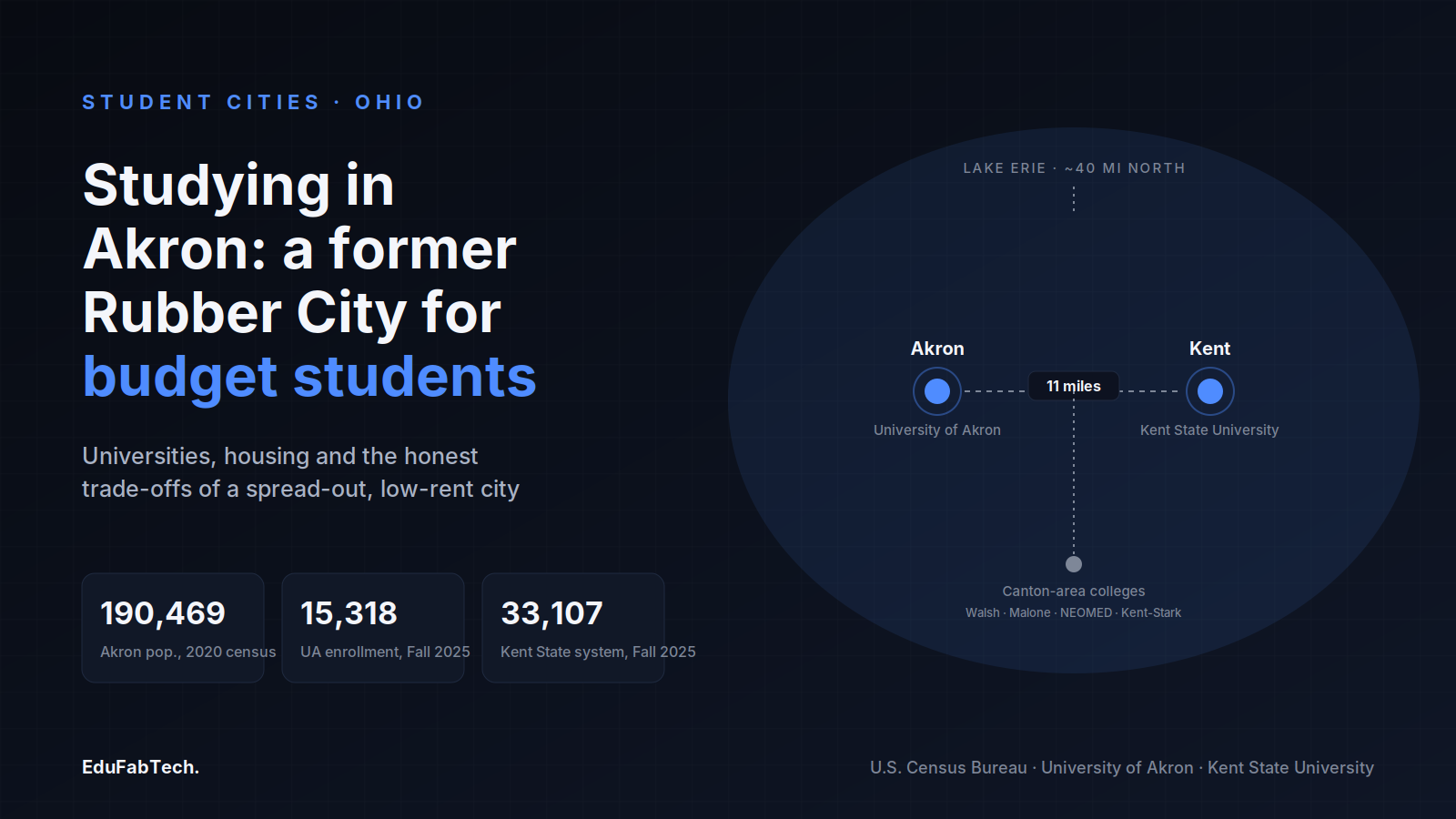
Akron sits in Summit County in northeast Ohio, about 40 miles south of Lake Erie and roughly an equal distance from Cleveland. The U.S. Census Bureau's QuickFacts put the city's population at 190,469 at the 2020 census, with a July 2024 estimate of 189,664 (census.gov QuickFacts). It is an old industrial city — the "Rubber City" where Goodyear, Firestone and Goodrich grew — and that history still shapes campus life: the University of Akron built one of the world's first polymer science and engineering programs out of that industry, and the Goodyear Polymer Center anchors part of its downtown campus.
For a student, the practical geography is this: the University of Akron is in and next to downtown, Kent State University is a separate college town 11 miles east, and a cluster of smaller universities sits south toward Canton. The metro is spread out and built for cars, winters bring lake-effect snow off Lake Erie, and rents are low by national standards — all of which shape where you choose to live and whether you bring a car. This guide works through the universities, housing, furnishing a room, work, study spaces, transport and costs, and ends with an honest reckoning and a checklist.
Current EduFabTech listings for the city are gathered at /in/united-states/akron.
The universities in and around Akron
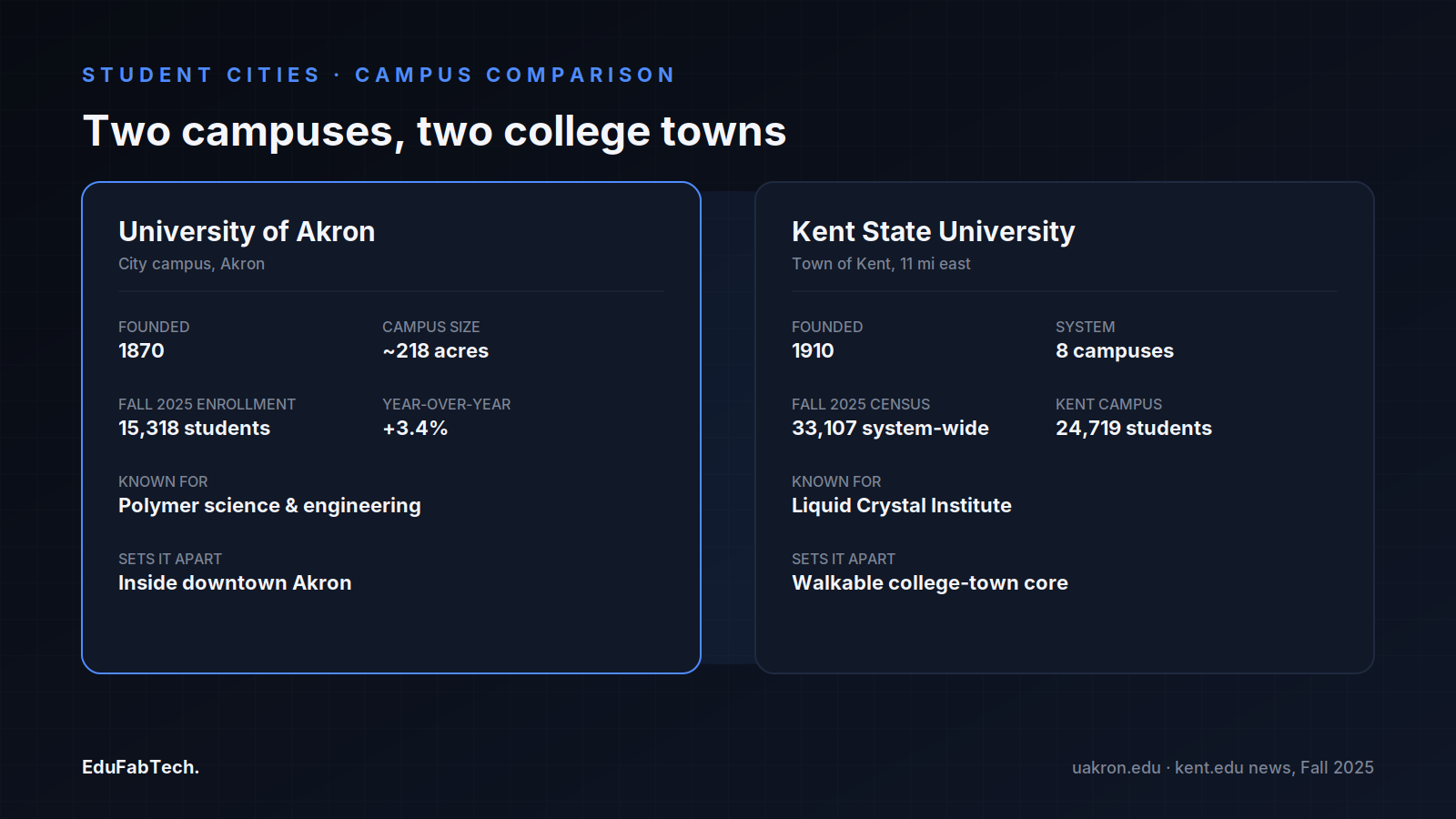
The University of Akron is the city's own public research university, founded in 1870, with a city campus of roughly 218 acres beside downtown at the Broadway and East Market area. Its enrollment reached 15,318 in Fall 2025, a 3.4% rise over 2024 and the largest since 2021, according to the university (uakron.edu news). It is best known regionally for polymer science and engineering — a direct inheritance of the rubber industry — alongside business, law and nursing. If you want to be inside Akron itself, this is the campus you will live around; listings near it are at /near/university-of-akron.
Kent State University, founded in 1910, is 11 miles east in the walkable town of Kent on the Cuyahoga River (kent.edu). It is the larger institution: Kent State reported a Fall 2025 census of 33,107 students across its eight-campus system, with 24,719 on the Kent campus itself (kent.edu news). Kent is known for its Liquid Crystal Institute and for the Kent State University Museum's fashion and textile collections. It is close enough that students sometimes live between the two cities; listings near it are at /near/kent-state-university.
Several smaller institutions ring the southern edge of the metro, toward Canton. Northeast Ohio Medical University is a public health-sciences university in Rootstown, near Ravenna, with colleges of medicine, pharmacy, dentistry and graduate studies; its students are overwhelmingly in professional and graduate programmes rather than undergraduate ones. Walsh University in North Canton is a private Catholic university founded in 1960, with around 2,192 students in Fall 2024 and strengths in nursing, business and education. Malone University in Canton is a private Christian university in the Evangelical Friends tradition, founded in 1892. Kent State University at Stark, also in North Canton, is Kent State's largest regional campus, open since 1946 and granting associate, bachelor's and master's degrees. These are commuter-heavy campuses in their own towns; if you enrol at one, orient your housing search to that town rather than to central Akron.
Where students live
Akron's student housing divides into two worlds. Around the University of Akron, first- and second-year students mostly live in university residence halls — Bulger and Spanton among them — clustered on the east side of campus near downtown. Beyond that, students spread into the surrounding neighbourhoods and rent houses and apartments, because Akron has a lot of older, inexpensive housing stock.
The neighbourhoods students gravitate to each have a distinct character. Highland Square, just west of downtown along West Market Street, is the walkable, arts-leaning district with cafés, a cinema and a younger crowd — the closest Akron comes to a classic student quarter, and it has its own public library branch. West Akron and Wallhaven stretch further west with quieter residential streets. The Merriman Valley, in the city's northwest, runs along the Cuyahoga River toward the Metro Parks and Cuyahoga Valley National Park, and draws students who want green space and don't mind driving. Downtown itself has added apartments in converted commercial buildings and is the most transit-connected. For Kent State students, the town of Kent has a compact, genuinely walkable core where off-campus houses sit within walking distance of campus — a different living pattern from spread-out Akron.
Start looking early. University of Akron housing contracts and room selection run months ahead of the autumn term, so apply through the university's residence-life office as soon as you are admitted if you want a hall place. For off-campus houses and apartments, the useful window for an autumn tenancy is spring and early summer, when outgoing students vacate. Rooms and places to stay posted on EduFabTech are at /in/united-states/akron/rooms.
Renting without losing a deposit
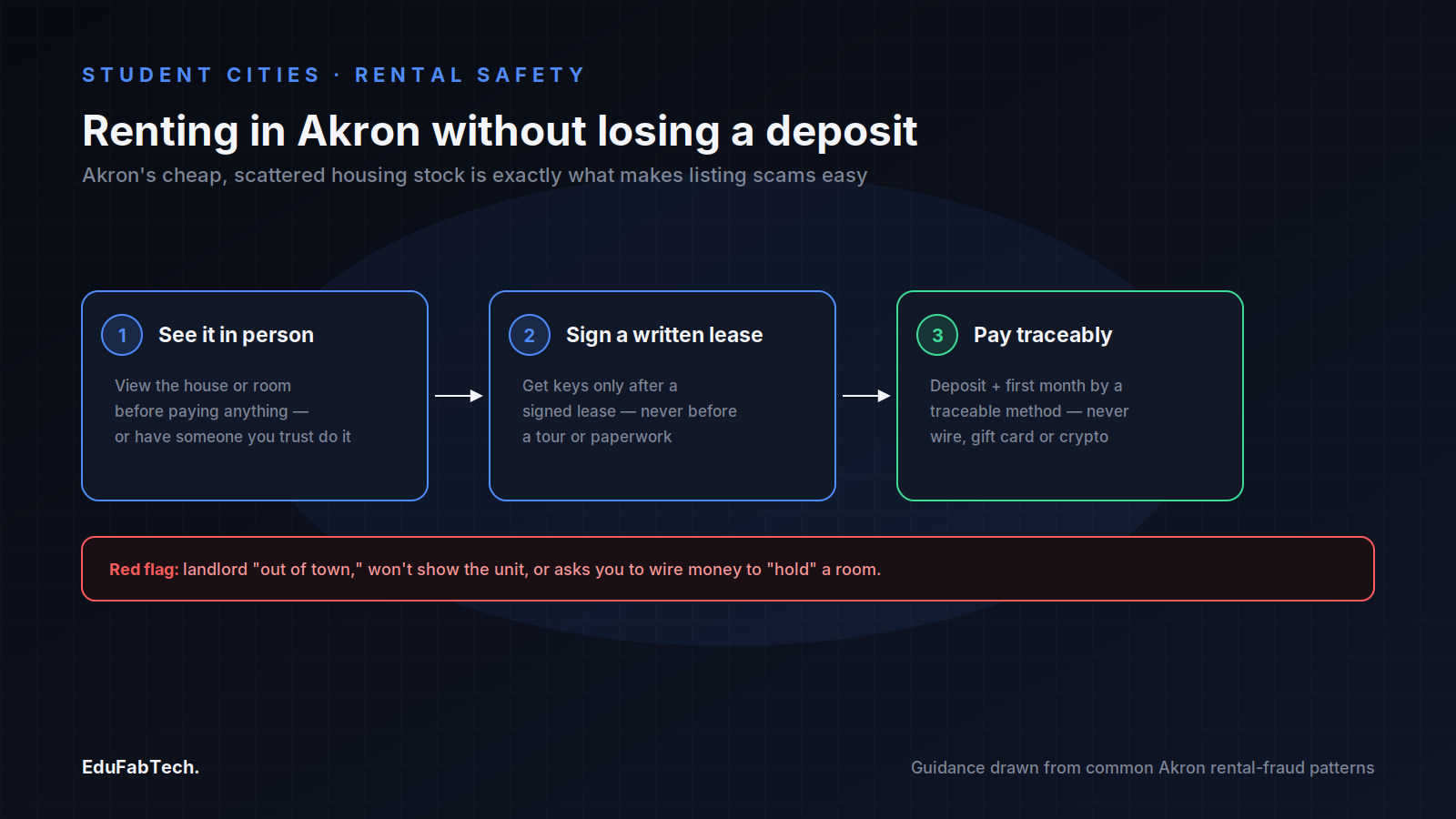
Akron's cheap rents and large stock of older single-family houses are exactly what make rental fraud easy here: a scammer copies a real listing for a Highland Square or West Akron house, prices it slightly below the others, and pressures you to pay before you can see it. The warning signs are a landlord who is "out of town", a refusal to show the unit in person, and a demand to wire a deposit to "hold" it.
Protect yourself in concrete terms. See the actual house or room in person, or have someone you trust see it, before paying anything — this matters more in a scattered city like Akron, where units are spread across many separate houses rather than a handful of big buildings. A normal arrangement locally is a security deposit plus first month's rent, paid by a traceable method after you have signed a written lease and been given keys. Never send money by bank wire transfer, gift card or cryptocurrency to reserve a room; no legitimate Akron landlord needs those, and they cannot be recovered. If you are arriving from abroad and cannot view a place yourself, prefer university-managed housing for your first term and search for a private rental once you are on the ground. International students can ask their university's international office for help reading a lease before signing.
Furnishing a room second-hand
Akron is a good city for furnishing a room cheaply, because its industrial-era housing turns over a lot of used furniture. The Habitat for Humanity of Summit County ReStore at 2301 Romig Road sells donated and surplus furniture, appliances and building materials at steep discounts, with proceeds funding local home-building. Goodwill operates resale stores across the metro, including on South Hawkins Avenue, carrying furniture, kitchenware and clothing. Between these, the Salvation Army and the many thrift and consignment shops around the city, a bare room can be furnished for a fraction of retail.
Two practical notes. End of term, when students move out, is when the best free and cheap furniture appears on the kerb and in local giveaway groups. And a used mattress is the one item worth buying new or inspecting very carefully. EduFabTech gathers local second-hand goods, used furniture and free giveaways at /in/united-states/akron/second-hand.
Working while you study
Part-time work is common among Akron students, from campus jobs to retail and food service around the universities. Local part-time listings are at /in/united-states/akron/jobs.
If you are an international student, the rules are federal and strict, and you should treat the official guidance as the authority rather than anything written here. The U.S. Department of Homeland Security's Study in the States site states that an F-1 student generally may not work more than 20 hours per week while school is in session; on-campus employment does not require separate approval from U.S. Citizenship and Immigration Services, but you must coordinate with your school's Designated School Official and obtain a Social Security Number (studyinthestates.dhs.gov). The same source explains that off-campus work requires completing at least one full academic year and receiving specific authorisation before you begin, and that working without permission can lead to termination of your SEVIS record. This is not legal advice: confirm your own situation with your DSO and the official guidance before accepting any job.
Libraries and places to study
At the University of Akron, the main academic library is Bierce Library, which has bookable study rooms, group spaces with whiteboards and screens, and a quiet third floor set aside for individual study. Kent State students have their own Kent campus library a short walk from the centre of town.
Off campus, the Akron-Summit County Public Library is a genuine asset. Its Main Library at 60 South High Street in downtown Akron offers free Wi-Fi, free public computers with internet access and meeting rooms, and it welcomes anyone — useful if you live off campus or want a neutral place to work (akronlibrary.org). The system has branches across the city, including one in Highland Square, so a study space is rarely far.
Getting around
Public transport in greater Akron is run by the METRO Regional Transit Authority (METRO RTA). The single most useful fact for a University of Akron student is that students, faculty and staff ride METRO's fixed-route buses for free simply by swiping their university Zip Card in the farebox; the dedicated Roo Express shuttle loops the campus and nearby areas on weekdays at 10–15 minute intervals during term (yourmetrobus.org). For everyone else, METRO's general one-way fare on regular fixed routes is $1.25 (METRO RTA fares). METRO also runs the x61 Northcoast Express to Cleveland, with a $1 discount for Zip Card holders.
That said, Akron is a car-oriented city, and bus coverage thins out in the evenings and in the outer neighbourhoods and surrounding towns. If you live in the Merriman Valley or commute to Walsh, Malone or Kent State Stark around Canton, you will likely find a car far more practical than the bus. Students who live on or beside the University of Akron campus can manage without one; students scattered across the metro usually cannot.
What it costs, and the honest trade-offs
Akron's defining advantage for students is cost. The Census Bureau's QuickFacts give a median gross rent of $955 for 2020–2024 and a median household income of $48,076 in the same period (census.gov QuickFacts) — rents well below those of larger US cities. For on-campus housing, the University of Akron's residence-life office lists a standard double room in Bulger Hall at $3,260 per semester for 2025–26, with single and suite options higher (uakron.edu residence hall rates). Tuition and fees are set separately by each university and change yearly; check the specific institution's bursar pages for current figures rather than relying on any single number here.
The honest picture is mixed. In Akron's favour: low rents, a lot of affordable housing to choose from, free campus-area bus travel on a Zip Card, a strong public library, cheap second-hand furnishing, and the Cuyahoga Valley and Metro Parks on the doorstep. Against it: this is a spread-out, post-industrial city where a car makes life much easier and the bus network does not reach everywhere; winters bring real lake-effect snow and grey stretches that newcomers underestimate; and the student scene is split between downtown Akron and the separate college town of Kent rather than concentrated in one place. Akron is comfortable and inexpensive, but it rewards students who plan their transport and their neighbourhood deliberately rather than assuming a single walkable core.
A checklist for the first weeks
- Apply for university housing as early as possible after admission if you want a residence-hall place; its selection runs months ahead of term.
- For a private room or house, view it in person (or have someone you trust view it) before paying, and never wire money, send gift cards or pay in crypto to "hold" a place.
- Collect your Zip Card from the University of Akron and start using it for free METRO buses and the Roo Express; if you live outside the campus core, work out whether you need a car.
- Furnish from the Habitat for Humanity ReStore on Romig Road, Goodwill and local giveaways — and watch the end-of-term move-out for free furniture.
- Get a library card for the Akron-Summit County Public Library and find your quiet spot in Bierce Library (or the Kent campus library).
- International students: meet your Designated School Official in the first week, apply for a Social Security Number if you will work on campus, and read the official Study in the States guidance before taking any job.
- Prepare for winter early — a proper coat and boots before the first lake-effect snow, not after.
A quick question for readers
Do you work part-time while you study?
Many students work to pay the bills. See how common it is — and how many hours people really do.
Pick an answer, create a free account in a minute, and your vote counts. Already a member? Sign in
Source: METRO Regional Transit Authority
Sources (4)
- METRO Regional Transit Authority. METROZip & The Roo Express. METRO RTA, 2026. yourmetrobus.org ↗ · checked 6 Oct 2026
- U.S. Department of Homeland Security. Working in the United States (F-1 students). Study in the States, 2026. studyinthestates.dhs.gov ↗ · checked 6 Oct 2026
- Akron-Summit County Public Library. Main Library. Akron-Summit County Public Library, 2026. akronlibrary.org ↗ · checked 6 Oct 2026
- U.S. Census Bureau. QuickFacts: Akron city, Ohio. U.S. Census Bureau, 2024. census.gov ↗ · checked 6 Oct 2026