Studying in Albany, United States: universities, housing and student life
A practical, sourced guide to the Capital Region's universities, the neighbourhoods students rent in, the student bus swipe, and what a room really costs.
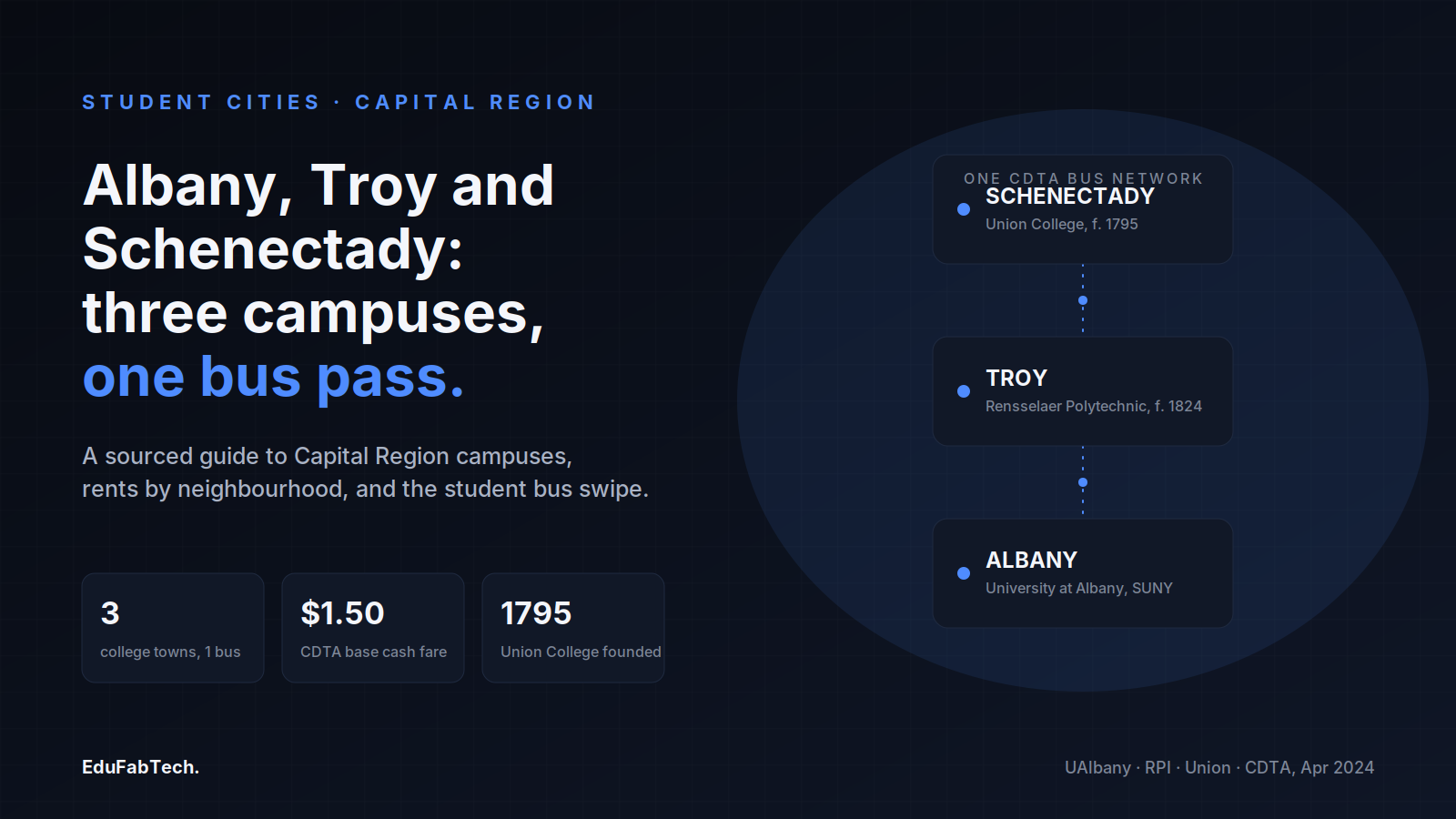
Albany is a small capital with an outsized number of lecture halls. The city of roughly a hundred thousand people sits on the west bank of the Hudson River, and within a short bus ride of its downtown you reach three separate college towns — Albany itself, Troy across the river, and Schenectady to the northwest — that together make up what locals simply call the Capital Region. For a student this geography matters: the campus you enrol at may be in one city, the cheap room you find may be in another, and the thing that stitches them together is a single bus network.
This guide is for anyone deciding whether to study here or already holding an offer — from down the Thruway or from the other side of the world. It names the universities, the neighbourhoods people actually rent in, the market where you kit out a room, the rules that apply to working while you study, and the few housing figures that can be sourced to the institutions that publish them. Where a number appears, so does the body that produced it and the year.
The universities on both banks of the Hudson
The largest is the University at Albany — also styled the State University of New York at Albany — part of the State University of New York (SUNY). Its Uptown Campus, a long, colonnaded complex designed by the architect Edward Durell Stone, sits at 1400 Washington Avenue on the city's north-west edge, out towards the hamlet of Roessleville, and holds most of the residence halls and science buildings, according to the university's own campuses page. A second Downtown Campus at 135 Western Avenue houses the Rockefeller College of Public Affairs & Policy and the University at Albany, SUNY School of Criminal Justice, which grants graduate degrees in the field. A free shuttle runs between the two, so where you live is partly a question of which campus you spend your days on.
Across the Hudson in Troy is Rensselaer Polytechnic Institute, founded in 1824, which describes itself as the nation's oldest technological research university, per RPI's own site. Its hilltop campus looks down over the river and the old collar-and-cuff factories of downtown Troy. North-west in Schenectady is Union College, founded in 1795 on a 100-acre campus in the heart of the city; it is a liberal arts college that also teaches engineering and enrols around 1,900 undergraduates, as the college states.
Closer in, several smaller institutions round out the student population. Siena University — formerly Siena College, a Franciscan liberal arts school enrolling about 3,000 students, per its about page — is in Loudonville, just north of the city line. The Albany College of Pharmacy and Health Sciences, founded in 1881 on New Scotland Avenue in the University Heights cluster, sits next to Albany Medical Center, according to the college. Russell Sage College keeps campuses in both Troy and Albany. And Mildred Elley, a career college at 855 Central Avenue in Albany, grants associate degrees, per the school's Albany campus page.
Neighbourhoods, from Pine Hills to downtown Troy
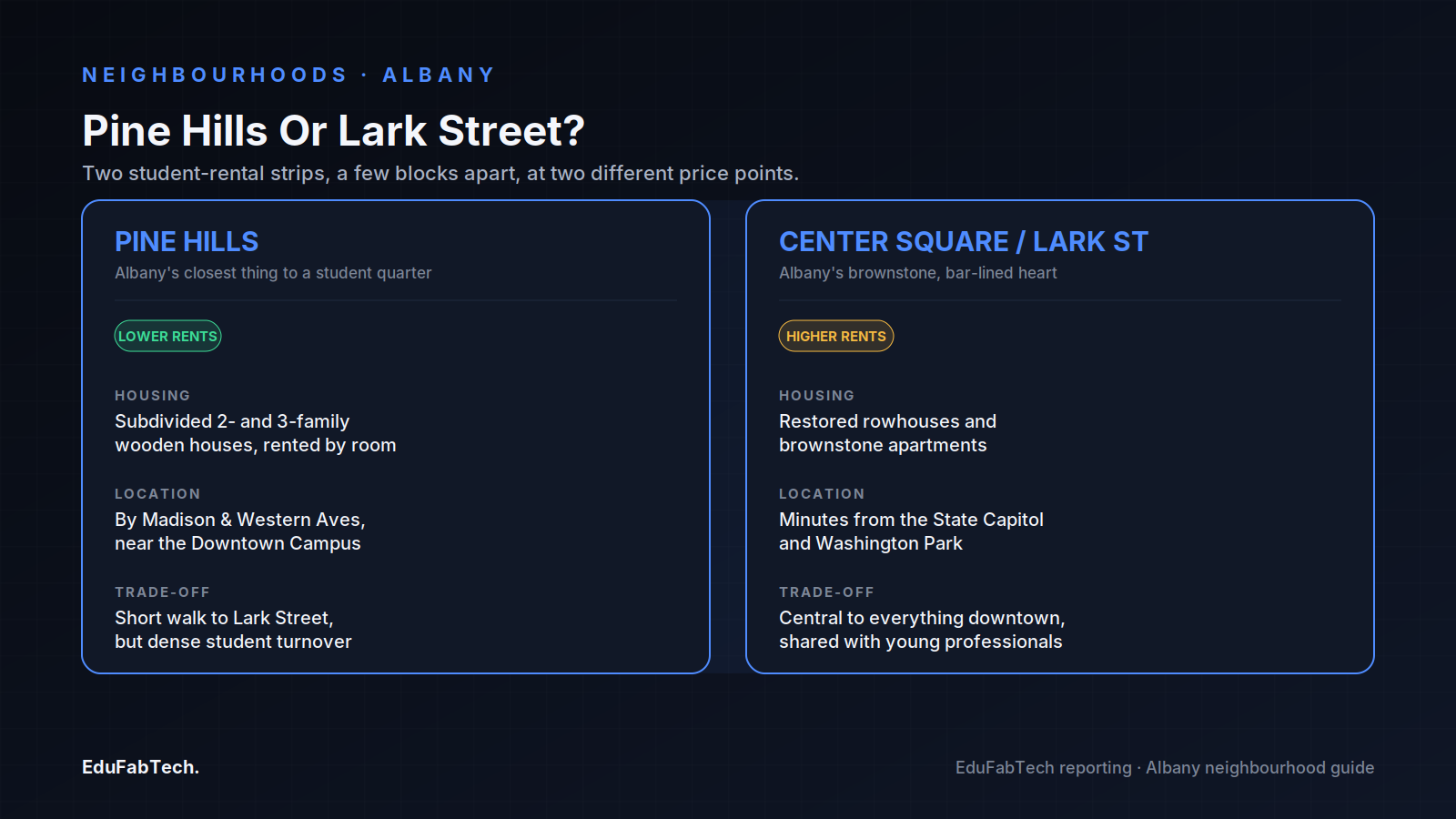
Pine Hills is the closest Albany has to a true student quarter. Strung along Madison and Western Avenues near the Downtown Campus and the former College of Saint Rose, it is block after block of two- and three-family wooden houses, most of them subdivided and rented by the floor or the room. Rents here run below the grander parts of the city, the walk to Lark Street is short, and it is where first off-campus leases usually land — along with the noise and turnover that come with a dense student population.
Center Square and Lark Street are the city's brownstone heart, a few minutes from the State Capitol, full of restored rowhouses, cafés and the bars that give Lark its reputation as Albany's liveliest stretch. You pay more here and share the streets with young professionals, but you are central to everything downtown. Bordering it, Washington Park — the Olmsted-influenced park that fills with tulips each spring — is ringed by some of the handsomest and priciest flats in the city.
Park South, the wedge between Washington Park and Albany Medical Center along New Scotland Avenue, has been heavily rebuilt in the past decade and suits anyone studying pharmacy, nursing or medicine: the College of Pharmacy, the medical college and the hospital are all within walking distance. Further out, the Buckingham Pond and Western Avenue districts near the Uptown Campus feel suburban — quieter, newer apartment blocks, more parking, and a near-total dependence on the bus if you want a night out downtown.
Many students skip Albany proper. Downtown Troy, below the RPI hill, is a compact grid of 19th-century buildings, independent shops and the Saturday market, and most RPI students live within a short walk of it. In Schenectady, Union students cluster in the leafy streets around the campus and the GE Realty Plot. Both cities are cheaper than central Albany and, because the bus network ties the three together, living in one while studying in another is normal here rather than eccentric.
Renting safely: deposits, viewings and local scams
Albany's student market moves on the academic calendar. Leases on the converted houses in Pine Hills typically run roughly June to May, and the better rooms are spoken for months ahead — serious searching for a September start usually begins in late winter and early spring. If you are arriving from abroad and cannot view in person, a short university-arranged room or a sublet for the first few weeks is safer than committing to a year-long lease you have only seen in photographs.
Scams in Albany tend to follow the same pattern: a listing priced noticeably below the going rate for Pine Hills or Center Square, a "landlord" who is conveniently out of town, and pressure to send money to reserve the place before anyone can see it. Treat any of that as a warning. See the actual unit, not a similar one; meet whoever holds the keys; and read the lease before money changes hands. A first month's rent plus a security deposit is the normal up-front cost locally. Never send a deposit by bank wire, gift card or cryptocurrency to "hold" a room — those payments cannot be recovered, and no legitimate landlord in Albany needs them. EduFabTech's own rooms listings for Albany and the wider city page are a place to start comparing against the market before you commit.
Furnishing a room: markets and the second-hand circuit
An empty room costs the most in its first week. The Capital Region's best-known market is the Troy Waterfront Farmers Market, which runs every Saturday year-round in downtown Troy — around Monument Square from May to October and indoors at the Troy Atrium from November to April — and is as much a weekly social fixture as a grocery run. For the hard furnishings — desks, lamps, a mattress base, kitchen things — the student turnover each May and August floods the second-hand channels, and buying used is both cheaper and faster than waiting on deliveries. EduFabTech lists second-hand items, used furniture and things given away free in Albany; the end-of-lease weeks are when the free pile is largest, so time your scavenging to the calendar.
The CDTA, and why your student ID is a bus pass
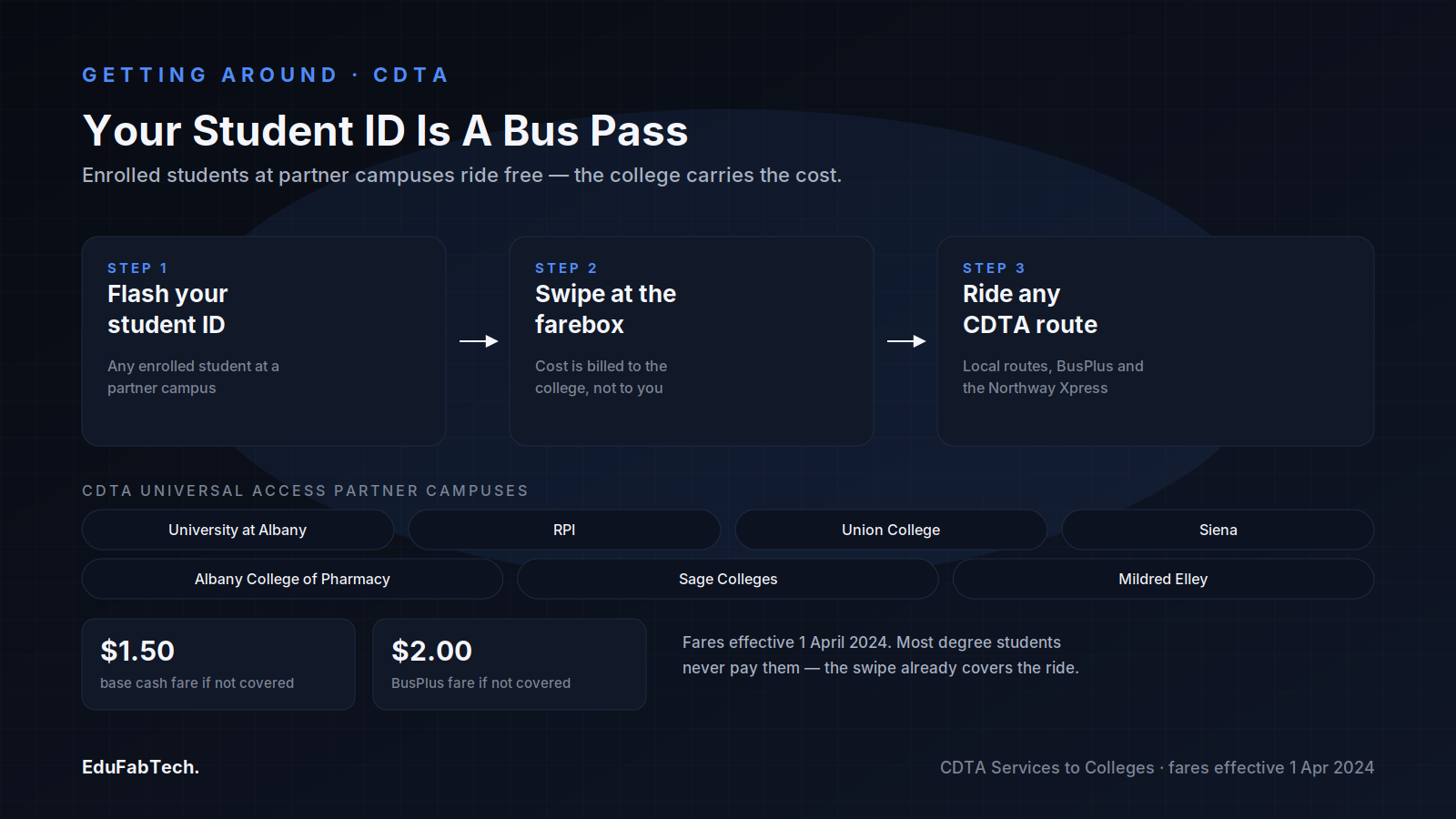
Getting around is the part Albany does unusually well for its size. The Capital District Transportation Authority (CDTA) runs routes across Albany, Rensselaer, Schenectady and Saratoga counties, and it has signed most of the region's campuses into its Universal Access programme. CDTA's Services to Colleges page lists the University at Albany, Rensselaer Polytechnic Institute, Union College, Siena, the Albany College of Pharmacy, the Sage Colleges and Mildred Elley among its partners, whose students ride every CDTA route — including the BusPlus lines and the Northway Xpress — simply by swiping their school ID at the farebox, with the cost carried by the institution rather than paid per trip.
If you are not covered by that programme, the published CDTA fares put the base cash fare at $1.50, with the BusPlus fare at $2.00, valid as of 1 April 2024; the Navigator smart card and mobile ticketing are the cashless ways to pay. For most degree students, though, the practical headline is that the bus is already paid for. The downside is honest to state: outside the main corridors, evening and weekend service thins out, and a car-free life in the suburban districts near the Uptown Campus takes planning.
Libraries and study spaces across three cities
On the Uptown Campus, the University at Albany's Science Library offers bookable group study rooms on its basement, first and second floors — with conference tables seating groups of up to fifteen — alongside a quiet computer lab, reserved through the library's online booking system. RPI's Folsom Library in Troy and Union's Schaffer Library in Schenectady serve their own students through term. For a study spot that needs no university affiliation, the Albany Public Library's Washington Avenue branch at 161 Washington Avenue, in the heart of Center Square, has three small-group study rooms you can reserve and is open to anyone in the city. EduFabTech also collects study spaces and desks around Albany.
Working while you study, and the international-student rules
Part-time work is common, and the Capital Region's mix of universities, hospitals and state government creates a steady supply of campus and service jobs; local openings are gathered on EduFabTech's Albany jobs page. The rules differ sharply by immigration status, and this is where to read the official source rather than rely on word of mouth. For students on an F-1 visa, the U.S. Department of Homeland Security's Study in the States guidance states that on-campus employment is capped at 20 hours per week while school is in session, and that off-campus work requires specific authorisation arranged through your Designated School Official before it begins. Working without that permission can end a student's status. Confirm your own situation with your university's international student office — the detail is specific to your visa, and nothing here is legal advice.
Costs, climate and the honest trade-offs
The clearest dated housing figure comes from the universities themselves. For the 2026–2027 academic year, the University at Albany's room-rate schedule lists a standard double or triple residence-hall room at $10,605 and a standard single at $12,726 per resident, with apartment-style Empire Commons (four beds, two baths) at $14,666 per resident; the university notes these rates include utilities, internet and laundry. Off-campus rents vary too much house to house to quote a single reliable figure, which is why viewing in person and comparing current listings matters more than any headline average.
What is genuinely good about studying here: the cost of living undercuts New York City or Boston a few hours away; the universities are close enough to share a bus pass; and the city is walkable, green around Washington Park, and small enough to feel navigable within a term. What is hard is equally real. Winters are long and cold, with snow from late autumn into spring, so budget for proper clothing. Pine Hills can be noisy and its housing stock aged. Albany is quieter than a big metropolis, which some find restful and others dull. And since the cheapest rooms are often in a different city from your campus, your real commute is worth checking on the map before you sign.
A checklist for your first two weeks
- Collect your student ID and confirm whether your campus is in the CDTA Universal Access programme, so you know if the bus is already paid for.
- If you arrived without a lease, stay somewhere short-term and view rooms in person before paying anything; never wire a deposit to hold a place unseen.
- Learn the shuttle and bus routes between your campus and where you live, and check evening and weekend frequencies.
- Register with your university's international student office if relevant, and get the work rules for your visa in writing.
- Furnish from the second-hand and free listings while the start-of-term supply is high, and walk the Troy market one Saturday to get your bearings.
- Find your study base early — a campus library room or the Albany Public Library in Center Square — before deadlines arrive.
- Browse what else is happening through EduFabTech's Albany events and the listings near RPI and near the University at Albany.
A quick question for readers
Do you work part-time while you study?
Many students work to pay the bills. See how common it is — and how many hours people really do.
Pick an answer, create a free account in a minute, and your vote counts. Already a member? Sign in
Source: University at Albany
Sources (5)
- University at Albany. Our Campuses. University at Albany, SUNY, 2026. albany.edu ↗ · checked 3 Oct 2026
- University at Albany. Room Rates (2026–2027 Academic Year). University at Albany, SUNY, 2026. albany.edu ↗ · checked 3 Oct 2026
- Capital District Transportation Authority. Services to Colleges. CDTA, 2026. cdta.org ↗ · checked 3 Oct 2026
- U.S. Department of Homeland Security. Working in the United States. Study in the States, 2026. studyinthestates.dhs.gov ↗ · checked 3 Oct 2026
- Union College. Union at a Glance. Union College, 2026. union.edu ↗ · checked 3 Oct 2026