Studying in Anchorage: universities, housing and student life
A practical, sourced guide to Anchorage's universities, where students live, what a room costs, how to get around, and the honest trade-offs of studying at the edge of the Chugach.
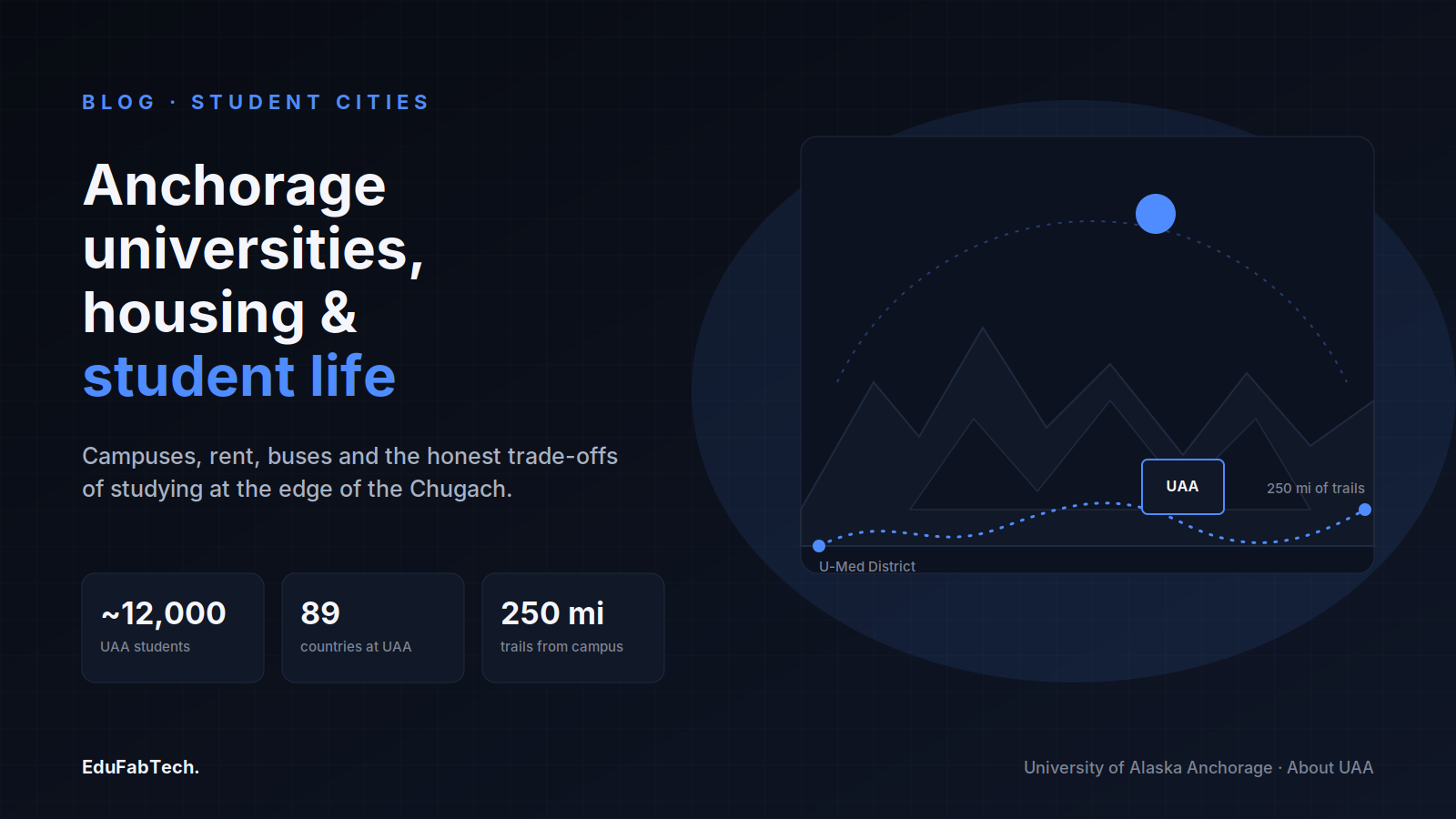
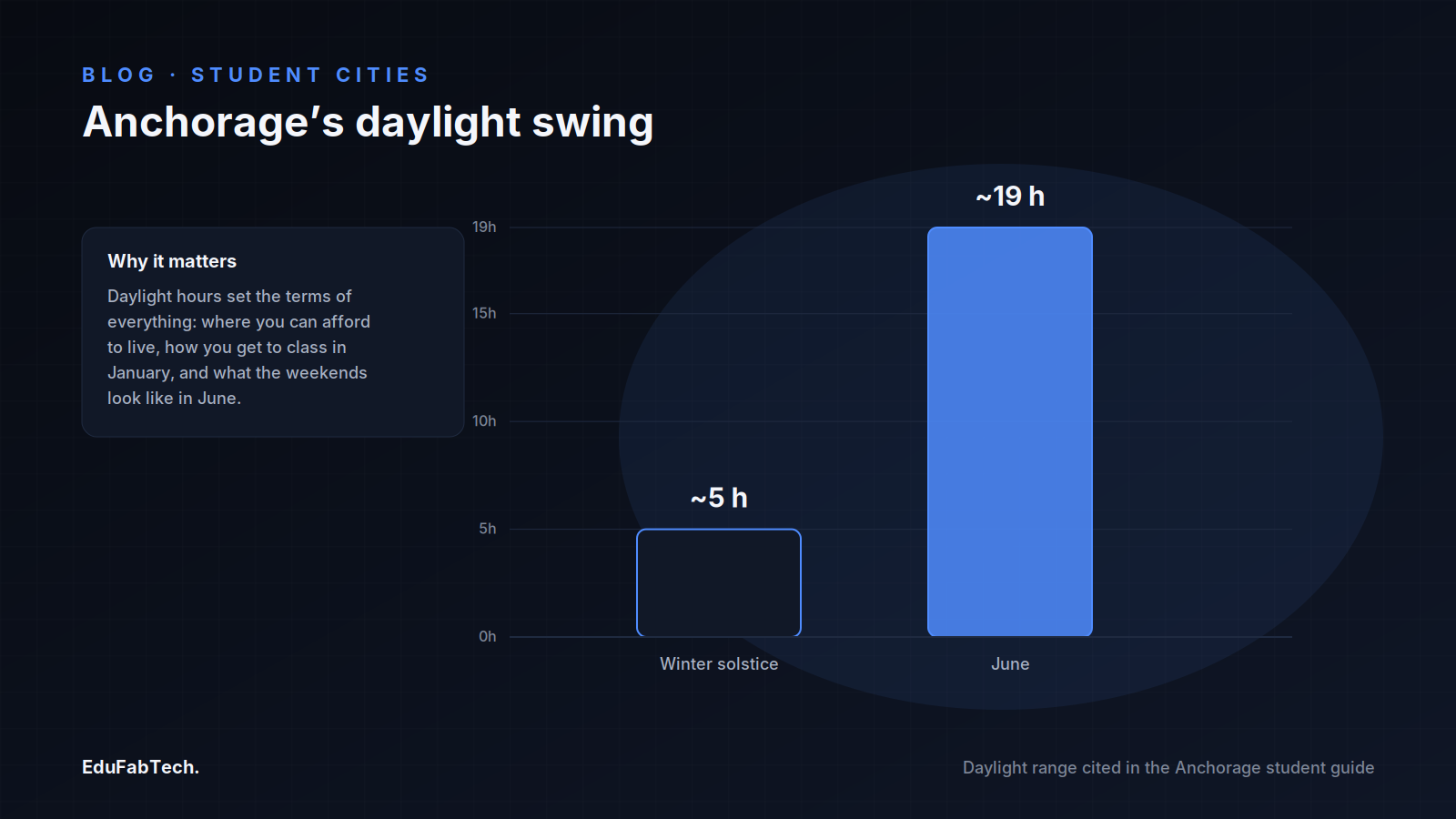
Anchorage is Alaska's largest city by a wide margin, pinned on a wedge of land between the waters of Cook Inlet and the wall of the Chugach Mountains. It is a city of roughly 300,000 people, as the University of Alaska Anchorage notes on its campuses page, and it behaves like one: big-box shopping along the Seward and Glenn highways, floatplanes on Lake Hood, moose on the bike paths, and daylight that swings from barely five hours around the winter solstice to nearly nineteen in June. For a student, that geography sets the terms of everything — where you can afford to live, how you get to class in January, and what the weekends look like.
Three institutions grant degrees to people living in Anchorage, and two of them sit almost side by side in the U-Med District, the cluster of hospitals and campuses in the east-central city along University Drive. Studying here is unlike studying in a dense, transit-first city; it is closer to studying in a spread-out northern town that happens to have a research university and a mountain range in its backyard.
This guide walks through the universities, the neighbourhoods students choose, how to rent without being cheated, where to furnish a room cheaply, the rules on working, the libraries, the buses, and the honest costs. Figures are tied to the page that publishes them, so you can check them yourself before you commit money.
Three places to earn a degree in Anchorage
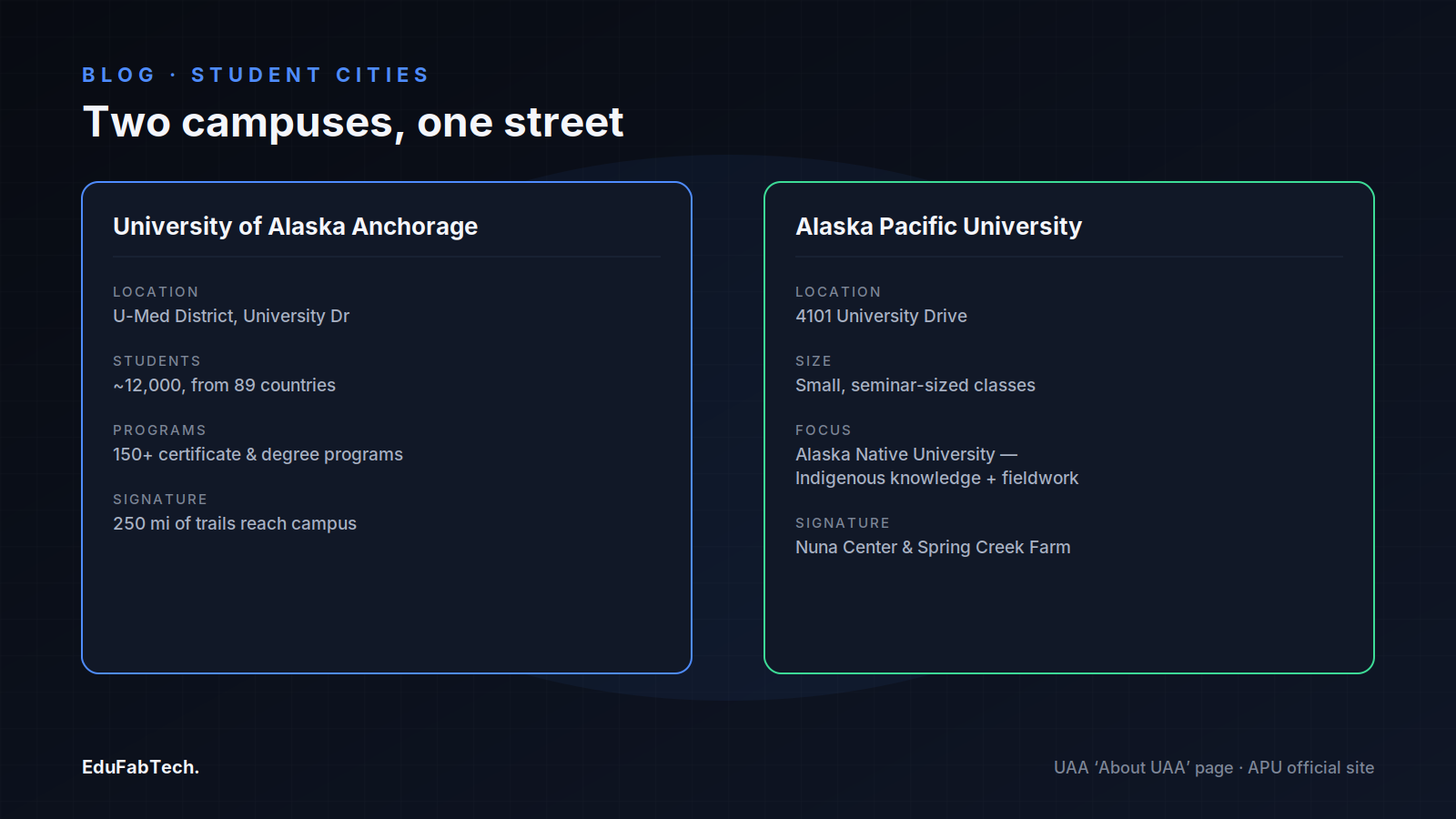
The University of Alaska Anchorage (UAA) is the anchor. Its main campus is in the U-Med District, and the university states on its About UAA page that roughly 12,000 students from across the United States and 89 countries study there, choosing from more than 150 certificate and degree programs, with strengths it describes in health, engineering, and the physical and social sciences. The campus is physically woven into the landscape: UAA says it is connected to 250 miles of trails, which in practice means you can ski or run to class. Teams compete as the Seawolves. For most international and out-of-state students, UAA is the default — it has the dormitories, the course breadth, and the student-services machinery that a smaller school cannot match.
Alaska Pacific University (APU) is the quieter neighbour, at 4101 University Drive, a short walk from UAA. It is small and distinct: APU describes itself on its own site as an Alaska Native University that blends Indigenous knowledge into its teaching and builds courses around hands-on work — exploring the backcountry through outdoor studies, running environmental research in local ecosystems, and operating sites such as the Nuna Center and Spring Creek Farm. If you want seminar-sized classes and fieldwork close to wilderness rather than a large campus, APU is the Anchorage option that offers it.
The third name students sometimes look for is Wayland Baptist University. The Texas-based university ran an Anchorage campus on Old Muldoon Road for decades, but Alaska Business Magazine reported in May 2025 that it was transitioning its Alaska operations to online-only instruction and selling the Anchorage building; a student seeking Wayland courses in Anchorage today does so through its online programmes rather than in a local classroom.
From the U-Med District to Spenard: where students settle
Because UAA and APU share a corner of the city, the neighbourhoods around University Drive and Providence Hospital are the obvious first choice: College Gate and the streets off Northern Lights Boulevard put you within walking or short-bus distance of both campuses and of the Alaska Native Medical Center, a major employer. The Chester Creek and Campbell Creek trail systems run through this part of town, so a bike or a decent pair of winter boots can replace a car for the campus commute.
Spread wider and the character changes fast. Spenard, west of Midtown along Spenard Road, is the city's eclectic quarter — cafés, music, food, and the Saturday farmers market — and draws students who want a bit of life off campus. Midtown, between Benson and Tudor, has the largest stock of ordinary apartment blocks and sits on several bus routes. Mountain View, northeast of downtown, is one of the city's most ethnically diverse and generally cheaper neighbourhoods, though it is also one of the areas where renters should look carefully at a specific building and street rather than the neighbourhood name. Downtown itself is pricier and busiest in summer, when the cruise traffic and the weekend market fill it.
UAA's own housing is the simplest safe start, especially for a first year or an international arrival. The university runs residence halls plus the MAC Apartments and Templewood Townhomes on campus; applying for these means you are dealing directly with the institution rather than an unknown landlord sight-unseen.
Renting here without losing a deposit
Most Anchorage rentals are advertised on general classified and social-media listings, and that is exactly where the trouble starts for students who have not yet arrived. The recurring scam is a listing — often for an unusually cheap house or apartment — where the "owner" is conveniently out of state, cannot show you in, and asks you to wire a deposit or send a gift card or cryptocurrency to "hold" the place. Do not. Legitimate Anchorage landlords expect you to view the unit, and they take a deposit by normal means against a signed, written lease, not by irreversible transfer to a stranger.
Two local habits protect you. First, see the place in person, or have someone already in Anchorage see it, before any money changes hands; winter photographs hide a lot, and a listing that cannot be viewed is a listing to walk away from. Second, know the legal ceiling on deposits: the Alaska Department of Law's guide to the Alaska Landlord & Tenant Act states that for units renting at $2,000 a month or less, a landlord may not demand a security deposit of more than two months' rent. If someone asks for far more up front, that is a red flag in itself.
Two Anchorage-specific things to check before signing. Ask who pays for heat — winters are long and heating a poorly insulated unit is a real monthly cost, so a cheap rent with tenant-paid heat may not be cheap. And ask about parking with an electrical outlet: Anchorage cars use engine block heaters, and a plug-in head-bolt outlet at your space is a genuine amenity here, not a curiosity.
For rooms, shared flats and sublets, EduFabTech keeps Anchorage listings at rooms and places to stay, with everything near the main campus gathered at listings near UAA.
Furnishing a room, and the summer markets
Anchorage's calendar matters when you are kitting out a room. The city's open-air markets run only in the warm half of the year. Visit Anchorage's farmers market guide lists the downtown weekend market at 225 E Street, open Saturdays and Sundays from early May through September; the South Anchorage Farmers Market at 11111 Old Seward Highway, Saturdays and Wednesdays over the same season; and the Spenard Farmers Market on Spenard Road, Saturdays from mid-May. These are strongest for food, crafts and local goods rather than furniture, but the summer turnover also brings resale and vintage stalls.
For the harder problem — a desk, a bed, winter gear — the practical move is second-hand. Arriving students cycle through furniture every spring and autumn, so the cheapest beds and shelves in Anchorage are usually other students' cast-offs. EduFabTech lists local second-hand furniture and things given away free, which is worth checking around move-out dates in April and August before paying retail. Warm clothing is the one category not to skimp on; a proper coat and boots are equipment here, not fashion.
Working while you study
If you are on an F-1 student visa, the core rule is federal and not specific to Alaska. The U.S. Department of Homeland Security's Study in the States service states, on its page on working in the United States, that a student in on-campus employment "may not work more than 20 hours per week when school is in session." On-campus jobs — in the library, dining, or departments — are the usual first option, and your Designated School Official (DSO) in the international office is the person who authorises them. Treat the DHS page and your own DSO as the authorities; this guide is not legal advice, and off-campus work, practical training and any exceptions carry conditions you must confirm with your school before you act.
Anchorage's seasonal economy — tourism, fishing-adjacent work, hospitality — peaks in summer, which can suit the long break but not the federal in-term hour limit. Local and campus job listings relevant to students are collected at jobs and part-time work.
Libraries and desks that stay warm
On campus, UAA's Consortium Library serves both UAA and APU students and is the main academic study building in the U-Med District. Off campus, the city's flagship is the Z.J. Loussac Library at 3600 Denali Street in Midtown. The Anchorage Public Library's own page for Loussac gives its service hours as Monday to Thursday 10 a.m. to 8 p.m., Friday and Saturday 10 a.m. to 6 p.m., and Sunday 1 p.m. to 5 p.m. It is a public building with free seating, which makes it a useful neutral study space on weekends and during university breaks when campus buildings keep shorter hours. More desks and bookable spaces around the city are indexed at study spaces and desks.
A northern detail worth planning around: in deep winter the library and campus become places you stay put. With only a few hours of daylight, many students batch errands and study sessions so they are not crossing town repeatedly in the dark and cold.
Moving around a city built for cars
Anchorage is a driving city, and that is the honest starting point. Public transport exists but is modest. The People Mover, run by the Municipality of Anchorage, is the bus network; its fares and passes page lists an adult single ride at $2.00, a day pass at $5.00, a 7-day pass at $26.00 and a 30-day pass at $60.00, with fares payable through the People Mover mTicket app or the Transit App. There is no People Mover student discount published on that page, so a student over 18 pays the adult fare; the same page notes that riders aged 18 and under ride free year-round, effective 10 July 2025. Plan routes and times carefully — service is sparser than in a transit-first city, and evening and Sunday frequencies are limited.
In practice many students combine the bus with a bike in summer — the paved trail network along Chester and Campbell creeks is genuinely good for commuting — and with a car, a car-pool or a well-timed bus in winter. The 250 miles of trail UAA advertises is not just recreation; for students living near the U-Med District it is a real commuting corridor.
What a year costs
The most reliable, dated housing figure for a student is UAA's own. The university's 2026-2027 housing rates list, per semester, a residence-hall double suite at $4,160, a shared quad suite at $3,835, and a single suite at $4,590; the on-campus MAC Apartments run $4,480 for a shared bedroom and $4,700 for a private one, and the Templewood Townhomes from $4,590. UAA states on the same page that housing and dining rates rose by approximately 8 percent for 2026-2027, effective 1 February 2026, and lists an application fee of $60 and a refundable deposit of $300.
Private-market rents in Anchorage vary widely by neighbourhood and season, and this guide will not quote a private figure it cannot tie to a primary source. Use the UAA rates as your anchor for a like-for-like comparison, and when you weigh an off-campus flat, add the winter heating and the engine-heater parking into the real monthly number rather than reading the headline rent alone.
The honest trade-offs
What is good about Anchorage for a student is specific and real. You can study a serious degree with mountains, sea and 250 miles of trail at the campus edge; the city is genuinely international for its size, with UAA drawing students from 89 countries; and the summers are long-lit and spectacular. The community around the U-Med District is compact, so campus life does not require crossing a sprawling metro.
What is hard is equally concrete. It is a car-oriented city with a thin bus network, so getting around without a vehicle takes planning and patience, especially in winter. The winter itself is the defining difficulty: short daylight, cold, snow, and heating bills that make a cheap-looking rental expensive. Housing stock is limited, so good rooms go quickly and scams prey on newcomers who rent sight-unseen. And Anchorage is remote — flights to the contiguous United States are long and costly, which shapes how often you can leave.
A checklist for your first weeks
- If you are an international student, meet your DSO at the UAA or APU international office early, sort your Social Security Number, and confirm on-campus work rules against the DHS Study in the States page rather than hearsay.
- Secure housing you have actually seen — ideally UAA on-campus for a first year — and never wire, gift-card or crypto a deposit to hold a place. Check the two-month deposit ceiling in the Alaska Landlord & Tenant Act guide before paying.
- Ask every prospective landlord who pays for heat and whether your parking space has an electrical outlet for an engine heater.
- Load the People Mover mTicket or Transit App and work out your campus route and its evening frequency before term starts, using the fares page.
- Get a library setup at both the UAA Consortium Library and the Z.J. Loussac Library so you have a warm study spot during breaks.
- Furnish from second-hand first — check the local furniture and free-stuff listings around move-out weeks — and buy proper cold-weather boots and a coat before the first snow.
A quick question for readers
Do you work part-time while you study?
Many students work to pay the bills. See how common it is — and how many hours people really do.
Pick an answer, create a free account in a minute, and your vote counts. Already a member? Sign in
Comments 3
Comment-
The housing numbers are the one part of this I'd push back on. An 8% bump to $4,160-4,700 a semester, landing right alongside a $60 applicat…
-
The entropy-collapse comparison that jumps out is the People Mover fare page: under-18s ride free as of July 2025, but there's no student di…
-
The housing section is the one that actually tells on itself a bit: UAA says rates jumped about 8% for 2026-2027, and then the guide refuses…
Join free to read the full comments and reply Comments are between members; an account takes a minute.
Source: University of Alaska Anchorage
Sources (5)
- University of Alaska Anchorage. 2026-2027 Housing Rates. University of Alaska Anchorage, 2026. uaa.alaska.edu ↗ · checked 22 Oct 2026
- Municipality of Anchorage. People Mover Fares and Passes. Municipality of Anchorage Public Transportation, 2026. muni.org ↗ · checked 22 Oct 2026
- U.S. Department of Homeland Security. Working in the United States. Study in the States, 2026. studyinthestates.dhs.gov ↗ · checked 22 Oct 2026
- Alaska Department of Law. The Alaska Landlord & Tenant Act: what it means to you. State of Alaska, 2026. law.alaska.gov ↗ · checked 22 Oct 2026
- Visit Anchorage. Anchorage Farmers Market Guide. Anchorage.net, 2026. anchorage.net ↗ · checked 22 Oct 2026