Studying in Ankara: Universities, Housing and Student Life
A practical, honest guide to Ankara's universities, the neighbourhoods students live in, finding a room safely, furnishing it cheaply, transport, part-time work and everyday costs.
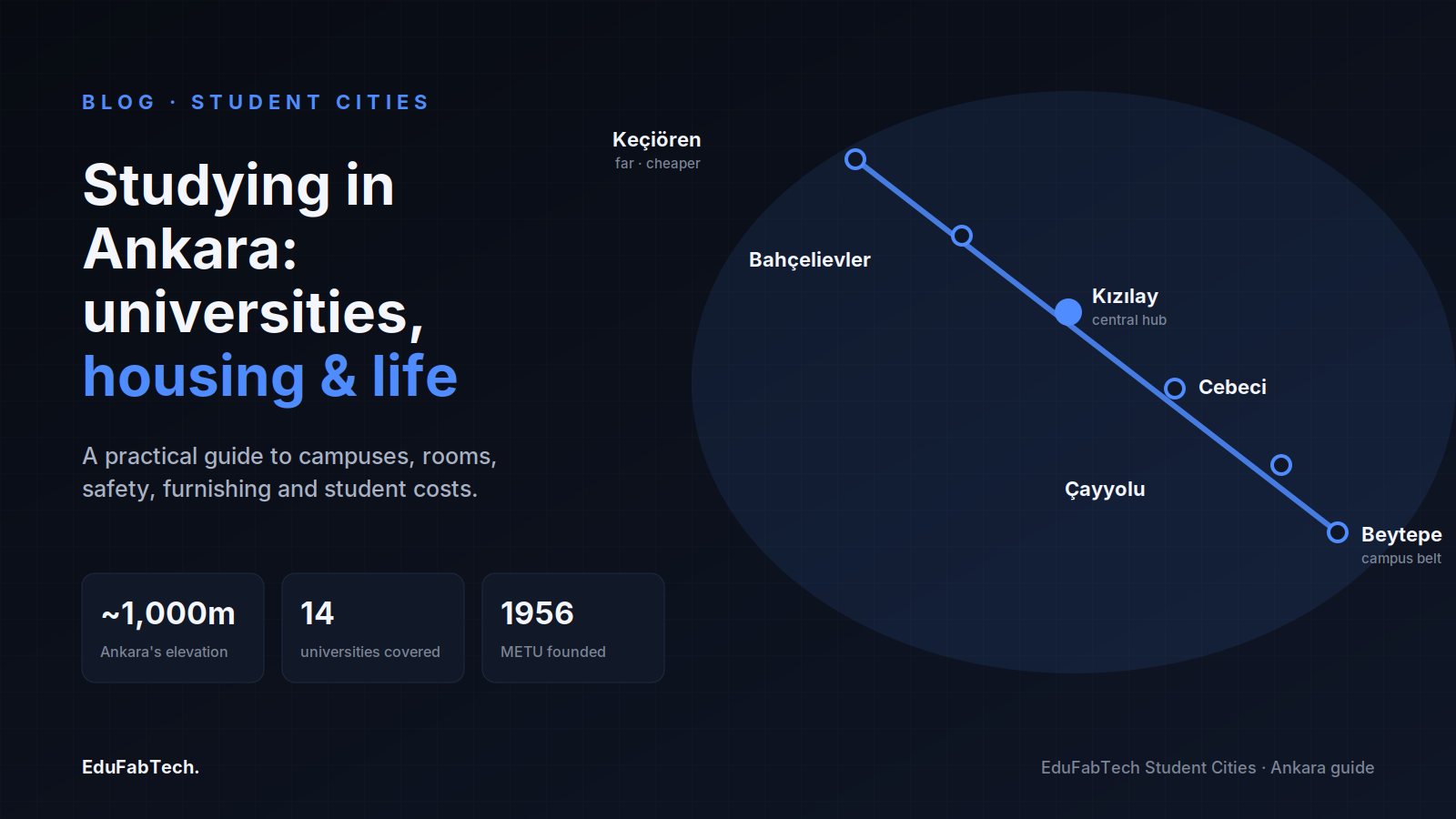
Ankara sits high on the Anatolian plateau, a little under a thousand metres above sea level, and it feels it. Winters are cold and often snowy; summers are hot, dry and bright. Unlike the coastal cities, it was largely a planned capital — a compact core of ministries and boulevards that grew outward in rings — and one constant across those rings is students. Hundreds of thousands study here each year, drawn by a density of universities that is unusual even for a capital.
The mix matters. Ankara has old public universities that helped build the modern state, English-medium research campuses set in forest and steppe, and a newer crop of foundation (private, non-profit) and specialised universities. That range shapes everything downstream: where rooms are cheap, which districts stay awake at night, how far you commute, and what a part-time job looks like.
This guide is for students — local or arriving from abroad — who want the practical version: who teaches where, where people live, how to find a room without being cheated, how to furnish it for almost nothing, and what is genuinely hard about the city. Figures appear only where a current, named source exists; everything else is described in relative terms, because prices here move quickly.
The universities, and what studying here is like
Middle East Technical University (METU/ODTÜ) is the campus most people picture first. Founded in 1956 and relocated in 1963 to what became the country's first purpose-built university campus, it teaches in English and occupies a vast wooded estate on the Eskişehir road that includes its own lake, Eymir. Studying there feels like living in a self-contained town: dormitories, forest, a strong engineering and sciences culture, and a famously active student body. The Middle East Technical University Campus is itself a piece of modern architectural history.
The other large research universities each have their own centre of gravity. Hacettepe University is split between a medicine-heavy campus at Sıhhiye, near the old centre, and its green Beytepe campus in the southwest; its Hacettepe University Ankara State Conservatory, whose roots reach back to the 1930s, trains many of the country's musicians, and the Hacettepe University School of Foreign Languages runs the English preparatory year that many first-years pass through. Ankara University, founded in 1946, is one of the country's largest and most established universities; its faculties are scattered across the city, with a well-known cluster at Cebeci. Bilkent University, established in 1984 as the country's first private, non-profit university, occupies a hilltop campus west of the centre and is known for research and English-medium teaching; the Bilkent Laboratory and International School, a K–12 IB school, sits on the same campus, and the headquarters of the stands nearby.
Gazi University grew out of a teacher-training institute founded in 1926 — the historic Gazi Eğitim Enstitüsü — and today behaves like a city-within-a-city, with campuses at Beşevler, Maltepe and Emek woven into central districts. Among the foundation and specialised universities, Çankaya University teaches mostly in English from its Central (Turkuaz) campus, opened in 2011 on the Eskişehir road toward İncek, with an earlier campus at Balgat; Başkent University, founded in 1994 around a strong medicine and health tradition, is centred on its Bağlıca campus in Etimesgut.
Other universities in Ankara
The roster runs well beyond the big names. Ankara Hacı Bayram Veli University was created in 2018 when several faculties separated from Gazi University. Ankara Yıldırım Beyazıt University, a public university, spreads across an Esenboğa campus to the north and health-faculty campuses at Etlik in Keçiören. The Turkish-Japanese University of Science and Technology, a young public institution in Çankaya, was founded to deepen scientific ties between the two countries. On the industrial west side, OSTIM Technical University sits inside the OSTIM organised-industry zone in Yenimahalle and is built around close links to manufacturing, while Ankara Science University, also in Yenimahalle, is a newer foundation university. Health sciences dominate at Lokman Hekim University in Çankaya and at Ufuk University, whose main campus is in Balgat. Degree recognition and central placement for incoming students run through the national higher-education authority rather than any single campus.
Where students actually live
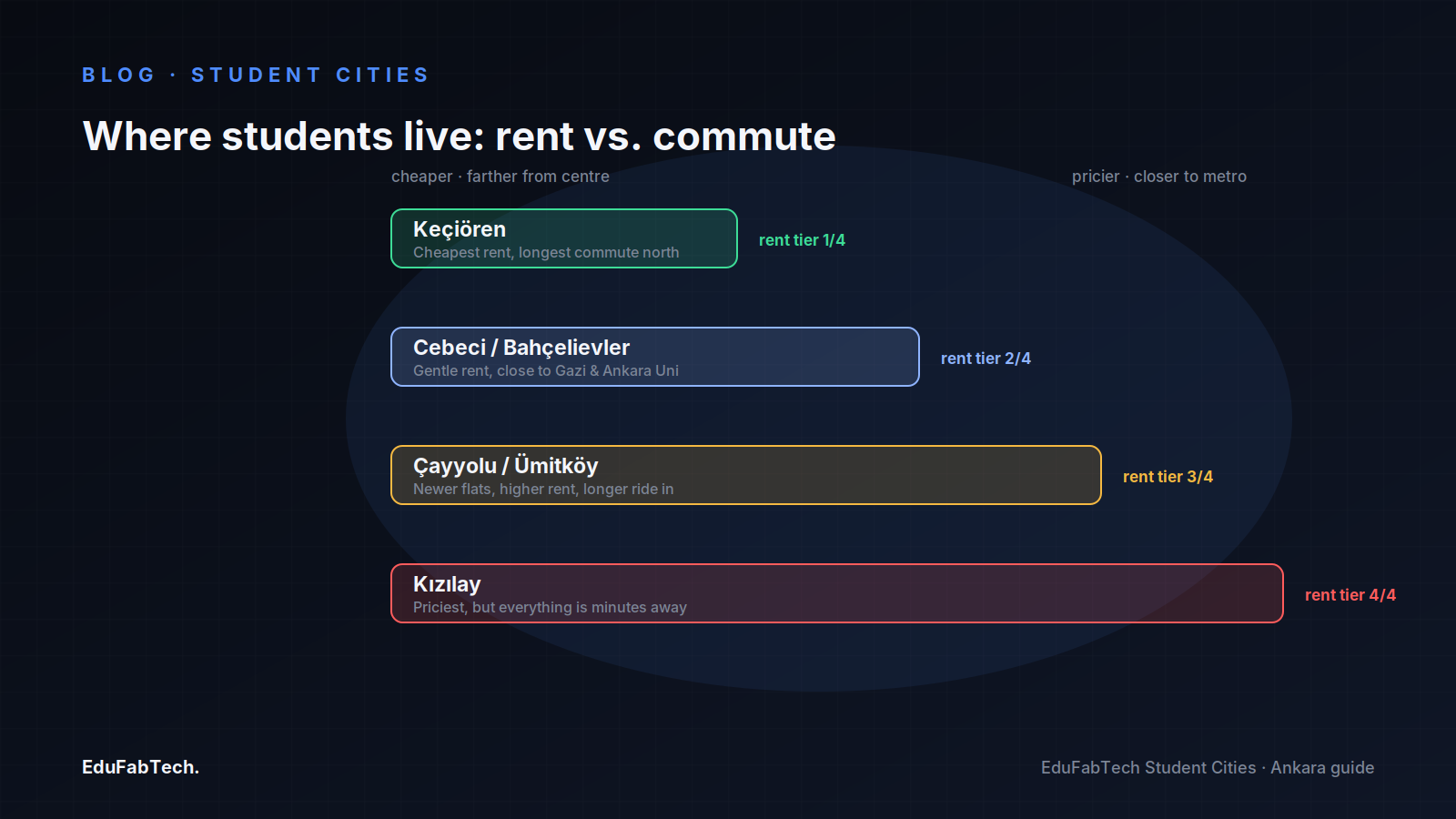
Kızılay is the dead centre and the transport pivot, where the Ankaray light-rail line meets the metro. The area around Sakarya Caddesi is thick with bookshops, cafés and cheap restaurants and is the heart of student social life. Rooms are small and not the cheapest, but you save time and money on commuting.
Cebeci, just east of the centre beside an Ankara University campus, is a classic student quarter: older apartment blocks, photocopy shops, canteens and cafés, and rents that are gentler than the smarter districts.
Bahçelievler, Beşevler and Emek form a leafy, middle-class belt close to Gazi University and several Ankara University faculties. The 7. Cadde strip in Bahçelievler is a long line of affordable eateries and bakeries. It is a good balance of calm and price, popular with students who want to be central without living on top of the nightlife.
Çayyolu and Ümitköy run southwest along the metro toward the western campuses. Flats are newer and greener, the streets quieter, and the rail line puts METU, Bilkent and Beytepe within reach — but rents are higher and the commute into the old centre is longer.
The Beytepe and Üniversiteler area in the southwest is built around campus life itself, sitting close to Hacettepe's Beytepe campus and not far from METU and Bilkent, with purpose-built student residences alongside ordinary flats. Students at Çankaya University and other Eskişehir-road campuses often look here or a little further out toward İncek and Gölbaşı.
Keçiören, a large district to the north, offers cheaper rents and suits students at the Etlik campuses, at the cost of a longer trip to the southern universities. Across all of these, the rule of thumb holds: the closer to a metro station, the more you pay, and the more time you keep.
Finding a room without being cheated
Housing comes in a few shapes: state and private dormitories (yurt), purpose-built private student residences, shared flats with flatmates (ev arkadaşı), small studios (a 1+0 in local listings), and, less often, a room in a family home. Dormitory places are limited and fill early, so most students end up in the shared-flat market.
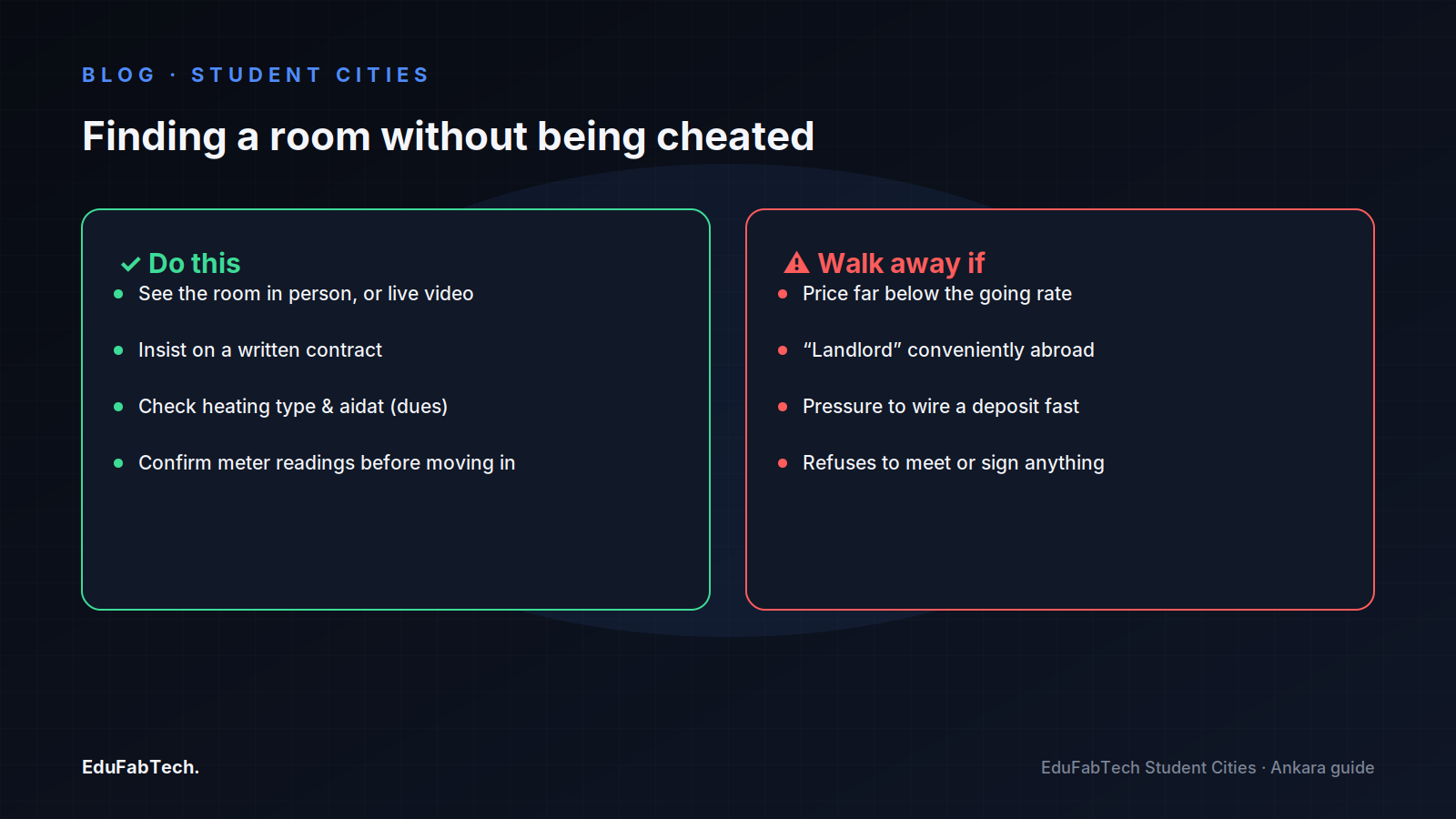
Demand peaks in late summer, in the weeks before term starts in the autumn, and tightens hardest around the big campuses. Start looking early. Before you pay anything, view the room, and check the essentials: the heating type (an individual gas kombi is cheaper to control than shared central heating), the monthly building dues (aidat), the electricity and gas meter readings, who pays for what, and the deposit terms. Insist on a written contract, and never hand over cash without one. Rooms and flatshares posted by other students appear on EduFabTech's Ankara rooms page.
On scams: the single most important habit is to see the place — in person, or at the very least on a live video call — before you send a single lira. A listing far below the going rate, a "landlord" who is conveniently abroad, and pressure to transfer a deposit quickly to "hold" the room are the classic warning signs. Never send money by bank transfer, gift card or cryptocurrency to reserve a room you have not seen, and be wary of anyone who refuses to meet or sign a contract. If it feels rushed, walk away.
Furnishing a room for next to nothing
Ankara is a good city for kitting out a room cheaply if you know where to look. The Ulus flea market (Bit Pazarı), near Fire Station Square in the old town, runs at weekends and is full of second-hand and antique dealers — furniture, kitchenware, books, tools. A short walk away, the historic Suluhan (Hasanpaşa Hanı), a caravanserai dating to the early sixteenth century just southeast of Ulus Square, houses small workshops and shops selling textiles, metalwork and household goods.
Beyond the fixed markets, almost every district holds a weekly open-air market (semt pazarı) where produce is cheap and, at the edges, used household items turn up. For beds, desks and appliances, students routinely buy from one another at the end of each term. EduFabTech lists second-hand furniture across the city — worth checking before you buy anything new.
Working, money and getting around
Rules on part-time work for international students are strict and change, so treat the official source as the authority and never as informal advice. According to METU's International Students Office, an undergraduate may apply for a work permit only after completing the first year of study, and only for part-time work; a residence permit alone does not grant the right to work, and it is the employer who applies for the permit on the student's behalf. The official national portal for international students is the place to confirm the current conditions before you accept any job. Part-time openings that students post appear on EduFabTech's Ankara jobs page.
Getting around is one of Ankara's genuine strengths for students. The metro (lines M1–M4) and the older Ankaray light-rail line, run by the municipal transit authority alongside an extensive bus network, form a spine that links the centre to the western university corridor. Fares are paid with the contactless Ankarakart, and students who register a personalised card pay a discounted rate.
| Fare (municipal transit, as listed 2026) | Amount |
|---|---|
| Student single journey | 20.00 TL |
| Student monthly unlimited pass | 650.00 TL |
These figures come from the municipal transit authority's fares page; check it before you travel, as tariffs are revised often. On broader costs, Ankara is markedly cheaper than the coastal metropolises, and rents fall sharply as you move out from the centre. State universities charge modest, regulated fees, while foundation universities such as Bilkent, Başkent, Çankaya and Ufuk charge substantially higher tuition — always confirm the current figure on the university's own site, since amounts are adjusted yearly.
Libraries and places to study
The city is unusually rich in reading rooms. The Nation's Library (Millet Kütüphanesi), opened in 2020 and reported by Anadolu Agency to be the largest in the country, offers thousands of reader seats and long opening hours. The older national library in Bahçelievler is another serious option for quiet, deep work. On campus, the central libraries at METU and at Hacettepe's Beytepe campus are large and open to their own students for long hours, and most faculties keep their own smaller collections. When the libraries are full — as they are in exam season — the cafés around Kızılay and Sakarya are the informal overflow. Desks and study spaces shared by students are listed on EduFabTech's Ankara study-spaces page.
What's good, and what's hard
The good: Ankara is cheaper and calmer than Istanbul, the academic culture is deep and serious, the metro makes a car unnecessary for most students, and the concentration of universities means a large, varied student population and plenty of events. The centre is walkable, and museums, concerts and theatres are well within a student budget.
The hard: winters are long, grey and cold, with snow that can linger, and the plateau climate takes adjustment. The city sprawls, so a cheap room can mean a long daily commute. Rents have risen quickly and rooms near popular campuses are scarce at the start of term. Winter air quality can be poor. And for some, Ankara's steadier, administrative character feels flat next to the coast — the trade-off for its lower prices and calmer pace.
Your first two weeks: a short checklist
- Start your enrolment and residence paperwork immediately — early appointments fill fast.
- Register a personalised student Ankarakart so you pay the discounted fare from day one.
- View any room in person (or by live video) before paying, and never wire a deposit to hold a place you haven't seen.
- Sign a written contract; photograph the electricity and gas meters and note the building dues.
- Furnish from the Ulus flea market, weekly neighbourhood markets and end-of-term sales rather than buying new.
- Map your commute on the metro and Ankaray before you commit to a neighbourhood.
- Find your faculty and central library hours, and one quiet backup study spot.
- If you plan to work, read the official conditions first and remember the employer must apply for the permit.
- Bilkent University. Historical Background. Bilkent University, 2026. link
- Middle East Technical University International Students Office. Work Permits for International Students. Middle East Technical University, 2026. link
- EGO General Directorate. Taşıma Ücretleri (Public Transport Fares). Ankara Metropolitan Municipality, 2026. link
- Study in Türkiye. Ankara University — university profile. Study in Türkiye (official portal), 2026. link
- Anadolu Agency. Erdoğan inaugurates Turkish Presidential (Nation's) Library. Anadolu Agency, 2020. link