Studying in Ann Arbor: universities, housing and student life
A practical, sourced guide to studying and living in Ann Arbor, Michigan — its universities, where students find rooms, the leasing calendar that catches newcomers out, part-time work, study spaces, transport and costs.
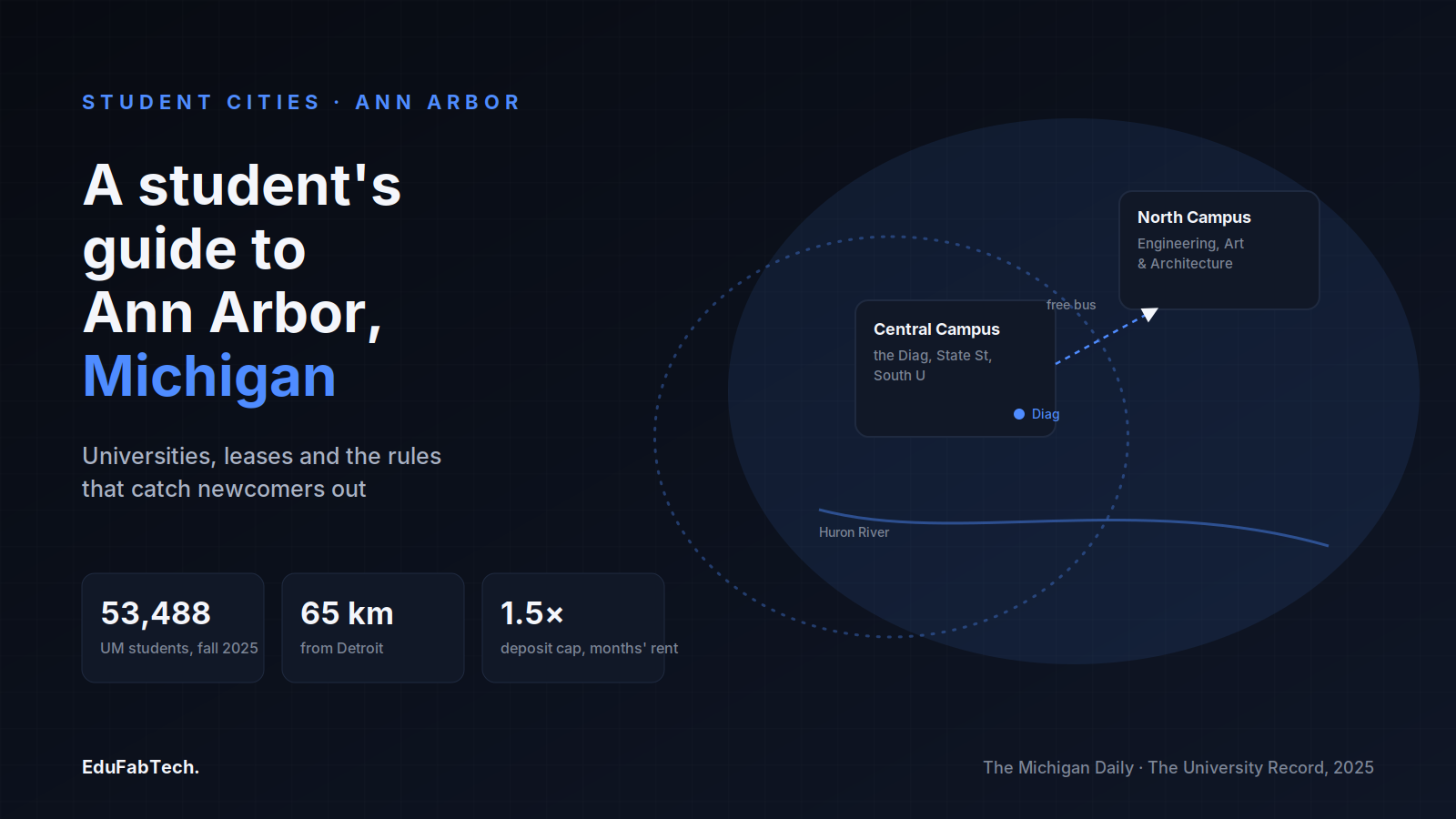
Ann Arbor is a small city in southeast Michigan that is organised, more or less openly, around a single very large university. It sits on the Huron River about 65 kilometres west of Detroit, and its downtown, its bus routes, its rental calendar and its weekend rhythm all bend toward the University of Michigan. For a student arriving from another country or another US state, this has an upside and a catch: almost everything you need is walkable or a free bus ride away, but the housing market moves on a schedule that surprises people who have rented anywhere else.
The city is compact enough to cross on foot in an afternoon, and the campus is woven straight into it — lecture halls, cafés and student houses share the same blocks rather than sitting behind a gate. Winters are genuinely cold and snowy; the stretch from the start of classes in September to the end of the first term runs through the greyest, iciest months, which is worth knowing before you pack.
This guide covers the universities in and around the city, where students actually end up living and how to sign a lease without being cheated, furnishing a room cheaply, part-time work rules, libraries and study spaces, getting around, what things cost, and the honest pros and cons. Figures are attributed in the sentence and linked to their source.
The university, and the schools around it
The University of Michigan is the reason the city exists in its present form. Founded in 1817 and relocated to Ann Arbor in 1837, it reported a record 53,488 students on its Ann Arbor campus in fall 2025, including 35,358 undergraduates, with an incoming undergraduate class drawn from all 50 states and 62 countries, according to The University Record (2025). It is a public research university organised across a walkable Central Campus and a larger, more spread-out North Campus. The historic core sits in and around the University of Michigan Central Campus Historic District, centred on the open square students call the Diag.
Two of its units are worth naming because international students often arrive specifically for them. The University of Michigan College of Engineering is based on North Campus, a short bus ride north of the centre, where most engineering teaching and labs sit alongside art, architecture and music (engin.umich.edu). The University of Michigan School of Public Health, one of the older public-health schools in the country, grants the Master of Public Health along with two undergraduate public-health degrees (sph.umich.edu). Both are schools within the university rather than separate institutions, so you apply and enrol through the University of Michigan.
Ann Arbor also has a smaller university of its own. Concordia University Ann Arbor, on Plymouth Road on the northeast side, is a Lutheran institution affiliated with the Lutheran Church–Missouri Synod and part of the Concordia University System; it grants undergraduate, graduate and doctoral degrees, and describes its setting as "a small, idyllic" campus in a college town (cuaa.edu). It is a very different scale and character from the university across town.
Two more degree-granting universities sit just outside the city and are easy to reach. Eastern Michigan University, in neighbouring Ypsilanti about ten kilometres east, is a public university that opened in 1853 as the first teacher-training "normal" school in Michigan, as its own history records (EMU Today); many Ann Arbor residents live in Ypsilanti and commute between the two towns. Madonna University, a Catholic university run by the Felician Sisters, is further east in Livonia, a Detroit suburb, and grants degrees from associate through to a doctorate in nursing practice. You can browse local listings near the main campus on EduFabTech at /near/university-of-michigan.
Where students live
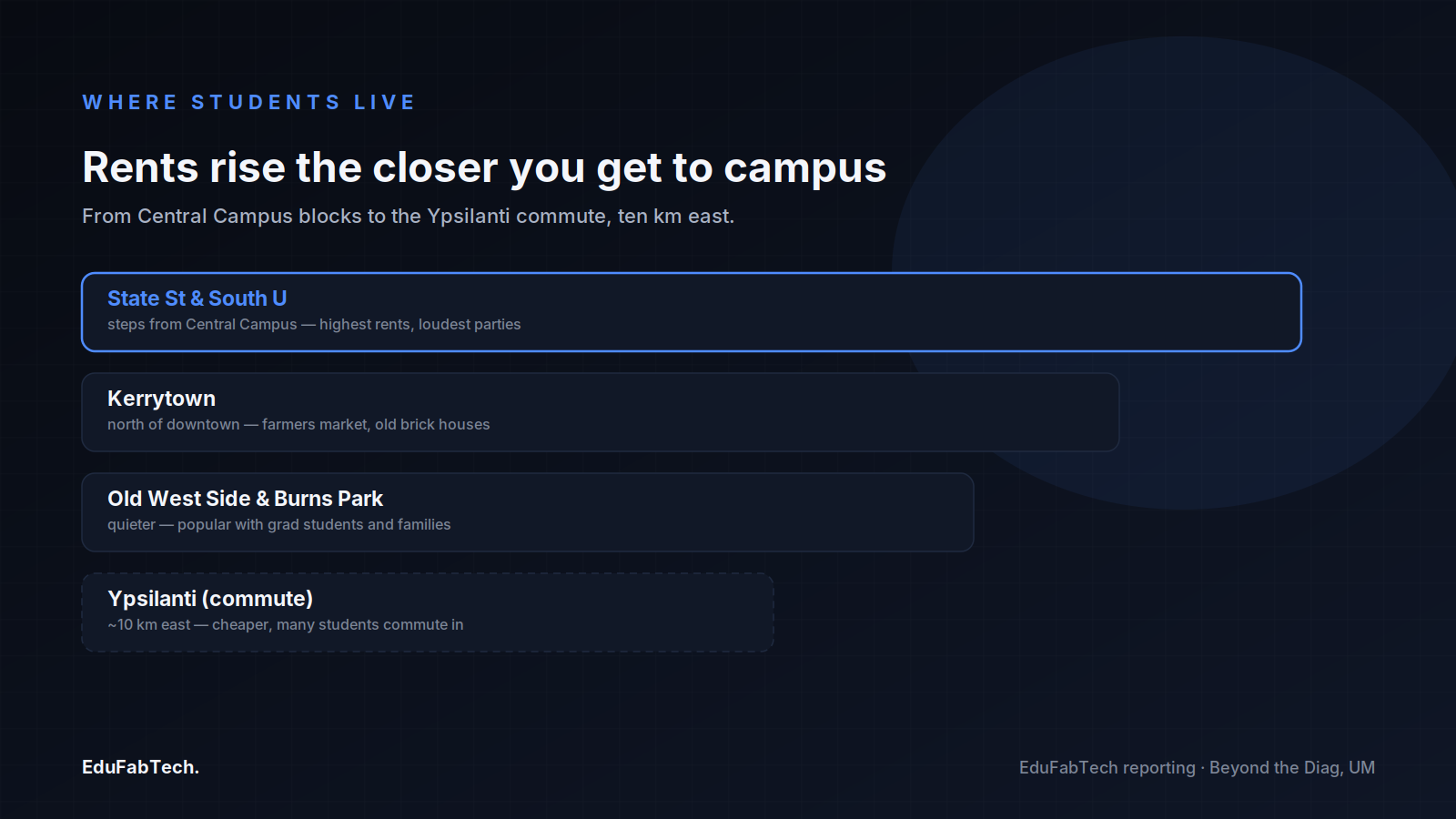
First-year undergraduates at the University of Michigan mostly live in residence halls — the Hill neighbourhood east of Central Campus, the central and South Quad halls, and the Bursley and Baits houses up on North Campus for engineering and arts students. From the second year on, most people move into the privately rented blocks and old houses that fill the streets just off campus.
The areas students know by name are specific and worth learning. Kerrytown, just north of downtown, mixes the farmers' market and old brick houses. The Old West Side, a historic district of wooden houses west of Main Street, and Burns Park, a leafier neighbourhood south of campus, are quieter and popular with graduate students and families. The dense student streets run along State Street and South University ("South U") right beside Central Campus, where rents are highest and parties loudest. Many students priced out of the centre rent in Ypsilanti and commute in. You can see what is currently listed across the city at /in/united-states/ann-arbor/rooms and the full set of city listings at /in/united-states/ann-arbor.
Signing a lease without being cheated
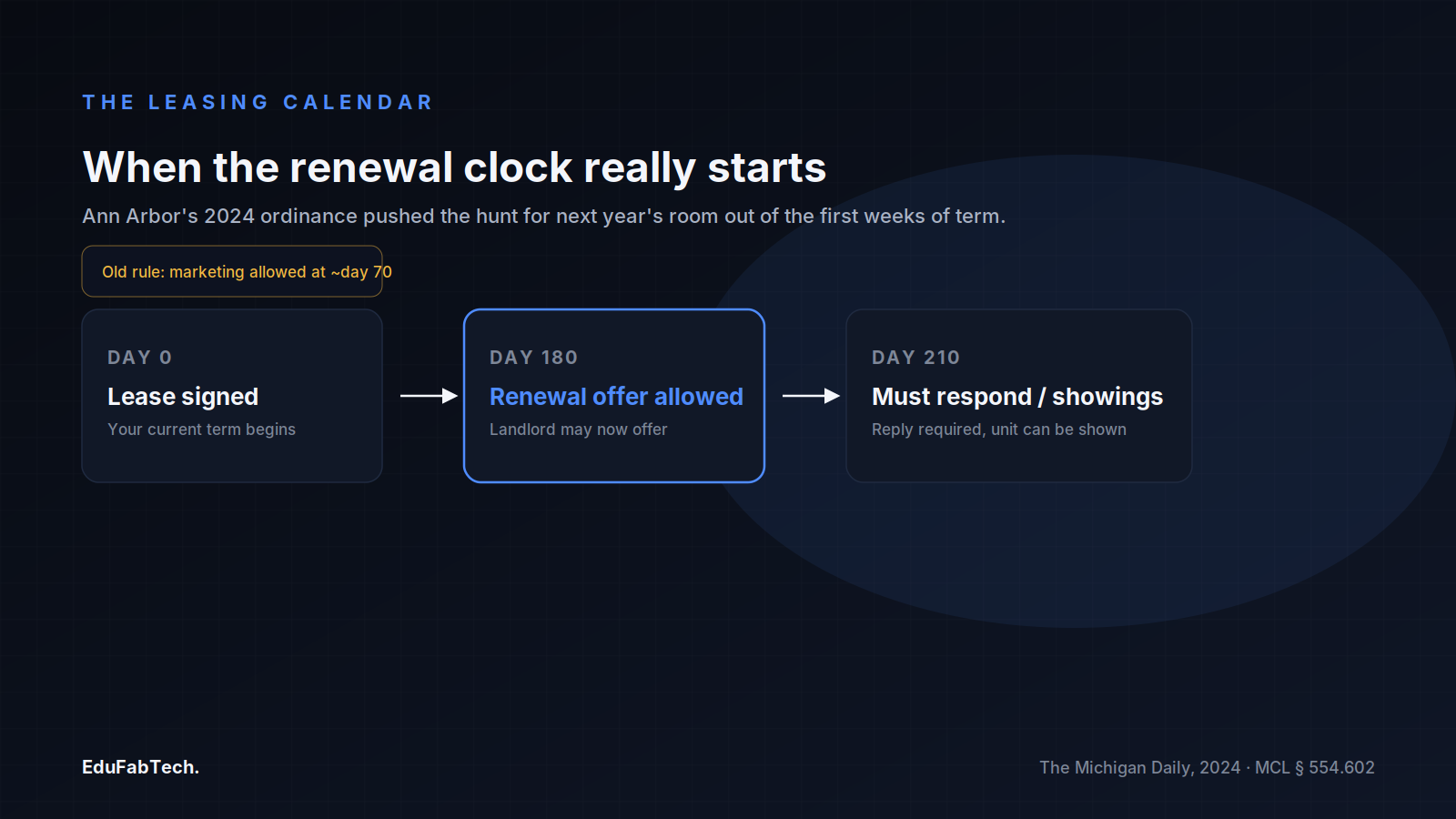
Ann Arbor's leasing calendar is the one thing that catches newcomers out. For years the city's Early Leasing Ordinance let landlords start marketing an occupied unit about 70 days into a lease, which pushed the hunt for the following September back into the previous autumn. A combined Early Leasing Ordinance and "Right to Renew" that took effect in March 2024 slowed that down: a landlord cannot make a renewal offer until 180 days into your lease, and cannot require a response or show your occupied unit to prospective tenants until 210 days in, as The Michigan Daily reported when City Council passed the measure (michigandaily.com, 2024). For a lease that begins in late summer, that moves the search for next year's room into the spring, not the first weeks of term. The University of Michigan's official off-campus service, Beyond the Diag, makes the same point about not rushing: its manager, Mark Simmonds, told The Michigan Daily that "there is not a shortage of housing in Ann Arbor, and therefore it is OK to take your time, weigh your options, and reflect on what is important to you" (michigandaily.com). You do not have to sign in your first fortnight.
Two concrete protections are worth knowing before any money changes hands. First, Michigan law caps a security deposit at no more than one and a half months' rent under Michigan Compiled Laws § 554.602 (legislature.mi.gov); a landlord demanding more than that is not following the statute. Second, Simmonds also points enrolled students to the university's Student Legal Services, which will review a lease for free before you sign — use it before, not after.
Rental scams in Ann Arbor tend to follow the market's weak points. They cluster on classifieds and marketplace posts advertising cheap sublets near South University or Central Campus, aimed at international students arriving in August who have not yet seen the place. The pattern is always the same: a "landlord" who cannot meet you, a room you cannot view, and pressure to send a deposit immediately to "hold" it. See the unit in person, or on a live video call where the person walks the actual rooms, and confirm the building is handled by a real leasing office. Never send a deposit or "holding fee" by bank wire transfer, gift card or cryptocurrency — no legitimate Ann Arbor landlord needs payment in those forms, and money sent that way is gone. A normal deposit here is paid against a signed written lease, within the one-and-a-half-month legal cap.
Furnishing a room for very little
Second-hand goods move constantly in a town that turns over thousands of leases every summer. The Kiwanis Thrift Sale, run by the Kiwanis Club of Ann Arbor at 100 North Staebler Road, sells donated furniture, clothing, books and kitchenware on Fridays and Saturdays, with proceeds funding the club's community grants (kiwanissale.com). For larger items, the Habitat for Humanity of Huron Valley ReStore at 6241 Jackson Road resells second-hand furniture, appliances and building materials to the public (h4h.org). The Ann Arbor PTO Thrift Shop at 2280 South Industrial Highway has sold donated clothing, furniture and household items since 1993, with proceeds going to local public-school groups (a2ptothriftshop.org). For fresh food and the general texture of the place, the Ann Arbor Farmers Market at 315 Detroit Street in Kerrytown is run by the City of Ann Arbor and operates year-round — Saturdays from January through April, and both Wednesdays and Saturdays from May through December (a2gov.org). The late-August move-out weeks are also when usable furniture appears on kerbs for free. On EduFabTech, browse second-hand listings at /in/united-states/ann-arbor/second-hand.
Working while you study
If you are on an F-1 student visa, the rules on work are set federally, not by the university, and they are worth reading from the source rather than from hearsay. The US Department of Homeland Security's Study in the States guidance states that F-1 students may take on-campus employment but may not work more than 20 hours per week while school is in session, and that you should always start by speaking to your school's designated school official (DSO) before taking any job (studyinthestates.dhs.gov). On-campus roles — a library desk, a dining hall, a research lab — are the usual first option, and you will need a Social Security Number to be paid. This is general information, not legal advice; your DSO in the international centre is the person who can tell you what applies to your specific status. Local part-time listings are at /in/united-states/ann-arbor/jobs.
Libraries and places to study
The University of Michigan Library spreads across several buildings on Central Campus, including the Harlan Hatcher Graduate Library and the Shapiro Undergraduate Library next to each other near the Diag, plus the Art, Architecture and Engineering Library serving North Campus (lib.umich.edu). Shapiro, known to students as the "UGLi," runs long hours during term and is the default late-night spot. Separately — and open to everyone, not just the university — the Ann Arbor District Library runs a Downtown Library at 343 South Fifth Avenue with study and tutoring rooms on every floor, plus the Malletts Creek, Pittsfield, Traverwood and Westgate branches across the city (aadl.org). For a quieter desk than a term-time campus library, the public branches are an underused option. See study-space listings at /in/united-states/ann-arbor/study-spaces.
Getting around
Public transport here is operated by the Ann Arbor Area Transportation Authority, branded as TheRide. For University of Michigan students the headline fact is that you ride for free: under the MRide agreement, active students, faculty and staff ride TheRide's fixed-route buses at no charge simply by swiping a valid yellow Mcard, because the university pays the fares (ltp.umich.edu). If you are not covered by MRide, TheRide's published adult fares are $1.50 for a single ride, $3.00 for a day pass and $45.00 for a 30-day Flex pass (theride.org, 2026). The city itself is flat and walkable, cycling is common, and the nearest major airport is Detroit Metropolitan (DTW), roughly a half-hour drive east. Plan for ice and snow from late autumn through early spring; buses run, but footpaths and cycle routes can be slick for months.
What it costs, and the honest trade-offs
Ann Arbor is an expensive town for its size, and rent is the main reason. The U.S. Census Bureau's QuickFacts put the median gross rent in Ann Arbor at $1,649 a month over 2020–2024 (census.gov QuickFacts) — a figure for all renters citywide, so rooms in shared student houses can run below it and new blocks near South University well above. University residence-hall rates, which bundle a required meal plan, are set each year by the Board of Regents and published by University Housing; they sit at the higher end of the options, which is partly why most students move off campus after first year. Against those costs, the free MRide bus access and the dense second-hand market take real pressure off a student budget.
The honest ledger looks like this. In its favour: the city is safe-feeling and genuinely walkable, the university's libraries, labs and events are world-class, free buses remove a recurring cost, and a medium-sized town means you are not commuting an hour each way. Against it: the rental market is tight and expensive, and although the 2024 ordinance pushed the renewal scramble later into the academic year, students still feel pressure to lock in next year's housing months ahead; winters are long, dark and icy; and on home football Saturdays in autumn the town fills with more than a hundred thousand visitors and normal life pauses. None of these is a reason to stay away, but all are easier to handle if you expect them.
A checklist for the first weeks
- Before you pay anything, see the room in person or on a live walk-through video, and confirm the leasing office is real.
- Never send a deposit or holding fee by wire transfer, gift card or cryptocurrency; pay only against a signed written lease.
- Check that any deposit is no more than one and a half months' rent, the Michigan legal cap.
- If you are enrolled, have Student Legal Services review the lease for free before you sign.
- Do not panic-sign for next year early: under the 2024 ordinance a landlord cannot show your occupied room to new tenants until 210 days into your lease, so you have until spring to look.
- Get your Mcard early so you can ride TheRide buses free through MRide.
- International students: meet your DSO at the international centre before taking any job, and apply for a Social Security Number if you will work on campus.
- Furnish from the Kiwanis Thrift Sale, the Habitat ReStore, the Ann Arbor PTO Thrift Shop and late-August kerbside give-aways rather than buying new.
- Find your study spots — Shapiro on campus, the Downtown Library for quiet — before deadlines arrive.
- Buy proper winter boots and a warm coat; the cold here is not a formality.
A quick question for readers
Do you work part-time while you study?
Many students work to pay the bills. See how common it is — and how many hours people really do.
Pick an answer, create a free account in a minute, and your vote counts. Already a member? Sign in
Source: The University Record (University of Michigan)
Sources (5)
- The University Record. U-M breaks enrollment record, welcomes 53,000 students for fall term. University of Michigan, 2025. record.umich.edu ↗ · checked 3 Oct 2026
- Ann Arbor Area Transportation Authority (TheRide). Fares. TheRide, 2026. theride.org ↗ · checked 3 Oct 2026
- U.S. Census Bureau. QuickFacts: Ann Arbor city, Michigan. U.S. Census Bureau, 2025. census.gov ↗ · checked 3 Oct 2026
- U.S. Department of Homeland Security. Working in the United States (Study in the States). DHS Study in the States, 2025. studyinthestates.dhs.gov ↗ · checked 3 Oct 2026
- Michigan Legislature. Michigan Compiled Laws § 554.602 (security deposit). State of Michigan, 2024. legislature.mi.gov ↗ · checked 3 Oct 2026