Studying in Antalya: universities, housing and student life
A practical, sourced guide to studying and living in Antalya — its universities, where students find rooms, what things cost, how to get around, and the honest trade-offs of a Mediterranean tourist city.
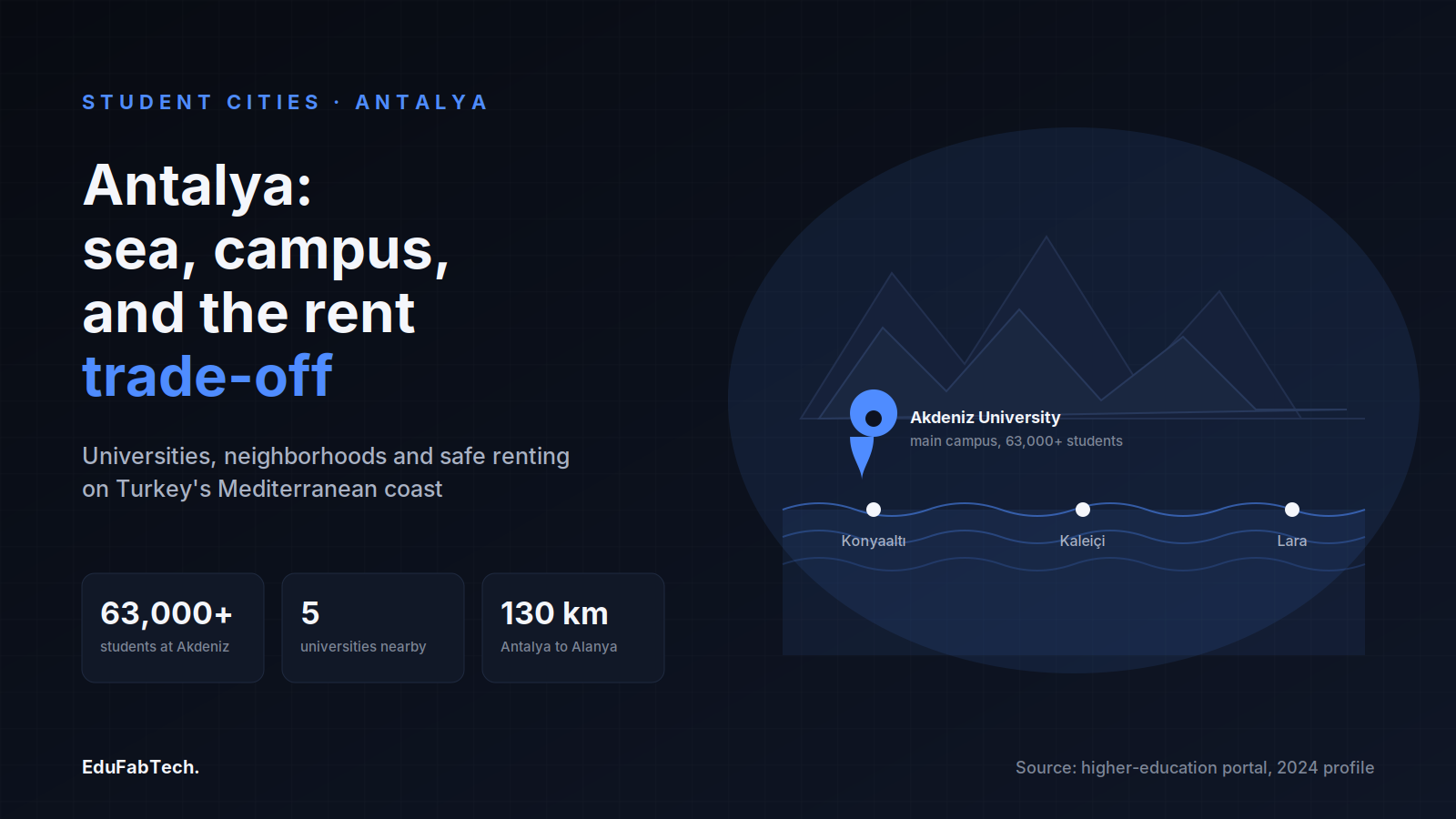
Antalya sits on the Mediterranean coast with the Taurus mountains rising directly behind it, and that geography shapes almost everything about student life here. The city faces the sea along two long stretches — the pebble beach at Konyaaltı to the west and the sandy cliffs of Lara to the east — with the old walled quarter of Kaleiçi in the middle. It is warm, bright and busy for much of the year, and its economy leans heavily on tourism, which is both the city's great convenience and its most awkward feature for anyone trying to live here on a student budget.
Unlike a purpose-built university town, Antalya is a large coastal province with its academic life concentrated in a few places rather than spread through a compact centre. Most students orient themselves around one big public campus, a handful of smaller foundation (private, non-profit) universities, and two universities further east in the resort town of Alanya. Knowing where each one is — and how far it is from the sea and the centre — matters more here than in most cities, because commute times and rents change sharply over a short distance.
The universities, starting with Akdeniz
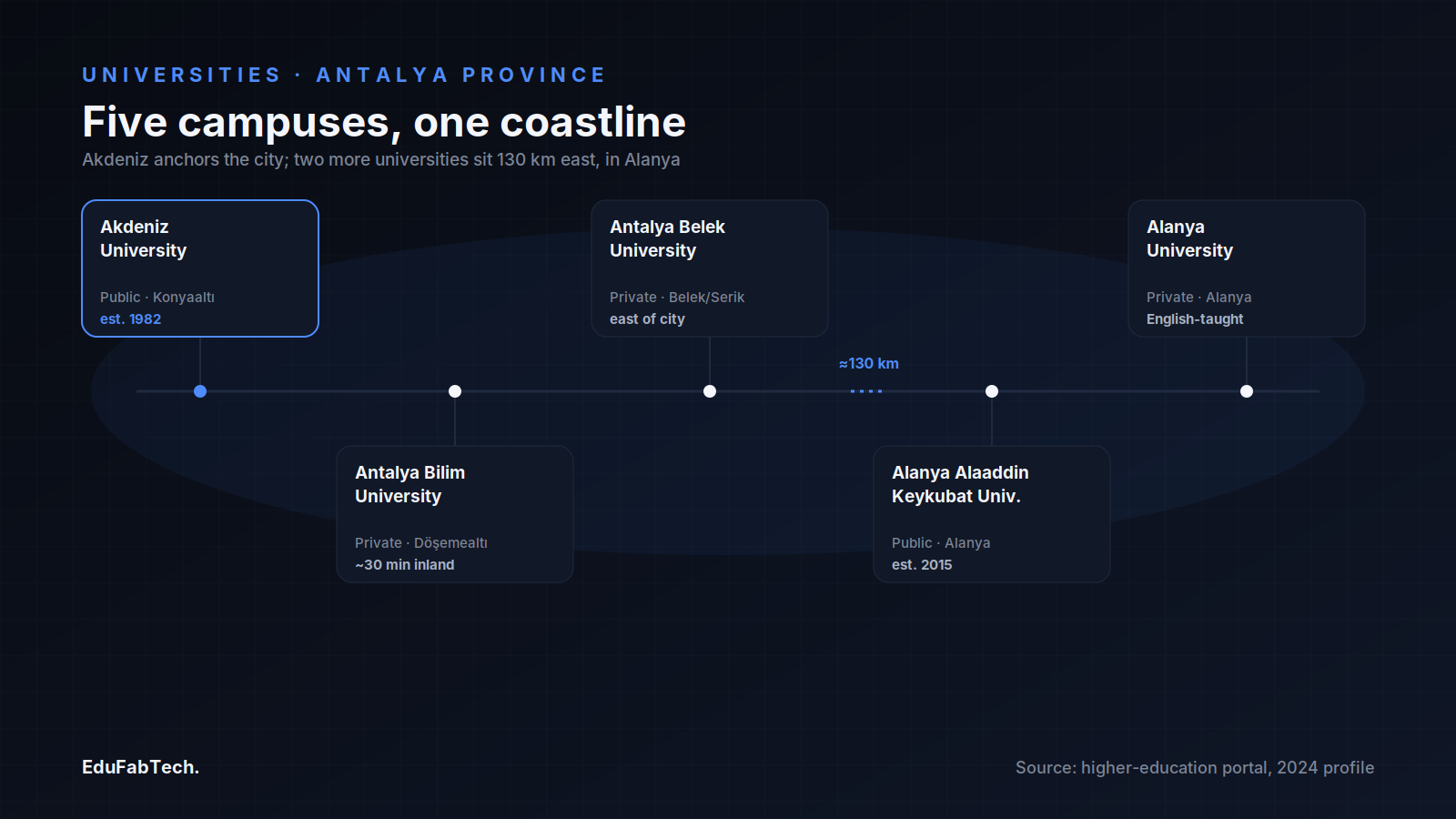
The anchor of student life is Akdeniz University, the city's large public research university, whose main campus is in the coastal district of Konyaaltı on the western side of Antalya. According to the higher-education information portal's 2024 institution profile, it was established in 1982 and now has 25 faculties, 13 vocational schools and more than 63,000 students across associate, undergraduate and postgraduate levels. It runs its own teaching hospital and is known regionally for medicine and health sciences, alongside tourism, agriculture and aquaculture — fields that fit the surrounding coast and farmland. The campus is a self-contained area of faculties, libraries, sports grounds and cafeterias, and for most undergraduates the daily routine revolves around it.
Other universities in and around Antalya
Beyond Akdeniz, several smaller institutions fill out the picture. Not all are in the city proper, so check the exact location before you commit to a lease near one of them.
- Antalya Bilim University — a foundation (private, non-profit) university whose campus is in Döşemealtı, inland to the north of the city, roughly a half-hour from the centre. It runs programmes in engineering, health sciences, tourism and civil aviation.
- Antalya Belek University — a foundation university (known until 2022 as Antalya AKEV University) based near Belek, the golf-and-resort belt east of the city in the Serik area.
- Alanya Alaaddin Keykubat University — a public university founded in 2015 in the seaside town of Alanya, about 130 km east of Antalya's centre; a separate place to live, not a commute from the city.
- Alanya University — a small foundation university, also in Alanya, formerly called Alanya Hamdullah Emin Paşa University, teaching largely in English.
If your programme is at Akdeniz, everything below about neighbourhoods and transport applies directly. If it is at one of the Alanya universities, treat Alanya as its own town with its own rental market and plan around that instead.
Where students live
Housing choice in Antalya is mostly a trade-off between distance from campus, distance from the sea, and rent. The coastal district of Konyaaltı, which contains the Akdeniz campus, is the obvious first option: neighbourhoods such as Pınarbaşı, Sarısu, Uncalı, Hurma and Liman put you within walking or short-bus distance of the university, and some of them are quiet and green. Being near the coast, though, Konyaaltı is also one of the pricier parts of the city, and demand from year-round residents and holiday lets keeps it that way.
For a lower budget, students often look inland to Kepez, the large district north of the centre, where rents tend to be the most affordable in the city, at the cost of a longer commute and a less scenic setting. Muratpaşa, the central district around Kaleiçi and the main shopping streets, is lively and well-connected but generally more expensive than Kepez. As a rough rule for Antalya, the closer you get to the sea and the old centre, the more you pay; move a few kilometres inland and prices ease. Housing itself ranges from a bed in the state-run dormitory system and privately run student residences (often called apart) to shared flats — the common "1+1" (one room plus a living room) or larger "2+1" and "3+1" flats split between students.
Finding a room safely
Start early. Demand peaks as the academic year begins in autumn, and in a tourist city landlords have the option of short-term holiday rentals, which thins the long-term supply just when students are looking. If you can, arrive a couple of weeks before term, stay somewhere temporary, and view places in person. Before you hand over anything, check the essentials: that the person showing the flat is the actual owner or an authorised agent; that a written contract names everyone and states the rent, deposit and what the deposit covers; whether bills and building fees (aidat) are included; the state of the boiler, damp, water pressure and — because Antalya summers are severe — whether there is working air conditioning. Confirm which bus lines actually serve the street, not just the district.
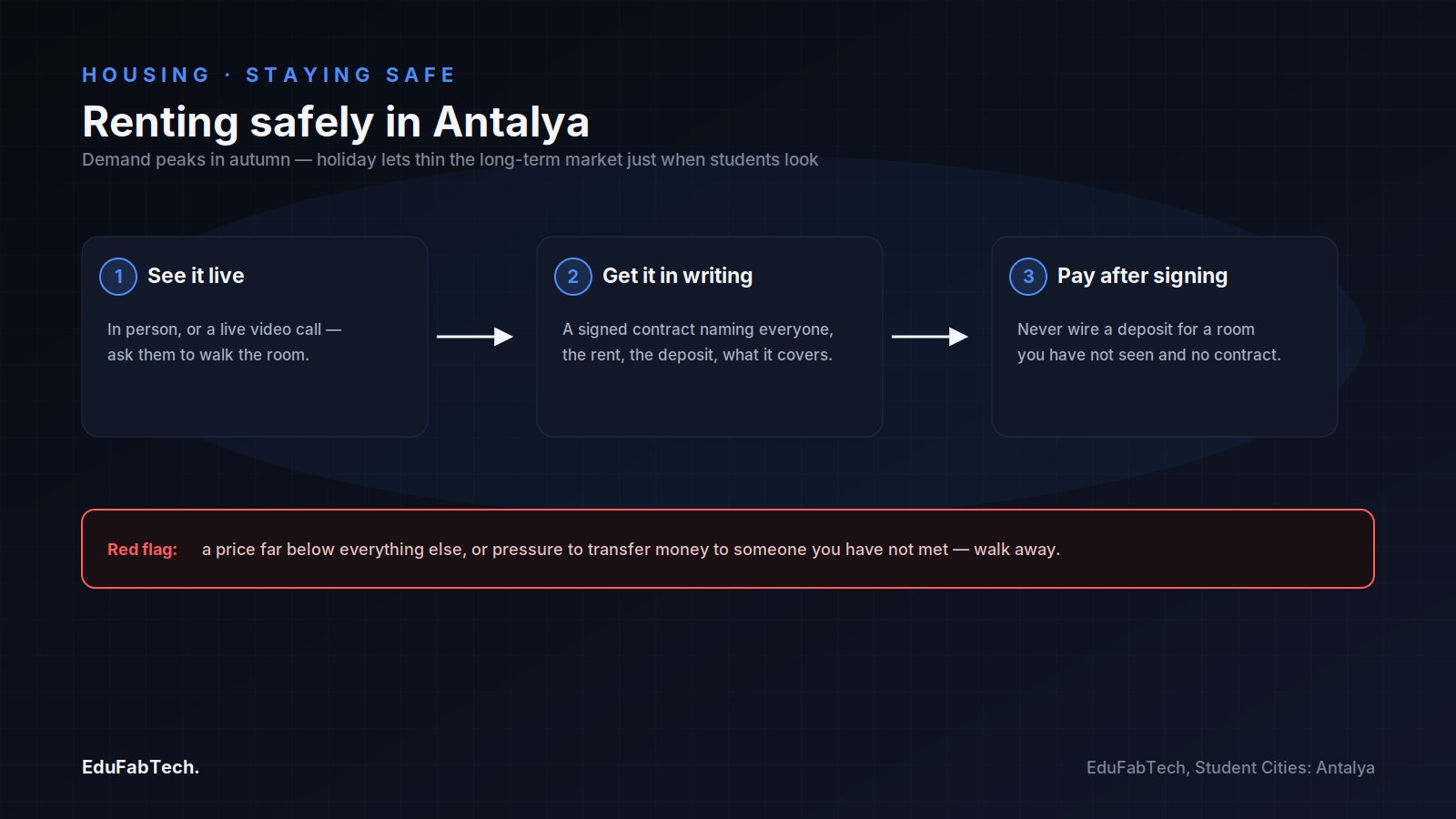
On scams: the single most important rule is to see the place — in person, or at the very least on a live video call where you can ask the person to move around and show detail — before you pay anything. Never send a deposit by bank transfer, gift card or cryptocurrency to "hold" a room for someone you have not met and a property you have not seen. A classic fraud is a listing, often with photos lifted from elsewhere, from someone who claims to be abroad and asks for a transfer to reserve it; once the money is sent it is gone. Pay a deposit only against a signed contract, for a property you have verified, ideally in a way that leaves a record. If a deal feels rushed or the price is conspicuously below everything else, walk away.
You can browse current student listings for the city on EduFabTech's Antalya page, and rooms specifically under rooms and places to stay. Listings tagged near Akdeniz University are a useful shortcut if you want to keep the commute short.
Furnishing a room without spending much
If you land an unfurnished flat, furnishing it new is the fast way to burn a term's budget. Antalya's weekly neighbourhood markets — the open-air pazar that rotates through almost every district on a fixed day — are the cheap way to buy produce, kitchen basics and household goods, and they are woven into the rhythm of local life. For second-hand furniture and clothes, the city has open-air flea and street markets, including a well-known Saturday street market in the Lara area on the eastern side; ask other students which nearby pazar and bit pazarı (flea market) run on which days, since these are organised by neighbourhood.
Buying from departing students is often cheaper and easier than the markets, because furniture changes hands locally at the end of each term. On EduFabTech you can look through second-hand things and second-hand furniture in the city, and check things given away free — graduating students frequently give away what they cannot take with them. A desk, a chair and a decent lamp bought used will serve you as well as new ones.
Working while you study
Rules on paid work depend on your status, and this is an area where you should rely on official sources rather than word of mouth. For international students, a residence permit does not by itself grant the right to work: a separate work permit is required, and it is the employer, not the student, who applies for it. As one university international office summarises the national rules, undergraduate students may apply for a work permit only after completing their first year and only for part-time jobs off campus, while graduate students can apply from their first year. Working without the required permit can put your residence status at risk. This is general information, not legal advice — confirm your own case with your university's international office and the official government pages before accepting any job, because the details and hour limits can change. When you are ready to look, part-time openings for students are collected under jobs and part-time work. Antalya's tourism economy does create seasonal hospitality and language-related work, but much of it is concentrated in the summer, which overlaps with exams and the long vacation rather than term time.
Libraries and places to study
The natural study hub for most students is the Akdeniz University central library on the Konyaaltı campus, with reading rooms, digital resources and long opening hours that extend during exam periods. Faculty libraries add subject-specific collections. Off campus, the foundation universities maintain their own libraries for their students, and public reading rooms and the many cafés along the coast and in Muratpaşa are common informal study spots — though the busy tourist areas can be noisy in season. If you would rather find a quiet desk or a study group near where you live, EduFabTech lists study spaces and desks around the city.
Getting around Antalya
Antalya runs on a fare card called the AntalyaKart, used on city buses and the tram network. The tram links the central corridor of the city, while an extensive bus network covers the outer districts and the university areas; because the city is long and coastal rather than compact, most students end up depending on buses for the daily commute. Students can obtain a discounted student AntalyaKart: the transit operator's card-type rules state that the student card is available to enrolled full-time students, including recognised foreign exchange students, on presentation of enrolment documents and a photo. The reduced student fare is substantially lower than the standard fare, so applying for the card early is worth the paperwork. Within neighbourhoods, walking and cycling are pleasant for much of the year, though the summer heat makes midday journeys on foot genuinely draining.
Costs and the honest trade-offs
The hardest thing to be precise about is cost, because rents and prices move quickly and vary a lot by district, so treat any single figure you see online with caution and compare several current listings before budgeting. In relative terms, expect Konyaaltı and central Muratpaşa to sit at the top of the rent range and inland Kepez at the bottom, with shared flats and dormitory places well below a solo flat. Transport is cheap with a student card; markets keep food and furnishing costs down if you use them.
The genuine upsides are real. The climate is Mediterranean — hot, dry summers and mild, wet winters — with a long warm season, a walkable coast and mountains within reach, so outdoor life is easy and the winter is gentle compared with inland cities. Akdeniz is a large, full-service university with a wide range of programmes and its own hospital. The honest difficulties are just as real. The tourist economy pushes coastal rents up and pulls long-term rooms into short-term holiday lets, so housing near the sea is competitive and not cheap. The city is spread out, so a cheap room inland usually means a long, hot commute. Summer heat and humidity are intense, air conditioning is close to essential, and the seasonal crowds that fill the beaches and old town can make the city feel less like a place to study and more like a resort for a few months of the year. None of this makes Antalya a poor choice — but it rewards students who plan the location of their room around their campus and their budget, rather than around the view.
A checklist for the first weeks
- Arrive before term if you can, with temporary lodging booked, so you can view rooms in person rather than renting sight unseen.
- Decide your priority — short commute (Konyaaltı, near campus) or lower rent (Kepez) — before you start viewing, and check which bus lines actually serve the street.
- View every place in person or on a live video call; sign a written contract; never wire a deposit to hold an unseen room.
- Apply for a student AntalyaKart with your enrolment documents as soon as you register.
- Register with your university's international office and confirm residence-permit and any work-permit steps directly with them and the official pages.
- Furnish from departing students and the weekly markets rather than buying everything new; check local events and notice boards to meet people and find shared flats.
- Plan for the heat: confirm working air conditioning before you sign, especially for a summer term.
- Akdeniz University. Akdeniz University — official website (English). Akdeniz University, 2026. link
- Study in Türkiye. Akdeniz University — institution profile. Study in Türkiye (higher-education information portal), 2024. link
- Middle East Technical University — International Student Office. Work Permits for international students. Middle East Technical University, 2026. link
- Directorate General of International Labour Force. Work Permit — frequently asked questions. Ministry of Labour and Social Security (Türkiye), 2026. link
- Antalya Ulaşım A.Ş.. AntalyaKart — card types and student card eligibility. AntalyaKart (Antalya public transport), 2025. link
- Antalya Bilim University. Antalya Bilim University — official website. Antalya Bilim University, 2026. link
- Alanya Alaaddin Keykubat University. Alanya Alaaddin Keykubat University — official website. Alanya Alaaddin Keykubat University, 2026. link