Studying in Appleton: universities, housing and student life
A practical, sourced guide to studying in Appleton, Wisconsin — Lawrence University and the Fox Valley colleges, where students live, what it costs, and how to get around.
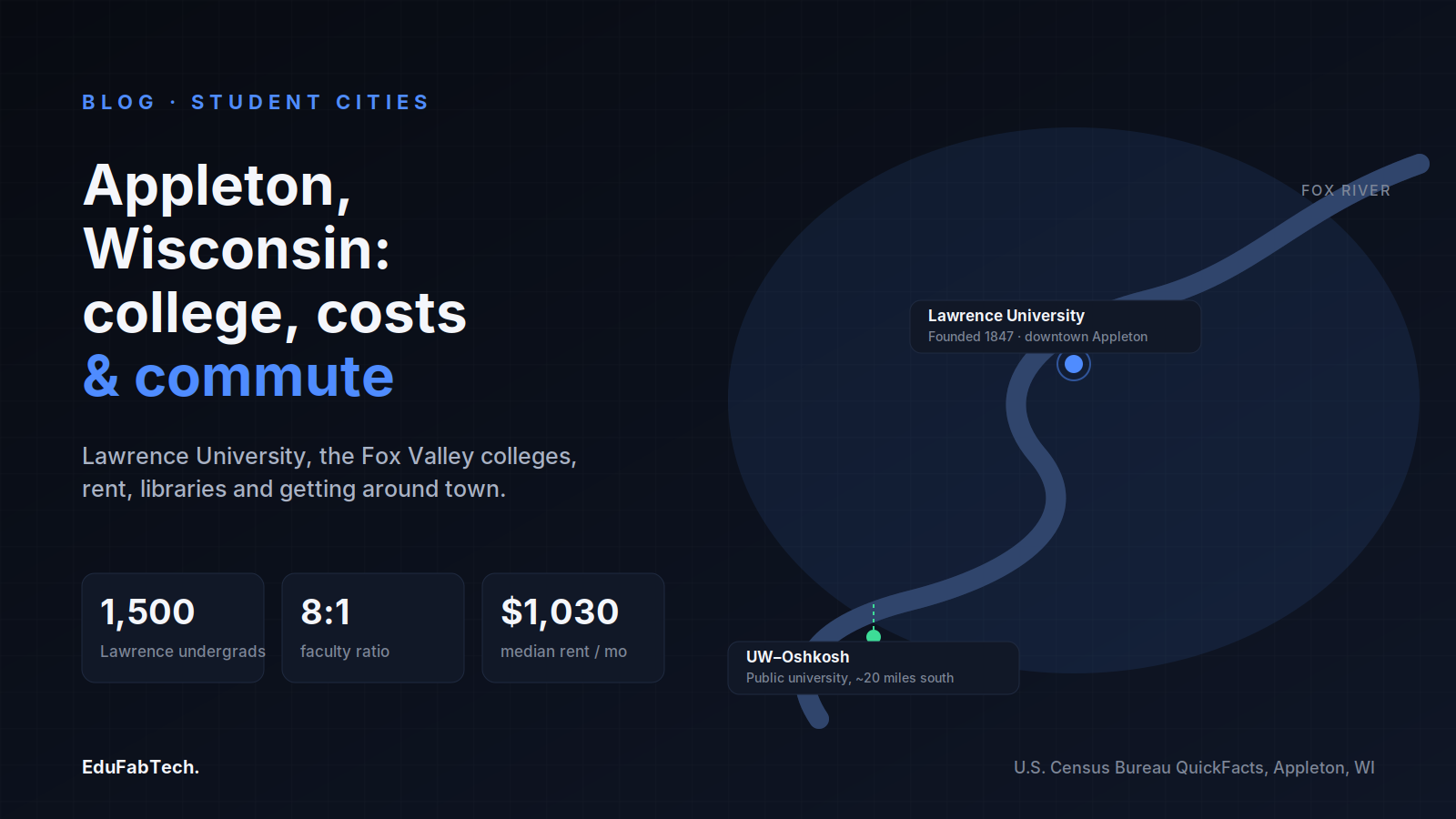
Appleton sits on the north bank of the Fox River in northeast Wisconsin, roughly midway between Lake Winnebago and Green Bay, and it is the largest of the string of towns — Neenah, Menasha, Kimberly, Little Chute, Kaukauna — that locals call the Fox Cities. Its spine is College Avenue, a long, low downtown street that runs past Houdini Plaza, named for the escape artist who grew up here, and widens on Saturday mornings into one of the region's busiest open-air markets. It is the seat of Outagamie County and, by Wisconsin standards, a mid-sized city rather than a college town built around a single campus.
For students, though, one institution does define the place. Lawrence University, a private liberal-arts college founded in 1847, occupies a compact campus at the eastern edge of downtown where the streets drop toward the river. Lawrence says on its About page that it enrols around 1,500 undergraduates and keeps an 8:1 student-to-faculty ratio — a scale that shapes everything from class sizes to where most of its students sleep at night.
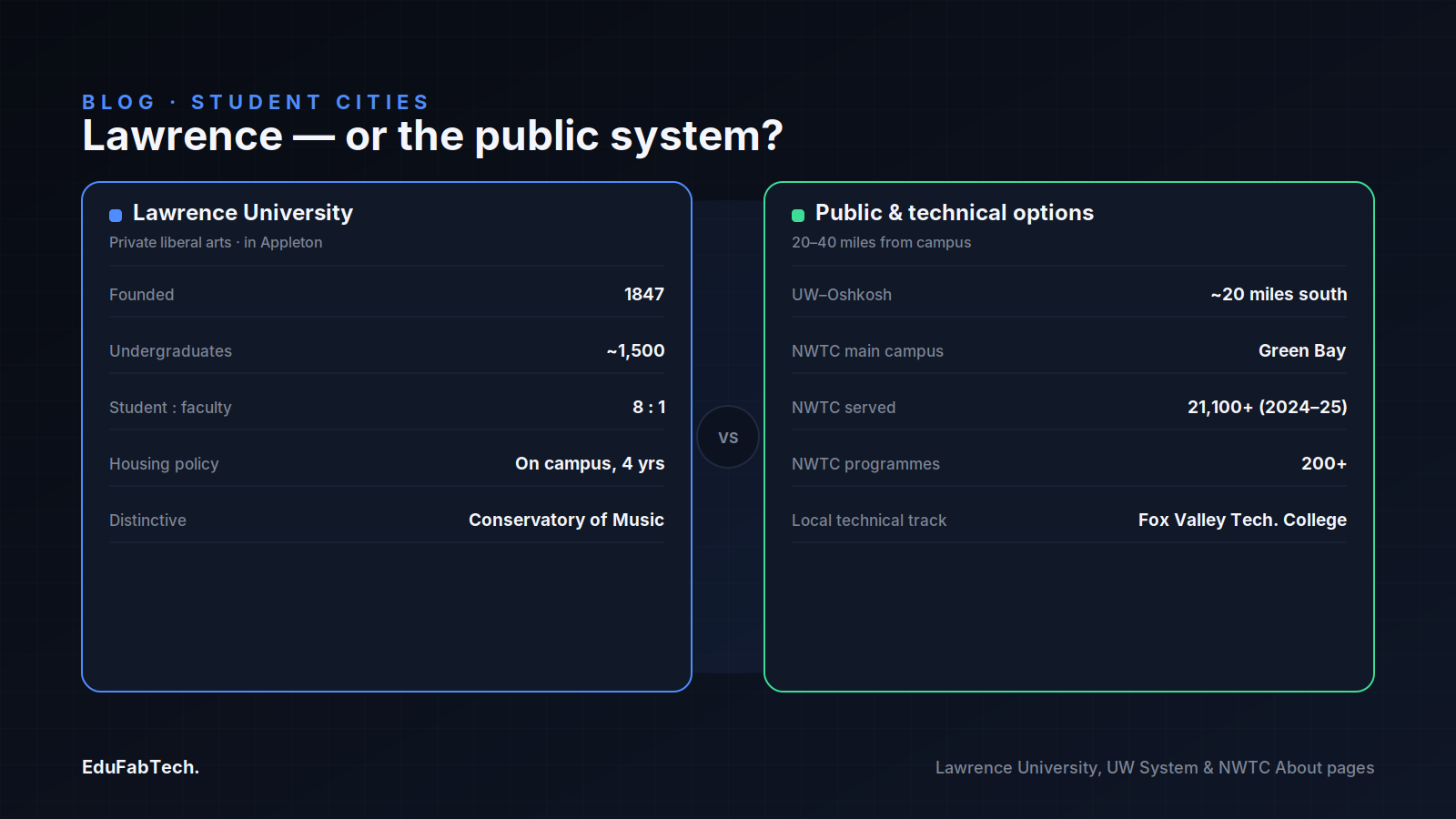
What makes Appleton unusual for anyone weighing it up is that the college in town is small and private, while the public and technical options that most Wisconsin students rely on are a short drive away in other Fox Cities and in Green Bay. That geography — one liberal-arts college here, the larger systems elsewhere — runs through housing, transport and cost alike, so it is worth laying out the colleges first.
The colleges in and around the Fox Valley
Lawrence University is the one four-year university physically in Appleton, at 711 E. Boldt Way according to its own site. It is a liberal-arts college in the full sense — small seminars, a residential culture, and an unusual pairing with a music school. The Lawrence University Conservatory of Music shares the same campus, and students can pursue a five-year double degree that combines a bachelor of music with a bachelor of arts, which gives the place a stronger performing-arts presence than its size suggests.
The nearest public university is the University of Wisconsin–Oshkosh, about 20 miles south at 800 Algoma Blvd in Oshkosh, on the far side of Lake Winnebago. Its About page places it in the Fox Valley region and within the University of Wisconsin System, one of the country's larger public higher-education systems; it is a far bigger institution than Lawrence and a realistic commuter option for some Appleton residents.
Two points of caution for anyone reading older guides. First, the two-year campus that once served Fox Cities students directly — the UW Oshkosh Fox Cities campus in Menasha, descended from the former University of Wisconsin–Fox Valley — stopped teaching at the end of the spring 2025 semester, a closure reported by PBS Wisconsin after years of falling enrolment. It no longer admits students. Second, Northeast Wisconsin Technical College is the regional technical college, but its home is Green Bay, not Appleton: its About the College page lists its main campus at 2740 West Mason St in Green Bay and says it served more than 21,100 people in the 2024–25 academic year across 200-plus degree, diploma and certificate programmes. If you want a technical or associate programme on Appleton's own doorstep, you will generally be looking at Fox Valley Technical College rather than NWTC.
Where students live, and the four-year rule
Lawrence is unusual in how firmly it keeps students on campus. Its housing page states plainly that the university believes living on campus for a minimum of four years is critical to students' success, so most undergraduates spend their whole degree in university housing rather than renting in town. First-year students are placed in the Colman, Kohler and Trever halls; later years move into Ormsby, Plantz, Sage and Hiett, into the apartment-style Fox Commons, or into one of the small formal houses tied to student organisations. In practice this means the Lawrence rental hunt most new students do is an internal room-draw, not a search of the local market.
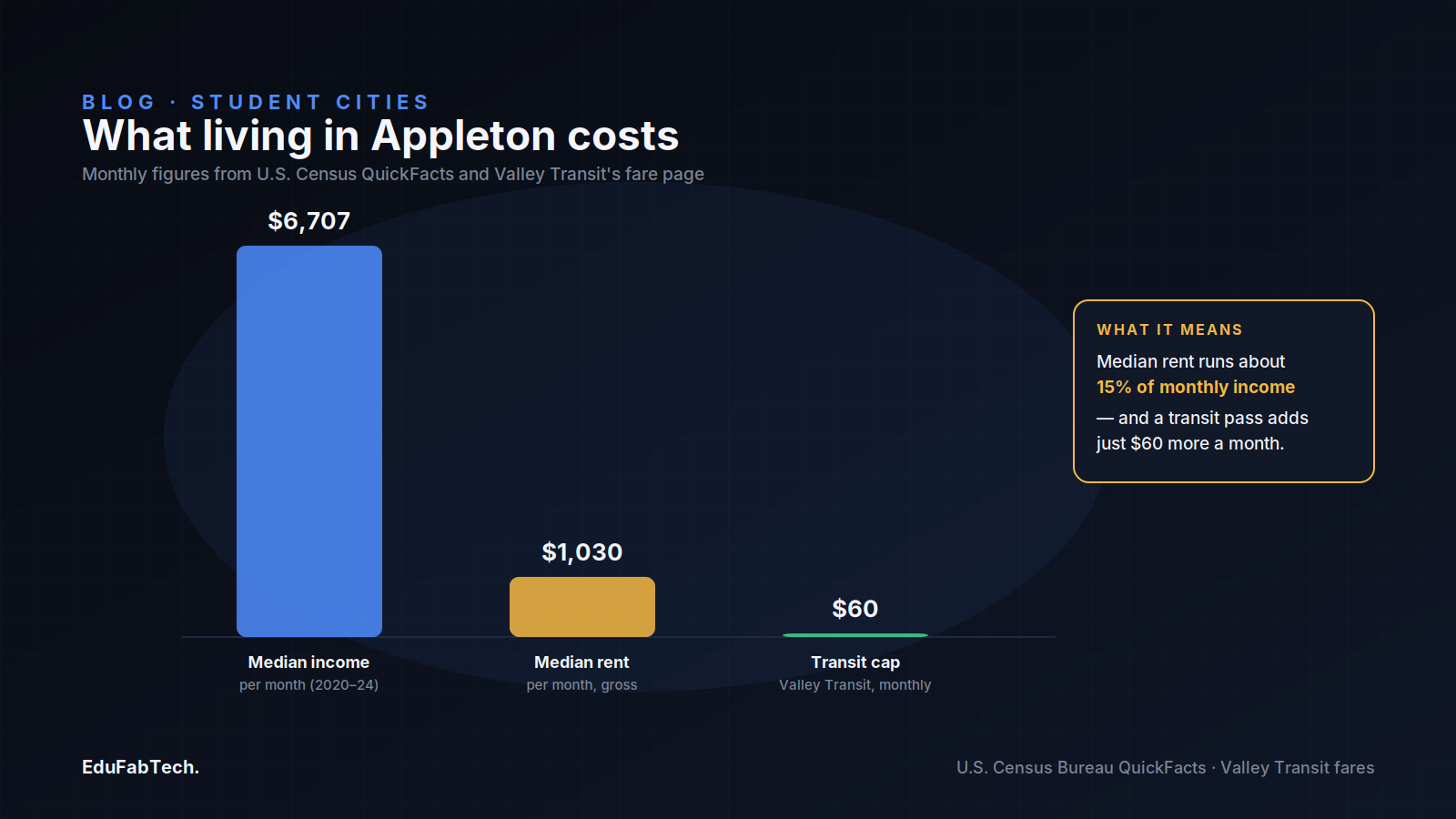
The off-campus market in Appleton matters more to graduate-age students, transfers, people commuting to UW Oshkosh or a technical college, and the small number of Lawrence students with an approved exemption. The rentable stock clusters in the older neighbourhoods on either side of College Avenue and north toward the hospital district; the U.S. Census Bureau's QuickFacts for Appleton put the city's median gross rent at $1,030 a month over the 2020–2024 period, with a median household income of $80,483, which gives a rough sense of what a modest one-bedroom costs relative to local wages.
Because Appleton has no large purpose-built student-letting sector, most off-campus listings here are ordinary apartments and shared houses advertised to the general public. Rental scams in a market like this usually take the same shape: a too-cheap listing, a "landlord" who says they are out of state or travelling and cannot show the unit, and pressure to send a deposit to hold it. Insist on seeing the actual apartment in person — or having someone you trust see it — before you pay anything, and expect a normal first-month-plus-security-deposit arrangement rather than several months up front. Never send money by bank wire, gift card or cryptocurrency to reserve a room; a genuine Appleton landlord will take a cheque or a standard transfer after you have signed a lease and seen the place. EduFabTech keeps local listings on its Appleton rooms page, with near-campus listings around Lawrence University.
Furnishing a room and the Saturday market
Furnishing a first apartment cheaply is straightforward here because Appleton has a dense second-hand economy. The city supports several established thrift operations, including Goodwill and the St. Vincent de Paul Society of Appleton's store on West College Avenue, which carry the usual mix of clothing, kitchen kit and furniture that turns over quickly at the start and end of each academic year.
The city's signature market is the Downtown Appleton Farm Market, run by Appleton Downtown Inc. Its event page lists more than 130 vendors along College Avenue on Saturdays, 8 a.m. to 12:30 p.m., running from 12 June to 16 October in 2027 — produce, baked goods, cheese and prepared food rather than furniture, but it is the easiest way to stock a cheap kitchen and to see downtown at its liveliest. For the bulkier things — a desk, a bed frame, a bookshelf — it is usually cheaper to buy locally second-hand than to ship or buy new; EduFabTech lists these on its second-hand page.
Working part-time while you study
Domestic students work the ordinary mix of campus and city jobs — dining halls, the library, downtown cafés and shops. International students face stricter limits that depend on visa status, and the rules are set federally, not locally. The U.S. Department of Homeland Security's Study in the States service explains on its Working in the United States page that F-1 students may apply for on-campus employment, that they may not work more than 20 hours per week when school is in session, and that they should talk to their Designated School Official (DSO) before starting — the DSO issues a letter of approval. This is a summary, not legal advice: confirm your own situation with your school's international-student office and the official DHS page before you take any job, because off-campus work (such as CPT or OPT) carries separate conditions. Local openings are collected on EduFabTech's Appleton jobs page.
Libraries and quiet places to work
Lawrence students work mainly in the Seeley G. Mudd Library on campus, whose collections page lists more than 350,000 books and periodicals, 23,000 musical scores, 14,000 audio recordings and 11,000 video recordings — the music holdings reflecting the Conservatory. The library's hours page shows long term-time opening, from 8 a.m. to midnight Monday through Thursday, with shorter hours at weekends and over breaks.
Off campus, the Appleton Public Library at 200 N. Appleton Street is the obvious free alternative, and a recently renovated one: the Community Foundation for the Fox Valley Region reported that the library reopened on 15 February 2025 after a $40.4 million renovation that added co-working areas, creation studios and meeting rooms. It is a short walk from the western end of College Avenue and open to everyone, which matters for commuter and technical-college students who have no campus library nearby. More desks and bookable rooms around the city are listed on EduFabTech's study-spaces page.
Getting around the Fox Cities
Public transport across the Fox Cities is run by Valley Transit, with its hub at the Appleton Transit Center downtown. Fares are paid by the regional WisGo reloadable card or the Umo mobility app; Valley Transit's fare page lists an adult regular fare of $2.50 per ride, with daily spending capped at $4 and monthly at $60, and notes that from 1 January 2026 cash riders must pay the exact fare each time with no capping benefit. The same page states that Lawrence University has partnered with Valley Transit so that current Lawrence students ride free, arranged through the university's Office of Student Engagement, Activities, and Leadership in the Warch Campus Center — a genuine saving worth setting up in your first week if you are a Lawrence student.
That said, Appleton is a car-oriented city, and bus frequencies and evening or Sunday service are limited compared with a large metro. Downtown and the Lawrence campus are comfortably walkable; reaching Oshkosh, Green Bay or the big-box retail on the west side realistically means a car, a lift or careful timetable-reading. Appleton International Airport (ATW), west of the city in Greenville, handles the region's flights.
What a year actually costs
At Lawrence, the headline numbers are high and bundled. Its tuition and fees page gives, for the 2026–2027 academic year, tuition of $61,407, housing of $7,047 and a meal plan of $6,792, for a total comprehensive fee of $75,558; the same page estimates a further $750 for books, $750 for transport and $1,200 for personal expenses. Financial aid changes what students actually pay, but the sticker figures are what you plan against.
| Lawrence University, 2026–2027 | Per year (USD) |
|---|---|
| Tuition | $61,407 |
| Housing (double room) | $7,047 |
| Meal plan | $6,792 |
| Comprehensive fee (total) | $75,558 |
For students living off campus — at a technical college, commuting to UW Oshkosh, or in graduate housing — the number that dominates is rent. Set against the Census Bureau's $1,030 median gross rent for Appleton over 2020–2024, a shared house splits the cost further, which is why the second-hand and shared-living routes above make a real difference to a student budget in this city.
The honest trade-offs
Appleton's strengths for a student are real. It is small, walkable at its core, and safe-feeling, with a genuine downtown — theatres, the Saturday market, independent cafés — rather than a dead main street. Rents are moderate by national standards, and Lawrence's live-on campus is tightly knit precisely because almost everyone stays in it.
The hard parts are the flip side of the same facts. Choice is limited: one small private university in town, with the larger public and technical options spread across other cities and reachable mainly by car. The winters are long and genuinely cold, which shapes months of the year. Nightlife and the wider student scene are modest for anyone used to a big university city, and Lawrence's four-year residency rule means the off-campus student culture that defines many college towns barely exists here. For a self-directed student who values a quiet, affordable, close-knit place, that is a feature; for someone who wants a sprawling campus and abundant off-campus housing, Appleton will feel small.
First weeks: a short checklist
- If you are at Lawrence, set up your free Valley Transit access through the Office of Student Engagement, Activities, and Leadership before you need it.
- If you are renting off campus, never pay a deposit before seeing the unit in person, and never pay by wire, gift card or cryptocurrency.
- Get a WisGo card or the Umo app early, and note the 1 January 2026 change requiring exact cash fares.
- International students: confirm your work limits with your DSO and the DHS Study in the States page before accepting any job.
- Register at the Appleton Public Library on Appleton Street for a free study space and borrowing off campus.
- Furnish from local thrift and second-hand listings rather than buying new or shipping.
- Browse all local listings — rooms, work, study spaces and events — on EduFabTech's Appleton page.
A quick question for readers
Do you work part-time while you study?
Many students work to pay the bills. See how common it is — and how many hours people really do.
Pick an answer, create a free account in a minute, and your vote counts. Already a member? Sign in
Comments 0
CommentNo comments yet. Members start the conversation.
Source: Lawrence University
Sources (5)
- Lawrence University. Tuition & Fees 2026–2027. Lawrence University, 2026. lawrence.edu ↗ · checked 24 Oct 2026
- U.S. Census Bureau. QuickFacts: Appleton city, Wisconsin. U.S. Census Bureau, 2025. census.gov ↗ · checked 24 Oct 2026
- Valley Transit. Fare Information. City of Appleton, Valley Transit, 2026. myvalleytransit.com ↗ · checked 24 Oct 2026
- U.S. Department of Homeland Security. Working in the United States. Study in the States, DHS, 2026. studyinthestates.dhs.gov ↗ · checked 24 Oct 2026
- Northeast Wisconsin Technical College. About the College. NWTC, 2025. nwtc.edu ↗ · checked 24 Oct 2026