Studying in Athens, United States: universities, housing and student life
A sourced, practical guide to the University of Georgia town — its campuses, neighbourhoods, dorm and rent costs, fare-free buses, work rules and study spaces.
A town the university grew into
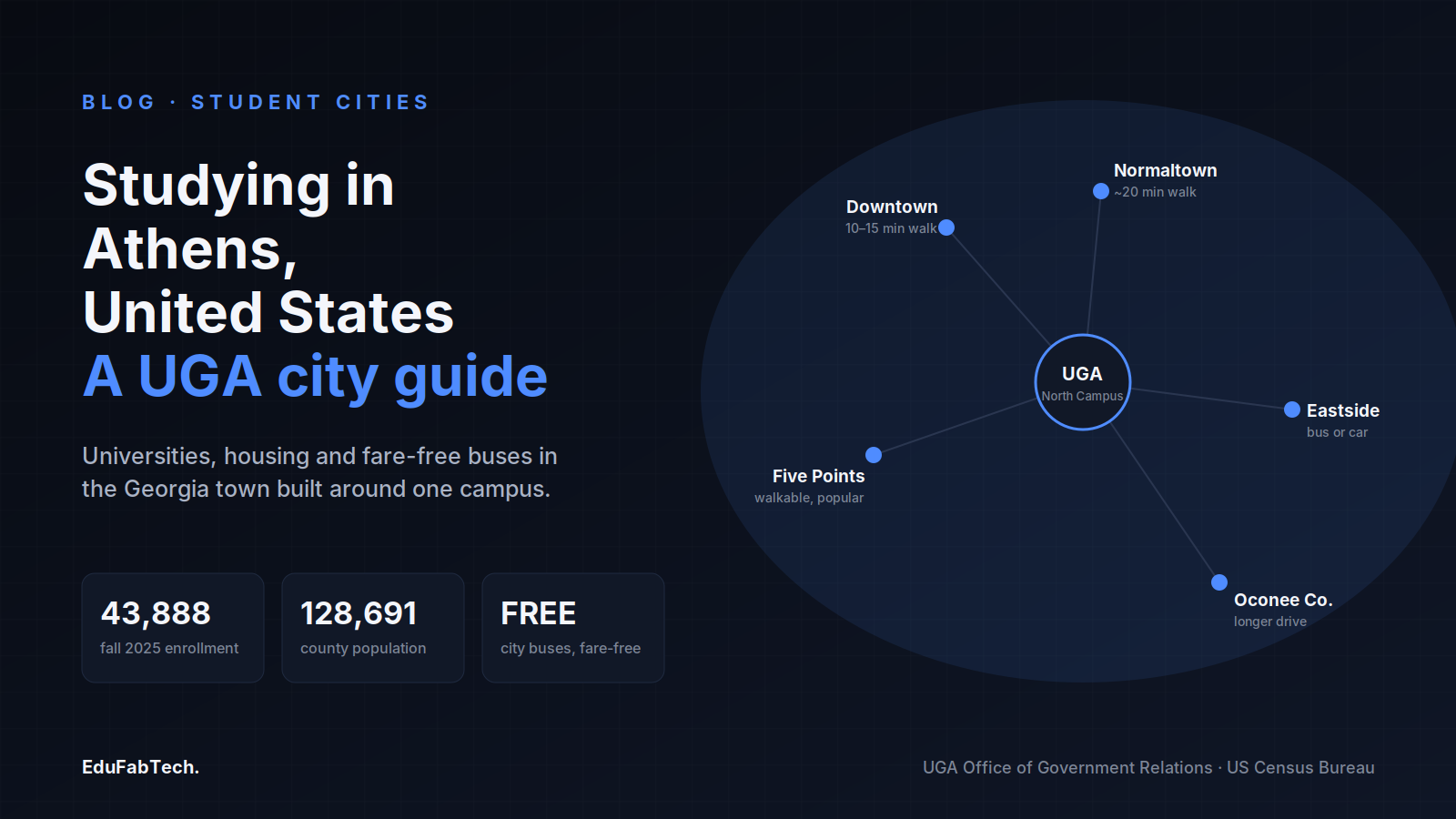
Athens sits in the rolling Piedmont of northeast Georgia, roughly 60 miles from Atlanta, and it is about as close to a single-institution town as a city of its size gets. The University of Georgia was chartered in 1785, and the university calls itself the birthplace of public higher education in the United States (alumni.uga.edu). Its oldest buildings and the famous Arch stand on North Campus at the edge of downtown, so the line between "campus" and "city" is blurry in a way it is not in most college towns — you can walk from a lecture hall to a coffee shop to a music venue without leaving a few blocks.
The scale matters for anyone moving here. UGA reported total enrollment of 43,888 for fall 2025, up 1.7% on the previous year, with Georgians making up 83% of all undergraduates, according to its Office of Government Relations (govt.relations.uga.edu). A student body that large, concentrated in a compact city, is what sets the rhythm of Athens: football Saturdays empty the library and fill the streets, and August is when rooms, buses and grocery queues are at their most crowded.
Athens is not a big city by national standards. The U.S. Census Bureau's QuickFacts put the population of the Athens-Clarke County unified government (balance) at 128,691 as of July 2024, with a median household income of $52,974 in 2020-2024 dollars (census.gov). Those low income figures partly reflect how many residents are students; they also mean rents, while rising, are below what you would pay in Atlanta. You can see the full spread of current student listings for the city on EduFabTech's Athens page.
The University of Georgia, its colleges, and the technical college
Most undergraduate teaching in the arts, humanities, mathematics and natural sciences runs through the Franklin College of Arts and Sciences, UGA's oldest and largest academic unit, whose home is the historic North Campus quad around Old College and the Chapel. Business students who specialise in accounting pass through the J. M. Tull School of Accounting, housed within the Terry College of Business; those drawn to government, diplomacy or policy enrol in the University of Georgia School of Public and International Affairs, which also sits on North Campus.
UGA is deliberately broad. The University of Georgia College of Public Health trains epidemiologists, health-policy and environmental-health students; the University of Georgia College of Environment & Design is known for landscape architecture and historic preservation; and the Daniel B. Warnell School of Forestry and Natural Resources grants degrees in forestry, wildlife, fisheries and natural-resource management, using the surrounding Georgia forests as a working classroom. Graduate students across all of these are admitted and administered through the University of Georgia Graduate School. If you are weighing where to live relative to classes, listings close to the main campus are gathered on EduFabTech's University of Georgia page.
Athens has a second degree-granting institution that students sometimes overlook: Athens Technical College, a public two-year college in the Technical College System of Georgia that offers certificates, diplomas and associate degrees in fields such as nursing, early childhood education and the engineering technologies (athenstech.edu). It serves many local and returning students and transfers into four-year programmes, and it is a realistic, lower-cost entry point into higher education in the area.
Where students settle
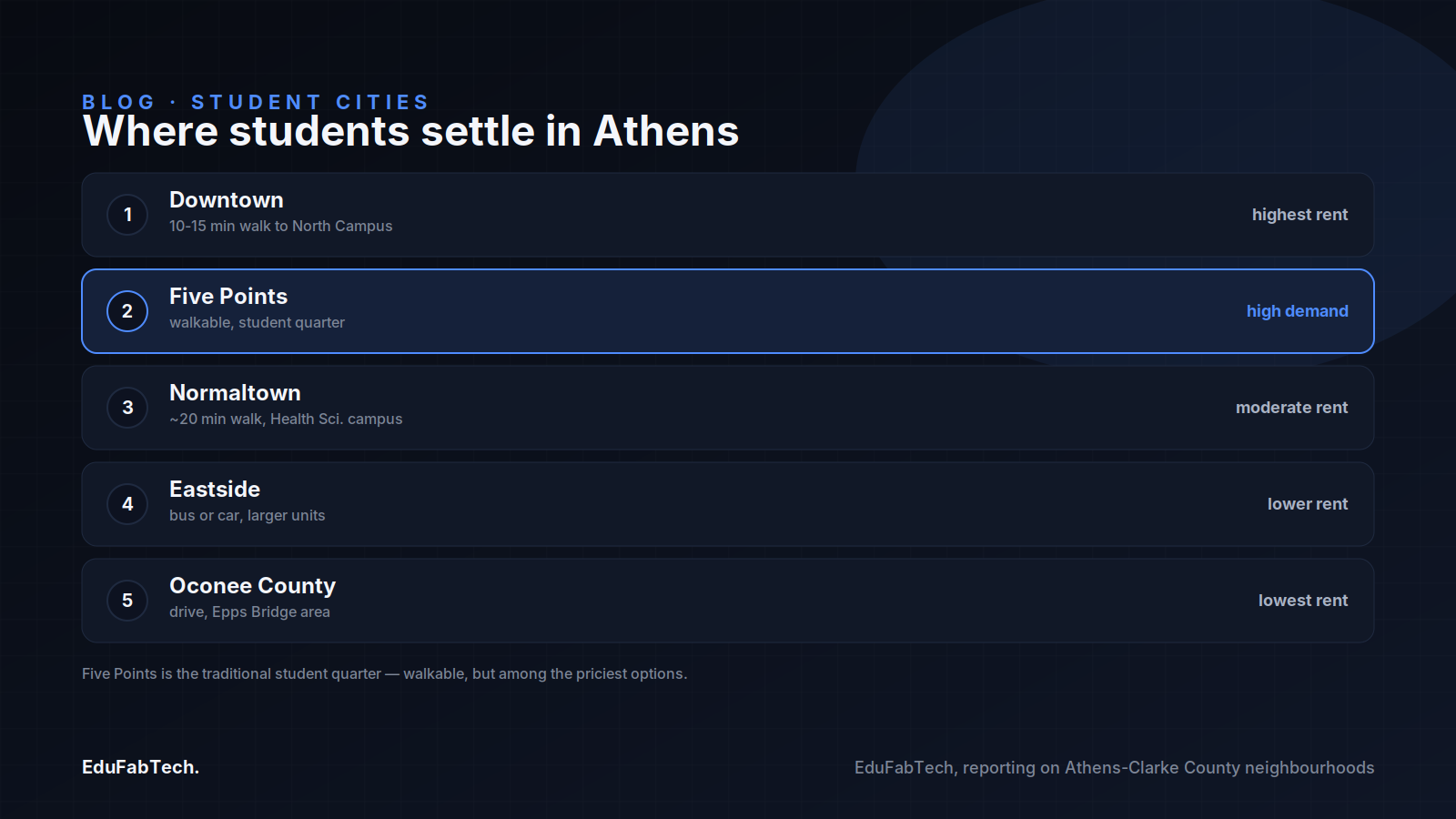
Downtown is the first choice for students who want to live inside the noise. It wraps directly around North Campus, so most of it is a ten-to-fifteen-minute walk to class, and the newer purpose-built towers along Broad, Clayton and Washington streets put you above the bars and venues that give Athens its music reputation. That convenience is the most expensive in town, and the trade-off is weekend noise that does not stop early.
Five Points, just southwest of campus along South Milledge and Lumpkin, is the traditional student quarter: fraternity and sorority houses, older divided homes, small apartment blocks and a walkable village of cafés and shops. It is calmer than downtown and still within walking or short cycling distance of the main campus, which keeps demand — and rents — high.
Normaltown, centred on Prince Avenue a little north of downtown, is the artsy, low-rise neighbourhood favoured by graduate students and anyone who wants independent cafés and murals over nightlife. It grew up around the old State Normal School, the teacher-training institution whose grounds are now UGA's Health Sciences Campus — so if your programme is based there, Normaltown is the natural place to look, with a mix of houses and smaller buildings and roughly a twenty-minute walk to central campus.
Eastside trades walkability for space and lower rents. Apartments here are larger and quieter and the area is well served by buses, but almost nothing is walkable, so you will plan errands around a bus timetable or a car. Many students on tighter budgets accept that commute. Beyond the county line, the Oconee County suburbs south of town (around Epps Bridge) draw students who prioritise newer, cheaper flats and don't mind a longer drive. Closer in, the Baxter Street corridor between downtown and Five Points is a dense band of older student apartment complexes that are among the cheapest places still within walking range of campus.
Renting in Athens without losing a deposit
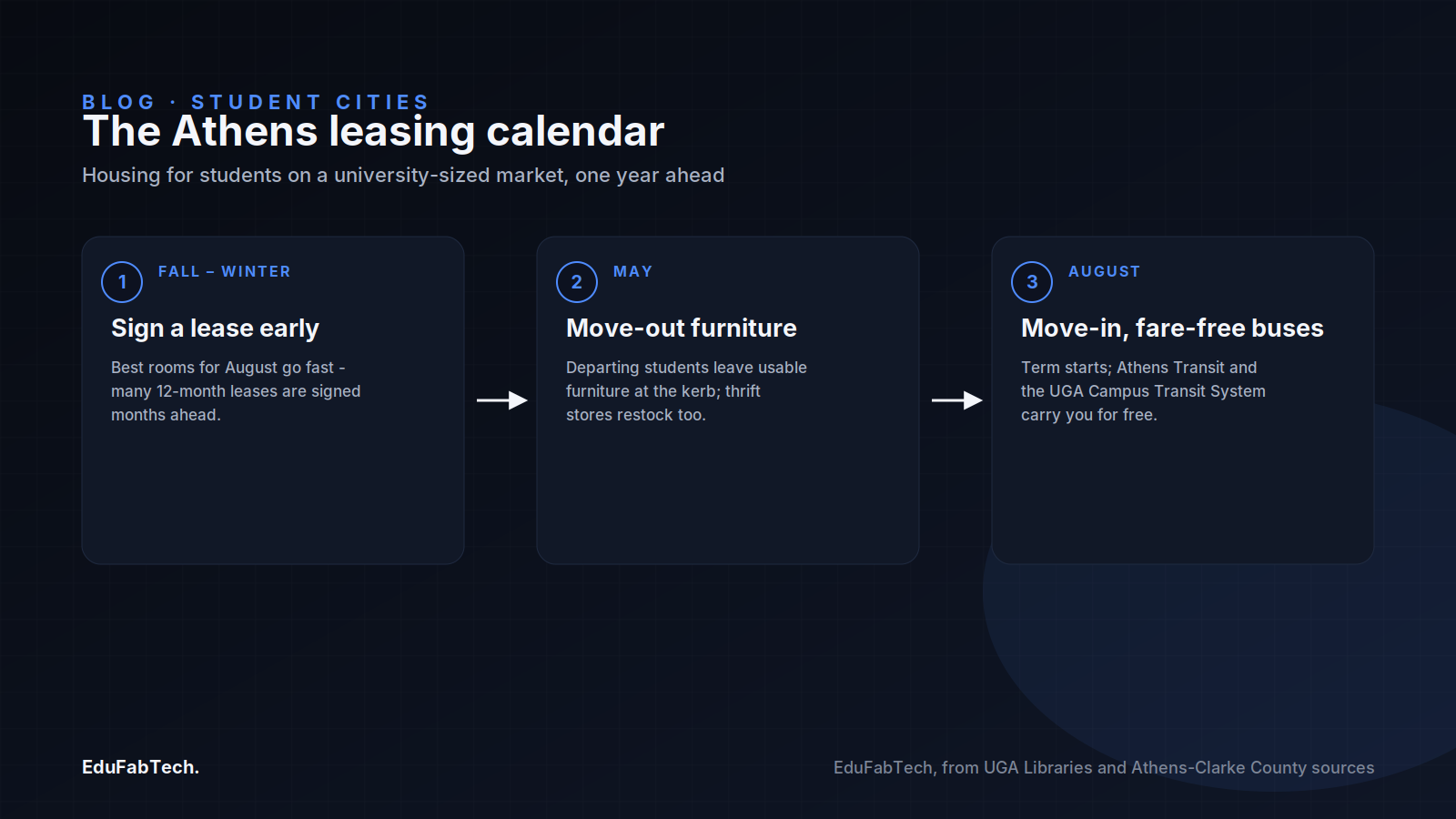
Athens runs on an unusually early leasing cycle. Because the student population is so large relative to the housing stock, the best rooms for an August move-in are often signed the previous autumn or winter, and many private leases run a full twelve months rather than for the academic year. Start looking early, and read whether a lease is "individual" (you are responsible only for your own room) or "joint" (everyone is liable for the whole rent) before you sign anything. You can browse rooms and sublets for the city on EduFabTech's Athens rooms page.
The scams that appear in Athens are the ordinary ones, amplified by the August rush: listings that copy real photos of a Five Points house or a downtown unit and advertise it well under the going rate, a "landlord" who is conveniently out of state during football season, and pressure to pay a holding deposit before you have seen the place. See the unit in person, or have someone you trust see it, before any money changes hands, and confirm the person showing it actually controls it. A security deposit of about one month's rent is normal here; never wire a deposit by bank transfer, and never pay with gift cards or cryptocurrency to "hold" a room — no legitimate Athens landlord asks for that.
Furnishing a room for almost nothing
Athens recycles its student furniture constantly, because thousands of people move out every spring. The non-profit Project Safe Thrift Store on Hawthorne Avenue carries furniture, clothing and household goods and funds local domestic-violence services; the Athens Habitat for Humanity ReStore is the place for cheap desks, shelving and kitchen items; and the Goodwill store on the east side handles the steady flow of donated basics. For a weekend outing, J&J Flea Market on Commerce Road, one of Georgia's largest, runs year-round with hundreds of vendors selling furniture, tools and household odds and ends (jandjfleamarket.com). Move-out week in May, when departing students leave usable furniture at the kerb, is its own informal market. EduFabTech lists local second-hand goods and things being given away free in the city, so check those before buying anything new.
Libraries and places to study
The centre of undergraduate study life is the Miller Learning Center (the MLC) on central campus, which the libraries describe as holding hundreds of computers alongside group study rooms; during fall and spring it stays open around the clock Monday through Thursday, with access limited to those holding a UGA or other college ID after 9 p.m. (libs.uga.edu). The Main Library on North Campus runs long hours into the early morning on weeknights and is the quieter choice for deep work, while the McBay Science Library serves the sciences; both restrict their study spaces to UGA ID holders after 6 p.m. (libs.uga.edu). Beyond campus, coffee shops in Normaltown and Five Points fill with laptops once the libraries move to their ID-only evening hours.
Getting around: buses, bikes and the parking problem
Transport is one of the genuinely easy things about Athens. The city bus network, Athens-Clarke County Transit, is currently fare-free for all riders (accgov.com), running Monday to Friday from 6 a.m. to 9:45 p.m. with reduced weekend service (accgov.com). On top of that, the UGA Campus Transit System carries students around campus and out to nearby student apartments and park-and-ride lots at no fare, funded through the student transportation fee. Between the two, a student living anywhere near a route can get to class without a car or a ticket. The hard part is driving: campus parking is limited and permit-controlled, so most students who bring a car still end up walking, cycling or taking the bus for daily trips.
Work, visas and what it actually costs
International students on an F-1 visa should treat the university's own immigration office as the authority on what they may do. UGA's Office of Global Engagement states that on-campus employment does not require prior permission but is limited to 20 hours per week or less while enrolled full-time, with longer hours allowed only during official breaks, and it describes the separate Curricular Practical Training and Optional Practical Training routes for off-campus work (globalengagement.uga.edu). Rules change and individual cases differ, so confirm anything employment-related with that office before you act — this is not legal advice. Local and domestic students face no such cap; part-time openings on and off campus are collected on EduFabTech's Athens jobs page.
On costs, the most reliable published figure is the university's own. For 2026-27, University Housing lists Myers Hall, a traditional residence hall, at $3,853 per term for a double with a community bath, rising to $4,661 for a single in a suite (housing.uga.edu); those are per-resident, per-semester rates for fall or spring. Off campus, the Census Bureau's QuickFacts put the median gross rent across Athens-Clarke County at $1,219 a month for 2020-2024 (census.gov) — a county-wide figure that includes family housing, so student rents split among roommates often fall below it while new downtown units sit well above.
What is good, what is hard, and a first-weeks checklist
What Athens does well for students is concentration and cost control: a compact, walkable centre built around campus, a music and food culture that is unusually strong for a city this size, free local and campus buses, and a dense second-hand economy that makes setting up cheap. What is hard is the August squeeze — a large student intake chasing a limited housing stock on an early leasing calendar — along with humid, hot summers that stretch into the start of term, weekend noise near campus and downtown, and a layout that quietly assumes a car once you move to Eastside or the Oconee suburbs. None of it is a surprise if you plan for it.
- Sort a bus route before a parking permit: check whether your address is on an Athens-Clarke County Transit or UGA Campus Transit line first.
- See any room in person before paying, confirm who controls it, and keep the deposit to about one month's rent — paid by a traceable method, never by wire, gift card or crypto.
- If you are on an F-1 visa, meet UGA's Office of Global Engagement early and keep your on-campus hours within the 20-per-week limit.
- Furnish from Project Safe, the Habitat ReStore, Goodwill and J&J Flea Market — and watch the kerbs in May.
- Learn the MLC, Main Library and McBay hours in your first week, and note when ID-only access begins in the evening.
- Budget against the real numbers: UGA's 2026-27 hall rates and the county's median rent, not a landlord's best-case quote.
A quick question for readers
Rate these parts of student life this term
Rate each one from 1 (very poor) to 5 (very good). Together the results show where students struggle most.
Rate 5 things →Comments 0
CommentNo comments yet. Members start the conversation.
Source: University of Georgia
Sources (5)
- University of Georgia Office of Government Relations. UGA enrolls record number of Georgians. University of Georgia, 2025. govt.relations.uga.edu ↗ · checked 9 Oct 2026
- University Housing. Myers Hall room rates 2026-27. University of Georgia, 2026. housing.uga.edu ↗ · checked 9 Oct 2026
- Athens-Clarke County Unified Government. Fare-free Transit. Athens-Clarke County, 2026. accgov.com ↗ · checked 9 Oct 2026
- U.S. Census Bureau. QuickFacts: Athens-Clarke County unified government (balance), Georgia. U.S. Census Bureau, 2024. census.gov ↗ · checked 9 Oct 2026
- UGA Office of Global Engagement. Employment for international students. University of Georgia, 2024. globalengagement.uga.edu ↗ · checked 9 Oct 2026