Studying in Atlanta: universities, housing and student life
A practical, sourced guide to Atlanta's campuses, neighbourhoods, rents, transit and second-hand markets for students arriving local or from abroad.
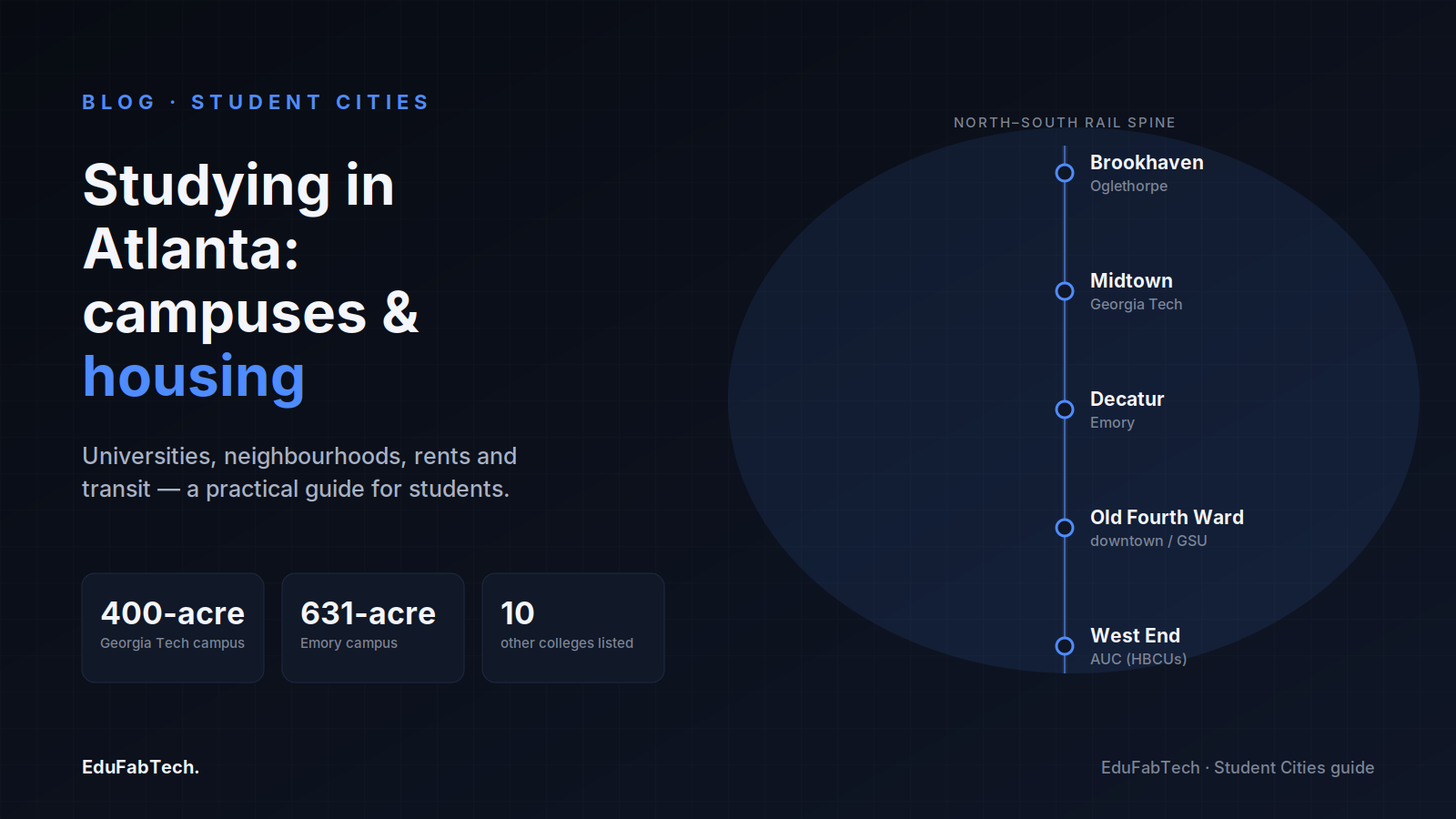
Atlanta sprawls across the rolling, tree-covered hills of north-central Georgia, and the first thing most students learn about it is that it is not one place but many, stitched together by interstates and a single north–south rail spine. The campuses sit scattered from Midtown out to the southern suburbs, and where you study shapes where you live, how long you commute, and how much you pay far more than it would in a compact city.
The character is distinctive. Atlanta is a centre of Black American culture and higher education, a music and film production hub, and a place whose civil-rights history is woven into the streets around downtown. It is also humid and green: summers are long, hot and sticky, winters are mild, and spring brings a famous coat of yellow tree pollen. Students come from every corner of the state, the country and many nations beyond it.
Practically, this is a car-shaped city with a rail system bolted on. You can live here well without a car if you choose your neighbourhood against your campus, but the choice matters a great deal. The sections below walk through the universities, where people actually live, how to find a room without being cheated, what things cost with sources attached, and the honest good and bad of the place.
The universities, and what it is like to study here
Georgia Tech anchors Midtown on a dense, roughly 400-acre campus and is a public research university best known for engineering and computing; its colleges span engineering, computing, design, sciences, business and liberal arts. Two of its named units turn up often in student life and in this city's industries: the Georgia Institute of Technology - Daniel Guggenheim School of Aerospace Engineering, one of the country's older aerospace programmes, and the Georgia Institute of Technology College of Architecture, which was renamed the College of Design in 2016. Studying at Tech means a demanding, project-heavy workload and immediate access to Midtown's research and internship economy.
Emory University sits on a leafy 631-acre campus in the Druid Hills area, officially in North Decatur, and is a private research university known for medicine, public health, law and the liberal arts. It sits in the Clifton Corridor, a dense cluster of federal public-health research facilities and teaching hospitals, a proximity that shapes its biomedical research. Its business school houses the Emory Center for Alternative Investments, a research centre focused on private capital markets. The feel is quieter and more residential than the intown campuses.
Georgia State University is woven into the fabric of downtown rather than walled off from it — its buildings share blocks with offices and transit, and it is one of the largest universities in the state by enrolment, drawing a notably diverse, commuter-heavy student body. If Tech is a campus in a city, Georgia State is a university that uses the city as its campus.
Southwest of downtown is the Atlanta University Center, the oldest and largest grouping of historically Black colleges and universities in the country. Clark Atlanta University is its largest member, formed in 1988 when the graduate-focused Atlanta University (founded 1865) merged with Clark College. Morehouse College and Spelman College are part of the same contiguous consortium, and students can cross-register between institutions — a rare arrangement that widens what any one campus offers. Oglethorpe University, a small private liberal-arts college on a wooded, Gothic-revival campus in Brookhaven, rounds out the better-known intown options.
Other universities and colleges around Atlanta
- Clayton State University — a public university south of the city near Morrow and Lake City, serving a largely commuter population.
- Southern Polytechnic State University — formerly an independent technology university in Marietta; it merged into Kennesaw State University in 2015, and its site is now the Marietta Campus, home to a large engineering college.
- Life University — a private health-sciences university in the Marietta/Fair Oaks area, known as the largest single-campus chiropractic college in the world.
- Georgia Piedmont Technical College — a public technical college with its main campus in Clarkston, DeKalb County, offering career and transfer programmes at low cost.
- Luther Rice University — a private Christian college and seminary in the Stonecrest/Lithonia area, east of the city.
- DeVry University Decatur Campus — a campus of the for-profit DeVry University in Decatur.
- Laurus Technical Institute — a small career and technical school in the Mableton area.
- Georgia Military Institute — a nineteenth-century military academy in the Marietta area that did not survive the Civil War; it is of historical interest only.
- Lanier University — a short-lived intown institution of the late 1910s and early 1920s that no longer exists.
- University of Atlanta — a for-profit, distance-education institution listed in Doraville that closed in 2013.
In short, the metro holds everything from a global research powerhouse to neighbourhood technical colleges, and your day-to-day experience depends far more on which of these you attend than on any city-wide average. You can browse all student listings across Atlanta on EduFabTech once you know your campus.
Where students actually live
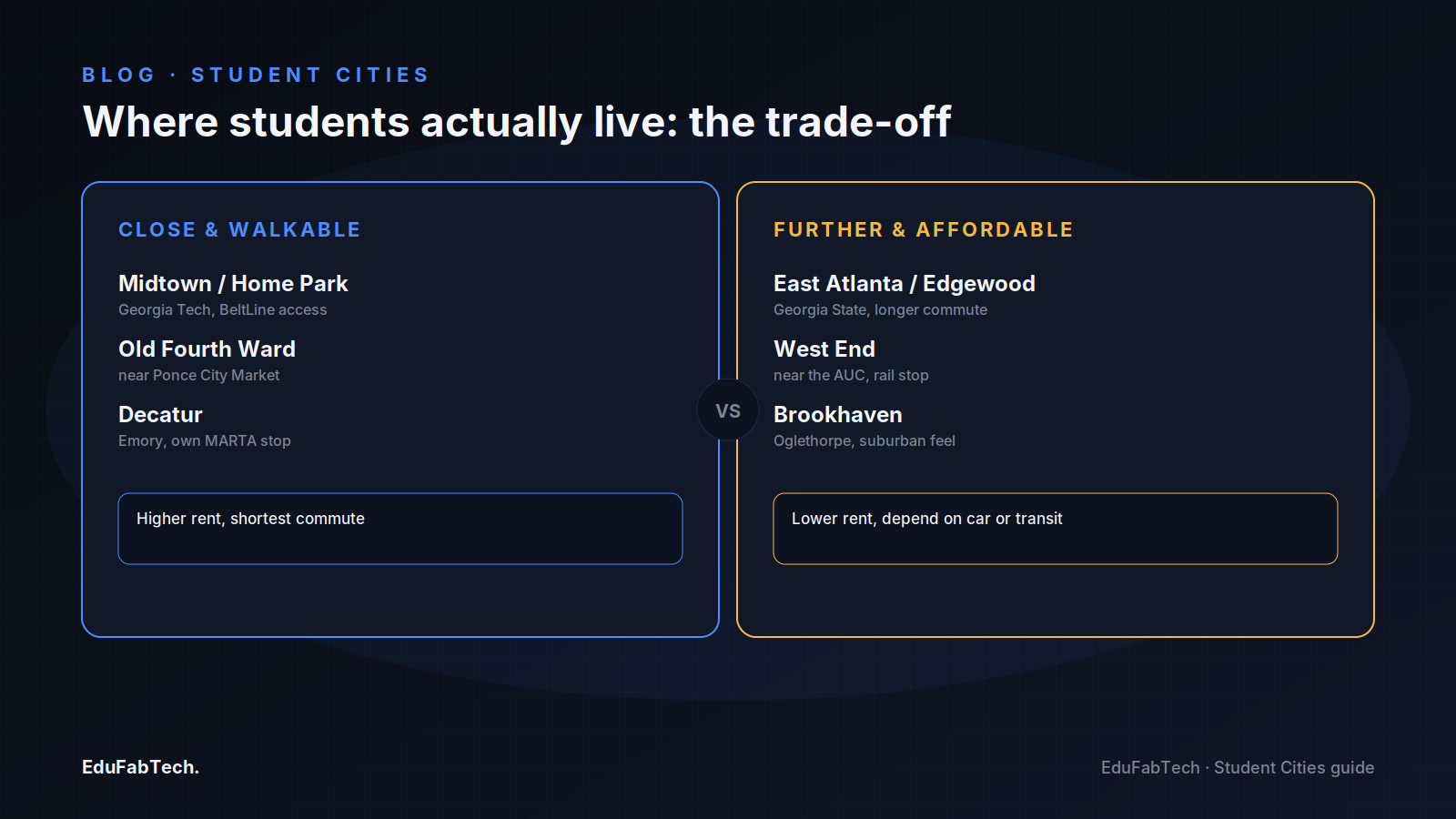
Midtown is the obvious first choice for Georgia Tech students: walkable, dense, full of apartments, cafés and the BeltLine's eastside trail nearby, but among the pricier intown areas. Home Park, the older residential grid just northwest of Tech, is the traditional student-rental pocket — houses split among roommates, a short walk or bus ride to campus, cheaper than Midtown proper.
Old Fourth Ward, east of downtown, is trendy and central, with the BeltLine and Ponce City Market on its doorstep; rents have climbed with its popularity. Decatur, a separate small city to the east, is leafy, safe-feeling and well-liked by Emory and graduate students, with its own downtown square and a MARTA rail stop — convenient but not cheap.
East Atlanta and the adjoining Edgewood and Kirkwood neighbourhoods are younger, more eclectic and generally more affordable, a mix of old bungalows and newer flats popular with Georgia State students willing to trade a longer commute for lower rent. The West End, close to the Atlanta University Center, is a historically Black neighbourhood with a rail stop, lower rents and ongoing change; it is the natural base for AUC students. For the quieter, suburban feel, Brookhaven suits Oglethorpe students, sitting on the rail line with easy reach into the city.
Across all of them, the trade-off is constant: the closer and more walkable the area, the higher the rent; the further out, the more you depend on a car or a long transit ride.
Finding a room — and not losing money to a scam
Typical student housing runs from purpose-built student apartments near the big campuses, to rooms in shared houses, to one-bedroom flats split with a partner. Start looking early: demand peaks in July and August before the autumn term, and the best shared houses near Tech and in Home Park go first. University housing offices and international-student offices are the safest starting points, and you can search rooms and places to stay in Atlanta on EduFabTech or listings near Emory University and near Georgia State University to compare areas before committing.
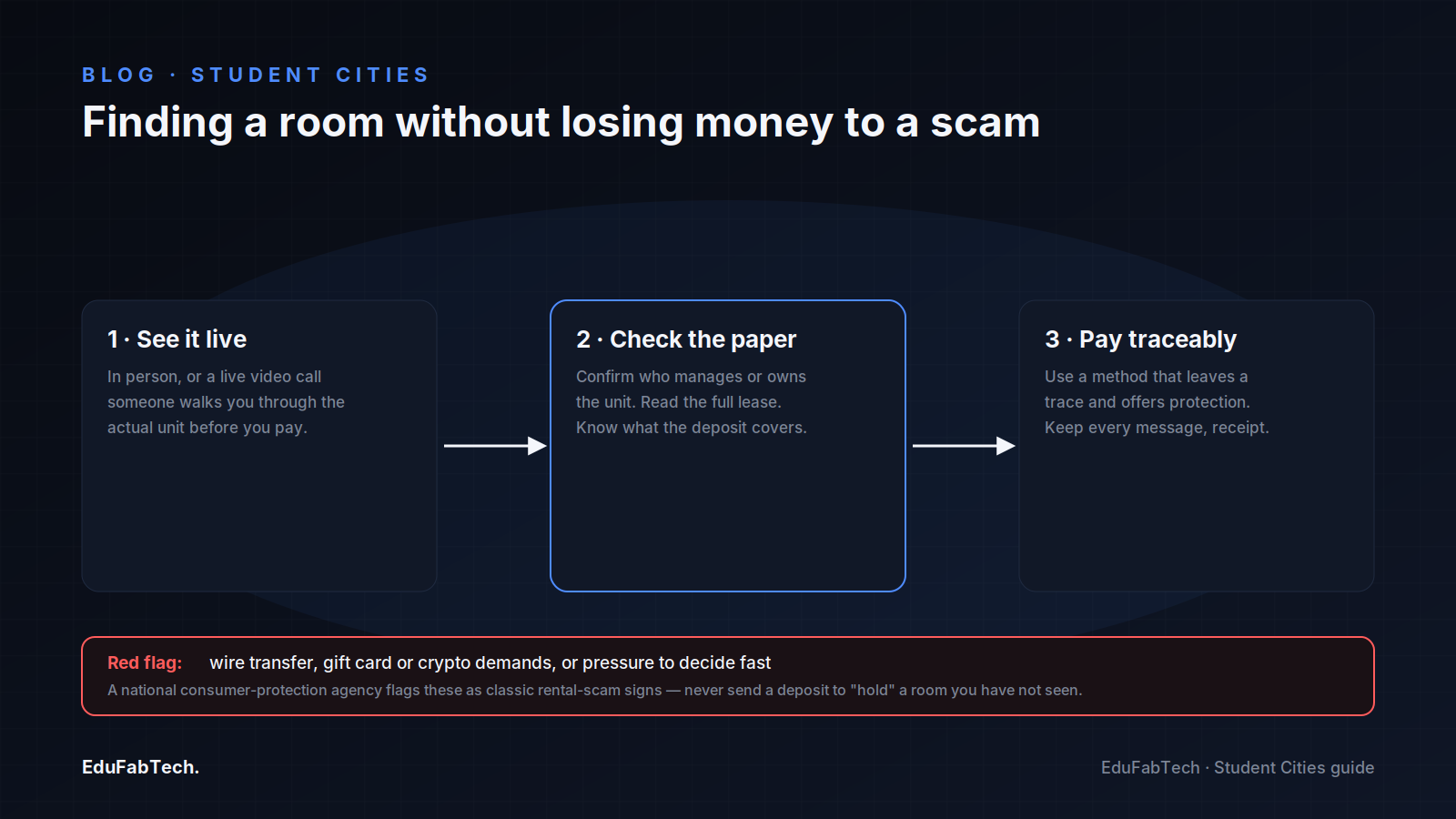
Before you pay anything, see the place — in person, or at the very least on a live video call where someone walks you through the actual unit. Check that the person showing it can prove they manage or own it, read the lease in full, and understand exactly what the deposit covers and when it is returned. A national consumer-protection agency warns that if anyone insists you can only pay by wire transfer, gift card or cryptocurrency, it is a scam, and that pressure to decide quickly is itself a red flag. Never send a deposit to "hold" a room you have not seen, and be especially wary of a "landlord" who claims to be out of the country and unable to show it. Pay by a method that leaves a trace and some protection, and keep every message and receipt.
Furnishing a room without overspending
Atlanta is good for second-hand furnishing if you know where to look. Scott Antique Markets, held on the second weekend of each month at the Atlanta Expo Centers on the south side, is one of the largest monthly antique and bric-a-brac shows in the region. For everyday furniture and kitchen kit, Goodwill and Habitat for Humanity ReStore outlets across the metro are reliable and cheap. For food and household basics, the sprawling Your DeKalb Farmers Market in Decatur and the Buford Highway Farmers Market up toward Doraville are vast international markets worth the trip, while the historic Sweet Auburn Curb Market downtown is handy for Georgia State students. Online, check EduFabTech's second-hand things in Atlanta page, where departing students often pass on furniture cheaply or free at the end of term.
Getting around: MARTA, the BeltLine and a car-shaped city
The region's rail and bus network, MARTA, is the backbone for students without cars. A single rail or bus trip costs $2.50 with up to four free transfers within three hours, and a 30-day pass is $95, according to the Metropolitan Atlanta Rapid Transit Authority (2026). Several universities negotiate discounts: Georgia State University's parking office (2026) lists a discounted monthly student MARTA pass at $61, and Georgia Tech's transportation office (2026) lists a student monthly pass at $50 — worth setting up before you buy full-price fares.
Rail is useful if your home and campus both sit near a station, but the network is limited for a city this size, so many students rely on buses, bikes and the BeltLine, a popular multi-use trail converted from old rail corridors that links several intown neighbourhoods. The honest caveat: outside the rail-and-BeltLine core, Atlanta is spread out and traffic is heavy, and a car becomes tempting the further out you live. The airport, on the far south side, is directly on the rail line — convenient for students arriving from abroad.
Libraries and places to study
Each major campus has its own library with long hours during term. The Robert W. Woodruff Library of the Atlanta University Center serves Clark Atlanta, Morehouse and Spelman students together and offers bookable group and individual study rooms, presentation-practice suites and media-editing space. Georgia State's and Georgia Tech's libraries sit at the heart of their campuses and add quiet floors and reservable rooms. Off campus, the county public library system has branches across the metro that anyone can use for free, and the city's many cafés double as informal study spots. EduFabTech also lists study spaces and desks in Atlanta if you want somewhere beyond your own campus.
Part-time work and what it costs
Rules on work depend on your status. International students on an F-1 visa generally may not work more than 20 hours per week when classes are in session, and on-campus work has its own conditions, while off-campus work is tightly restricted and needs authorisation — see the U.S. government's official guidance for international students and always confirm your own situation with your school's international-student office before accepting any job. This is general information, not legal advice.
On costs, treat city-wide figures as a backdrop, not a budget. The federal American Community Survey put the median monthly rent across metropolitan Atlanta at $1,563 for its 2019–2023 five-year estimates — a rise of more than 41% over the 2014–2018 period — as the Atlanta Journal-Constitution reported from that data. Student rents vary widely by neighbourhood and by how many roommates share a place, so the practical lever is location and sharing, not the headline number. Transit, as above, is modest if you use a pass; a car adds insurance, parking and fuel that quickly dwarf a transit pass.
The good and the hard
What is good: a genuine spread of institutions, from a major engineering and computing university to the oldest consortium of historically Black colleges in the country; a strong graduate-job market in technology, logistics, health and film; a deep Black cultural life, music scene and food culture; abundant green space; and, by the standards of other large American cities, still-reachable rents if you share and choose carefully.
What is hard: the city is physically spread out and built around driving, so commutes can be long and traffic is notorious; transit coverage is thinner than the metro's size warrants; rents have risen sharply and some intown neighbourhoods are gentrifying fast; summers are hot and humid and spring pollen is intense; and, as in any big city, safety varies block by block, so it pays to visit a neighbourhood at night before signing. None of these is a reason to stay away — but they are reasons to pick your neighbourhood with your campus and your tolerance for commuting firmly in mind.
Your first weeks: a short checklist
- Confirm your campus and pick two or three neighbourhoods that match it for commute and budget before you look at any room.
- Start the housing search early (July–August for autumn), using your university housing office and verified listings.
- See any room in person or on a live video walk-through before paying; never wire a deposit or pay by gift card or crypto to "hold" a place.
- Read the whole lease and know your deposit terms before signing.
- Set up a transit pass through your university if it offers a discount, and test your commute at rush hour.
- Furnish from second-hand markets, thrift stores and departing students rather than buying new.
- If you are an international student, confirm your work rules with your school's international-student office before taking any job.
- Find your study spots early — your campus library plus one backup off campus.
A quick question for readers
Do you work part-time while you study?
Many students work to pay the bills. See how common it is — and how many hours people really do.
Pick an answer, create a free account in a minute, and your vote counts. Already a member? Sign in
- Metropolitan Atlanta Rapid Transit Authority. Fares & Transfers. MARTA, 2026. link
- Federal Trade Commission. Rental Listing Scams. FTC Consumer Advice, 2024. link
- U.S. Department of Homeland Security. Working in the United States. Study in the States, U.S. Department of Homeland Security, 2026. link
- Georgia State University. Alternative Transportation (MARTA UPass). Georgia State University Parking & Transportation, 2026. link
- Georgia Institute of Technology. Public Transit — Commute Options. Georgia Tech Parking & Transportation Services, 2026. link
- Atlanta Journal-Constitution. Metro Atlanta rents rose as residents feel the squeeze, new census data shows. The Atlanta Journal-Constitution, 2024. link
- Georgia Institute of Technology. About Georgia Tech. Georgia Institute of Technology, 2026. link