Studying in Auburn, United States: universities, housing and student life
A practical, sourced guide to Auburn, Alabama for students — the universities, where to live, what campus rooms cost, how to get around, and the honest trade-offs.
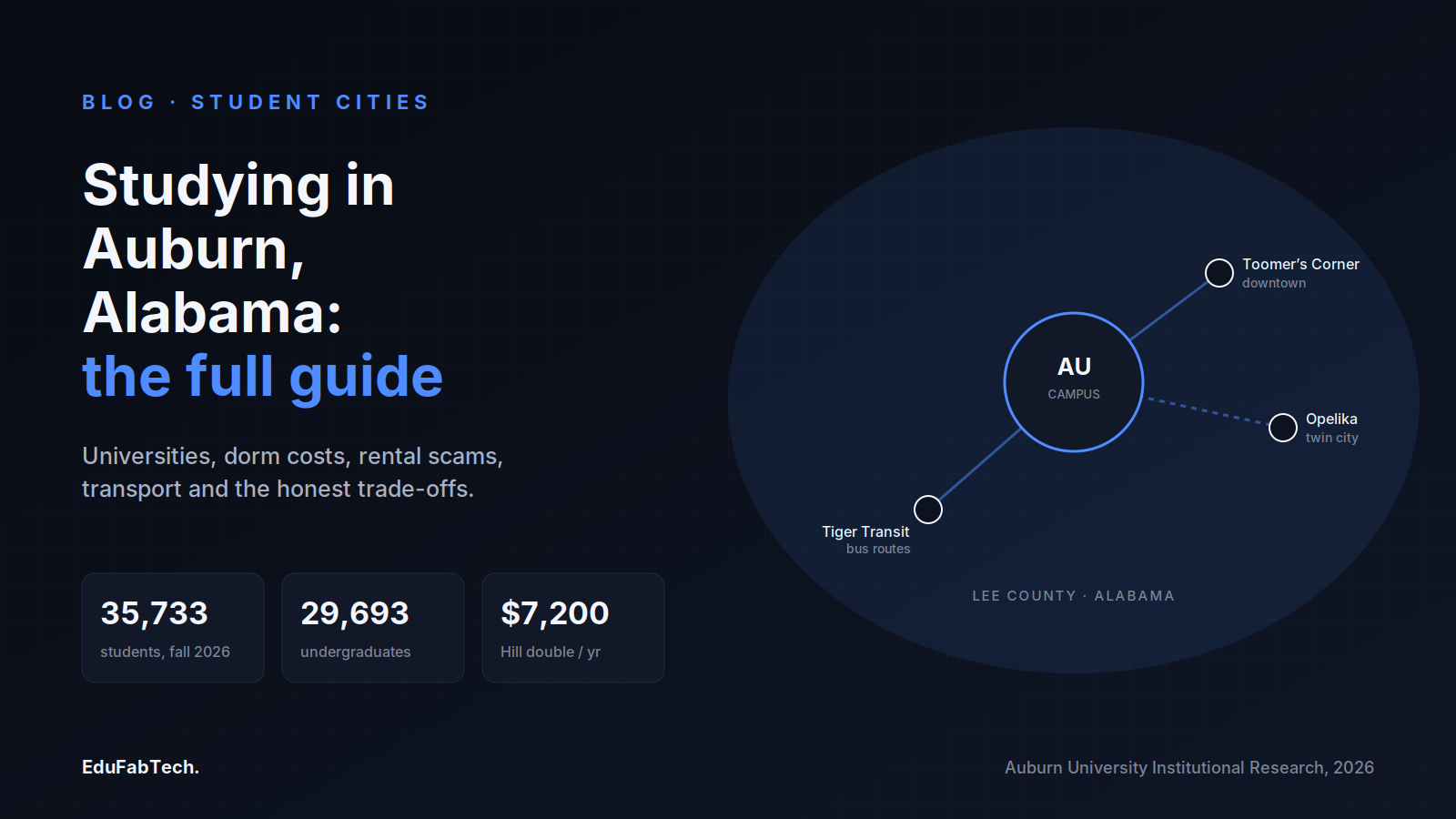
Auburn sits on a low rise of east-central Alabama that locals and the football crowd both call "the Plains." It is a university town in the fullest sense: the city of Auburn and the campus of Auburn University grew up together in Lee County, and the rhythm of the place still follows the academic calendar. Its twin city, Opelika, is a few minutes east along the old rail line, and the two share a single commuter fabric of shops, markets and bus routes. Montgomery, the state capital, is about an hour southwest; Atlanta is a couple of hours northeast across the Georgia line.
The student population is large for a town this size. Auburn University's Office of Institutional Research reported a record total enrollment of 35,733 students in autumn 2026, of whom 29,693 were undergraduates. In a city whose year-round population is a fraction of a big metro area, that means students are not a subculture here — during term they are a large share of everyone you pass downtown around College Street and Magnolia Avenue, at Toomer's Corner, and in the grocery queues.
This guide is for anyone weighing a move to Auburn to study — an Alabama resident, someone from another US state, or an international student arriving on a visa. It covers the universities, where students actually sleep, what a campus room costs this year, how to avoid rental trouble, where to furnish a room cheaply, the rules on part-time work, study spaces, transport, and an honest account of what the town does and does not do well.
The universities in and around Auburn
Auburn University is the anchor. It is a public land-grant research university founded in 1856, with its main campus spread over a compact, walkable core in the middle of the city. Auburn is classified in the top "very high research activity" tier of US doctoral universities, and it is best known for engineering, agriculture, architecture, business, and veterinary medicine — the professional and applied fields that grew out of its land-grant mission. The campus is dense enough that most undergraduates can walk between classes, the Ralph Brown Draughon Library and the student union, which shapes how housing and transport decisions play out below.
Tuskegee University lies west of Auburn in the town of Tuskegee, Macon County — close enough that prospective students in the area often consider both, far enough that it is a drive rather than a walk. Tuskegee is a private, historically Black land-grant university founded in 1881, with Booker T. Washington as its first principal, and it trained the aviators remembered as the Tuskegee Airmen. According to the university's own degree-programs page, it offers more than 60 academic programs across undergraduate and graduate levels, with recognised strengths in engineering, architecture, the agricultural and health sciences, and business, and it describes itself as the only historically Black college or university to offer ROTC programmes for all of the military branches, including the Space Force.
Two other names turn up on local maps. Point University is a small private Christian university whose residential campus is in West Point, Georgia — across the state line, north of Auburn, rather than in the city itself; its published history traces it to Atlanta Christian College, founded in 1937, which relocated its residential campus to West Point in 2012, and it grants associate, bachelor's and graduate degrees. The Auburn University Historic District is not a separate college but a protected area of older campus buildings and streets — worth a walk, not a place you enrol.
Where students live, and what a campus room costs
Auburn University's on-campus housing is organised into named residential communities rather than a single dormitory. The suite-style halls — The Hill and The Quad — put two students in a bedroom sharing a bathroom with a neighbouring room; the apartment-style communities — The Village and South Donahue, along with newer buildings such as The Union, 160 Ross and 191 College — give a private or shared bedroom with a small kitchenette and living area.
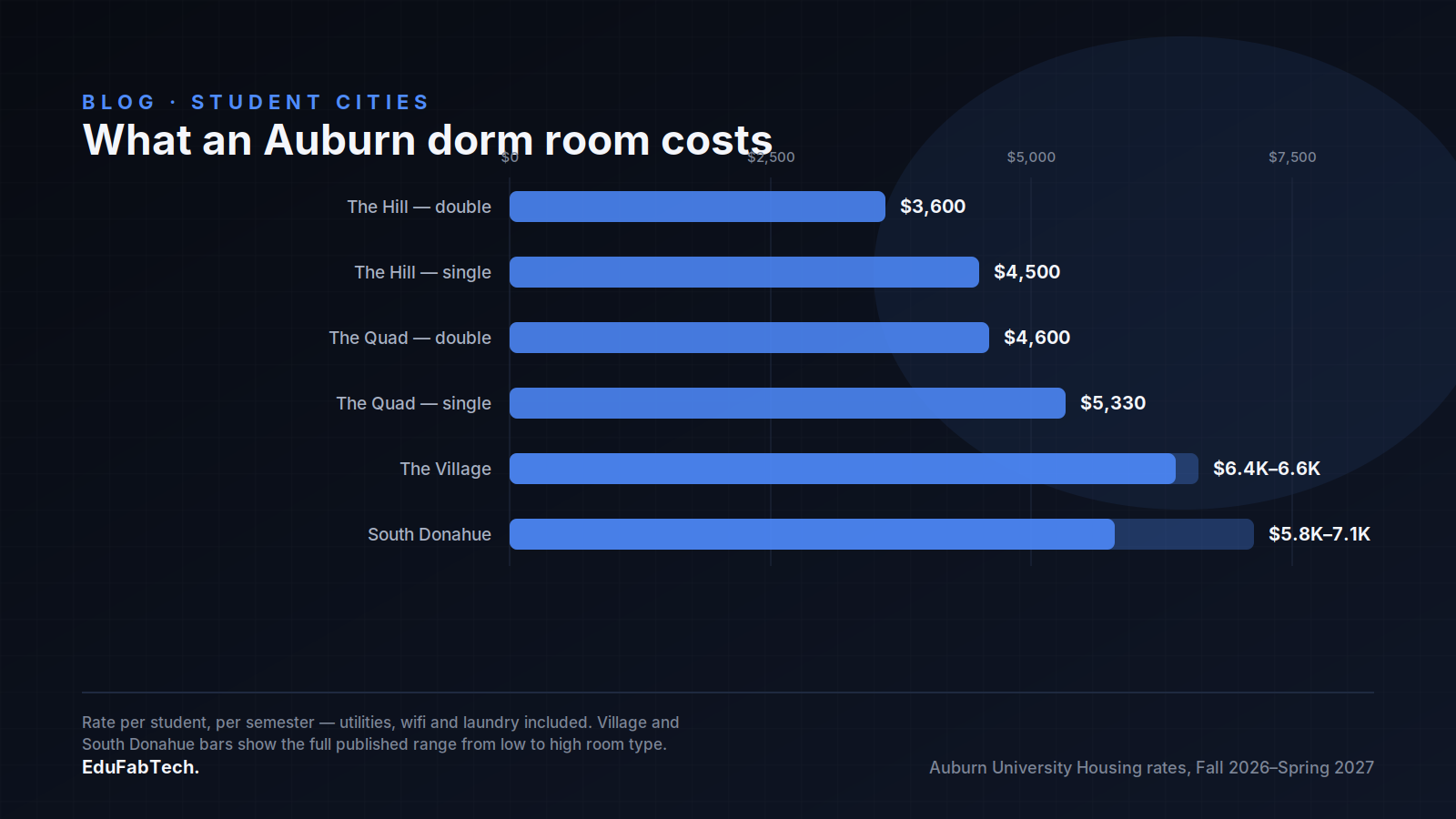
Rates are charged per student, per semester, and Auburn's housing office publishes them openly. For Fall 2026–Spring 2027, Auburn University lists a double room in The Hill at $3,600 per student per semester and a single at $4,500; a standard double in The Quad at $4,600 and a single at $5,330; rooms in The Village at $6,380–$6,600; and rooms in South Donahue at $5,800–$7,130, with all of those figures including utilities, wireless internet and laundry. Because the charge is per semester, a Hill double works out to roughly $7,200 for the academic year before meals.
Many upper-year and graduate students move off campus into the apartment complexes that ring the city, especially south and west toward the Tiger Transit lines. Rents there are set by private operators and are not published in one official table, so budget for them separately from the campus figures above. For the full picture of what a year costs, Auburn's Office of Financial Aid publishes an estimated total cost of attendance for 2026-27 of $39,516 for an Alabama resident undergraduate living on campus and $63,540 for a non-resident — numbers that fold in tuition, fees, housing, food, books and personal costs, not room alone. You can browse current student rooms and shared places in the city on EduFabTech's Auburn rooms listings, and everything else students are posting locally under the Auburn city page.
Renting off campus without losing a deposit
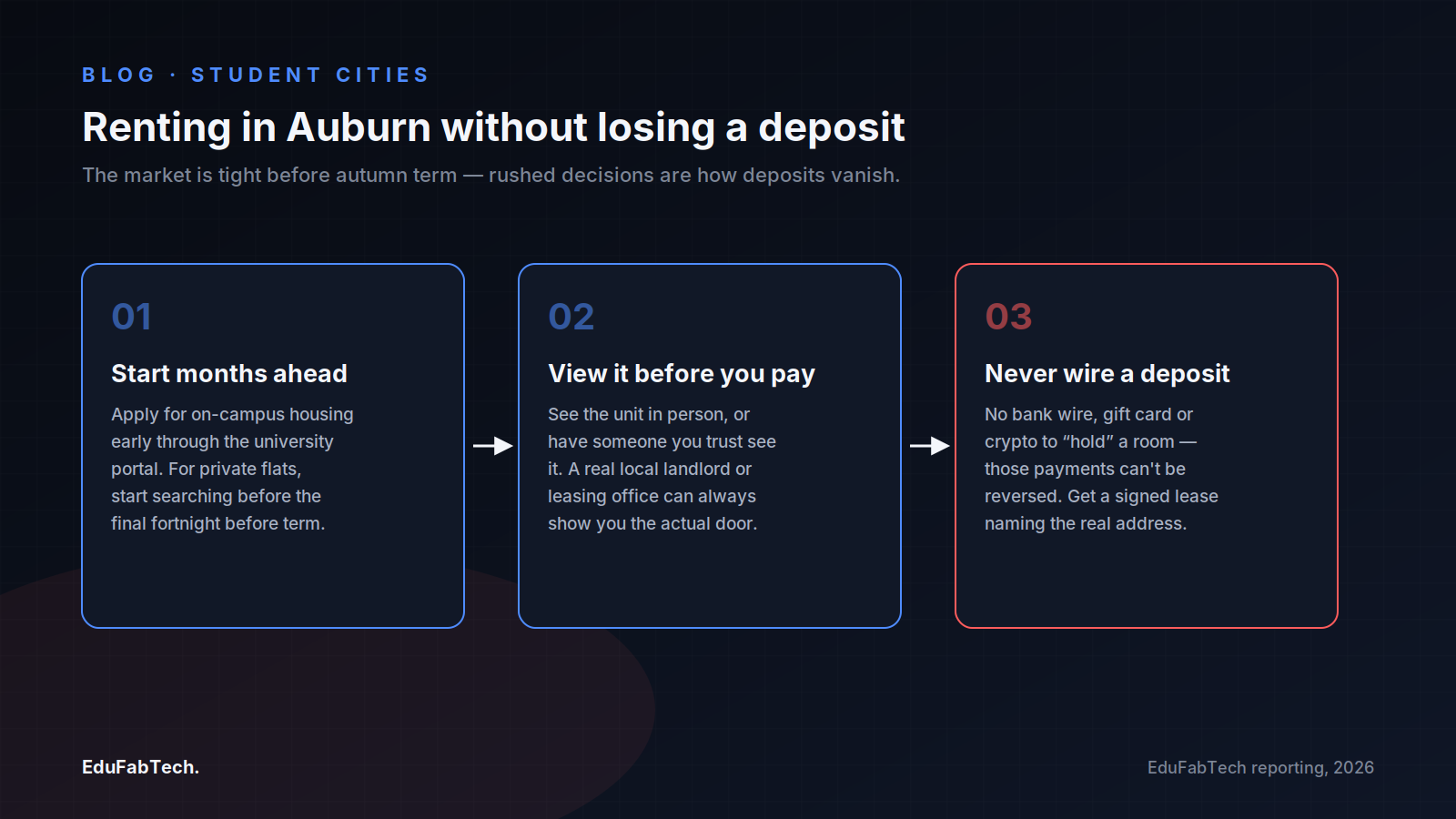
Auburn's rental market is seasonal and tight in the weeks before autumn term, which is exactly when rushed decisions turn into bad ones. Apply for on-campus housing early through the university's own portal if you want a residence hall; for private flats, start looking a few months ahead rather than in the final fortnight, when the good options near the Tiger Transit routes are already gone.
The scams that appear in a college town like Auburn follow a pattern. A "landlord" posts a room near campus at a price a little below the market, says they are out of state or travelling, and asks you to send a holding deposit before you can see the place. Treat that as the warning sign it is. See the unit in person, or have someone you trust see it, before any money changes hands; a real local landlord or a leasing office can show you the actual door. Never send a deposit or first month's rent by bank wire, gift card or cryptocurrency to "hold" a room — those payments cannot be reversed, and no legitimate Auburn landlord needs them. Get a signed lease that names the property address and the real party you are paying, and keep a written record of what the deposit is for. If an offer only exists over messaging and the person will not meet or let you view the property, walk away.
Furnishing a room and shopping second-hand
You do not need to buy everything new. The Auburn-Opelika area has a genuinely large second-hand scene for a town this size. The standout is Angel's Antique and Flea Mall in Opelika, which the Opelika Chamber of Commerce lists at 900 Columbus Parkway; it packs hundreds of independent dealers into a converted big-box store, with a vintage-and-antique side and a tag-sale side where furniture, kitchen kit and oddments turn over week to week. It is a realistic place to kit out a room cheaply if you have a way to carry things home.
Seasonal markets are the other route. The Market at Ag Heritage Park, hosted by Auburn University's own College of Agriculture, runs on the grounds near the red barn on South Donahue Drive; the college says it operates on Thursdays from 3 to 6 p.m. across the summer season, with local produce, honey, baked goods, plants and cut flowers. Downtown, the City Market runs Saturday mornings in Town Creek Park over the same summer window, and Opelika has its own farmers market. For furniture and smaller second-hand items from other students — especially at move-out in spring — browse EduFabTech's Auburn second-hand furniture and the wider second-hand listings before you spend anything.
Working while you study
Part-time work is common among Auburn students, from campus dining and the library to shops and cafés downtown. If you are a US citizen or permanent resident, the ordinary state and federal labour rules apply and campus job boards are the obvious starting point.
If you are here on an F-1 student visa, the rules are set by the US Department of Homeland Security, not by the university, and they are strict about hours. The DHS Study in the States guidance states that F-1 students with active SEVIS status may work on campus but "may not work more than 20 hours per week when school is in session," that students who wish to work must apply for a Social Security number, and that off-campus employment generally requires completing at least one full academic year and meeting specific conditions, with approval from a Designated School Official and a filed Form I-765 for off-campus work. This is official guidance, not legal advice — before you accept any job, confirm your own situation with Auburn's international student office, which acts as your DSO. Local part-time openings students are posting appear on EduFabTech's Auburn jobs page.
Libraries and places to study
The hub is the Ralph Brown Draughon Library on Mell Street, at the centre of campus and connected to the Mell Classroom Building. During term it keeps long hours: the library's own hours calendar shows it open 24 hours on many weekdays through the semester, with reduced hours around breaks and home-game days, which matters in the stretch before exams. It holds a mix of silent individual floors and open group space, so you can pick your noise level. Beyond the main library, Auburn University runs branch collections including the Architecture, Design and Construction Library, the Charles Cary Veterinary Medical Library, and the Innovation and Research Commons — useful if your coursework lives in one of those buildings. The student union and campus cafés fill in as informal study spots, and students also trade quieter desk space and study rooms on EduFabTech's Auburn study-spaces page.
Getting around Auburn
Auburn's campus is walkable, and that is the first thing to understand about transport here: for many students the daily commute is on foot or by bike. On top of that, the university runs Tiger Transit, its own bus network. According to Auburn University's transportation services page, Tiger Transit operates 22 lines travelling both on and off campus, running Monday to Friday from 7:00 a.m. to 8:00 p.m. during the autumn and spring semesters (a couple of lines stop at 6:00 p.m.), and riders board with a valid Auburn University ID card. Be aware that routes change: the student outlet Eagle Eye TV reported that Tiger Transit — a free system funded mainly by student fees rather than fares — cut 16 stops for the autumn 2026 semester after a third-party review of low-ridership stops, so confirm your nearest stop on the live app before you commit to an off-campus address.
For trips the campus buses do not cover, the Lee-Russell Council of Governments runs LR Rides, an on-demand public transit service. The council states that LR Rides are free and serve Auburn, Opelika and Lee and Russell counties, operating from 6:00 a.m. to 6:00 p.m., booked through the app, website or dispatcher. It is slower and more limited than a city metro, but it fills gaps for residents without a car. A car is genuinely useful in Auburn for anything beyond the campus core, and many students keep one; just factor parking permits into the cost.
The honest trade-offs, and a first-weeks checklist
What Auburn does well for students: a compact, walkable core where the library, classes and much of social life sit within a short radius; a university with on-campus housing at published, utilities-included rates; free campus transit and free on-demand county transit; and a cost of living that is modest by the standards of big US college cities. The town is safe-feeling and oriented almost entirely around the university.
What is harder: the rental market tightens sharply before term, so late arrivers get the worst of it; off-campus rents are set privately and vary, so there is no single official number to plan against; the bus network runs on weekday daytime hours and has just trimmed stops, which makes a far-flung flat without a car a real commitment; and the summers are long, hot and humid, with the spring severe-weather season that comes with this part of the South. Auburn is also a small place — rich in student life, thin on the big-city amenities some students miss.
A short checklist for the first weeks:
- Decide on-campus versus off-campus early, and if you want a residence hall, apply through Auburn University Housing before the good communities fill.
- Never pay a deposit before seeing the actual unit, and never pay by wire, gift card or crypto to "hold" a room.
- Check your nearest Tiger Transit stop on the live app before signing an off-campus lease, given the 2026 route cuts.
- If you are on an F-1 visa, meet your international student office (your DSO) before taking any job, and get your Social Security number sorted.
- Furnish from Angel's Antique and Flea Mall, the seasonal markets, and student giveaways rather than buying everything new.
- Get your Auburn University ID early — it is your key to Tiger Transit and the library.
- Browse what students are already posting locally on the Auburn listings before you commit to anything.
A quick question for readers
Do you work part-time while you study?
Many students work to pay the bills. See how common it is — and how many hours people really do.
Pick an answer, create a free account in a minute, and your vote counts. Already a member? Sign in
Source: Auburn University
Sources (5)
- Auburn University Housing. Rental Rates. Auburn University, 2026. studentaffairs.auburn.edu ↗ · checked 8 Oct 2026
- Auburn University Office of Institutional Research. Total Enrollment Quick Facts. Auburn University, 2026. ir.auburn.edu ↗ · checked 8 Oct 2026
- Auburn University Office of Financial Aid. Estimated Cost of Attendance. Auburn University, 2026. auburn.edu ↗ · checked 8 Oct 2026
- U.S. Department of Homeland Security. Working in the United States (F-1 students). Study in the States, 2026. studyinthestates.dhs.gov ↗ · checked 8 Oct 2026
- Tuskegee University. Degree Programs. Tuskegee University, 2026. tuskegee.edu ↗ · checked 8 Oct 2026