Studying in Augsburg: universities, housing and student life
A practical, sourced guide to Augsburg's two higher-education institutions, where students find rooms, what it costs, and what is easy and hard about the city.
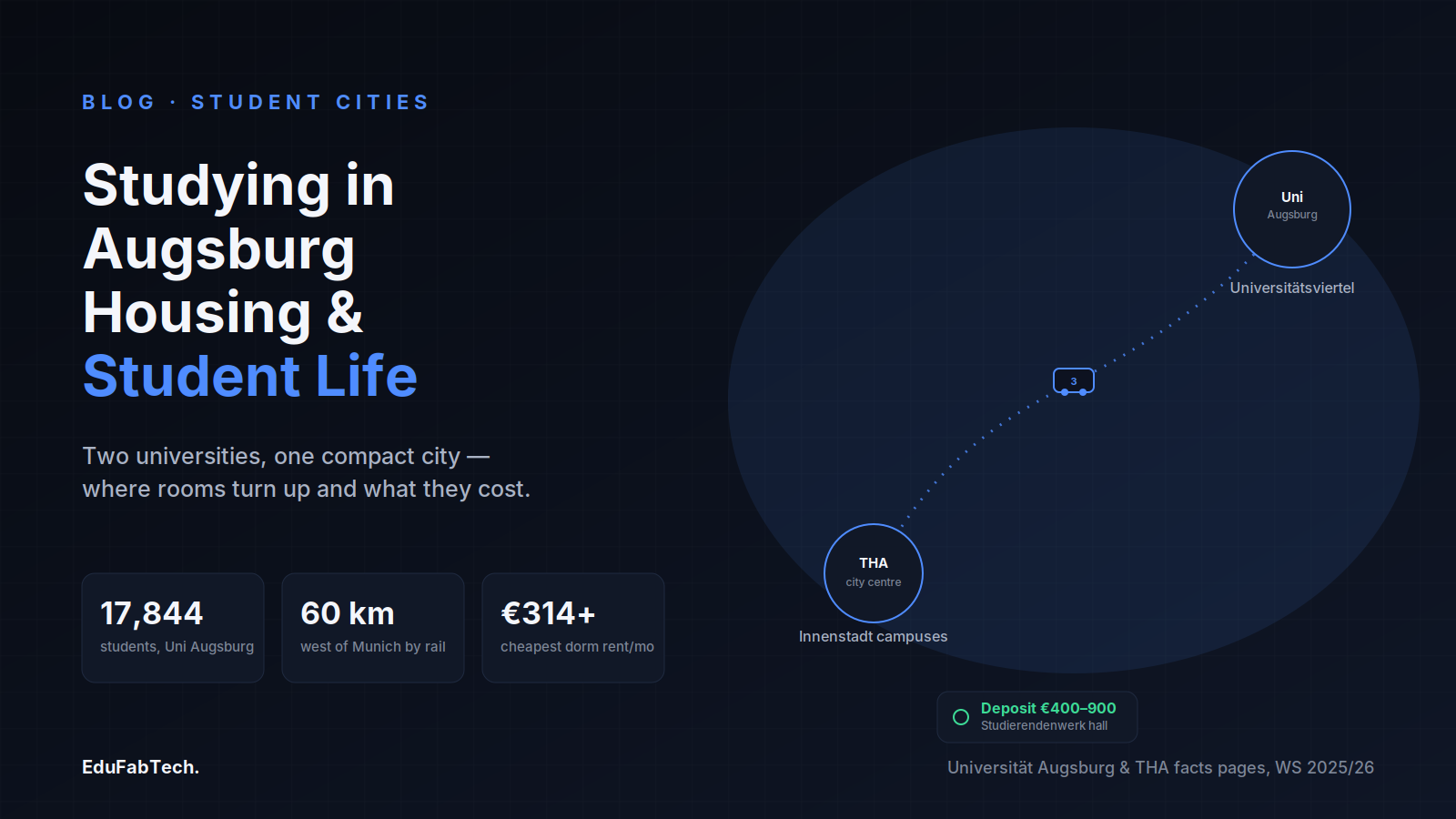
Augsburg sits in Bavarian Swabia, wedged between the Lech and the Wertach and roughly 60 kilometres west of Munich on the main railway line toward Ulm and Stuttgart. It is one of the oldest cities in Germany, founded by the Romans, and its old town is still laced with working canals rather than ornamental ones. For a student the practical upshot is a mid-sized city — big enough for a full tram network and two higher-education institutions, flat and compact enough to cross by bicycle in well under an hour. It is not Munich, and the rents show it; it is also not a sleepy college town, because the universities sit inside a real working city with its own industry and markets.
Two institutions here award degrees, and they shape where rooms are tight, which tram fills up at nine in the morning, and when the reading rooms run out of seats. The University of Augsburg (Universität Augsburg) is the larger, a single green campus on the city's southern edge. Augsburg Technical University of Applied Sciences (Technische Hochschule Augsburg, abbreviated THA) is the applied-sciences institution, spread across sites in the city centre. Knowing which one you belong to is the first thing that decides where you should look for a room.
The University of Augsburg reports 17,844 students for Winter Semester 2025/26, of whom 1,749 are international, across eight faculties, according to its own facts and figures page. The largest faculties on that page are Philology and History (4,335 students) and Law (2,781), and the university also runs a Faculty of Medicine (913 students) — a relatively young addition that has pulled a university hospital and clinical research into the city's academic life. The campus itself is a planned development begun in the 1970s on the site of Augsburg's former airfield, where flights ended in 1968; tram line 3 runs right into it and stops at a station called simply "Universität," as the university's own campus page notes.
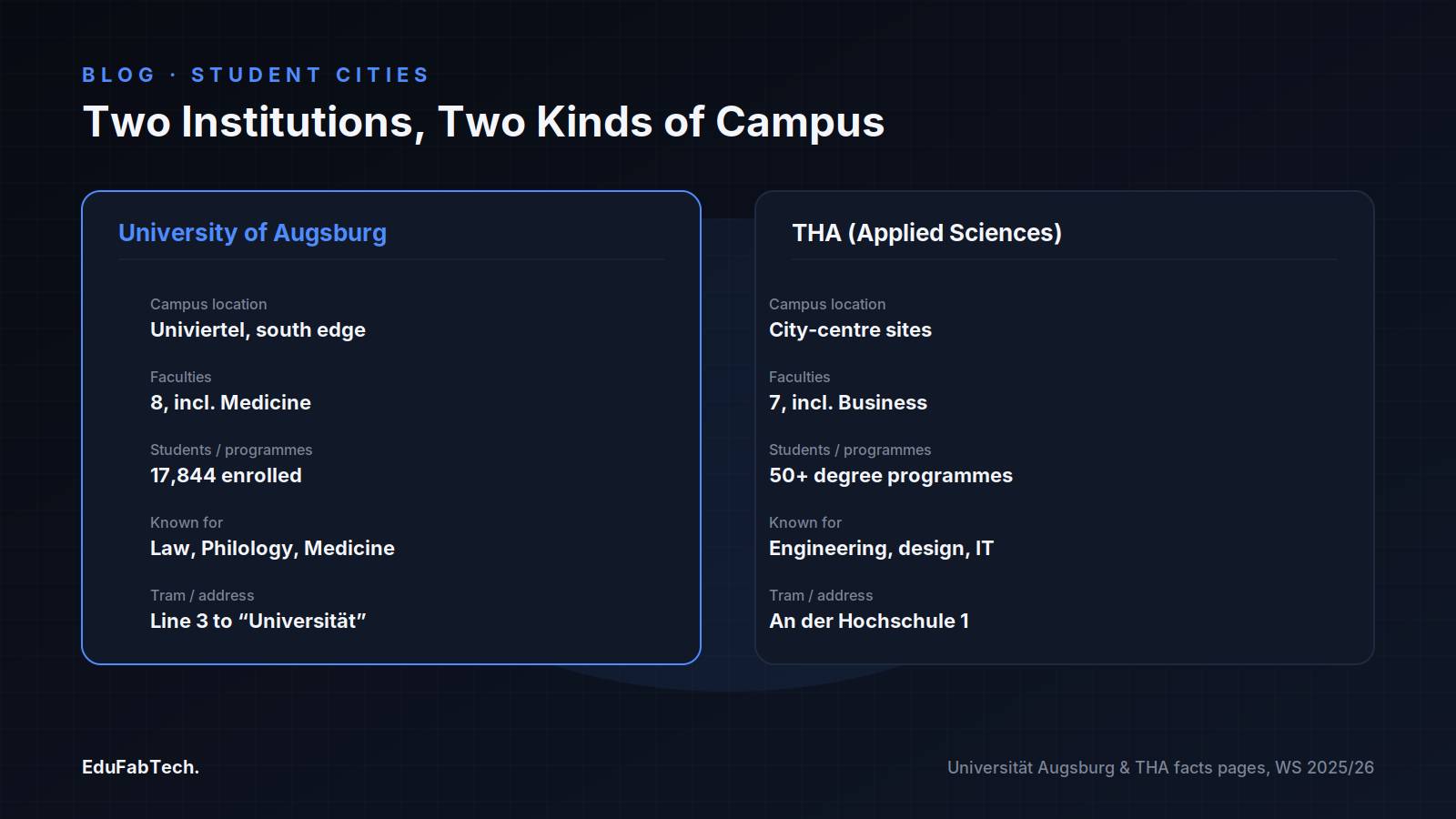
Augsburg Technical University of Applied Sciences is the hands-on counterpart. Its own website lists seven faculties — spanning liberal arts and sciences, architecture and civil engineering, electrical engineering, design, computer science, mechanical and process engineering, and a School of Business — and more than 50 degree programmes, with its administrative address at An der Hochschule 1. Where the University of Augsburg leans toward theory, law and medicine, THA is built around engineering, design and business, with teaching tied closely to the region's manufacturing employers. Its campuses are in the centre of town rather than on a green edge, which changes the housing maths: students there often want to be near the Innenstadt, not near the Univiertel tram terminus.
Where rooms actually turn up
The obvious place to live is the Universitätsviertel, the quarter built around the University of Augsburg campus. It has the most purpose-built student housing and the most direct tram link, but it is also where demand concentrates, so rooms there go first. Students who miss out spread into neighbouring districts — Hochzoll, Göggingen, Haunstetten and Pfersee — all of which have tram or bus links back to campus, and into the central districts near the old town, which suit THA students better. Because Augsburg is compact, "a bit further out" here still usually means twenty minutes by tram, not an hour.
The non-profit Studierendenwerk Augsburg runs the subsidised halls of residence, and its rooms are the cheapest reliable option. For its Universitätsviertel residence on Salomon-Idler-Straße, the Studierendenwerk's own listing gives single apartments of roughly 16–26 m² at €314–€581 total monthly rent, with internet and operating costs included, and shared double apartments from €289–€295 per person. The same page lists deposits of €500–€900 for the single units and €400 for a shared one. These are furnished rooms, which matters if you are arriving from abroad with two suitcases. Demand outstrips supply, so treat a hall place as something you apply for early and may wait for, not something guaranteed.
The rest of the market is private: single rooms in a shared flat (a WG), or whole studio apartments. Start looking well before the semester begins — the rush is heaviest in September for the winter semester and in March for the summer one. You can browse what is currently on offer around the city on our own listings for rooms in Augsburg and everything else collected under Augsburg on EduFabTech, and the pages for listings near the University of Augsburg and near Augsburg Technical University of Applied Sciences sort by which campus you need.
Paying a deposit without being cheated
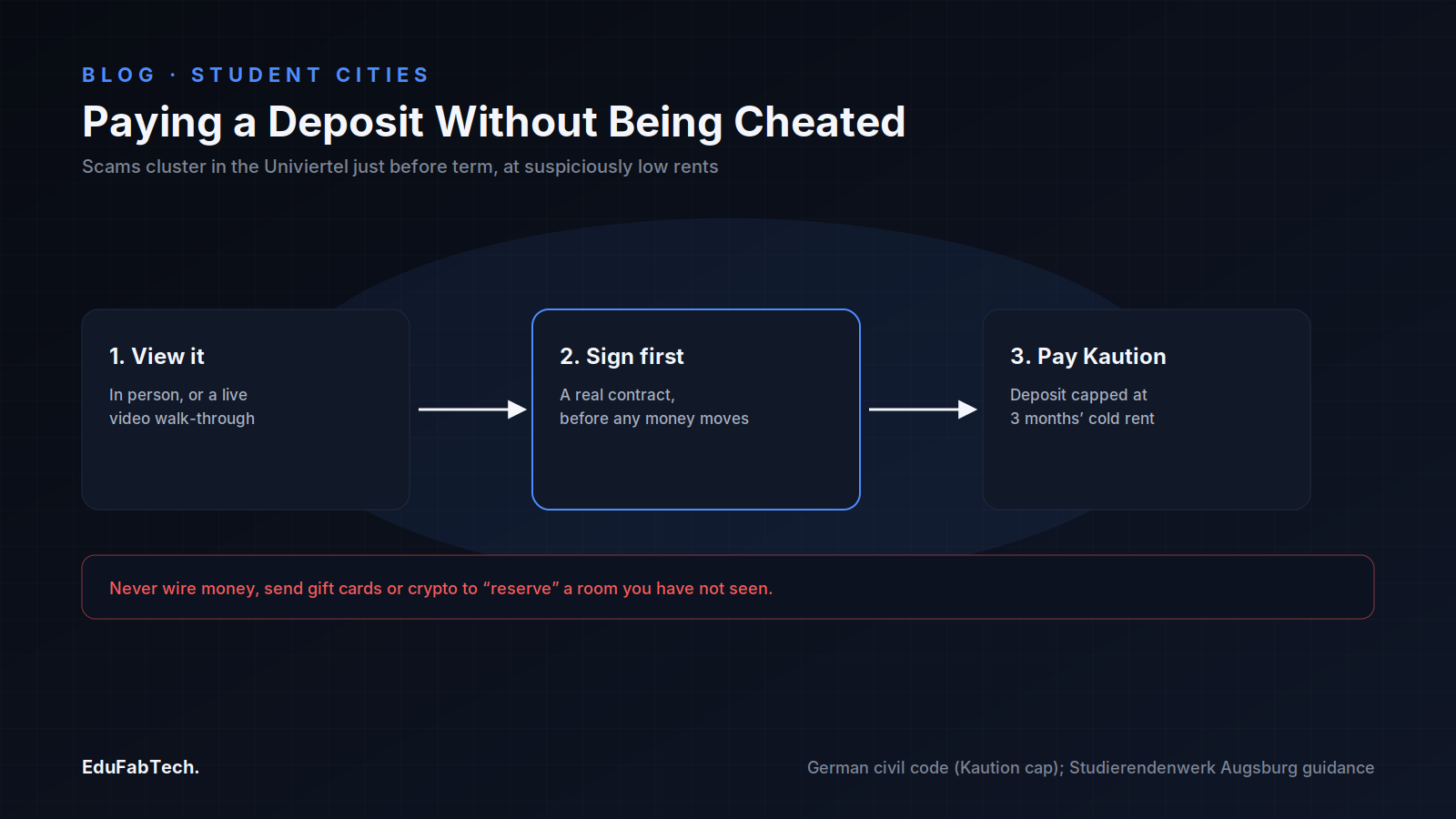
Rental scams in Augsburg follow the same pattern as in every German student city, and they cluster where desperation is highest: in the weeks right before term, for rooms in the Universitätsviertel, advertised at suspiciously low rents with photogenic pictures. The warning signs are a "landlord" who is conveniently abroad, cannot show you the flat, and wants money before you have a signed contract and a key. A normal German deposit (Kaution) is capped by law at three months' cold rent and is paid after you have viewed the place and signed — never as an upfront fee to "reserve" a room you have not seen.
The safe procedure is simple and local: view the room in person, or have someone you actually know view it for you, before any money moves. If you are still abroad, ask for a live video walk-through rather than photos, and be wary of any story that explains why that is impossible. Never send money by bank transfer, gift card or cryptocurrency to hold a room — a genuine Augsburg landlord or the Studierendenwerk will not ask for that, and no legitimate deposit is paid before a contract exists. For the first weeks, a hostel or a short sublet while you search in person beats paying a stranger sight unseen.
Furnishing a room for very little
Augsburg rewards the patient second-hand shopper. The city's anchor for fresh food is the Stadtmarkt in the heart of the old town, which the city describes on its official page as a 10,000-square-metre market with more than 100 traders, open Monday to Friday 7:00–18:00 and Saturday 7:00–17:00, with the farmers' section closing at 14:00 on Saturdays, per augsburg.de. Its Viktualienhalle and Fleischhalle are a cheap, reliable lunch as much as a grocery run. For furniture and household odds and ends rather than food, the city has regular flea markets — including the Saturday flea market on the Plärrer festival grounds — where a desk lamp or a set of plates costs a fraction of new.
Beyond the markets, the fastest way to kit out a room is other students clearing theirs out, especially at the end of each semester. Our Augsburg pages collect what is currently going: second-hand things, second-hand furniture, and items being given away free. Because the Studierendenwerk halls come furnished, dorm residents mainly need small things; students in private WGs are the ones who benefit most from a secondhand desk, shelf and lamp.
Working alongside your studies
Many students here take a term-time job, and the rules depend on your nationality. According to the DAAD's guide to side jobs, students from outside the EU may work 140 full days or 280 half days per year without special permission; going beyond that requires approval from both the employment agency and the foreigners' office (Ausländerbehörde). The same DAAD page states that students from the EU and EEA have essentially unrestricted access to the labour market on the same terms as German students, though working more than 20 hours a week triggers mandatory social-insurance contributions. This is general information, not legal advice — confirm your own permit's wording with the Ausländerbehörde before you sign a contract. One practical step to plan for: you must register your Augsburg address (Anmeldung) after moving in, and your German tax identification number is then issued automatically and sent by post, which an employer needs in order to tax your wages correctly. Current openings in the city are gathered under jobs in Augsburg.
Libraries and places to study
The University of Augsburg's own library, on the campus in the Universitätsviertel, is the main workhorse for its students, with long evening and weekend hours during term — the kind of place that fills up in the fortnight before exams. In the city centre, the Staats- und Stadtbibliothek Augsburg is a public research library open to everyone; note that it is running from temporary quarters at Schillstraße 94 from 17 April 2023 until, on its own opening-hours page, roughly spring 2027, with the reading room open Monday to Friday 10:00–17:00. THA has its own central library at its city-centre campus. When term-time seats run short, cafés and the markets' seating double as informal desks; you can also check what study space is currently going on our Augsburg study-spaces page.
The tram, the ticket and the bill
Public transport is run by Stadtwerke Augsburg (swa) and priced through the Augsburger Verkehrs- und Tarifverbund (AVV). The tram is the spine of the system, and for most students it replaces a car entirely. Enrolled students at both the University of Augsburg and THA pay a compulsory semester ticket: according to the Studierendenwerk Augsburg, it costs €96.95 per semester and covers local transport in the AVV, with your validated Campus Card as proof. That same page explains the national upgrade: for €27.62 a month in Augsburg you can extend the semester ticket to a nationwide Deutschlandticket, ordered through Stadtwerke Augsburg, with the semester-ticket contribution credited toward it. For a city this size, the local ticket alone covers almost everything a student needs day to day.
On living costs, the University of Augsburg's advice to incoming international students puts average monthly expenses at about €992, broken down on its costs page as €350 for rent, €240 for groceries, €125 for health insurance, a €27 pro-rated semester fee, plus smaller amounts for phone and internet, learning materials, the public broadcasting fee and leisure. Treat the €350 rent line as a planning anchor rather than a promise: a subsidised Studierendenwerk room can sit near it, while a private studio will usually run higher. The honest reading is that Augsburg is cheaper than Munich but is not a bargain town, and the single biggest variable in your budget is whether you land a subsidised room.
What is good, and what is hard
The good: Augsburg is compact, well connected and genuinely walkable, with a real tram network, a cheap semester ticket, and a historic centre that is pleasant to live in rather than merely visit. Munich is close enough for a day trip without Munich rents. The University of Augsburg campus is unusually green and self-contained, which suits students who like everything in one place.
The hard: housing is the recurring pain point, as it is across southern Germany — demand outpaces the subsidised halls, and the cheapest rooms go to whoever applied earliest. Winters are grey and cold, and the flat riverside geography that makes cycling easy also makes January feel long. German is the working language of most part-time jobs and much of daily life, so arriving with little of it narrows your options, particularly for work. And because the two institutions sit in different parts of the city, the "best" neighbourhood genuinely depends on which one you attend.
A checklist for the first weeks
- Apply to the Studierendenwerk Augsburg for a hall place as early as you can, and keep searching private rooms in parallel — do not rely on either alone.
- View any room in person (or via a live video call) before paying anything; never wire a deposit to "reserve" an unseen flat.
- Register your Augsburg address (Anmeldung) promptly — your tax ID, which an employer needs to tax your pay correctly, is issued automatically once you do.
- Validate your Campus Card so the semester ticket is active, and decide whether the Deutschlandticket upgrade is worth it for your travel.
- Get your library access set up early, before the pre-exam rush fills the reading rooms.
- Furnish from the flea markets and end-of-semester clear-outs rather than buying new; check what is being given away locally first.
- If you are a non-EU student, confirm your work allowance with the Ausländerbehörde before signing any job contract.
None of this is unique to one person's experience of Augsburg, but it is specific to the city: a Roman town on two rivers, with one campus university on its green edge and one applied-sciences institution in its old centre, a tram that runs into the lecture halls, and a housing market that rewards the people who start early. For everything else happening around town while you settle in, our Augsburg events page is a reasonable place to start.
A quick question for readers
Do you work part-time while you study?
Many students work to pay the bills. See how common it is — and how many hours people really do.
Pick an answer, create a free account in a minute, and your vote counts. Already a member? Sign in
Comments 2
Comment-
The €350 rent line in that €992 budget doesn't line up with the numbers given just above it. A subsidised single in the Universitätsviertel…
-
The part worth testing yourself is the halls math, not the sticker price: single apartments at 16–26 m² for €314–€581 sounds like a wide ran…
Join free to read the full comments and reply Comments are between members; an account takes a minute.
Source: University of Augsburg
Sources (5)
- University of Augsburg. Facts and Figures (Winter Semester 2025/26). University of Augsburg, 2026. uni-augsburg.de ↗ · checked 16 Nov 2026
- Studierendenwerk Augsburg. Wohnanlage Augsburg – Universitätsviertel. Studierendenwerk Augsburg, 2026. studierendenwerk-augsburg.de ↗ · checked 16 Nov 2026
- Studierendenwerk Augsburg. Semesterticket. Studierendenwerk Augsburg, 2026. studierendenwerk-augsburg.de ↗ · checked 16 Nov 2026
- DAAD. Side jobs. Deutscher Akademischer Austauschdienst, 2026. daad.de ↗ · checked 16 Nov 2026
- Technische Hochschule Augsburg. Technical University of Applied Sciences Augsburg. Technische Hochschule Augsburg, 2026. tha.de ↗ · checked 16 Nov 2026