Studying in Austin, United States: universities, housing and student life
A practical, sourced guide to studying in Austin, Texas — its universities, where students live, what rooms and transport cost, and the honest trade-offs of a fast-growing city.
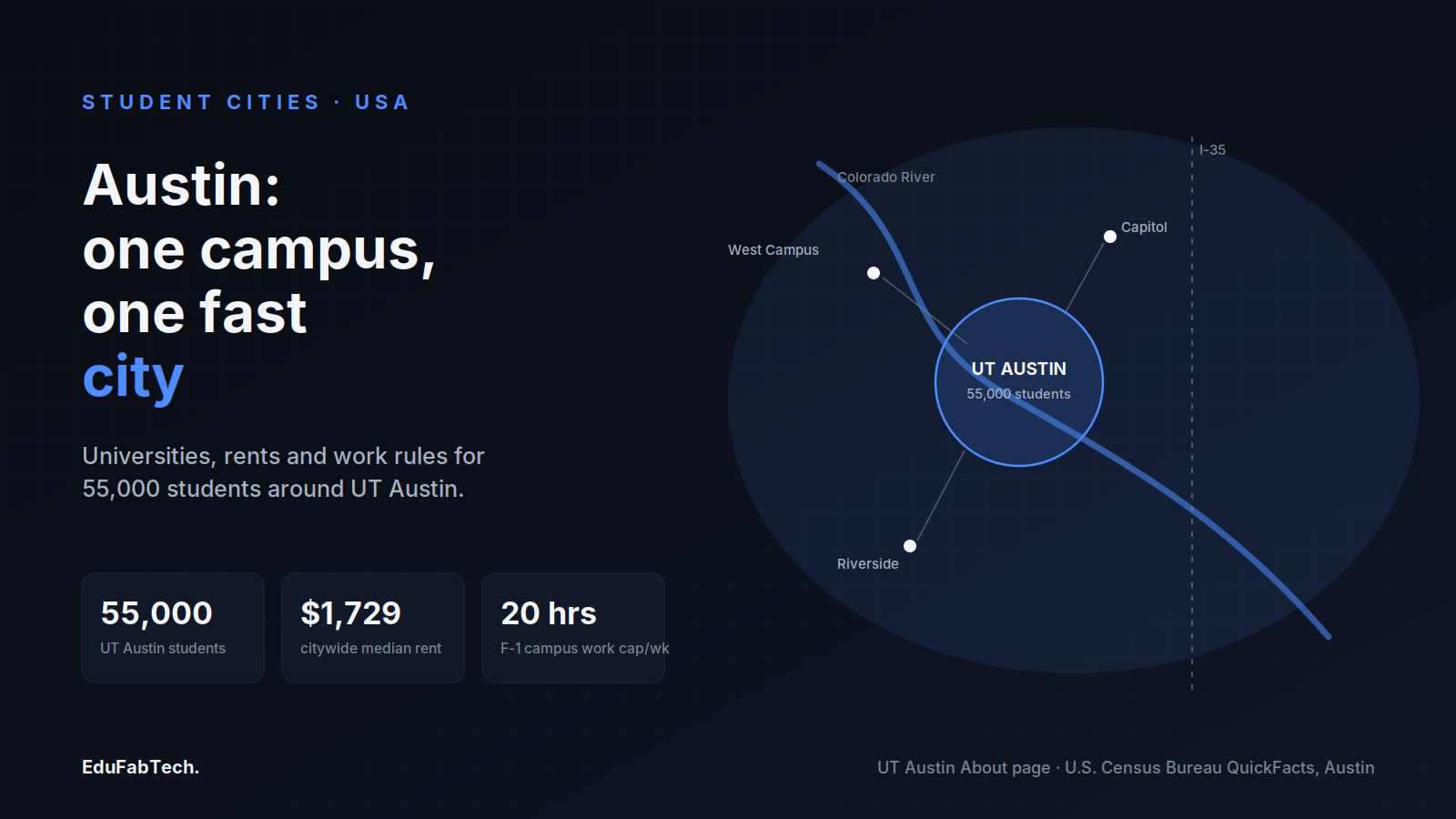
Austin spreads along the Colorado River in Central Texas, the state capital and a city that has grown quickly on the strength of music, film and a large technology sector. Student life here is unusually concentrated: one institution, the University of Texas at Austin, sits just north of the downtown grid and sets the rhythm of whole neighbourhoods around it. The city is warm, green along the river, and expensive in ways newcomers do not always expect.
According to the University of Texas at Austin's own About page, the university supports "some 55,000 students, 4,600 faculty, 15,000 staff" across "16 colleges and schools," and it reports attracting "more than $1.37 billion annually for discovery." The main campus occupies a compact core between Guadalupe Street — whose western edge students call "the Drag" — and Interstate 35, within walking distance of the Texas State Capitol. Because the campus is so central, the boundary between "university" and "city" is thin: the same streets carry undergraduates, state workers and festival crowds.
Many of UT's academic units carry names you will see on buildings and in course catalogues. The Moody College of Communication, the Jackson School of Geosciences, the University of Texas at Austin College of Liberal Arts and the University of Texas at Austin School of Nursing all sit under the same university. The Dell Medical School at The University of Texas at Austin anchors a health district on the east side of the central campus, and the university's J. J. Pickle Research Campus holds laboratories several miles north in Travis County. Current student listings for the whole city are collected on EduFabTech's Austin page.
From a South Congress hilltop to a downtown office floor
Austin's smaller campuses are scattered and distinct. St. Edward's University, a private Catholic institution, occupies a hilltop campus at 3001 South Congress Avenue in the 78704 postcode, south of the river — close enough to walk toward the music venues of South Congress, far enough to feel residential. It is a small, teaching-focused university, a different experience from UT's scale.
Downtown, the University of Austin is a new private institution. Its own FAQ states that "the Texas Higher Education Coordinating Board has granted a Certificate of Authority to UATX to award" a Bachelor of Arts in Liberal Studies, that its campus is "located at 522 Congress Ave," and that it "opened [its] doors to the first undergraduate class in fall 2024." Northwest of the centre, Concordia University Texas describes its site in its About page as "437 acres" of which "250 acres of it is protected nature and wildlife preserve," and says it is accredited by SACSCOC "to award the associate, bachelor, and master degrees along with the Doctorate in Education." For shorter vocational training, Southern Careers Institute runs a campus in the small enclave of Rollingwood and awards certificates and associate degrees. Rooms near the biggest campus are grouped on EduFabTech's listings near the University of Texas at Austin.
Where students put down roots, from West Campus to Riverside
West Campus is the dense student quarter directly west of UT, between Guadalupe Street and Lamar Boulevard. The university's off-campus living guide describes it as close to the university, mostly undergraduate, with "a louder atmosphere" and "typically most expensive because of the location." It is the most walkable option and the easiest for an early class, which is exactly why its purpose-built towers lease well ahead of time and command a premium. Expect noise, construction and a very young crowd.
North Campus and Hyde Park sit just above the university. UT's guide groups "North Campus/Hyde Park" as home to upperclassmen and graduate students, with a "quieter atmosphere," proximity to "parks and shops" and a short walk to the engineering buildings. Hyde Park in particular is a historic bungalow district a short bus ride or bike from campus, favoured by people who want calm over the social intensity of West Campus.
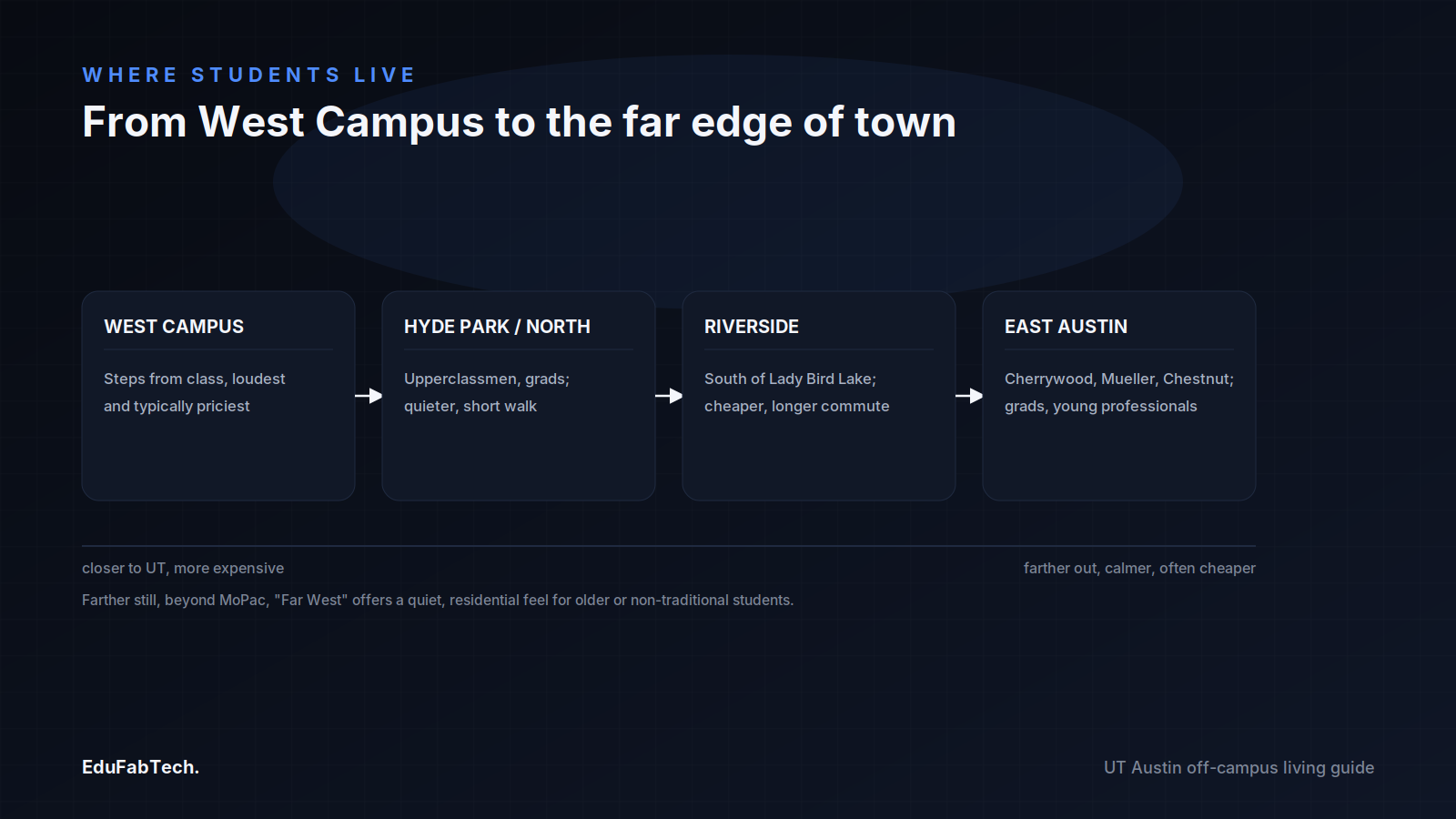
Riverside — south of Lady Bird Lake, in UT's description — is framed as a "more affordable, trendy neighborhood" at a "moderate distance from campus," though the guide also flags a "trend of rising rent rates." Rents are lower there than in West Campus, but the trade-off is a daily bus or bike commute back across the river to class.
To the east, across Interstate 35, UT's guide points to the Cherrywood, Mueller and Chestnut neighbourhoods as "up and coming neighborhoods" with an "adult atmosphere that is ideal for older students," home to graduate students, young professionals and families, but "farther away from campus." Mueller, built on a former airport, is newer and quieter. Farther out, the "Far West" area beyond the MoPac Expressway is described as "quiet and calm" with a "residential feel that is great for older or non-traditional students." Students at St. Edward's tend to cluster instead in South Austin, in the 78704 area around South Congress and South First, rather than fighting for West Campus rooms.
Renting in a fast, early-leasing market
Austin's student housing market runs ahead of the calendar. Purpose-built apartments in West Campus commonly pre-lease for the following August many months in advance, so if you want to be inside the walkable core, start looking in the autumn or winter before you arrive rather than in the summer. Sublets and rooms across the city are listed on EduFabTech's Austin rooms page, which is useful for mid-year arrivals who missed the main leasing wave.
Before you pay anything, see the specific unit — not a model apartment — in person, or through someone you trust who can visit for you. Scams in Austin usually appear as listings that look too cheap for West Campus or Riverside, with an owner who "can't show it yet" because they are supposedly out of state. Confirm that the person collecting money actually controls the room, insist on a written lease naming the exact address and unit, and be clear about what the deposit covers and when it is returned. Never send money by bank wire, gift card or cryptocurrency to "hold" a place; legitimate Austin leasing offices do not ask to be paid that way, and once such a transfer is gone it is effectively unrecoverable.
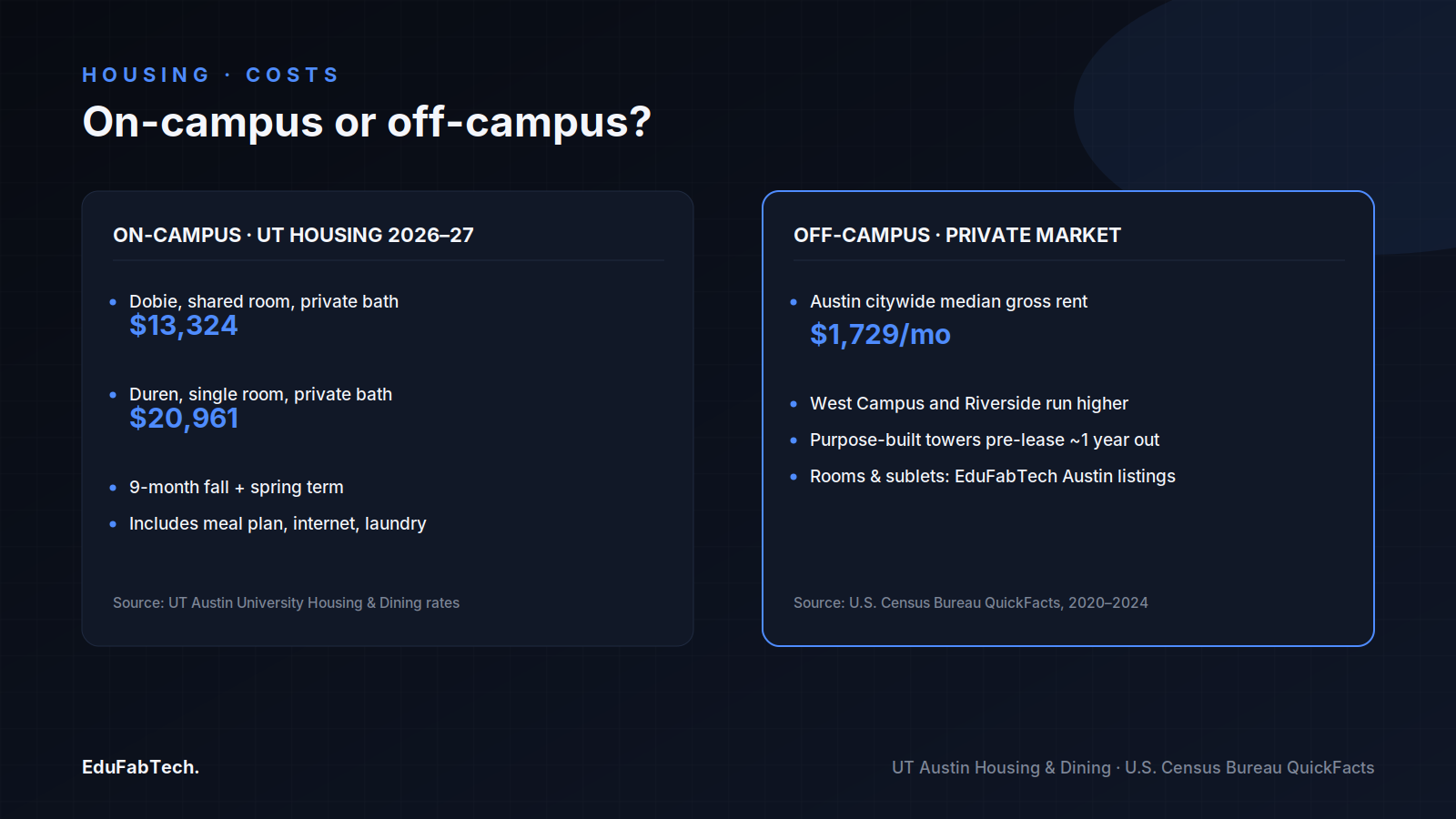
If you are weighing on-campus living against renting, UT publishes current figures. Its University Housing and Dining residence hall rates for 2026-27 run from US$13,324 per person for a shared Dobie room with a private bath to US$20,961 for a Duren single with a private bath, for the nine-month fall and spring terms, with each rate including room, a meal plan, internet and laundry. For the private market, the U.S. Census Bureau's QuickFacts for Austin city put median gross rent at US$1,729 a month across its 2020–2024 estimates — a citywide figure, not a West Campus one, where student rooms often run higher.
Furnishing a room without buying new
Austin makes it easy to furnish a room second-hand, partly because so many leases turn over on the same spring and late-summer dates. The city has a strong weekend-market culture: the Sustainable Food Center runs a long-standing downtown farmers' market on Saturdays at Republic Square, and the Texas Farmers' Market holds a large Sunday market at Mueller — good for cheap produce as well as the informal trade in used goods that springs up around student move-out weeks. Thrift and resale shops cluster along North Lamar Boulevard and through South Austin. On EduFabTech you can browse local second-hand things, including the listings that fill up when Austin leases end in spring and late summer.
Working while you study
Campus jobs are common, and many students take one. International students have to stay within the terms of their visa. U.S. Immigration and Customs Enforcement, through its Student and Exchange Visitor Program, states on its employment page that an F-1 student may generally work on campus part time — up to 20 hours per week while school is in session — and full time during official breaks, without separate work authorisation. Rules change and exceptions apply, so confirm your own situation with your university's international student office and with that official source rather than relying on second-hand summaries; this is not legal advice. Local part-time openings are gathered on EduFabTech's Austin jobs page.
Desks, stacks and quiet floors
The University of Texas Libraries system centres on the Perry-Castañeda Library, known on campus as the PCL, just east of the main campus. Its own page describes it as the university's flagship research library, with a Scholars Commons for silent study and reservable group study rooms; the details are on the library's page. For a place to work off campus, the Austin Public Library's Central Library at 710 W. César Chávez Street offers free Wi-Fi, quiet reading areas and bookable rooms, open to anyone with a quiet afternoon to fill. More desks and study spaces around the city are listed on EduFabTech's study-spaces page.
Getting around without a car
Austin's transit authority is CapMetro. Its UT rider's guide states that "UT students, faculty and staff ride most CapMetro services for free with a valid ID," which covers the local buses, the MetroRapid lines and the MetroRail Red Line running from downtown out to Leander. Students at other Austin colleges do not ride free automatically; CapMetro's half-price Reduced Fare ID is limited to specific groups — riders 65 and older, Medicare holders, military, people with disabilities, and students aged 18 and under — so most college students pay the standard fare. The ground near the river is flat enough to cycle, though the long, hot season and the city's sprawl mean most students lean on a mix of the bus and a bike rather than either alone.
What Austin gives students, and what it charges them
The upsides are real. A large research university sits beside a deep technology and music economy that generates part-time, internship and graduate work; winters are mild; and Lady Bird Lake and its trails put green space within reach of the centre. The hard parts are just as concrete. Housing near UT is expensive and leases early, as the dorm and Census figures above suggest. Summers are long and genuinely hot, stretching from spring well into autumn. The city's growth has outpaced its roads, so journeys on Interstate 35 and MoPac can crawl. And beyond the campus core, Austin is spread out and awkward to navigate without a bike or a settled bus habit. None of this argues against coming — but it is worth budgeting for, in both money and time, before you arrive.
Your first two weeks: a short checklist
- Get your university ID early — at UT it doubles as your free CapMetro pass.
- Install the CapMetro app and map your route to campus before classes begin.
- If you arrive without a signed lease, stay somewhere short-term and view any room in person before paying a deposit.
- International students: visit your international student office in the first days to confirm work rules and keep your documents current.
- Furnish from weekend markets and second-hand listings rather than buying everything new.
- Claim a study spot — a PCL floor or the Central Library downtown — before deadline season arrives.
- Plan around the heat: carry water, and expect warm terms from spring through October.
A quick question for readers
Do you work part-time while you study?
Many students work to pay the bills. See how common it is — and how many hours people really do.
Pick an answer, create a free account in a minute, and your vote counts. Already a member? Sign in
Source: The University of Texas at Austin
Sources (5)
- The University of Texas at Austin. About UT Austin. The University of Texas at Austin, 2026. utexas.edu ↗ · checked 3 Oct 2026
- University Housing and Dining. Residence Hall Rates, 2026-27. The University of Texas at Austin, 2026. housing.utexas.edu ↗ · checked 3 Oct 2026
- U.S. Census Bureau. QuickFacts: Austin city, Texas. U.S. Census Bureau, 2024. census.gov ↗ · checked 3 Oct 2026
- Capital Metropolitan Transportation Authority. UT Student Rider's Guide. CapMetro, 2026. capmetro.org ↗ · checked 3 Oct 2026
- U.S. Immigration and Customs Enforcement. Employment (Student and Exchange Visitor Program). U.S. Department of Homeland Security, 2026. ice.gov ↗ · checked 3 Oct 2026