Studying in Bakersfield: California State University, housing and student life
A practical, sourced guide to California State University, Bakersfield and to living as a student in Kern County's largest city — housing, second-hand markets, work rules, study spaces, transport and costs.
Bakersfield sits at the southern end of California's San Joaquin Valley, the seat of Kern County and the point where the flat farmland of the Central Valley runs into the Tehachapi and San Emigdio mountains. It is a working city — oil derricks still nod on the edges of town, almonds and carrots move out on the freight lines, and the "Bakersfield Sound" of Buck Owens and Merle Haggard gave the place a claim in country music that locals have not forgotten. For a student, this matters in plain ways: the city is spread out, built for driving, hot for much of the year, and considerably cheaper than coastal California — though "cheaper than Los Angeles" is a low bar to clear.
The anchor for most students is California State University, Bakersfield, out on the city's southwest side. It is not a huge institution, and the city around it is not a campus town in the way a smaller place might be. That shapes nearly every practical decision below, from where you rent to how you get to class. This guide pulls together what can be verified from the university's own pages, the local transit operator, the county library and census data, and is honest about where the gaps are.
You can browse current student listings for the city on EduFabTech's Bakersfield page, and the sections below point to the more specific ones as they come up.
California State University, Bakersfield
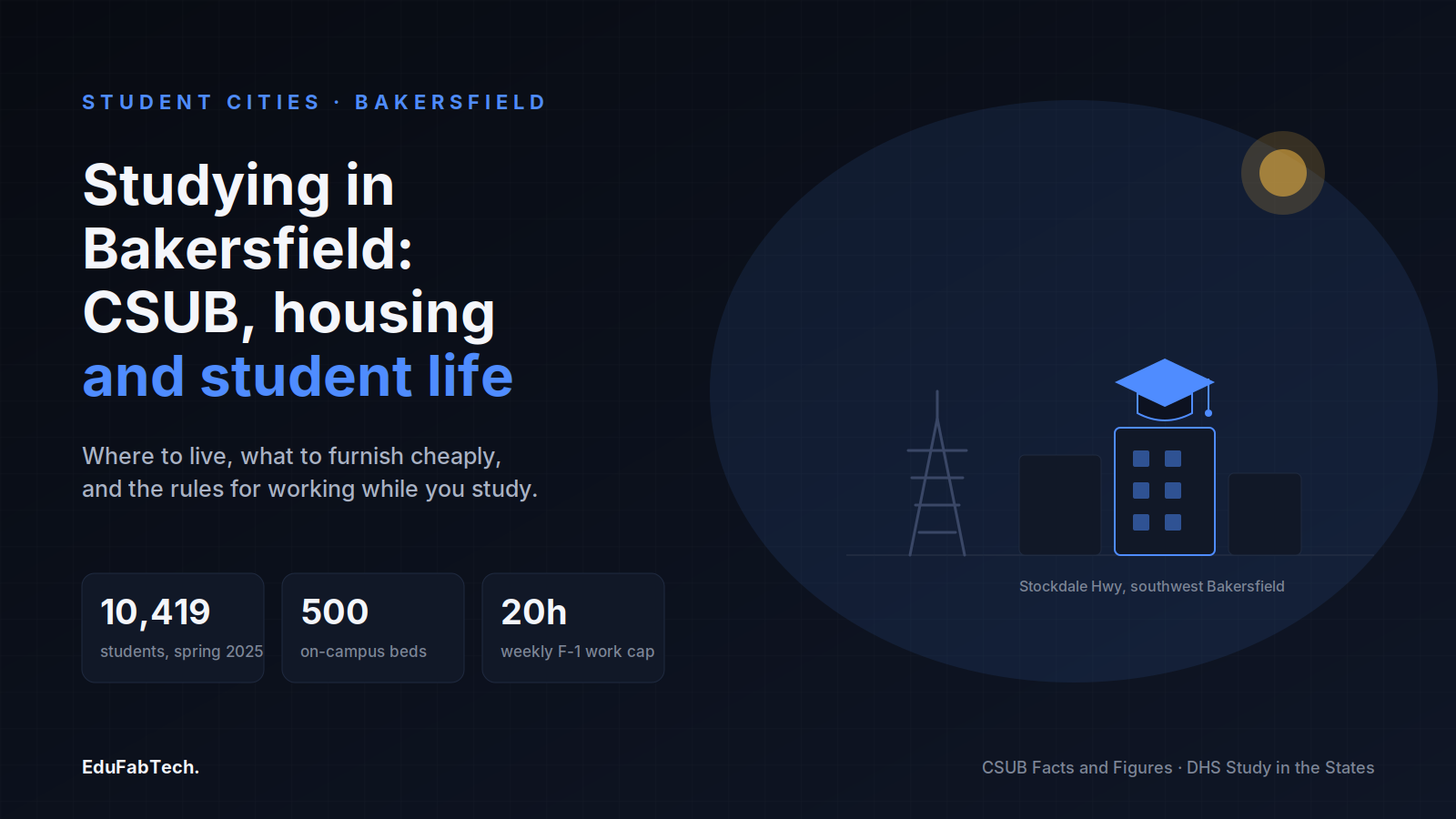
California State University, Bakersfield opened in September 1970 as the 19th campus of the California State University system, having been founded in 1965, according to the university's About CSUB page. Its main campus occupies a 375-acre site on Stockdale Highway, and in spring 2025 it served 10,419 students, of whom 86% were undergraduates and 14% graduate or post-baccalaureate students, per the university's Facts and Figures page. That same page lists more than 57 undergraduate and graduate degree programmes across four colleges — Arts and Humanities; Business and Public Administration; Natural Sciences, Mathematics and Engineering; and Social Sciences and Education.
CSUB is a comprehensive regional university rather than a research-heavy flagship, and it leans toward serving Kern County: teacher preparation, business, nursing and the health sciences, and the sciences and engineering are all substantial. Its sports teams, the Roadrunners, compete in NCAA Division I in the Big West Conference, with wrestling among the programmes the Facts and Figures page lists. Bakersfield College, a separate two-year community college on the north-east side of town, is the other large place students enrol; it grants associate degrees and some bachelor's programmes, and many students move between it and CSUB.
Where students live
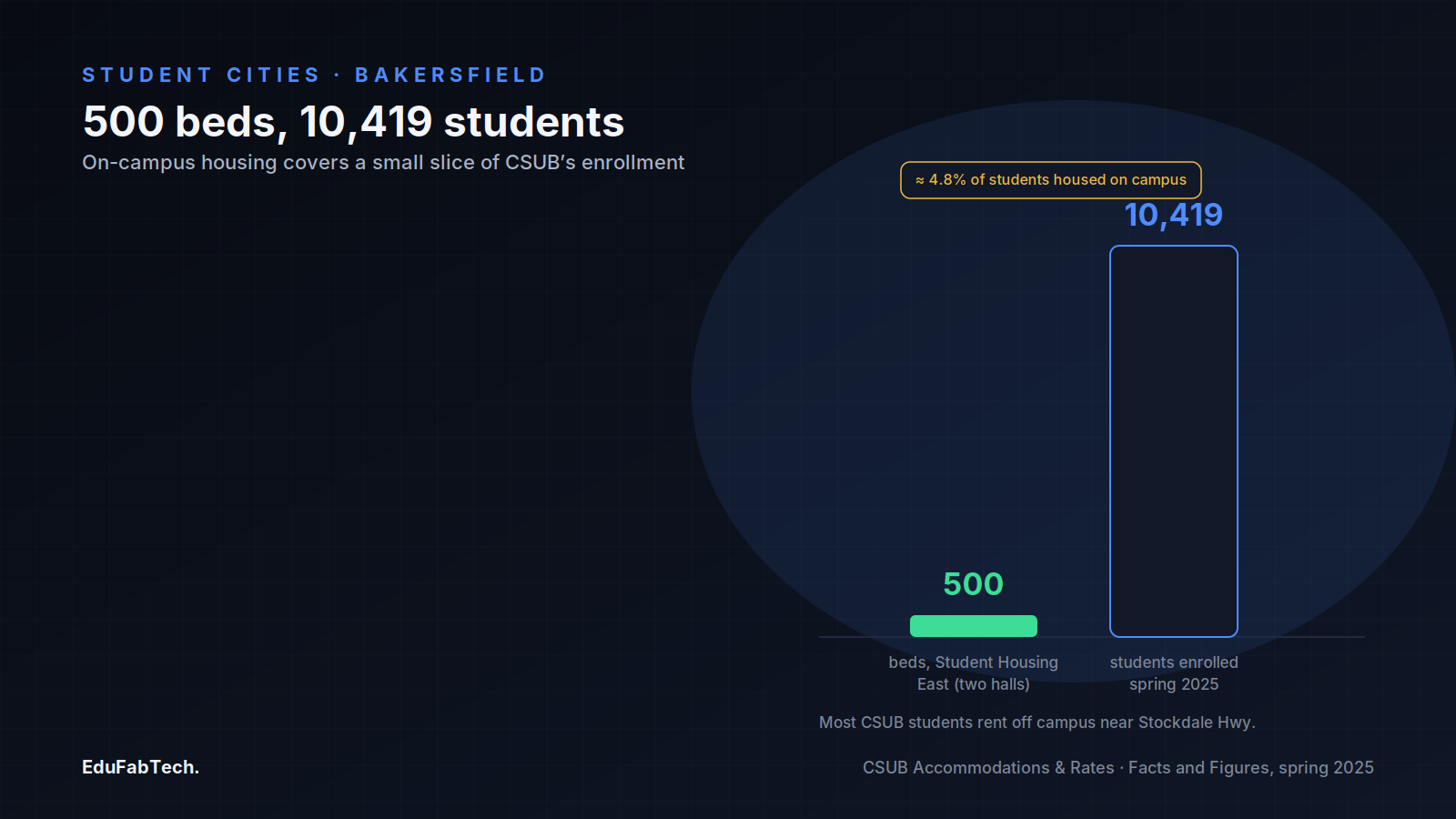
On-campus housing at CSUB is limited. The university's housing community, Student Housing East, is described on its Accommodations & Rates page as a 500-bed facility made up of two residence halls, Juniper Hall and Pinyon Hall. Set that 500 against the 10,419 students enrolled in spring 2025 and the arithmetic is obvious: the large majority of CSUB students live off campus, and a good share commute from elsewhere in the city or from nearby valley towns such as Delano, Shafter or Wasco.
Off campus, students mostly rent apartments or share houses in the newer south-west quadrant near the university — the grid around Stockdale Highway, Ming Avenue and Gosford Road — where much of Bakersfield's recent apartment building has gone. Rooms and apartments closer to downtown and to the older east side tend to be cheaper and older. Because the city is so car-oriented, where you live is really a question of how you will get to campus: a short drive, or a bus route that actually runs when you need it. Browse what students are currently offering on the Bakersfield rooms page, and look specifically at listings near California State University, Bakersfield if you want to stay within cycling or bus distance of the Stiern Library.
If you want on-campus housing, apply early through the CSUB housing office rather than assuming a bed will be free in August; with only 500 beds, demand is the constraint. For everyone else, start the off-campus search a month or two before term, and be ready to sign quickly when something near campus comes up.
Renting without losing a deposit
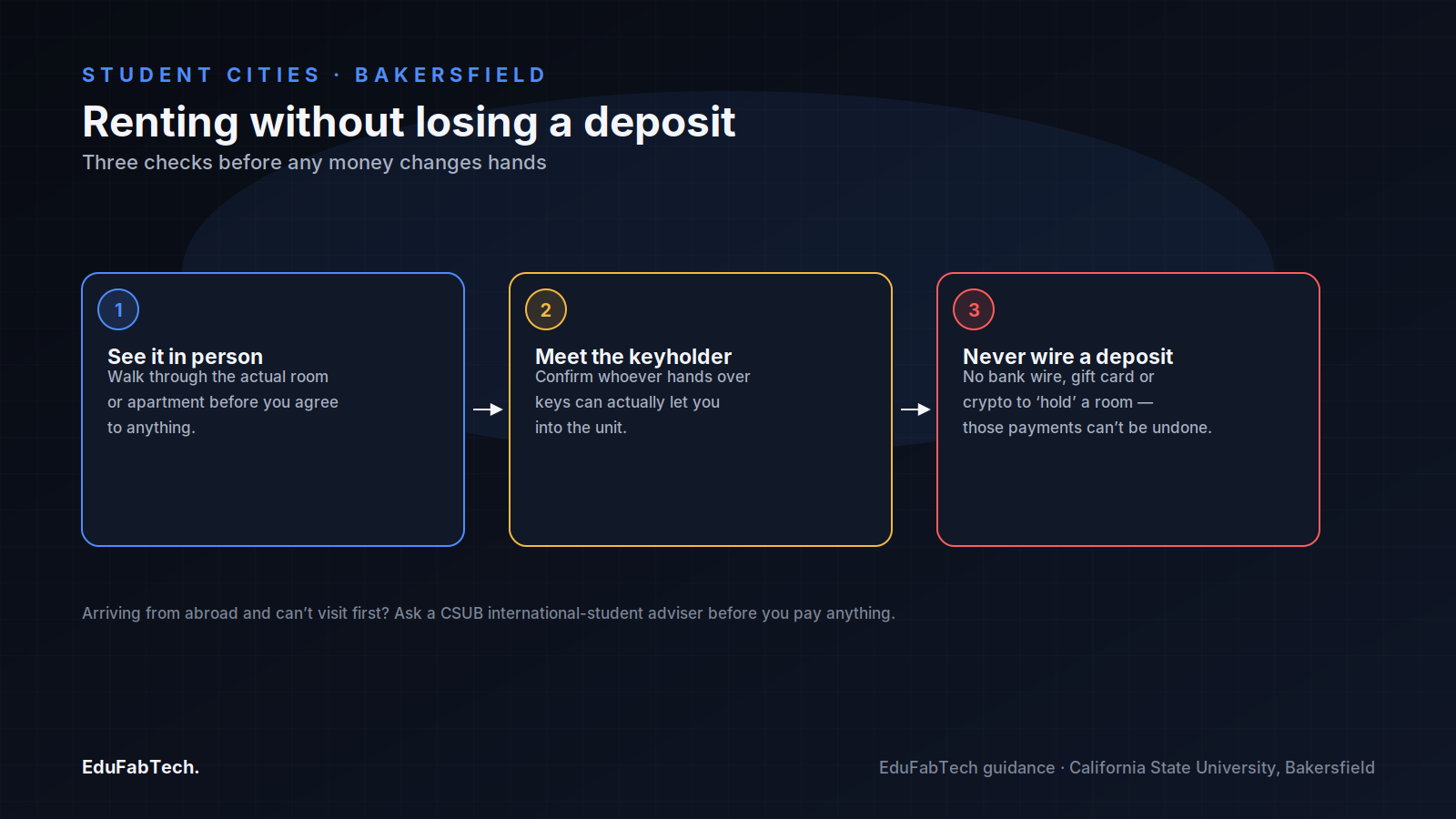
Most rental trouble in a car-dependent city like Bakersfield starts online, in the listings for the cheap-looking apartments and shared rooms that students reasonably chase. The pattern to watch for is the one that works anywhere: a place priced noticeably below the others nearby, a "landlord" who is conveniently out of town, and a request to wire a deposit or holding fee before you have seen the unit or met anyone.
The protections are concrete. See the actual apartment or room in person — Bakersfield is spread out but drivable, and anyone genuinely renting will let you walk through. Meet whoever hands over the keys and ask to see that they can let you in. Never send money by bank wire, gift card or cryptocurrency to "hold" a room; those payments cannot be reversed, and no legitimate Bakersfield landlord needs them. Be wary of any large up-front payment dressed up as an unusual or non-refundable fee before you have a signed lease. If you are arriving from abroad and cannot visit first, ask the university's housing office or an international-student adviser whether a listing or a landlord is known to them before you pay anything. EduFabTech does not name private landlords or agencies, and you should treat any listing — here or anywhere — as unverified until you have stood inside the room.
Furnishing a room cheaply: the swap meet and second-hand
Bakersfield's best-known second-hand institution is the swap meet at the Kern County Fairgrounds. According to the Kern County Fair, the swap meet runs in the Union Avenue parking lot at the Kern County Fairgrounds (1142 South P Street) on Tuesday, Saturday and Sunday from 6 a.m. to 3 p.m., and on Friday nights from 2 p.m. to 9:30 p.m., with adult admission between $1.50 and $2.50 depending on the day. It is an outdoor market where furniture, tools, kitchen goods, clothes and household odds and ends change hands cheaply — the obvious first stop for a student setting up an empty room, and worth going early for the best of the used goods.
Beyond the swap meet, the usual chain thrift and second-hand stores are scattered across the city, and students pass furniture and appliances between themselves at the end of each term, when leases turn over. On EduFabTech you can look through second-hand things in the city, from furniture to free giveaways — worth checking in May and June, when graduating students clear out. A mattress is the one item most people buy new; almost everything else in a first student room can be found used.
Working while you study
Many students work part time, and the rules differ sharply by immigration status. International students on an F-1 visa face federal limits rather than local ones. The U.S. Department of Homeland Security's Study in the States site states that if you participate in on-campus employment, you "may not work more than 20 hours per week when school is in session," and that the first step is always to talk with your designated school official, or DSO — the staff member at the university who authorises and tracks your work and status (Study in the States). On-campus jobs at CSUB — in the library, dining, departments or student services — are the straightforward route, because they can begin without a separate work-authorisation application; off-campus work (such as the practical-training categories) has its own conditions and approvals.
None of this is legal advice, and the rules change. Confirm your own situation with a CSUB international-student adviser and the official DHS pages before you accept any job. Domestic students face no such federal cap and compete for the same campus and retail work; current local openings students are sharing sit on the Bakersfield jobs page.
Libraries and places to study
On campus, the Walter W. Stiern Library is the main study building. Its LibGuides page describes individual and group study rooms reserved for the CSUB community, a Research Corner, and a 24-hour study room that stays open when the rest of the library is closed — a quiet zone for which a CSUB ID is required and may be checked, and from which non-campus guests are excluded (CSUB Library). The same page notes several hundred open table and carrel spaces alongside the bookable rooms, so there is room to work even in busy weeks.
Off campus, the public system is the Kern County Library, headquartered at the Beale Memorial Library at 701 Truxtun Avenue in downtown Bakersfield. The library system's hours page lists Beale as open Monday to Thursday 10 a.m. to 7 p.m., Friday 10 a.m. to 6 p.m., and Saturday 10 a.m. to 4 p.m., and lists further Bakersfield branches including Baker, Holloway-Gonzales, Northeast, Rathbun, Southwest and Wilson. A public-library card is worth having for quiet daytime study away from campus and for the branches closer to where you live. More desk-and-study-space listings are collected on the Bakersfield study spaces page.
Getting around
Public transport in the metro area is run by the Golden Empire Transit District, known as GET. For students the headline is the fare: GET's student-rides page states that a grant allows it to provide "FREE bus rides to all students Kindergarten through College including vocational and private schools" in the Bakersfield area, and confirms that students can continue to use their passes for the Fall 2026 school year (Golden Empire Transit District). Riders in 7th grade and older must show a student ID to the driver when presenting the pass, and passes can be picked up at the Customer Service Center at 2111 Chester Avenue, or at participating schools including Bakersfield College and CSUB, per the same page.
A free bus pass is a real saving, but be realistic about frequency and coverage: Bakersfield is a low-density, freeway-shaped city, and bus trips can be slow compared with driving. Many students end up with a car or a bicycle for the distances the network does not cover quickly, and plan their housing around a single reliable route to campus. Before you rely on the bus, check that a line runs near both your room and the university at the hours you actually travel.
Costs, and the honest trade-offs
The clearest dated housing figures come from the university itself. For 2026–27, CSUB's housing office lists a double room at $5,010 per semester per resident, a triple at $4,180 per resident, and a single at $7,020 per resident, and states that all resident students are required to have a meal plan, with a base cost of $2,720 per student per semester (CSUB Accommodations & Rates). For the wider city, Census Reporter's summary of the U.S. Census Bureau's 2024 American Community Survey one-year estimates put Bakersfield's population at 417,461, its median household income at $82,093 and per-capita income at $33,380 (Census Reporter). A reliable, recent citywide median student rent is harder to pin to a primary source, so treat any single rent figure cautiously and compare several current listings before you budget.
What is genuinely good about Bakersfield for a student is cost and space: rents and everyday prices are well below coastal California, and a modest budget stretches further here than in Los Angeles or the Bay Area. Free GET passes remove one recurring expense. The campus is calm and the valley is close to the Sierra Nevada, the coast and the mountains for weekends.
What is hard is equally concrete. Summers are long and very hot, and winter brings Tule fog and the poor air quality the San Joaquin Valley is widely known for — a real consideration if you have asthma or run outdoors. The city is spread out and built around driving, so without a car or a convenient bus route, daily life takes longer. And CSUB is a commuter-shaped campus with only 500 residential beds, so the dense, walkable student-town feel of some college cities is simply not here. Students who thrive in Bakersfield tend to be the ones who sort out transport and housing early and make their own community on campus.
A checklist for the first weeks
- If you want on-campus housing, apply through the CSUB housing office as early as possible — there are only 500 beds.
- Searching off campus, view the room in person, meet whoever holds the keys, and never wire a deposit, send gift cards or pay in cryptocurrency to "hold" a place.
- Pick up your free GET student pass at the Customer Service Center (2111 Chester Avenue) or at CSUB, and carry a student ID to show the driver.
- International students: book a first appointment with a CSUB designated school official before taking any job, and confirm the on-campus 20-hour limit on the DHS Study in the States pages.
- Get both a CSUB student ID for the Stiern Library's 24-hour room and a Kern County Library card for the Beale Memorial Library downtown.
- Furnish the room from the Kern County Fairgrounds swap meet and end-of-term giveaways; buy only the mattress new.
- Plan your week around one dependable route to campus, and prepare for extreme summer heat and winter fog and air quality from the start.
For current rooms, jobs, second-hand goods and study spaces in the city, the Bakersfield listings on EduFabTech are updated as students post them.
A quick question for readers
Do you work part-time while you study?
Many students work to pay the bills. See how common it is — and how many hours people really do.
Pick an answer, create a free account in a minute, and your vote counts. Already a member? Sign in
Comments 3
Comment-
The free GET pass gets pitched as the recurring-cost win, but read on and the same piece admits bus trips can be slow and that many students…
-
The number that actually tells you something here is 500 beds against 10,419 students enrolled in spring 2025. That's under 5% residential c…
-
The stat that jumps out is 500 beds against 10,419 students, and then the housing office prices a single at $7,020 a semester anyway - so th…
Join free to read the full comments and reply Comments are between members; an account takes a minute.
Source: California State University, Bakersfield
Sources (5)
- California State University, Bakersfield. Facts and Figures. California State University, Bakersfield, 2025. csub.edu ↗ · checked 29 Oct 2026
- California State University, Bakersfield. Accommodations & Rates. California State University, Bakersfield, 2026. csub.edu ↗ · checked 29 Oct 2026
- Golden Empire Transit District. Free Bus Rides for Students. Golden Empire Transit District, 2026. getbus.org ↗ · checked 29 Oct 2026
- Kern County Library. Find Hours & Locations. Kern County Library, 2026. kerncountylibrary.org ↗ · checked 29 Oct 2026
- Census Reporter. Bakersfield, CA — Profile data. Census Reporter (U.S. Census Bureau ACS 2024 1-year), 2024. censusreporter.org ↗ · checked 29 Oct 2026