Studying in Baltimore: universities, housing and student life
A practical, sourced guide to Baltimore's universities, the neighbourhoods students actually live in, finding a room safely, part-time work, markets, libraries, transit and the honest trade-offs.
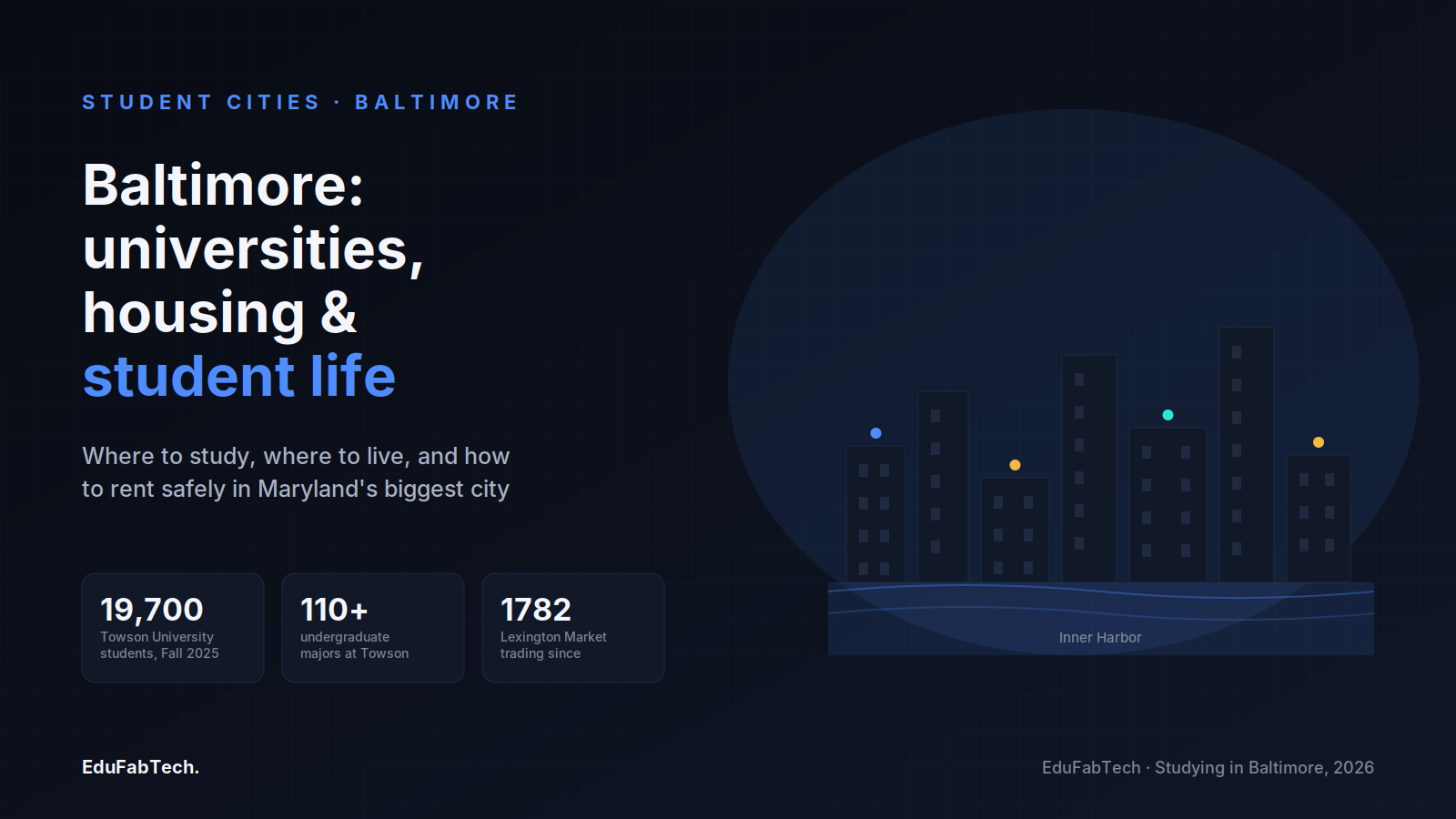
Baltimore is a city of row houses, red brick and water. It sits at the top of the Chesapeake Bay in the mid-Atlantic United States, close enough to Washington for a day trip but with a character entirely its own: industrial, literary, musical, often described by its residents as a big town rather than a small metropolis. For students it offers something increasingly rare in an American city — a genuinely large concentration of universities inside a place where rent is still within reach.
What makes Baltimore unusual is the mix. A single bus ride can take you from one of the world's leading research universities to a historically Black university that has been teaching since the nineteenth century, to a downtown professional campus turning out most of the region's doctors, dentists and lawyers. This guide walks through who teaches where, which neighbourhoods students settle in, how to rent a room without being cheated, and what daily life actually costs — with every figure tied to the institution and year that published it.
A word on geography before anything else: "Baltimore" means two things. There is the independent City of Baltimore, and there is the much larger Baltimore County and metro area wrapped around it. Several of the universities below are not in the city at all but in the suburbs and satellite towns — worth knowing before you sign a lease on the wrong side of a long commute.
The universities, and what studying here is like
The best-known name is Johns Hopkins University, whose main undergraduate Homewood campus sits on North Charles Street in the Charles Village area of north Baltimore, home to its Krieger School of Arts and Sciences and Whiting School of Engineering. Its medical campus — the Johns Hopkins School of Medicine — is on the other side of the city in East Baltimore, near Butcher's Hill, and runs on its own rhythm. Hopkins is intense, research-heavy and international; studying there means small seminars alongside enormous laboratories, and a student bubble that can feel separate from the neighbourhoods around it.
Downtown, the University of Maryland, Baltimore is the state's public health, law and human-services campus, made up of professional schools of medicine, law, dentistry, nursing, pharmacy and social work — it describes its dental school as the first in the world. If you are here, you are almost certainly a graduate or professional student, and your life is organised around the clinics and courts of the west side of downtown. Nearby, the University of Baltimore on North Charles Street is a career-focused public university built around business, law, public affairs and the applied arts, with a long tradition of taking transfer students and older learners who work while they study.
To the north-east, in the Waltherson area, Morgan State University is Maryland's largest historically Black university and a public research university; its campus is the only university campus the National Trust for Historic Preservation has designated a National Treasure, an honour it received in 2016. It is known for engineering, architecture, business and the social sciences, and for a campus culture — marching band, homecoming, student organisations — that is central to the experience, not a sideshow. On the west side, Coppin State University is a smaller historically Black university in West Baltimore with a strong nursing school and deep roots in teacher education and community service.
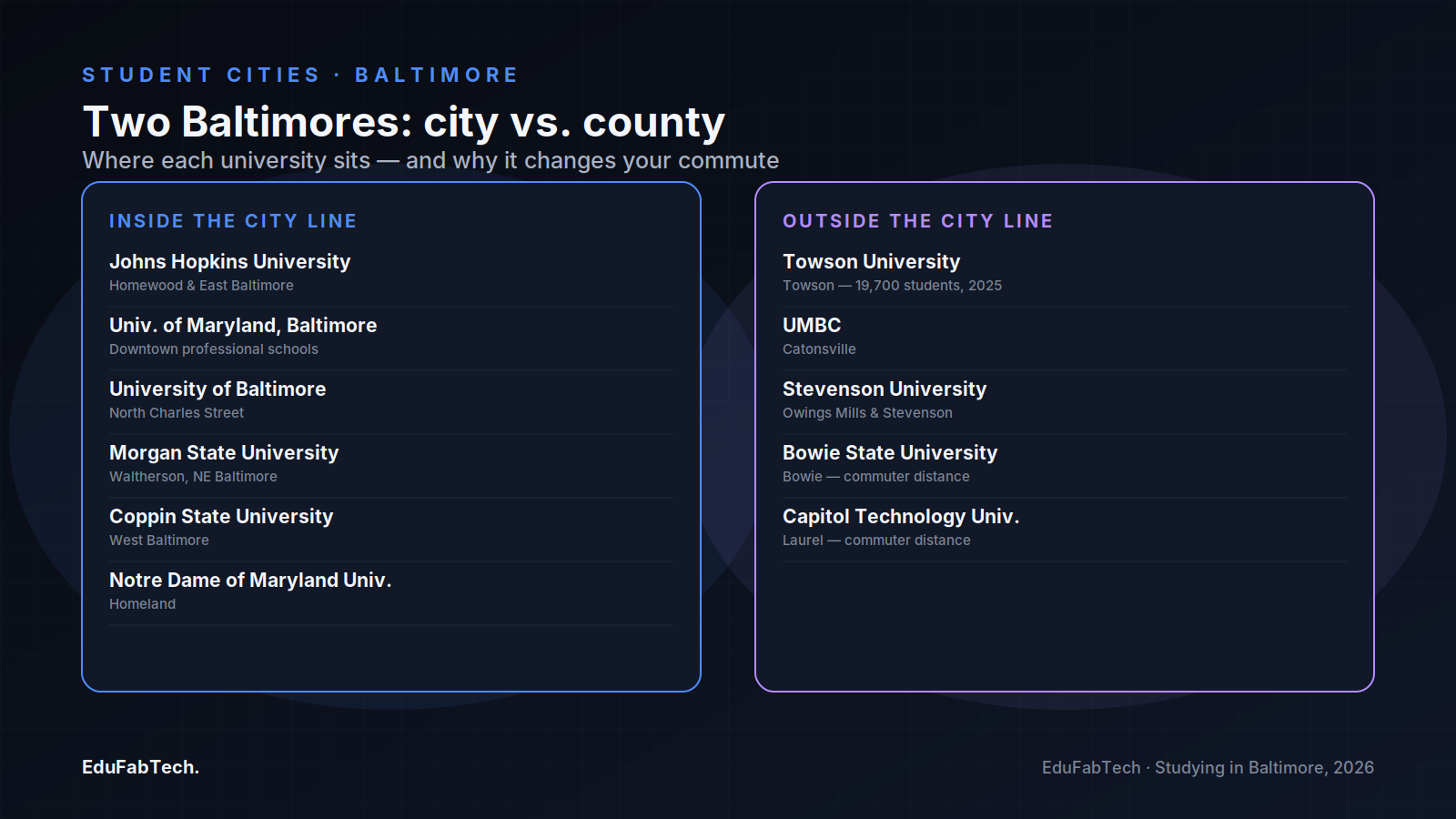
Two large public campuses sit just outside the city line and pull in huge numbers of Baltimore students. Towson University, in the leafy suburb of Towson to the north, is a large public university that reported a Fall 2025 enrollment of about 19,700 students across more than 110 undergraduate options plus master's and doctoral programmes in the arts and sciences, business, health and education. South-west of the city in Catonsville, the University of Maryland, Baltimore County (UMBC) styles itself "an honors university in Maryland" and is nationally known for STEM research, its chess team, and a model for supporting under-represented students in science through its Meyerhoff Scholars Program.
Two private institutions round out the city proper. Notre Dame of Maryland University, in the quiet Homeland neighbourhood between Guilford and the northern suburbs, is a Catholic institution historically focused on educating women and known for its school of pharmacy. Stevenson University is a career-oriented private university with campuses just north-west of the city in Owings Mills and Stevenson, strong in nursing, business and the health sciences.
Other universities in and around Baltimore
- Bowie State University — Maryland's oldest historically Black university (founded 1865), now based in Bowie, roughly midway between Baltimore and Washington; it began in Baltimore before moving south, so it is a commuter option only for students on the city's far southern edge.
- Capitol Technology University — a small STEM-focused private university in Laurel, south of the city, specialising in engineering, computer science, cybersecurity and aerospace; like Bowie State, it is really between the two cities rather than in Baltimore itself.
- Several historic institutions survive only in the record or inside today's universities: the Old Baltimore College of Dental Surgery and the former College of Medicine of Maryland are now part of the University of Maryland, Baltimore; Woodstock College (a former seminary near Randallstown), Rock Hill College in Ellicott City, and Sojourner–Douglass College have all closed.
Where students actually live
Charles Village is the classic student neighbourhood, wrapped around the Homewood campus. Painted row houses, cheap eats, and the ability to walk to class make it the default for Hopkins undergraduates; rents are lower than you might expect for how central it is. Remington and Waverly, just to the west and east, are a little cheaper and increasingly popular with graduate students who want the same walk to campus for less.
Mount Vernon, just north of downtown, is the cultural heart of the city — mid-rise apartments and converted townhouses around monuments, museums and the Peabody Conservatory. It suits students at the downtown and arts campuses and anyone who wants a dense, walkable, lively base. Hampden, west of Homewood, is Baltimore's famously quirky quarter, built around "The Avenue" on West 36th Street; upper-year and graduate students gravitate here for vintage shops, cafés and a bit more space in shared houses.
Fells Point and Canton, on the waterfront south-east of downtown, are livelier and pricier, full of bars, restaurants and young professionals; they are a reasonable bet for medical and professional students who want nightlife and don't mind paying for it. For those studying at Towson or UMBC, living near campus in Towson or Catonsville — small, green, suburban town centres — usually beats commuting from the city, though you will want a bike or a transit pass to avoid depending on a car.
Finding a room without getting burned
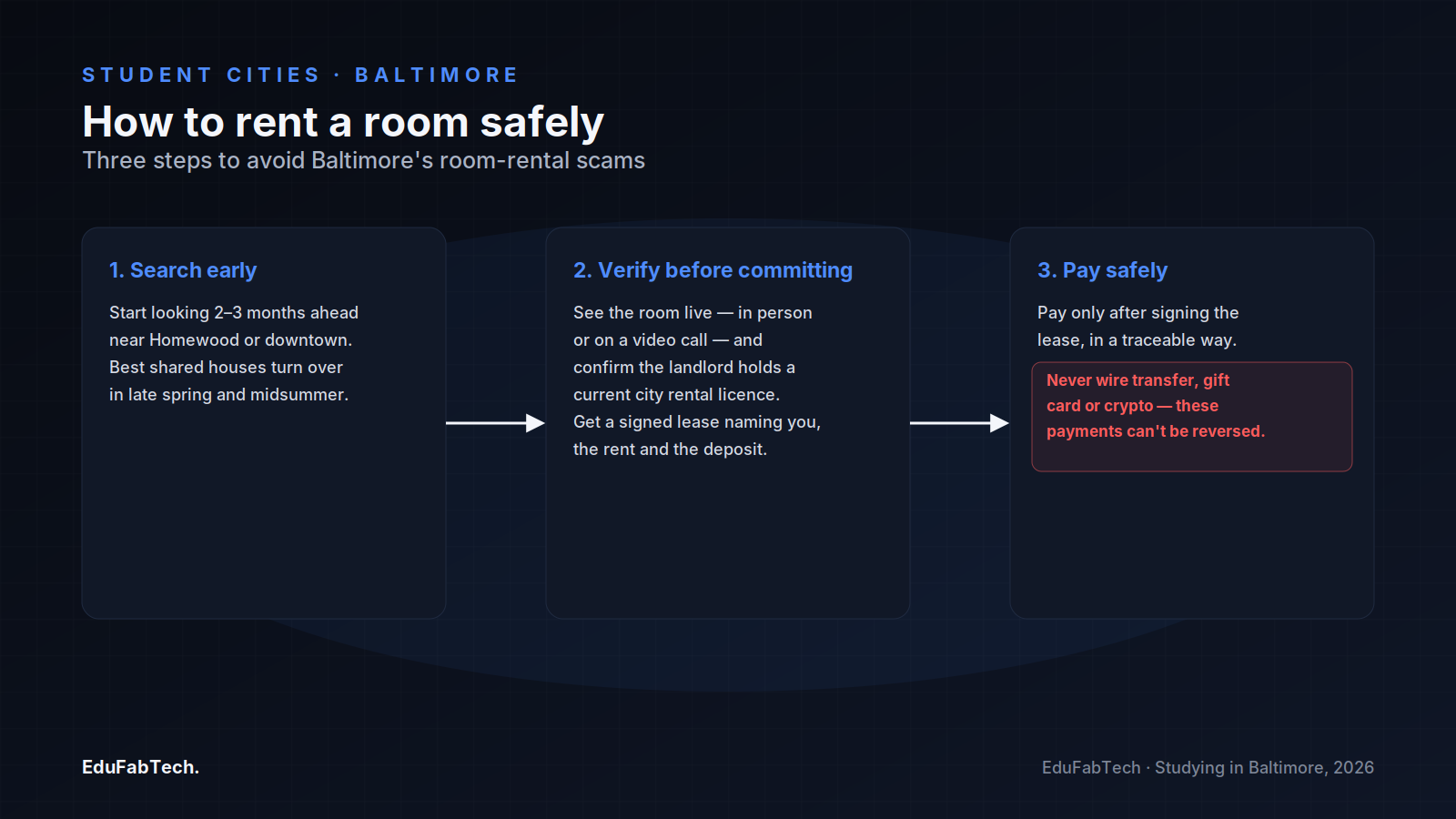
Most students rent either a room in a shared row house or a studio in a small apartment building. The academic year runs roughly September to May, and the market moves earliest around the big campuses: for a place near Homewood or downtown, start looking two to three months ahead, and expect the best shared houses to turn over in late spring and midsummer. Check the basics before you commit anything: that heating and hot water work (Baltimore winters are real), that the lease names you and lists the rent and deposit clearly, who pays for utilities, and whether the landlord holds a current rental licence for the property, which the city requires. Browse what is currently on offer across the city on EduFabTech's rooms listings, or look specifically near Johns Hopkins University if you want to minimise the commute.
On scams: never pay a deposit or "holding fee" for a room you have not seen with your own eyes, in person or over a live video call where the person can show you the actual property and the street outside. A listing far below the going rate, a landlord who is conveniently abroad, or pressure to decide today are all warning signs. Above all, never send money by bank wire transfer, gift card or cryptocurrency to secure a room — these payments cannot be reversed, and that is exactly why scammers ask for them. Pay in a traceable way, only after a signed lease, and only to a landlord you have verified.
Furnishing a room for next to nothing
Baltimore is a thrifter's city, and you can furnish a room cheaply if you are willing to hunt. Lexington Market, trading since 1782, bills itself as the longest continuously operating public market in the country and is a good first stop for cheap food and the feel of the old city; Cross Street Market in Federal Hill and the historic Hollins Market and Broadway Market are smaller neighbourhood versions. For second-hand furniture, housewares and clothes, the city's thrift and salvage shops are where students actually kit out a room. And for books, Baltimore has something genuinely unusual: The Book Thing, a volunteer-run warehouse that gives books away entirely free, every weekend, no purchase required.
Online, start with EduFabTech's local page for used furniture and second-hand things — the end of each semester, when students move out, is when the best free furniture appears on the kerb and online.
Working part-time while you study
Pay for casual work is anchored to the state floor: Maryland's statutory minimum wage was US$15.00 an hour as of 2026 according to the state labour department, with a few neighbouring counties setting their own higher rates. For international students the rules are stricter and matter enormously: under federal immigration regulations, a student on an F-1 study visa may generally work on campus up to 20 hours per week while classes are in session, and full-time during official breaks, with the approval of their school's designated official. Off-campus work needs separate authorisation. This is not legal advice — your own status, school and circumstances govern what you may do, so check with your university's international student office and the official guidance before you accept any job. When you are ready to look, local part-time jobs are listed here.
Libraries and places to study
Each university has its own library — the Milton S. Eisenhower Library serves Homewood, and students at the downtown campuses have access to specialist health and law collections. Two libraries, though, are worth seeking out whichever campus you attend. The Enoch Pratt Free Library, one of the oldest free public library systems in the country, has a grand Central Library on Cathedral Street that anyone can use for reading, studying and free wifi, plus branches across the city. And the George Peabody Library in Mount Vernon — now part of Johns Hopkins — is one of the most beautiful reading rooms anywhere, five tiers of cast-iron balconies rising to a skylight, and it remains open to the public. For quieter, bookable desks and study rooms around the city, see EduFabTech's study spaces listings.
Getting around
Baltimore is compact enough to walk or cycle in its core, and most students get by without a car. The regional transit network runs local buses, a Light RailLink line that threads north–south through the city, a Metro SubwayLink line, and MARC commuter trains out to Washington and beyond. A single trip on the local bus, light rail or metro costs US$2.00 at the full fare, with a US$1.50 student fare and a US$4.60 day pass according to the regional transit authority's 2025 fare schedule; students need a valid transit ID to claim the reduced rate, so ask your university or the transit authority how to obtain one. Downtown, the city also runs the free Charm City Circulator shuttle on several colour-coded routes. Many students combine transit with a bike, and several campuses sit on or near the city's growing network of trails and bike lanes.
What costs, and what is hard
Housing is the dominant cost, and it is where Baltimore compares well with its neighbours. As a benchmark, Towson University's official 2025–2026 cost-of-attendance budget set its room-and-food (housing and board) allowance at US$16,666 for the academic year — a useful institutional estimate for the suburbs, with shared rooms in the city often coming in below that. The honest picture, though, has two sides.
The good: rent and everyday costs are markedly lower than in Boston, New York or Washington; the city is small and walkable; the universities are serious and varied; and Baltimore's food, music and museum scene punches above its size, with much of it free or cheap for students. The hard: Baltimore is a city of sharp contrasts, and safety varies block by block rather than neighbourhood by neighbourhood — it pays to learn your specific streets and to walk them before you rent. Public transit is usable but patchy and can be slow, so a bad commute can quietly dominate your week. Summers are hot and humid, winters cold; and the student bubbles around the wealthier campuses can feel disconnected from the wider city unless you make the effort to step outside them.
A checklist for your first weeks
- See any room in person or on a live video call before paying, and never wire money, send gift cards or pay in crypto to hold a place.
- Get the lease in writing with your name, the rent, the deposit and the utilities clearly stated, and confirm the property has a valid rental licence.
- If you are an international student, visit your university's international student office in week one and confirm your work and status rules before taking any job.
- Get a transit ID and, if eligible, the student fare; work out your real door-to-campus commute before you rely on it.
- Join a library — the free public system as well as your university's — for study space, wifi and quiet.
- Furnish from markets, thrift shops, free-book warehouses and end-of-semester giveaways rather than buying new.
- Walk your neighbourhood at different times of day so you know your own streets, and find the nearest late shop, pharmacy and clinic.
- Browse everything for students in the city on EduFabTech Baltimore.
A quick question for readers
Do you work part-time while you study?
Many students work to pay the bills. See how common it is — and how many hours people really do.
Pick an answer, create a free account in a minute, and your vote counts. Already a member? Sign in
- University of Maryland, Baltimore. About UMB. University of Maryland, Baltimore, 2025. link
- Towson University. Facts & Figures. Towson University, 2025. link
- Towson University Office of Financial Aid. 2025-2026 Cost of Attendance Budgets. Towson University, 2025. link
- Maryland Transit Administration. Regular Fares. MDOT MTA, 2025. link
- Maryland Department of Labor. Maryland Minimum Wage and Overtime Law. Division of Labor and Industry, 2026. link
- U.S. Citizenship and Immigration Services. Policy Manual, Volume 2, Part F, Chapter 6: Employment. USCIS, 2025. link
- Baltimore Public Markets Corporation. Our Story (Lexington Market). Baltimore Public Markets, 2024. link
- Enoch Pratt Free Library. Central Library. Enoch Pratt Free Library, 2025. link