Studying in Bielefeld: universities, housing and student life
A practical, honest guide to the universities, rooms, markets, jobs, libraries and transport of a working city folded into the Teutoburg Forest ridge in East Westphalia.
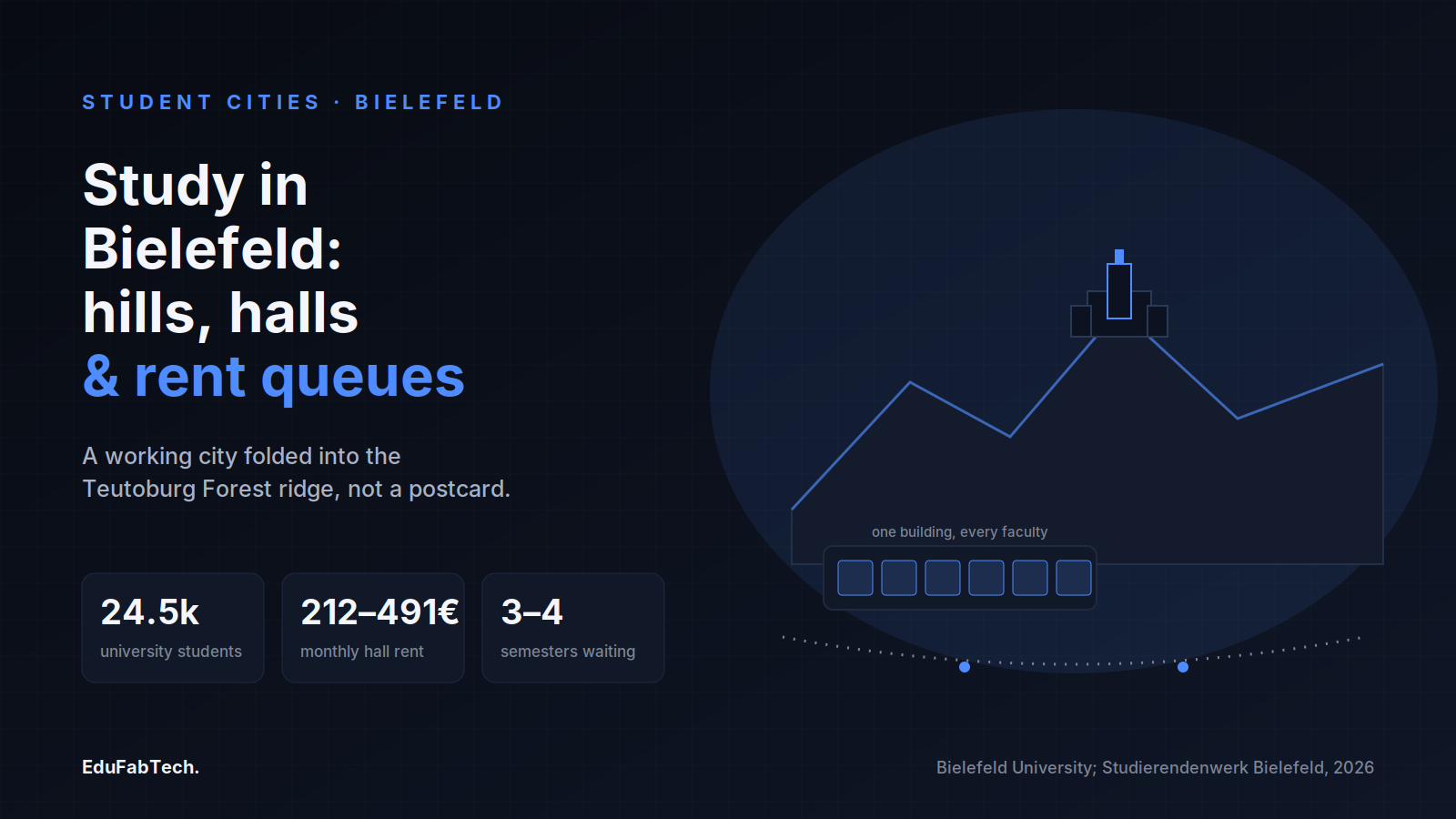
A university city folded into the Teutoburg Forest
Bielefeld sits in East Westphalia-Lippe (Ostwestfalen-Lippe, often shortened to OWL), on the wooded ridge of the Teutoburg Forest that cuts diagonally through the city. The old town gathers below the Sparrenburg, the medieval castle on the hill, and the former linen-weaving trade that gave the city its nickname — the Leineweberstadt — has long since given way to food companies, machine builders and, for tens of thousands of residents each winter semester, universities. The ridge matters in daily life: neighbourhoods on the southwestern side of it feel quite separate from the centre, and a bike commute that looks short on a map can involve a climb.
The result is a city that does not perform for visitors the way Heidelberg or Freiburg do, and students tend to describe that plainly: rents are lower than in the big Rhine cities, the centre is compact, and the social life is built around a handful of squares and the campus rather than a picture-postcard core. If you want a student town that is affordable and functional rather than famous, Bielefeld is a reasonable bet — provided you understand how its housing and transport actually work.
This guide names the institutions, the housing provider, the transit operator and the authorities you will deal with, and attaches a source to every figure. Where a number could not be verified against a primary page, it has been left out. Everything about opening hours, rents and rules changes, so check each linked page before you rely on it.
The universities, and who studies where
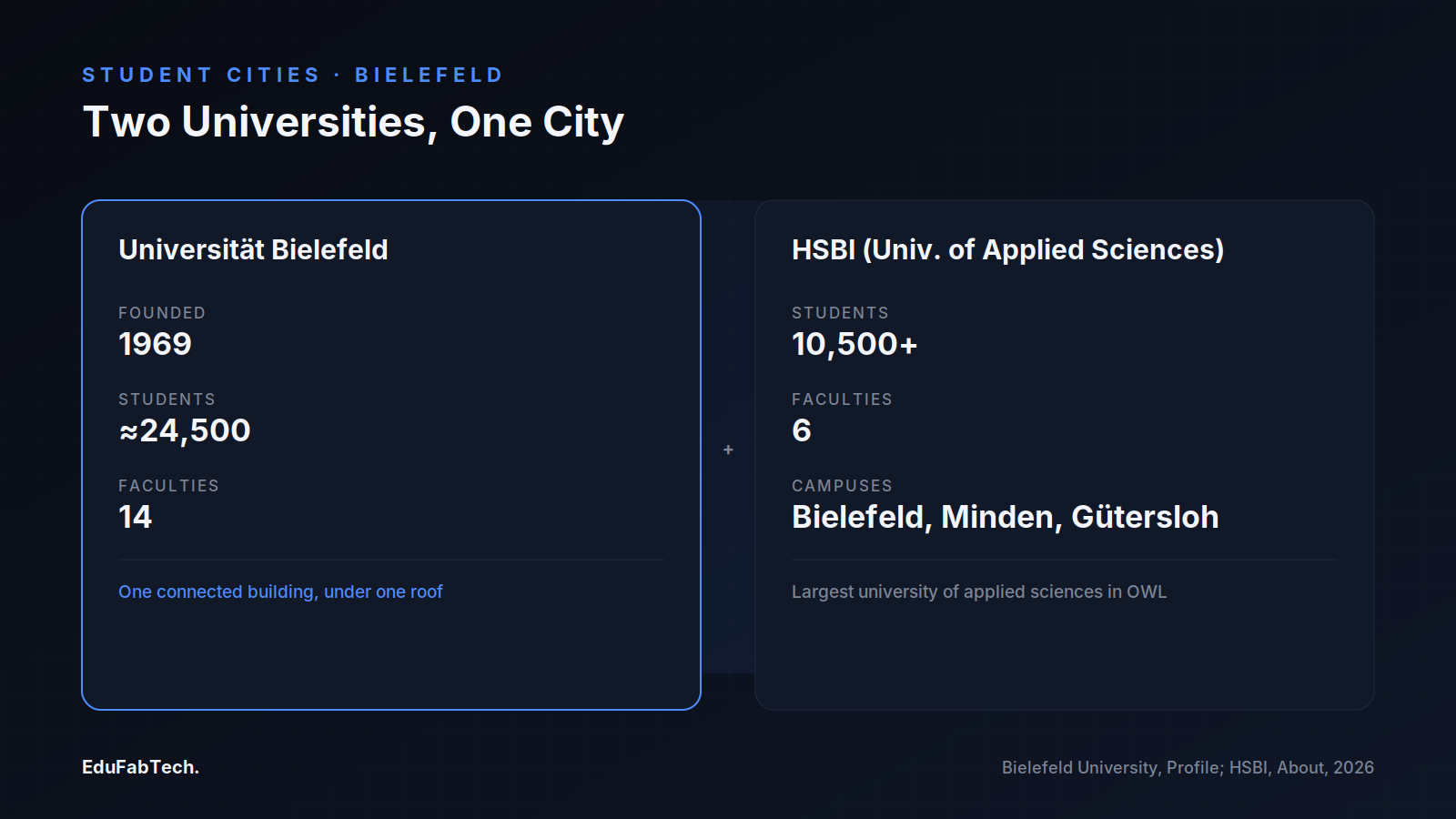
Bielefeld University (Universität Bielefeld) is the anchor. Its own profile page states it was founded in 1969, teaches roughly 24,500 students, and is organised into 14 faculties spanning the humanities, natural and engineering sciences and medicine (Bielefeld University, Profile, 2026). Architecturally it is unusual: the core of the campus is one enormous connected building on the northwestern edge of the city, so that lecture halls, cafeterias, the library and offices sit under effectively one roof — convenient in a Westphalian winter. The university was built with a research mandate and has a long reputation in sociology and the social sciences.
Hochschule Bielefeld – University of Applied Sciences and Arts (HSBI) is the applied counterpart. HSBI's own page describes it as having more than 10,500 students and being the largest university of applied sciences in OWL, with campuses in Bielefeld, Minden and Gütersloh and six faculties including Design and Art, Engineering and Mathematics, and the Bielefeld School of Business (HSBI, About, 2026). Its Bielefeld campus sits close to the university in the north of the city.
Three more degree-granting institutions in the task area lie outside Bielefeld itself but draw students from the same region. Technische Hochschule OWL (TH OWL) has campuses in Lemgo, Detmold and Höxter; its Detmold campus is home to the Detmold School of Design (TH OWL, Faculties, 2026). Hochschule für Musik Detmold is a public conservatory in Detmold, training performers, composers, conductors, church musicians and music teachers (Hochschule für Musik Detmold, 2026). The University of Cooperative Education Melle (Berufsakademie Melle), in Melle in the neighbouring Osnabrück district, awards dual-study bachelor's degrees that alternate study blocks with paid work, in Social Work, Wood and Furniture Technology, and Glass, Windows and Façade (Berufsakademie Melle, 2026). HSBI and TH OWL also share a joint Campus Minden, worth knowing if your programme is based there rather than in Bielefeld. You can browse student listings on EduFabTech's Bielefeld hub, and specifically near Bielefeld University.
Where students live — and how to rent without losing a deposit
Most newcomers aim for the belt of districts near the university in the city's north — Gellershagen, Schildesche and the streets around Universitätsstraße and Voltmannstraße — because the campus, the hospital and a Stadtbahn stop are all there. The other student pull is the Westviertel around Siegfriedplatz, known locally as the "Siggi", a denser quarter of older flats, cafés and bars that suits people who want city life over a short commute. The centre (Mitte) and districts like Sennestadt further south are cheaper but mean more time on the tram.
The largest organised provider is Studierendenwerk Bielefeld, which runs student residences in Bielefeld and the surrounding OWL campus towns, including halls close to the university. Its housing pages put the current monthly all-inclusive warm rent — covering heating, water, electricity and in most houses internet — between 212 € and 491.20 € as listed in 2026, and warn that waiting lists for its apartments currently run about three to four semesters because demand is high (Studierendenwerk Bielefeld, Wohnen, 2026). The practical lesson: apply the moment you receive your admission letter (Zulassungsbescheid), and treat a hall place as something you queue for, not something guaranteed for your first semester. Private shared flats (WGs) are the common fallback, and current tenants usually pick their own replacement rather than working through a waitlist.
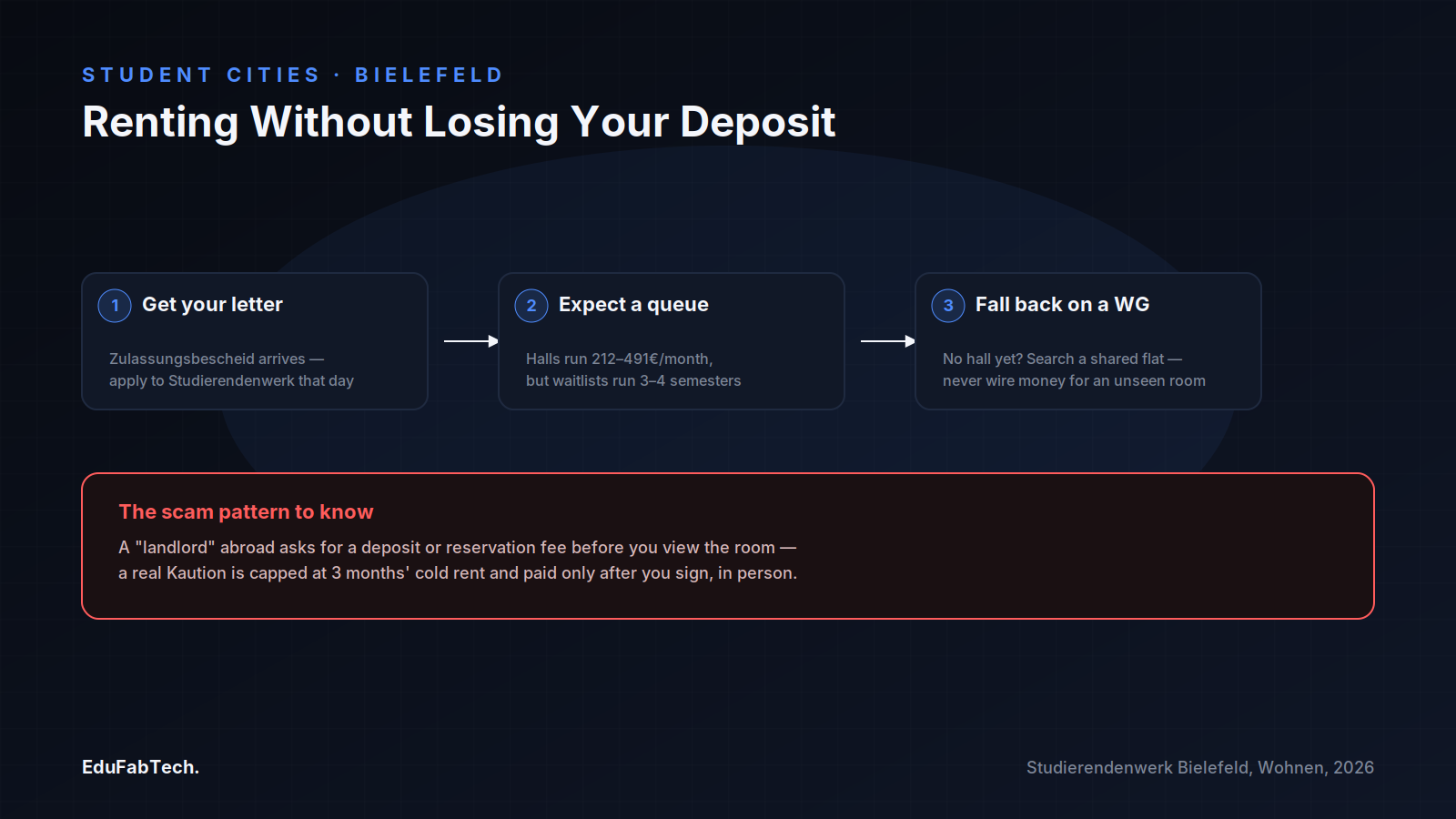
Rental fraud in Bielefeld, as elsewhere in Germany, clusters around online classified listings aimed at students who have not arrived yet. The pattern is consistent: an attractive flat, a "landlord" who is abroad or unavailable, and a request to wire a deposit or a "reservation fee" before you can view the place or receive keys. Do not send money to hold a room you have not seen. A legitimate deposit in Germany is a Kaution — capped by law at three months' cold rent — paid into a proper account after you sign, not transferred in advance by instant bank transfer, gift card or cryptocurrency to secure a viewing. If you cannot travel to Bielefeld to see a room, ask someone you trust to view it in person, or start with a Studierendenwerk place or a short booking and search for a WG once you are in the city. EduFabTech lists rooms in Bielefeld, but the same caution applies to every platform.
Furnishing a room: markets, flea markets and second-hand
Furnishing cheaply is realistic here because Bielefeld has a steady second-hand culture and regular markets. The city runs several weekly markets (Wochenmärkte): the main one, the Hauptmarkt on the Kesselbrink, trades on Saturdays from 7:00 to 13:00, and the Siegfriedmarkt on Siegfriedplatz runs Wednesdays and Fridays from 7:00 to 13:00, with more in the eastern districts (City of Bielefeld, Wochenmärkte, 2026). Those are food markets, useful for cheap produce rather than furniture, but they anchor the rhythm of a neighbourhood and the Kesselbrink in particular also draws clothing and household stalls.
For actual furniture and kitchen gear, the cheapest routes are student move-out seasons (late March and late September, when leases turn over), neighbourhood flea markets, and give-away culture. Rather than name private shops or platforms, start with EduFabTech's local pages for second-hand things in the city; a desk, a shelf and a bike can usually be assembled for very little if you are patient across a couple of weekends. Bring your own transport for anything large — Bielefeld's hills make carrying a bookshelf home on the tram less charming than it sounds.
Working while you study
A part-time job is normal for students here, and the rules differ by nationality. The DAAD sets out that international students from outside the EU/EEA may work 140 full days or 280 half days per year, and that anyone wanting to work more needs permission from both the Agentur für Arbeit (Federal Employment Agency) and the Ausländerbehörde, the local foreigners' authority (DAAD, Side jobs, 2026). EU and EEA students are broadly treated like German students. This is a summary, not legal advice: your exact conditions are written on your residence permit, and the authority that interprets them is Bielefeld's own immigration office, so confirm your limits with them and with the DAAD page before you sign a contract. Working as a student assistant (Hilfskraft) at the university is often treated differently, and a job on campus also saves you a commute. Current openings posted on EduFabTech are on the Bielefeld jobs page.
Libraries and places to study
Study space is one of Bielefeld's genuine strengths, largely because the university library sits inside that single main building. The Universitätsbibliothek's branches (including the central BDZ and the subject libraries) are generally open Monday to Friday from 08:00 to 24:00 and on weekends and public holidays from 09:00 to 22:00 (Bielefeld University Library, Opening hours, 2026). Late closing times matter during exam periods, when desks fill quickly and the walk home is short because everything is under one roof. HSBI runs its own library with a learning centre on the Bielefeld campus. Beyond the libraries, cafés around Siegfriedplatz and the centre are the usual informal spots; EduFabTech also collects bookable study spaces and desks in the city.
Getting around on the Deutschlandsemesterticket
The local operator is moBiel, which runs Bielefeld's Stadtbahn (light rail) and buses. Since 1 April 2024 enrolled students at Bielefeld University have received the Deutschlandsemesterticket, valid everywhere the national Deutschlandticket is valid, and the university notes that Stadtbahn line 4 and bus line 31 stop directly at the campus (Bielefeld University, Mobilität, 2026). moBiel confirms the Semesterticket for students and that no first-class upgrade is needed for its own trams and buses (moBiel, Semesterticket für Studierende, 2026). In practice the ticket is bundled with your semester fee and covers not just Bielefeld but regional and national regional-rail travel, which makes weekend trips cheap. Line 4 is the student artery: it links the campus to the centre and the main station. Bikes are common despite the ridge, and the flatter northern districts are easy to cycle.
Costs, and the honest trade-offs
The strongest case for Bielefeld is money. A Studierendenwerk hall room at an all-inclusive warm rent starting around 212 € per month in 2026 is well below what comparable rooms cost in Munich, Frankfurt or Cologne, and the city is compact enough that a semester ticket plus a bike removes most transport spending. The honest counterweights are three. First, the cheap rooms are scarce — the three-to-four-semester wait for Studierendenwerk apartments is real, so budget for a pricier private WG at the start. Second, geography costs time: the Teutoburg ridge and the spread-out districts mean some students commute more than a city this size suggests, and the campus's northern location is a trek from the southern suburbs. Third, the weather is Westphalian — grey, wet and long in winter — and Bielefeld is not a tourist magnet, so the nightlife and cultural scene are student-driven rather than lavish. Many people find that an acceptable trade for the lower cost and the easy, under-one-roof campus; some find it dull. Both reactions are common and neither is wrong.
Your first two weeks: a checklist
- Register your address (Anmeldung) at the city's residents' office within the legal window after moving in; you need the landlord's confirmation (Wohnungsgeberbestätigung).
- Complete enrolment (Immatrikulation) and pick up your student card, which carries the Deutschlandsemesterticket.
- If you are a non-EU student, confirm your exact work limits with the Ausländerbehörde and the DAAD side-jobs page before taking a job.
- Open a German bank account and arrange statutory health insurance, which enrolment requires.
- Put your name on the Studierendenwerk Bielefeld waiting list even if you have interim housing, given the wait times.
- Learn Stadtbahn line 4 and bus line 31, and test your actual door-to-campus time before committing to a flat across the ridge.
- Furnish gradually from second-hand listings and the Saturday Kesselbrink market rather than buying new.
A quick question for readers
Do you work part-time while you study?
Many students work to pay the bills. See how common it is — and how many hours people really do.
Pick an answer, create a free account in a minute, and your vote counts. Already a member? Sign in
Comments 3
Comment-
The piece is proud of sourcing every figure, then the one comparison that actually sells the city - cheaper than Munich, Frankfurt or Cologn…
-
The number worth sitting with is the 212–491.20 € warm-rent spread sitting next to a three-to-four-semester wait. That's not a minor caveat,…
-
The number that actually matters here isn't the headline rent, it's the queue behind it: 212 to 491.20 a month sounds great until you read t…
Join free to read the full comments and reply Comments are between members; an account takes a minute.
Source: Bielefeld University
Sources (5)
- Bielefeld University. Profile. Bielefeld University, 2026. uni-bielefeld.de ↗ · checked 16 Nov 2026
- Hochschule Bielefeld (HSBI). About HSBI. Hochschule Bielefeld – University of Applied Sciences and Arts, 2026. hsbi.de ↗ · checked 16 Nov 2026
- Studierendenwerk Bielefeld. Wohnen: Allgemeine Informationen. Studierendenwerk Bielefeld, 2026. studierendenwerk-bielefeld.de ↗ · checked 16 Nov 2026
- DAAD. Side jobs. Deutscher Akademischer Austauschdienst, 2026. daad.de ↗ · checked 16 Nov 2026
- moBiel. Semesterticket für Studierende. moBiel GmbH, 2026. mobiel.de ↗ · checked 16 Nov 2026