Studying in Big Rapids: Ferris State University, housing and student life
A practical, sourced guide to living and studying in Big Rapids, Michigan — Ferris State University, where students find rooms, what housing costs, second-hand shops, part-time work, study spaces and getting around.
A county seat the size of its university
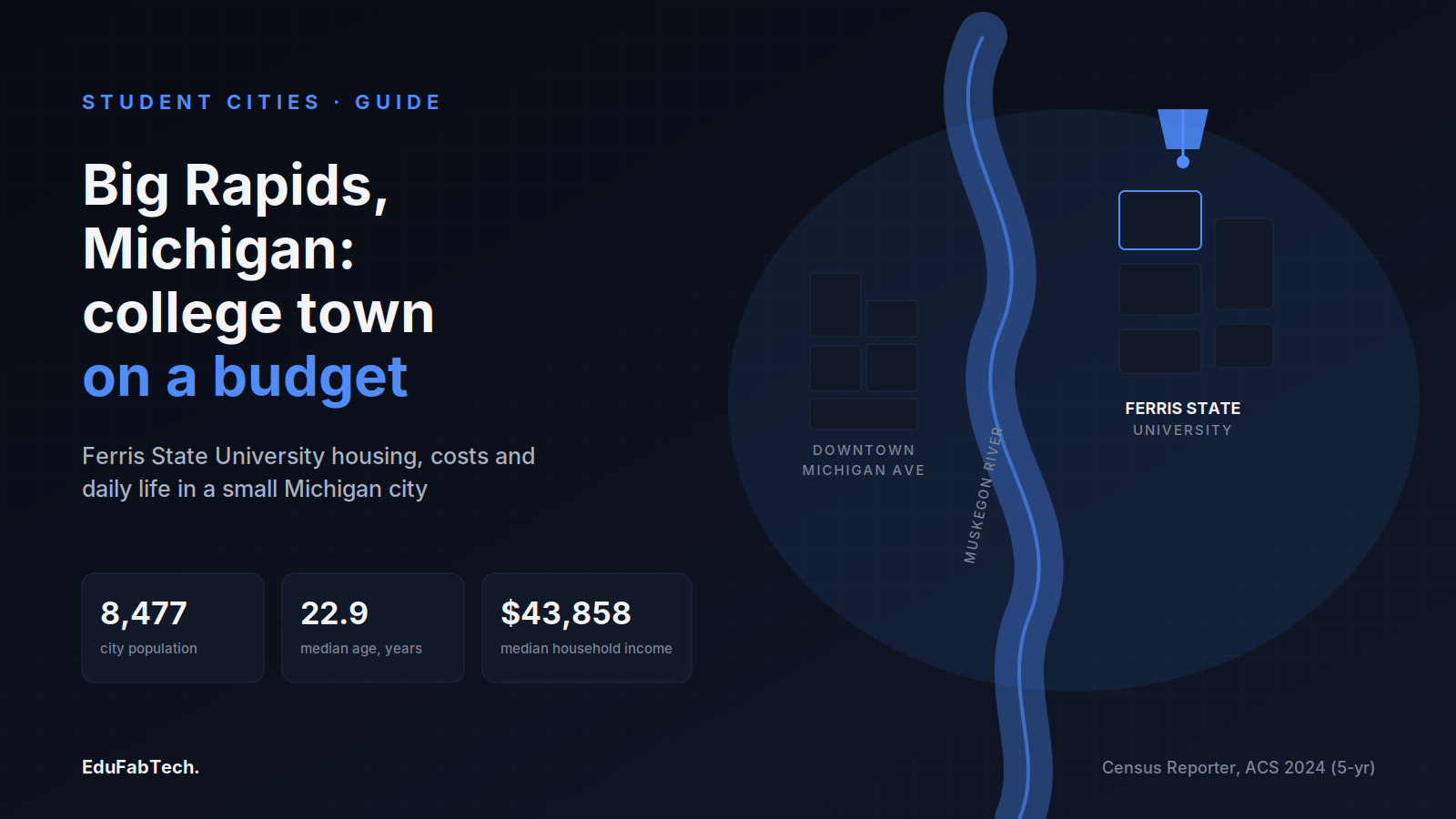
Big Rapids is a small city in west-central Michigan, built on a bend of the Muskegon River and serving as the seat of Mecosta County. According to Census Reporter, drawing on the U.S. Census Bureau's 2024 American Community Survey (5-year), the city had a population of 8,477 and a median age of 22.9 years — a figure that tells you almost everything about the place, because the wider state's median age is far higher. That young median is the footprint of a single institution: Ferris State University, whose main campus runs along the river on the east side of downtown.
The practical consequence for a student is that Big Rapids is compact and legible. Michigan Avenue carries the downtown — a short strip of nineteenth-century storefronts, a few restaurants and the county buildings — and campus is a walkable distance from it across the river. There is no large unrelated economy competing for housing or attention; term time fills the sidewalks and summer empties them. If you want a busy multicentre city, this is not one. If you want to be able to reach your lecture, your job and the grocery store without a long commute, Big Rapids delivers that easily.
This guide covers the university, where students live and how to rent without being cheated, furnishing a room cheaply, part-time work and the rules that bind international students, study spaces, the local bus, what things cost with sources, and an honest account of the trade-offs. Listings specific to the city are gathered on EduFabTech's Big Rapids page.
Ferris State University: trades, health sciences and two rare professional schools
Ferris describes itself on its own site as a "mid-sized four-year public university," and it is unusual in its origins: the university's About page states that "Ferris was founded in 1884 by Woodbridge and Helen Ferris as the privately-owned Big Rapids Industrial School." It became a public institution in the twentieth century and keeps that practical, applied character today, with programmes running from associate to doctoral degrees. The campus is the economic and social heart of the city rather than a quarter within it.
The university is strongest in fields that need workshops, clinics and labs rather than lecture theatres alone — engineering technology, health professions, business, art and design through the affiliated Kendall College of Art and Design, and the applied trades. Two of its colleges are genuinely scarce. Ferris's colleges page describes the Michigan College of Optometry as "one of only 24 accredited colleges and schools of optometry in the country," and the College of Pharmacy as "one of only three colleges that offer a PharmD program in Michigan." For a city this size to host either is notable; to host both pulls in students from well beyond Michigan. Listings close to the campus are on EduFabTech's Ferris State University page.
What studying here is like follows from the scale. Classes tend to be small and hands-on, the campus is self-contained, and the Bulldogs' sports — hockey in particular — give the autumn and winter calendar its rhythm. The flip side is that much of your life will happen within a few hundred metres, so the quality of your room, your study spot and your part-time job matters more than it would in a large city where the whole metropolis is your campus.
Where students live: the halls, then the streets around them
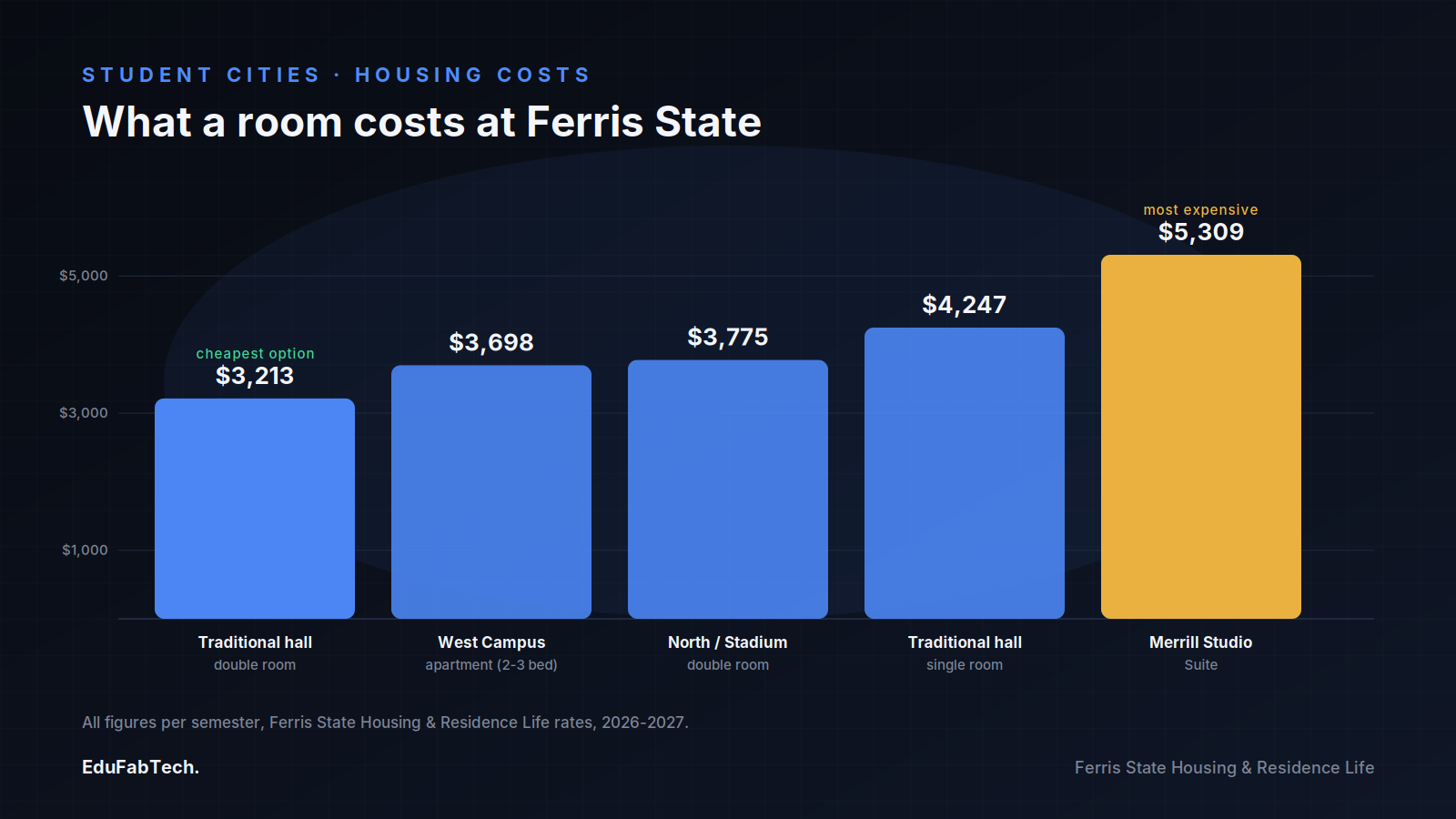
Most first-year students live on campus, and Ferris's Housing and Residence Life office sets the prices openly. For the 2026-2027 year, the university's housing-rates page lists a double room in a traditional residence hall at $3,213 per semester and a single at $4,247 per semester; a double in North or Stadium Hall at $3,775 per semester; and a Merrill Studio Suite at $5,309 per semester for students with a residency requirement. The same page lists East Campus Suites and West Campus Apartments for students moving out of the halls — a two- or three-bedroom West Campus apartment with central air at $3,698 per semester, for example — which keep you on university land with a lease that behaves like a dormitory contract rather than a private tenancy.
Beyond campus, students rent houses and flats in the blocks immediately north, east and south of the university and in the streets off Michigan Avenue. Rents reflect a modest local economy: Census Reporter, using the 2024 ACS (5-year), puts the median household income in Big Rapids at $43,858, well below the Michigan figure, which is one reason off-campus rooms here are cheaper than in a big college city. The housing stock is largely older single-family houses converted to student lets, so condition varies a great deal from one porch to the next. Rooms and shared houses in the city are collected on EduFabTech's Big Rapids rooms page.
Timing matters in a town this small. The supply of good houses near campus is finite, and the best are taken months ahead by groups re-signing for the next year, so the serious search for an off-campus place for the following autumn tends to happen in the winter and early spring. Leave it to August and you will be choosing from what no one else wanted.
Renting without being cheated in a small market
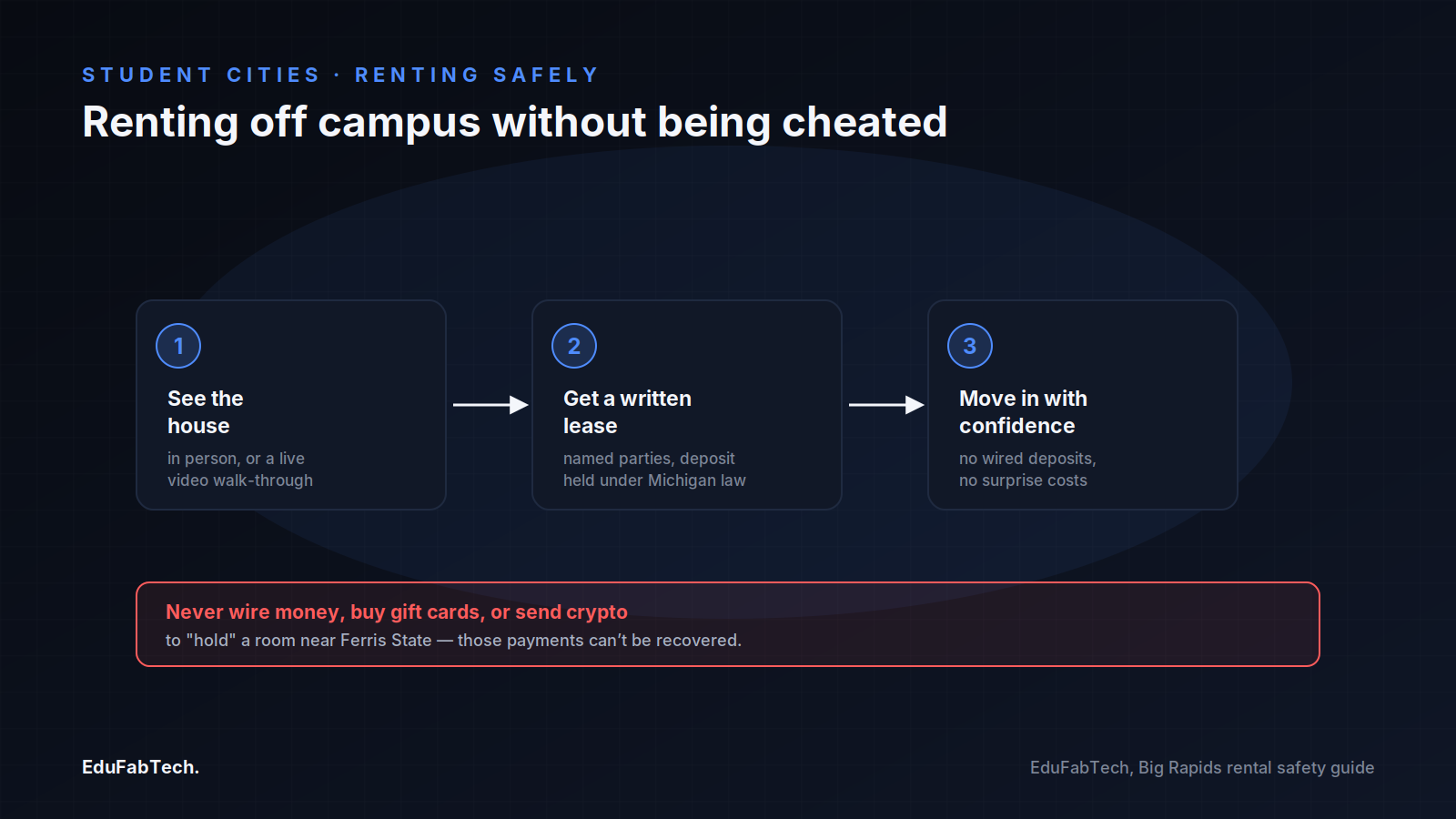
Because Big Rapids has a thin, seasonal rental market, the scams that appear here are the familiar ones aimed at students who are rushing: a listing for a house near campus at a suspiciously low rent, a "landlord" who is conveniently out of town, and a request to wire a deposit or buy gift cards to "hold" the room before you have seen it. The rule that defeats almost all of them is simple and local: see the actual house in Big Rapids, in person or on a live video walk-through with someone standing inside it, before any money changes hands. Cross the river and knock on the door if you can.
Never send a deposit by bank wire, gift card or cryptocurrency to reserve a room — those payments cannot be recovered, and no legitimate Big Rapids landlord needs them. Expect a written lease naming the property and the parties, and a deposit held under Michigan law rather than handed over in cash to a stranger. If a room near Ferris is advertised far below everything else you have seen, treat the price as a warning, not a bargain. For the first weeks, a campus hall contract is the safest default precisely because the counterparty is the university; you can move into a private house once you are in town and can inspect it yourself.
Furnishing a room cheaply: thrift shops and the Friday market
Furnishing a student room in Big Rapids is cheap if you shop second-hand, and the university itself keeps a list. Ferris's Students with Children Program publishes an affordable-shopping page that names local resale options including the Goodwill store on Perry Avenue, the Salvation Army on North Michigan Avenue, the St. Vincent de Paul Society on Williams Street, and the Wise Fabulous Finds Resale Shoppe on South Michigan Avenue. Between them they cover the basics — crockery, lamps, a desk chair, winter coats — at a fraction of new prices.
The city's weekly market is the other place to stock a kitchen. According to the Ferris State Torch, the student newspaper, the Big Rapids Farmers' Market ran in 2026 on Fridays from 8 a.m. to 2 p.m. between 8 May and 30 October, with added Saturday dates from 11 July to 26 September, in "the parking lot next to Bernie's Place" downtown. The same report notes the market accepts SNAP and takes part in the Double Up Food Bucks programme, which "matches Bridge Card purchases of fresh produce dollar for dollar," and partners with Ferris's Bulldog Pantry to hand students coupons for use at the stalls. EduFabTech also tracks second-hand goods and giveaways across the city.
Part-time work, and the rules that bind international students
On-campus jobs are the most reliable student work in a town built around one employer — dining halls, the library, residence life, departmental assistantships. For any student the attraction is the short walk; for an international student on an F-1 visa the attraction is that these jobs are, within limits, allowed. U.S. Citizenship and Immigration Services sets those limits, and they belong to the federal government, not the university. The USCIS Policy Manual (Volume 2, Part F, Chapter 6) is the authoritative statement: on-campus employment is generally capped at 20 hours per week while school is in session, and an F-1 student authorised by their Designated School Official for on-campus work does not need to file a separate employment-authorisation application with USCIS for it. Off-campus work, and training programmes such as CPT and OPT, carry their own conditions.
This is a summary, not legal advice, and the rules change. Confirm your own situation with Ferris's international-student office and with the current USCIS text before you accept any work, because the consequences of getting it wrong fall on your visa status. Local openings are listed on EduFabTech's Big Rapids jobs page.
Libraries and places to study
The centre of study life is the FLITE building — the Ferris Library for Information, Technology and Education — on Campus Drive. It is open beyond the student body: Ferris's AskFLITE service states that the library "welcome[s] visitors from the community and visiting scholars," that the first-floor Information Commons computers can be used without a login, and that campus wireless is available to visitors, with under-14s requiring adult supervision. For a resident of a small city, that open door matters; FLITE is effectively the town's serious reading room as well as the university's.
Beyond the library, the usual quiet corners apply — department buildings during the day, study lounges in the residence halls, and the cafés along Michigan Avenue for group work. Which spaces are open late shifts with the semester calendar and with exam weeks, so check current hours rather than assume. EduFabTech keeps a running list of study spaces in Big Rapids.
Getting around: Dial-A-Ride and the free campus shuttle
Big Rapids has no fixed-route city bus; it runs a demand-responsive service called Dial-A-Ride Transportation (DART), operated by the City of Big Rapids. Per the city's rates-and-hours page, a regular adult ride costs $2.50, with a reduced fare of $1.25 for riders aged 16 and under, seniors and disabled riders; the service runs 6:30 a.m. to 6:30 p.m. Monday to Friday and 9:00 a.m. to 4:00 p.m. on Saturday, and is closed Sundays and holidays. You book a ride by phone rather than wait at a timetabled stop, and the office takes last calls up to 30 minutes before closing.
Students have a cheaper option for the campus itself. Ferris's Campus Shuttle via DART page describes a "free shuttle" open to anyone, running 7:30 a.m. to 7:30 p.m. Monday to Thursday and 7:30 a.m. to 2 p.m. on Friday during the fall and spring semesters. Between the free shuttle on campus and low-fare DART rides across town, a student can manage here without a car — though, as below, winter tests that.
What is good, and what is hard
The good is real. Big Rapids is cheap by the standards of American college towns — the low median household income noted above is mirrored in low rents — and it is small enough that your whole routine fits inside a short radius. The university's housing costs are published rather than negotiated, the second-hand economy is genuine, and the river and the surrounding countryside are on your doorstep. For students in optometry, pharmacy, the health professions and the trades, the programmes are a draw in their own right.
The hard parts are the other side of the same coin. A one-institution town means the social and economic life thins out dramatically over the summer and on breaks, and nightlife and variety are limited year-round. The absence of a fixed-route bus makes you dependent on booking rides or owning a car once you need to go beyond the campus shuttle's reach. And the climate is a serious factor: this is west-central Michigan, with long, snowy winters, so budget for warm clothing, allow extra time in the dark months, and factor winter walking and waiting into any car-free plan. None of these is a dealbreaker, but a reader deciding between cities should weigh them honestly.
A checklist for the first weeks
- If you are arriving from abroad, see Ferris's international-student office first and confirm your on-campus work limits against the current USCIS employment rules before taking any job.
- Secure a safe place to sleep for week one — a hall contract via Residence Life is the lowest-risk option — and start the hunt for a private house only once you can inspect it in person.
- Never wire a deposit or pay in gift cards to hold a room you have not seen; view the actual Big Rapids address first.
- Furnish from the local resale shops and the Friday market rather than buying new.
- Get FLITE's current hours and find your quiet spot early; register for campus wireless.
- Learn how to book a Dial-A-Ride trip by phone and the free campus shuttle times; plan how you will manage in winter.
- Buy winter clothing before the first cold snap, not after it.
For the full set of local listings — rooms, jobs, second-hand goods and study spaces — start from EduFabTech's Big Rapids page and work outward.
A quick question for readers
Do you work part-time while you study?
Many students work to pay the bills. See how common it is — and how many hours people really do.
Pick an answer, create a free account in a minute, and your vote counts. Already a member? Sign in
Comments 3
Comment-
The transportation section reads fine until winter actually shows up. DART is closed Sundays and holidays, the free campus shuttle stops at…
-
The two accredited-programs claims (one of 24 optometry schools, one of three PharmD programs in Michigan) are the only real justification f…
-
The thing that jumps out is the $43,858 median household income sitting right next to the fact that most rental listings are aimed at studen…
Join free to read the full comments and reply Comments are between members; an account takes a minute.
Source: Ferris State University
Sources (5)
- Ferris State University. About Ferris State University. Ferris State University, 2026. ferris.edu ↗ · checked 2 Nov 2026
- Ferris State University. 2026-2027 Housing Rates. Ferris State University Housing & Residence Life, 2026. ferris.edu ↗ · checked 2 Nov 2026
- City of Big Rapids. Dial-A-Ride Rates and Hours. City of Big Rapids Department of Public Works, 2026. cityofbr.org ↗ · checked 2 Nov 2026
- U.S. Census Bureau (American Community Survey 2024 5-year). Big Rapids, MI — Profile data. Census Reporter, 2024. censusreporter.org ↗ · checked 2 Nov 2026
- U.S. Citizenship and Immigration Services. Policy Manual, Volume 2, Part F, Chapter 6 — Employment. USCIS, 2026. uscis.gov ↗ · checked 2 Nov 2026