Studying in Birmingham, United Kingdom: universities, housing and student life
A practical guide to Birmingham's universities, the neighbourhoods students rent in, where to furnish a room cheaply, part-time work rules, study spaces and getting around on Swift.
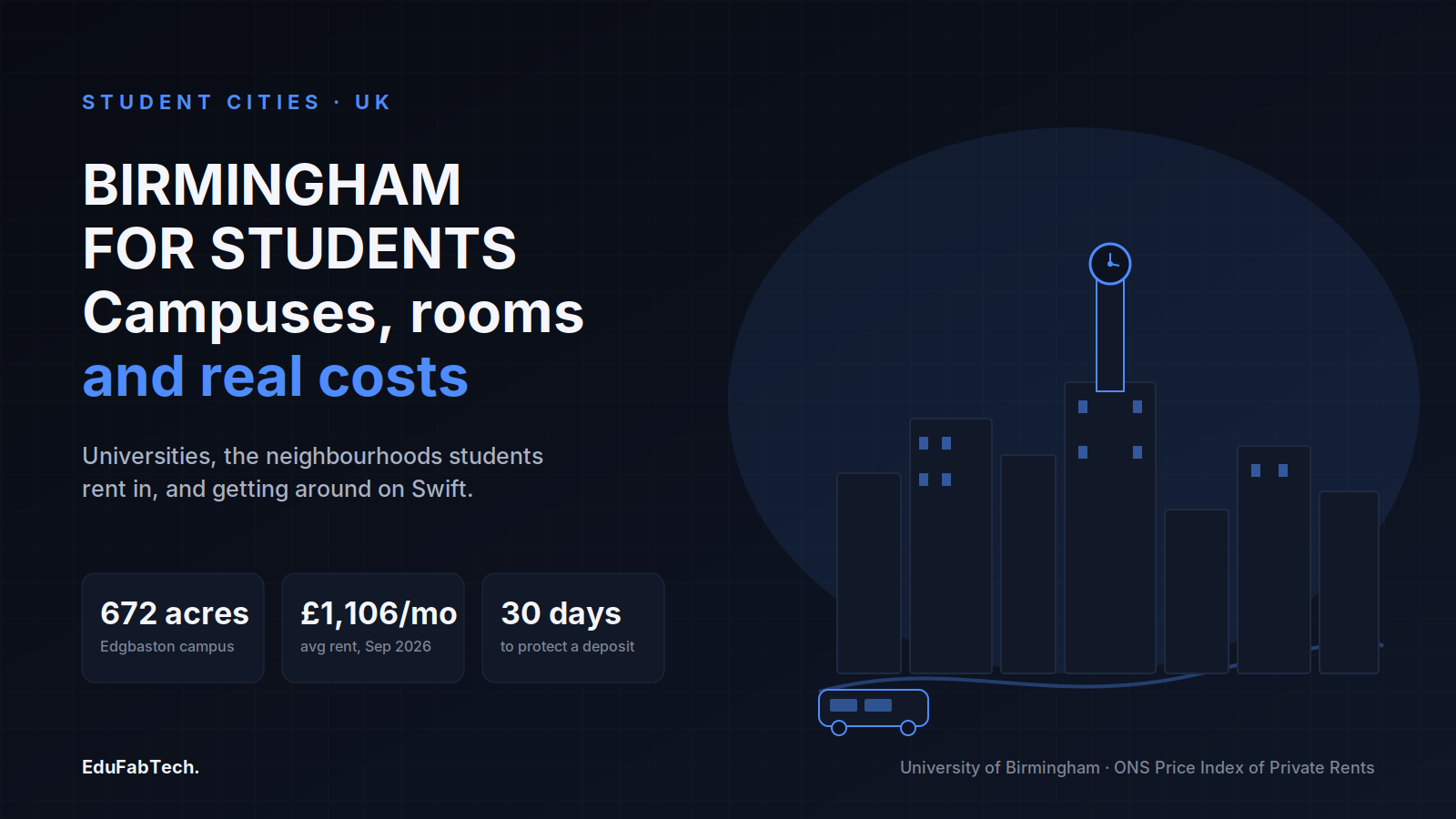
Birmingham is the largest city in England outside London, and it carries one of the biggest student populations in the country spread across several universities and a ring of further-education colleges. It sits at the centre of the West Midlands conurbation, so a student based here is rarely more than a train ride from Coventry, Wolverhampton, Dudley, Walsall or Solihull. The city is compact at its core — you can walk from New Street station to most of the central campuses — but it sprawls outward into dozens of distinct suburbs, and where you choose to live changes your rent, your commute and your week far more than most newcomers expect.
What follows is a plain account of the universities, the areas people rent in, how to take a room without being cheated, where to furnish it for very little, the rules on part-time work, places to study, and how to move around the region. Costs are given with the source and the year attached, because student budgets turn on exactly these numbers.
Two things are worth saying at the start. Birmingham is cheaper to live in than London or the South East, but it is not a cheap city by national standards, and rents have been climbing. And it is a genuinely large place: the student scene is not centred on one quarter but scattered between a leafy southern campus, a city-centre cluster and a creative district by the canals.
The universities across the city and its neighbours
The University of Birmingham is the oldest and best known. It was founded by Royal Charter in 1900 as England's first civic university, and its Edgbaston campus has grown to cover 672 acres, anchored by the Chancellor's Court redbrick buildings and the clock tower known as Old Joe, according to the university's history and heritage pages; it describes itself as part of the Russell Group on its about pages. It has its own railway station on the cross-city line and a large main library in the campus's Green Heart.
Aston University takes the opposite approach to space. Its campus is a self-contained, roughly 60-acre site on the Aston Triangle in the city centre, within a short walk of the main shopping and business areas, with teaching, accommodation, a sports centre and a supermarket all on one plot — the university describes it on its visitor pages. Aston is known for business, engineering, pharmacy and its long tradition of integrated placement years.
Birmingham City University is the city's other large institution. Its City Centre Campus sits in the Eastside regeneration area and is made up of eight buildings — among them the Curzon Building, Millennium Point, STEAMhouse and the Royal Birmingham Conservatoire — as the university sets out on its campus pages, while health and education subjects are taught at its City South campus in Edgbaston. It is strong in art and design, media, architecture, nursing and music.
University College Birmingham is a smaller, career-focused institution whose main Summer Row site, by the Colmore business district, grew out of the old Birmingham College of Food; it is built around industry-standard kitchens and a training restaurant and specialises in food, hospitality, tourism and related degrees, per its Summer Row campus page. Newman University — now also styled Birmingham Newman University — is the smallest, set in Bartley Green on the city's south-western edge, and is known for teacher training, education and psychology.
Several more universities are within easy reach in the wider West Midlands. Coventry University has a large city-centre campus in Coventry, about half an hour away by train, strong in engineering and design. The University of Wolverhampton is built around its City Campus in central Wolverhampton to the north-west. Arden University, headquartered in Coventry, delivers blended and online distance-learning degrees and runs a study centre in Birmingham. Alongside the universities, colleges such as South & City College Birmingham, Birmingham Metropolitan College and Bournville College supply access courses, apprenticeships and foundation routes that many students pass through before a degree.
Neighbourhoods students settle into
Selly Oak is the default student address for the University of Birmingham. It runs along the Bristol Road just south of campus, with terraced houses, late-opening shops and a dense concentration of shared student lets; most people here are undergraduates, and the walk or short bus to the Edgbaston campus is the main reason. It is among the cheaper central-south options and the most sociable, at the cost of noise and churn.
Edgbaston and Harborne sit immediately around and west of the main campus. Edgbaston is leafy, quieter and close to both the university and the Queen Elizabeth Hospital, which makes it popular with postgraduates and medics. Harborne is more of a village high street with cafés and independent shops, greener and a little pricier, and favoured by students who want calm within a short bus ride.
Moseley and Kings Heath, a few miles south of the centre, draw postgraduates, mature students and sharers who want a settled neighbourhood: Victorian houses, parks, a Monday farmers' market tradition and a strong independent food scene. Commutes into town are by bus along the A435, which can be slow at peak times.
Digbeth, just south-east of the core, is Birmingham's creative quarter and the nearest lively district to Birmingham City University's City Centre Campus — a short walk along the canal, as the university itself puts it on its guide to the area. It is full of street art, independent bars and converted factories, and increasingly of new-build flats; it suits students who want nightlife on the doorstep and do not mind building sites.
The Jewellery Quarter, north-west of the centre, has been reshaped by new residential conversions of its old workshops and warehouses, with canal-side flats, its own railway and tram stops and a walkable link into town. It is a popular city-centre choice for postgraduates and professionals, and rents reflect that. Finally, the city centre and Eastside themselves — close to Aston, BCU and UCB — are dominated by purpose-built student accommodation blocks: convenient and all-inclusive, but usually the most expensive way to live.
Signing for a room: costs, deposits and avoiding scams
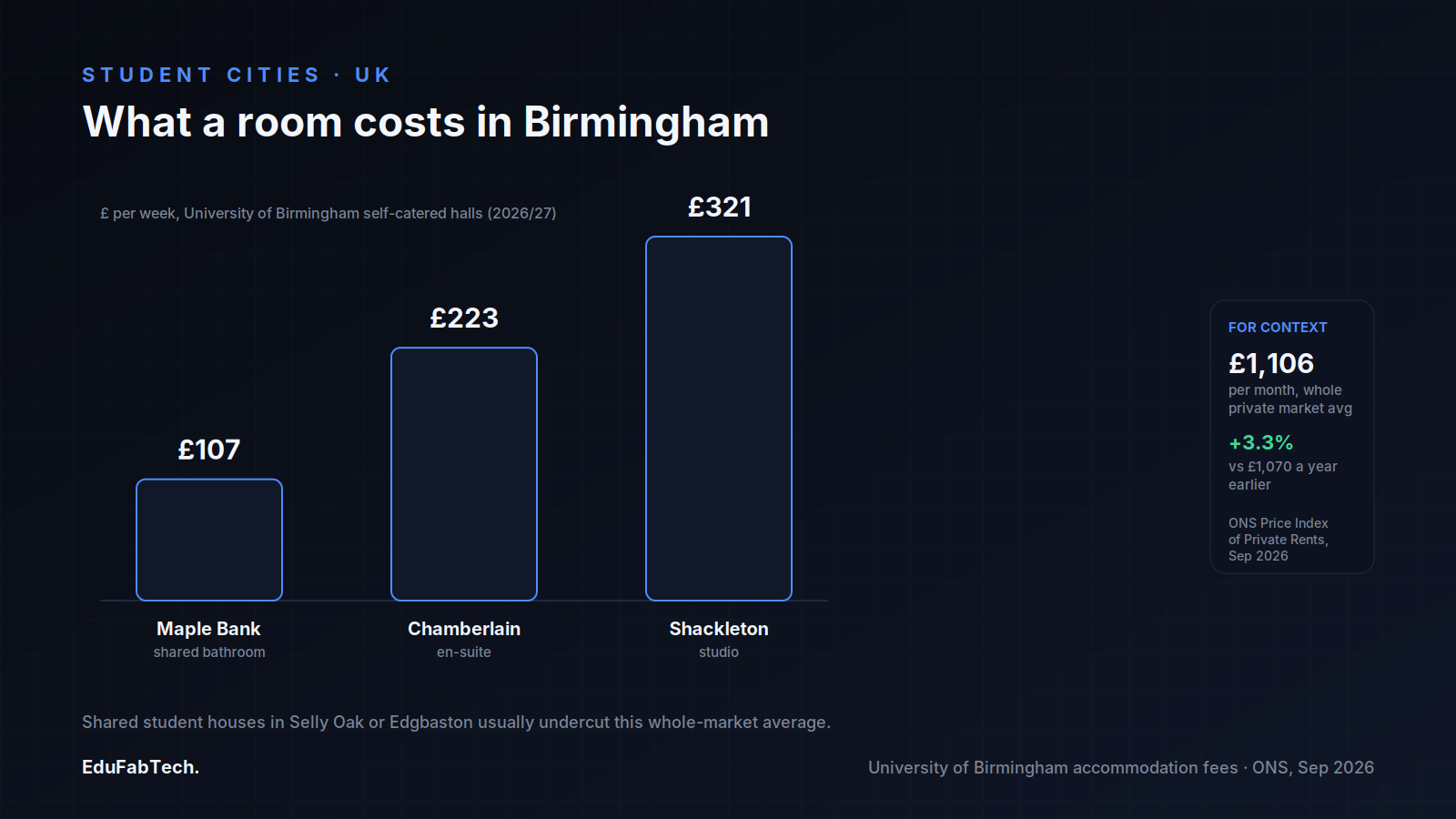
For a sourced anchor on price, the University of Birmingham lists its 2026/27 self-catered rooms from £107 a week for a shared-bathroom room at Maple Bank up to £321 a week for a studio at Shackleton, with en-suite rooms such as Chamberlain at £223 a week; Wi-Fi, contents insurance and utility bills are folded into a single charge, on contracts of 42, 50 or 51 weeks, on its accommodation fees page. For the private market, the Office for National Statistics put the average private rent in Birmingham at £1,106 a month in September 2026, up 3.3% from £1,070 a year earlier, in its Price Index of Private Rents — that is a whole-market figure, so a room in a shared student house typically costs much less than the headline.
The private letting cycle in the student areas, especially Selly Oak and Edgbaston, opens unusually early: houses for the following September are often advertised during the autumn term, which pushes groups to commit months ahead. That pressure is exactly what scams exploit. In Birmingham the danger spots are the fast-moving student-house markets around Selly Oak and the new-build flat listings in Digbeth and the city centre, where a plausible advert can appear before anyone has seen the property.
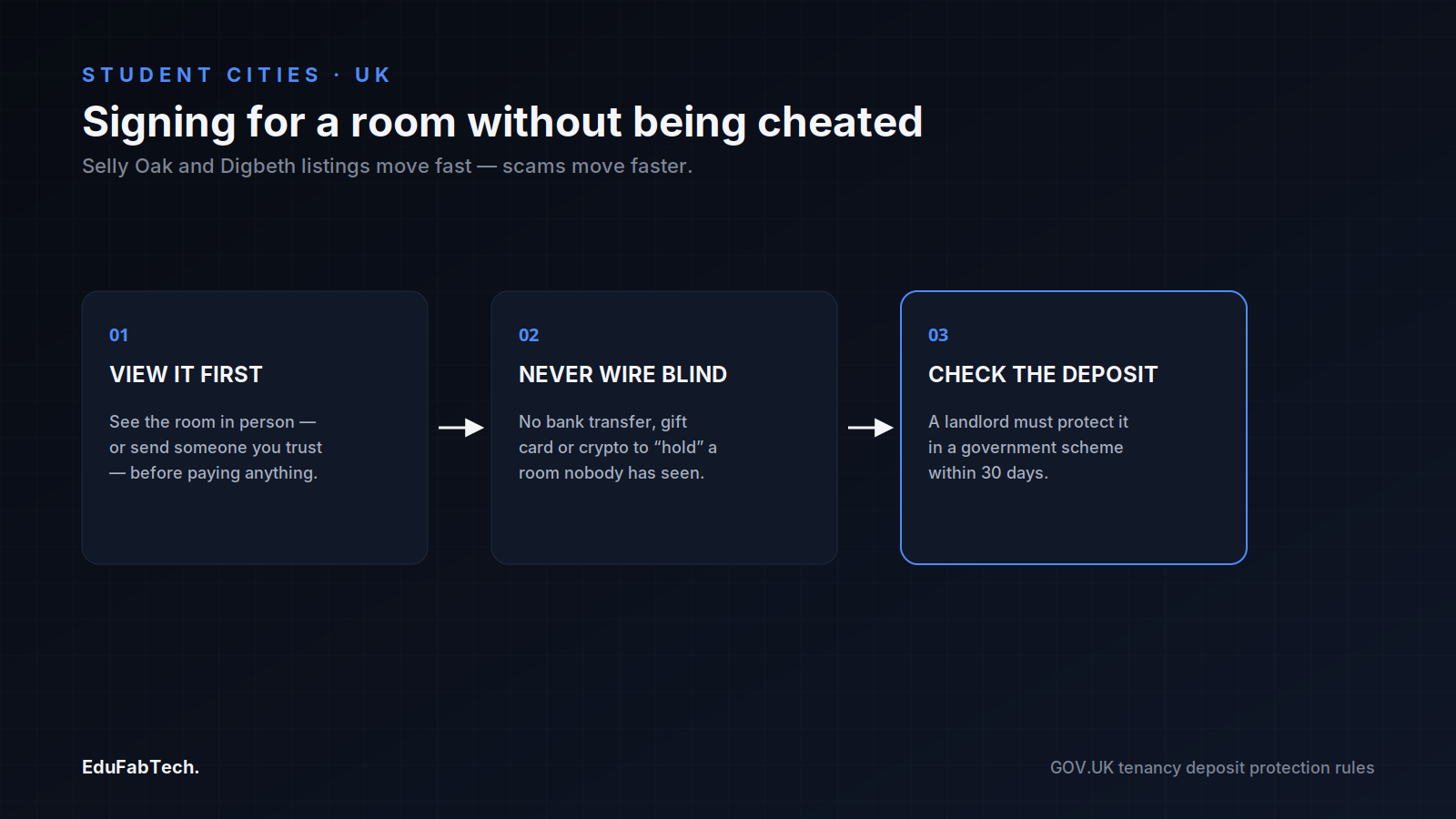
A few habits protect you. View the room in person, or send someone you trust, before paying anything. Never send money by bank transfer, gift card or cryptocurrency to "hold" a room you have not seen — a genuine landlord does not need an untraceable payment to take a property off the market. And know where your deposit goes: under the rules in England a landlord must protect your deposit in one of three government-approved tenancy deposit schemes within 30 days of receiving it, as GOV.UK sets out, so ask which scheme will hold it and get the paperwork.
Furnishing a room: markets and second-hand Birmingham
Birmingham has a long market tradition clustered around the Bull Ring in the city centre: the Open Market for fruit, vegetables and household goods, the Rag Market for fabric, haberdashery and cheap clothing, and the Indoor Market. Between them they are the obvious first stop for the pans, bedding and odds and ends a new room needs, at a fraction of high-street prices.
For furniture and clothes, the second-hand scene is strongest in Digbeth, where the university itself points students to Cow Vintage, a warehouse of affordable vintage clothing, and Red Brick Market, which gathers more than 50 independent sellers under one roof, on its Digbeth guide. Beyond that, the suburban high streets of Kings Heath, Moseley and Harborne are lined with charity shops that are reliable sources of crockery, lamps and desks, and students leaving at the end of term routinely give away or sell furniture locally. On EduFabTech you can browse second-hand things and used furniture in the city.
Part-time work and the rules on it
Many students work alongside study, and the city centre, the retail parks and the hospitals provide a steady supply of part-time jobs. If you are an international student, your visa sets a hard limit. UKCISA, the UK Council for International Student Affairs, advises that most Student visa holders may work up to 20 hours a week in term time if studying for a qualification at degree level or above, and full time outside term time, including vacations and the period before a course starts, on its student work page; it notes that a "week" is any seven-day period starting on a Monday, and that the limit is on your total hours across all jobs, not per employer. This is general information, not legal advice — check your own visa conditions and your university's international office, and treat the official guidance as the authority. Listings for local work are collected on EduFabTech's Birmingham jobs page.
Libraries and places to study
Each university runs its own libraries — the University of Birmingham's main library in the Green Heart of the Edgbaston campus, Aston's on-site library, and Birmingham City University's Curzon library in Eastside — and these are where most students do their serious work, with extended hours around exams. Beyond the campuses, the Library of Birmingham on Centenary Square is a large public library with free study space and public computers that is open to residents and anyone studying in the city, a useful neutral ground for students whose campus is across town. The independent study and co-working desks people list around the city are gathered on EduFabTech's study spaces page.
Getting around on Swift
Public transport in the region is coordinated by Transport for West Midlands, and its fare card is called Swift. TfWM offers discounted student fares on bus, tram and multi-modal tickets; to qualify you must be aged 18 or over and in full-time education and provide a letter from your place of study showing your course end date, and it states that NUS cards or students' union cards are not accepted as proof, on its student discounts page. Day to day, most students rely on National Express West Midlands buses; the city also has the West Midlands Metro tram running from the city centre out through the Jewellery Quarter toward Wolverhampton, and local rail, including the cross-city line that stops at University station on the Edgbaston campus and runs through Selly Oak. Because Birmingham is spread out, the right ticket and the right neighbourhood together decide how much of your week goes to commuting.
What is good, and what is hard
The good is real. Birmingham gives you several universities and a large, genuinely multicultural student population in a city with serious cultural weight, a strong food scene, cheaper living than London, and fast rail links across the Midlands and beyond. The central campuses are walkable and well connected, and the market and second-hand culture makes setting up a room cheap.
The hard parts are worth facing honestly. Rents are rising, as the ONS figure above shows, and the early letting cycle in the student areas forces quick decisions. The city is large and polycentric, so a cheap room far from campus can cost you in daily travel time. Some streets in the densest student districts are noisy and transient, construction is a constant backdrop in regenerating areas like Eastside and Digbeth, and the Midlands climate is grey and wet for much of the academic year. None of this is a reason to stay away; it is a reason to choose your area and your contract with care.
A checklist for your first few weeks
- Register with your university and, if you are an international student, confirm your visa work conditions in writing with the international office before taking any job.
- Get a Swift card and the student ticket that matches your actual commute, with the proof of study TfWM requires.
- If you are house-hunting for next year, view in person and never pay a "holding" fee by bank transfer, gift card or crypto; confirm which deposit scheme will protect your money.
- Register with a local GP and a dentist near where you live, not where you study.
- Furnish from the Bull Ring markets, Digbeth's second-hand shops and local charity shops before buying anything new.
- Join your students' union and one society early — in a city this size it is the fastest way to stop it feeling anonymous.
- Browse local listings for rooms, and see what is near the University of Birmingham on EduFabTech.
A quick question for readers
Do you work part-time while you study?
Many students work to pay the bills. See how common it is — and how many hours people really do.
Pick an answer, create a free account in a minute, and your vote counts. Already a member? Sign in
Comments 3
Comment-
The Swift discount rule is the catch here: you need to be 18 or over, full-time, and produce a letter from your institution, with NUS or uni…
-
The accommodation fee range is the weak spot: £107 a week at Maple Bank up to £321 at Shackleton looks like a clean low-to-high comparison,…
-
The thing I'd want a first-year to clock is that early letting cycle buried in the deposit section - houses for next September going up duri…
Join free to read the full comments and reply Comments are between members; an account takes a minute.
Source: University of Birmingham
Sources (5)
- University of Birmingham. Accommodation fees 2026/27. University of Birmingham, 2026. birmingham.ac.uk ↗ · checked 5 Nov 2026
- Office for National Statistics. Housing prices and private rents, Birmingham (Price Index of Private Rents). Office for National Statistics, 2026. ons.gov.uk ↗ · checked 5 Nov 2026
- UKCISA. Student work. UK Council for International Student Affairs, 2026. ukcisa.org.uk ↗ · checked 5 Nov 2026
- Transport for West Midlands. Discounts for students. Transport for West Midlands, 2026. tfwm.org.uk ↗ · checked 5 Nov 2026
- GOV.UK. Tenancy deposit protection. Government Digital Service, 2026. gov.uk ↗ · checked 5 Nov 2026