Studying in Blacksburg: universities, housing and student life
A practical, sourced guide to studying in Blacksburg, Virginia — its universities, where students live, how to rent without being scammed, what it costs, and what is genuinely hard about the place.
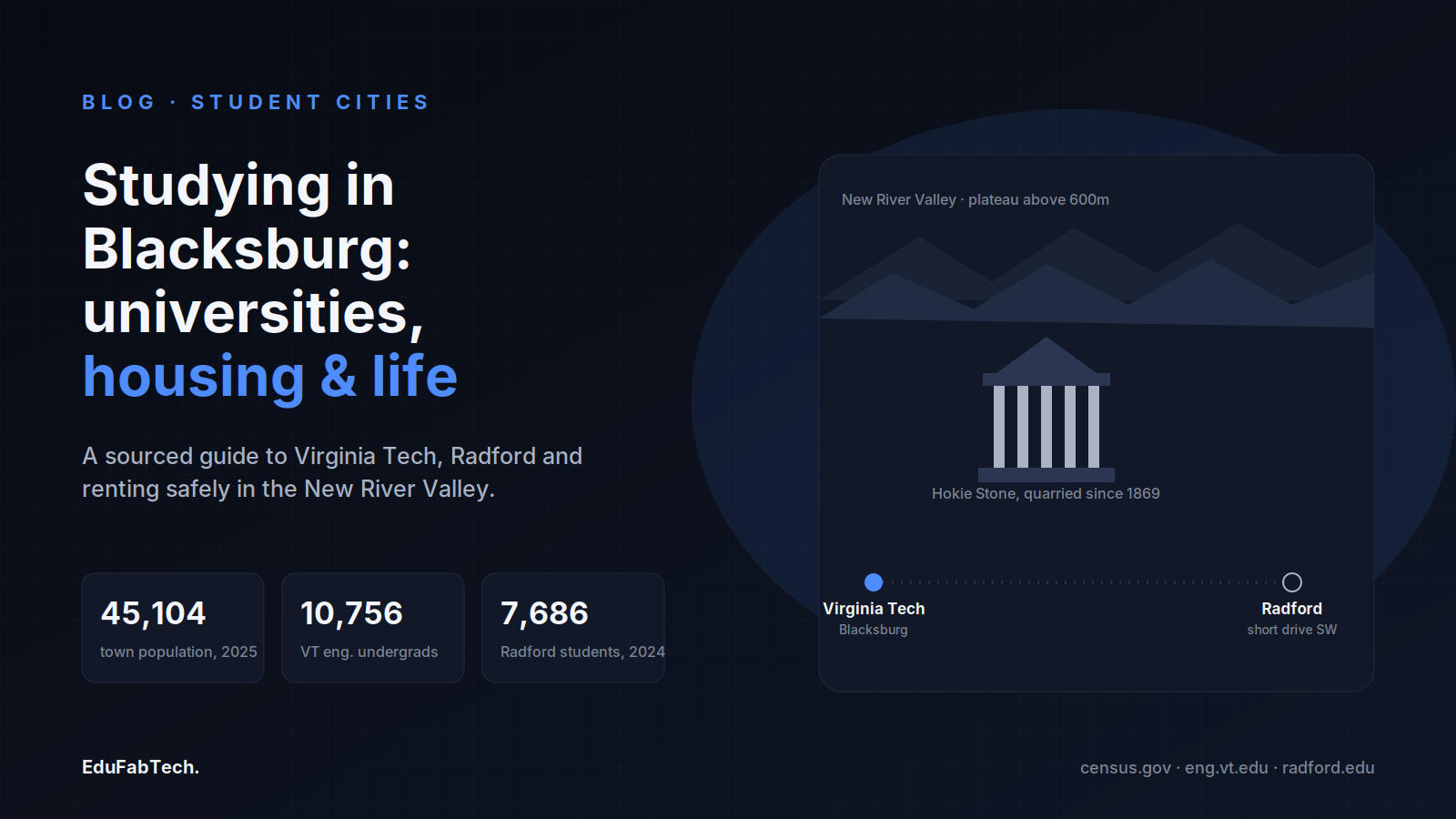
Blacksburg sits on a limestone plateau in the New River Valley of southwestern Virginia, ringed by the Appalachian ridges and roughly a 45-minute drive west of Roanoke. It is a genuine university town: the U.S. Census Bureau's QuickFacts put the town's population at about 45,104 as of July 2025 (census.gov), and the single largest thing in it by far is Virginia Tech. When term ends and students leave, the difference is visible on Main Street.
The town's geography shapes daily life more than newcomers expect. Downtown is compact and walkable — Main Street and Draper Road, the shops around College Avenue, and the broad green of the university's Drillfield a block away. The grey stone on most campus buildings is "Hokie Stone," a native limestone that Virginia Tech has quarried from its own land since 1869 and still cuts with its own crews (facilities.vt.edu). The elevation — the plateau sits above 600 metres — means real winters, with cold snaps and snow that can close roads to the surrounding hills.
What draws students is less the town than the institutions in and around it. There are three degree-granting bodies to know: Virginia Tech in Blacksburg itself; Radford University, in the neighbouring city of Radford a short drive southwest; and the joint Virginia Tech - Wake Forest University School of Biomedical Engineering & Sciences, whose Blacksburg wing shares the Virginia Tech campus. Each has a different character, and where you enrol changes where it makes sense to live.
Virginia Tech, Radford, and a school split between two universities
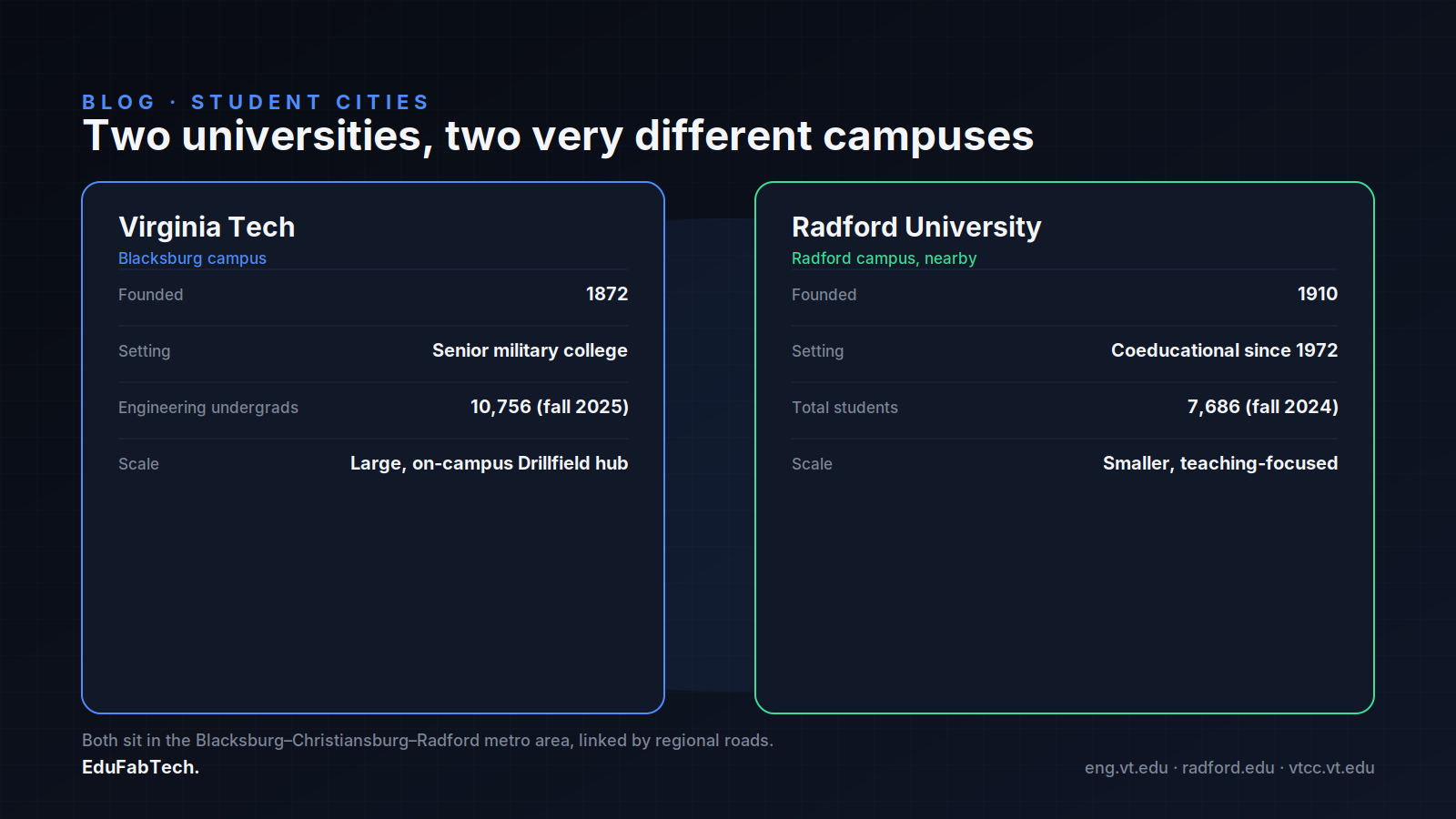
Virginia Tech — formally the Virginia Polytechnic Institute and State University — has been in Blacksburg since its establishment in 1872, and its Corps of Cadets dates from the same founding, which is why it is one of the country's small number of senior military colleges (vtcc.vt.edu). It is best known for engineering: the College of Engineering alone reported 10,756 undergraduate primary-major students in Fall 2025 (eng.vt.edu). Architecture, agriculture and veterinary medicine are also long-standing strengths. The campus is physically large, and its hub — the Carol M. Newman Library at 560 Drillfield Drive — sits in the middle of it (lib.vt.edu).
The Virginia Tech - Wake Forest University School of Biomedical Engineering & Sciences is a joint partnership between the two universities that grants master's, doctoral, and combination degrees at both campuses; its Blacksburg base is at 317 Kelly Hall on Stanger Street (bme.vt.edu). The degrees include an M.S. and Ph.D. in biomedical engineering plus combined D.V.M./Ph.D. and M.D./Ph.D. tracks, and a graduate's diploma carries both universities' names. It is a graduate school, so it matters mainly to research students rather than undergraduates.
Radford University is a separate public institution, founded by the Virginia General Assembly in 1910 and originally a women's teacher-training school on a grove in east Radford (radford.edu). It became coeducational in 1972 and a university in 1979, and now spans more than 100 undergraduate fields with graduate and several doctoral programmes. Radford's fall 2024 census counted 7,686 students across all locations (radford.edu) — a much smaller, more teaching-focused campus than Virginia Tech, and a realistic alternative if Blacksburg's scale or rents feel like too much. The two sit in the same Blacksburg–Christiansburg–Radford metropolitan area, linked by regional roads.
On campus first, then the corridors along Prices Fork and Toms Creek
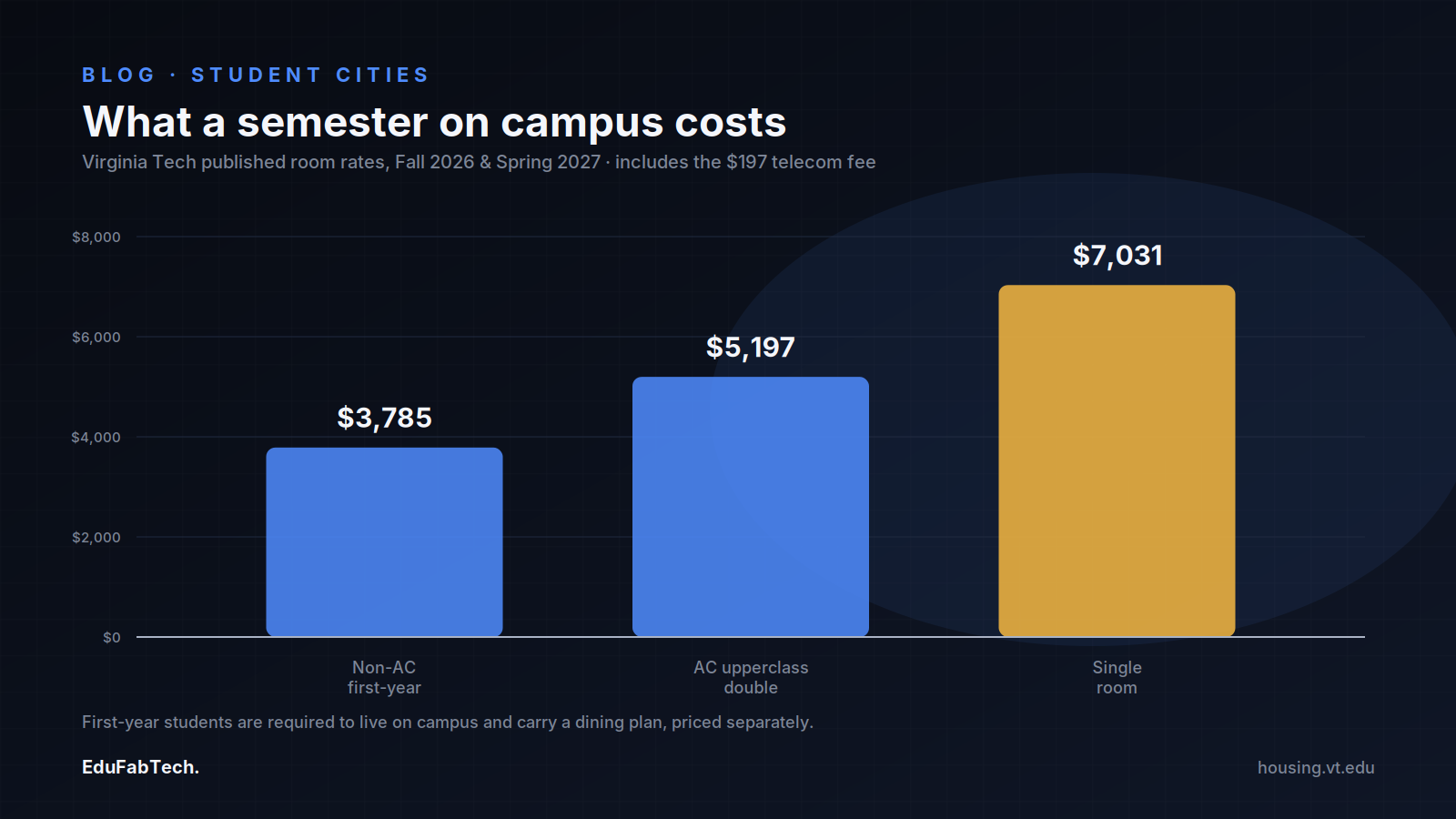
Virginia Tech requires most first-year students to live on campus, and its residence halls run the gamut from older, non-air-conditioned buildings near the Drillfield to newer upperclass halls. For 2026–2027 the university's published room rates (listed as "Fall 2026 and Spring 2027") start at $3,785 per semester for a first-year space in a non-air-conditioned hall, including the mandatory $197 residential telecom fee, rising to $5,197 for an air-conditioned upperclass double and $7,031 for a single (housing.vt.edu). First-year students on campus also carry a required dining plan, which the same page prices separately.
After first year, most students move off campus, and Blacksburg's rental map is well defined. Large purpose-built apartment complexes cluster along Prices Fork Road, North Main Street and the Toms Creek corridor to the north and west of campus — the Foxridge, Terrace View, Hethwood and Patrick Henry areas are names you will hear repeatedly. Downtown flats above the shops on Main and Draper put you within walking distance of class but cost more and are scarce. Nearly everything in Blacksburg is organised around the academic-year lease: landlords market the following August's rooms very early, often in the autumn a full year ahead, and group houses get claimed by friend-groups months before move-out. You can browse what is currently listed near each campus on EduFabTech's Blacksburg rooms page and the near Virginia Tech listings.
If you are arriving from abroad or from out of state and cannot visit, do not rush to sign the earliest thing you see. Demand is real, but so is turnover; subleases and room-shares open up through the summer as plans change. Start with the university's own off-campus housing resources, which list rooms and roommates without charging you to look, before committing to anything you have not seen.
Where rental scams show up in Blacksburg
Rental scams in Blacksburg follow a predictable script, and it is worth knowing the exact shape. They appear mostly in the gap the real market leaves: incoming international students and transfers who need a room before they can fly in, and the frantic early-autumn rush for the next year's houses. The classic version is a "landlord" who is conveniently out of town — relocated for work, out of the country — who cannot show the place but will "hold" it if you wire a deposit now. A listing priced noticeably below the going rate for Foxridge or Toms Creek is bait, not luck.
The defences are concrete. See the unit in person, or have someone you trust see it, before any money changes hands; a legitimate Blacksburg landlord or a complex's leasing office will let you walk through a model or the actual room. Confirm that the person collecting rent actually controls the property. In Virginia a security deposit is capped by law and is normally refundable, so a demand for a large non-refundable "holding fee" is a warning sign. Above all, never send a deposit or first month by bank wire, gift card or cryptocurrency to secure a room sight-unseen — those payments are effectively irreversible, and no honest local lease requires them. Pay by a method that leaves a record, and get the lease in writing.
Furnishing a room from thrift shops and the May move-out
Blacksburg's student turnover is itself a supply chain. Every May, graduating and departing students shed furniture, kitchenware and bicycles, and a patient first-year can furnish a whole room from what others leave behind. The YMCA at Virginia Tech runs a long-standing thrift shop on North Main Street; Goodwill has a store on North Main as well; and for larger items the Habitat for Humanity ReStore over in Christiansburg carries second-hand furniture and building materials. These are the realistic places to find a desk, a lamp or a mattress frame without paying retail.
For food and the weekly rhythm of the town, the Blacksburg Farmers Market is the fixture. It is a year-round, producer-only market — every vendor farms or makes within a 50-mile radius — held at Market Square Park on the corner of Roanoke Street and Draper Road, on Saturdays from 8am to 2pm and Wednesdays from 2pm to 6pm, and it accepts SNAP/EBT with Virginia Fresh Match matching for fresh produce (blacksburgfarmersmarket.com). It is also simply where the town gathers. On EduFabTech you can scan what is being sold locally through the second-hand and furniture pages for Blacksburg.
Part-time work and the rules that apply
Most student jobs in Blacksburg are on campus or in the downtown service economy — dining halls, the library, labs, cafés and shops. For international students, the limits are not optional. Virginia Tech's Cranwell International Center, the office that handles immigration advising, states plainly that during the Fall and Spring semesters F-1 students are limited to 20 hours or less of work per week, and that the limit is enforced across a defined Saturday-to-Friday work week (international.vt.edu). The same page is the authority to check for your own situation, and any question about off-campus work, practical training or exceeding those hours should go to Cranwell directly rather than to a landlord, employer or forum — this guide is not legal advice. Current openings students are advertising locally are on the EduFabTech Blacksburg jobs page.
Libraries, study spaces and getting around
Newman Library is the default workspace for most of Virginia Tech. It runs across five floors with individual and group study space, creation studios and multimedia lounges, and bookable group rooms (lib.vt.edu); during busy stretches of the semester parts of it stay open around the clock. Radford students have their own McConnell Library on that campus. Beyond the libraries, downtown cafés and the student centres fill in, and EduFabTech keeps a running list of desks and quiet rooms on the Blacksburg study spaces page.
Getting around town without a car is unusually easy for a place this size. Blacksburg Transit serves Blacksburg and Christiansburg and, Virginia Tech notes, has been named one of the ten best small transit systems in North America; crucially, fares for students, faculty and staff are prepaid, so a Virginia Tech ID gives unlimited access to every route (getaround.vt.edu). The university adds that students, faculty and staff make up 95 percent of the system's ridership, which tells you how central the buses are to student life. For trips beyond the valley, the Smart Way bus links the area to Roanoke and its airport, and the paved Huckleberry Trail connects Blacksburg to Christiansburg for cyclists and walkers.
What it costs, and the honest trade-offs
Off campus, the U.S. Census Bureau's QuickFacts put Blacksburg's median gross rent at $1,359 a month for 2020–2024 (census.gov) — a town-wide figure that includes families, so a room in a shared student house typically costs less, while a downtown one-bed costs more. Set against the on-campus rates above, the arithmetic usually favours sharing a house with several people once you are past first year.
The genuine upsides are easy to state. Blacksburg is compact, green and safe-feeling, the transit is free at the point of use for students, and the setting — ridgelines, the New River, autumn colour on Hokie Stone — is real. Engineering and the sciences are deep, and the town's identity is wrapped around the university in a way that makes it welcoming to students specifically.
The hard parts are the flip side of being a small mountain town. It is remote: the nearest large-city services are the Roanoke drive away, and without a car some errands and most weekend travel are awkward even with good in-town buses. Winters are cold and can be icy. The rental market's extreme head-start means the best houses go a year early, and a late-deciding arrival takes what is left. And the town more or less empties in summer and over breaks, which suits some students and isolates others. None of this is hidden if you visit; it is simply the texture of studying somewhere built around one university in the hills.
A checklist for your first weeks
- If you are an incoming international student, complete your immigration check-in and read the on-campus work rules on the Cranwell International Center site before you take any job.
- Get your Virginia Tech ID and start using Blacksburg Transit immediately — fares are prepaid for students, so the buses cost nothing extra (getaround.vt.edu).
- Never wire money, buy gift cards or send crypto to "hold" a room you have not seen; pay deposits only by traceable means on a signed lease.
- If you still need housing, work from the university's off-campus listings and the EduFabTech rooms page rather than the cheapest unverified advert.
- Furnish from the YMCA thrift shop, Goodwill and the Habitat ReStore, and watch the May move-out for free furniture.
- Find your study base early — Newman Library's floors fill up fast once exams approach.
- Learn the Saturday and Wednesday rhythm of the Blacksburg Farmers Market; it is the cheapest way to eat well and the easiest way to feel part of the town.
A quick question for readers
Do you work part-time while you study?
Many students work to pay the bills. See how common it is — and how many hours people really do.
Pick an answer, create a free account in a minute, and your vote counts. Already a member? Sign in
Source: Virginia Tech Housing and Residence Life
Sources (5)
- Virginia Tech Housing and Residence Life. Room and Dining Rates, Fall 2026 and Spring 2027. Virginia Tech, 2026. housing.vt.edu ↗ · checked 8 Oct 2026
- Cranwell International Center. On-Campus Employment for F-1 Students. Virginia Tech, 2026. international.vt.edu ↗ · checked 8 Oct 2026
- U.S. Census Bureau. QuickFacts: Blacksburg town, Virginia. U.S. Census Bureau, 2025. census.gov ↗ · checked 8 Oct 2026
- Virginia Tech. Getting Around: Blacksburg Transit. Virginia Tech, 2026. getaround.vt.edu ↗ · checked 8 Oct 2026
- Radford University. University History. Radford University, 2026. radford.edu ↗ · checked 8 Oct 2026