Studying in Bloomington, United States: universities, housing and student life
A practical guide to Indiana University's home town — its campus and schools, where students live, what rooms and dorms cost, getting around fare-free, and the honest trade-offs.
Bloomington sits in the wooded limestone country of southern Indiana, about an hour's drive south of Indianapolis and far enough from any larger city that it runs on its own rhythm. It is the seat of Monroe County, and for most practical purposes it is a university town: Indiana University's oldest and largest campus spreads across the eastern side of the city, and the student population is a large share of everyone living there. The quarried Indiana limestone that built much of the campus also built a good part of downtown, which gives the place a consistent grey-gold look that is hard to mistake for anywhere else.
For a student arriving from abroad or from another US state, the scale is the first thing to understand. This is not a metropolis with a university tucked inside it; it is a small city organised around one. That has consequences for everything below — rents, buses, where you can work, and how quickly the good rooms disappear each spring. This guide walks through the universities, the housing, the costs you can actually verify, and the parts of student life that are easy to get wrong.
The academic core is compact and walkable. Kirkwood Avenue runs from the Sample Gates — the limestone arches at the edge of campus — down to the courthouse square downtown, and the Jordan River, a small creek, threads through the grounds. Much of what a first-year needs is within that walk.
Indiana University Bloomington and its schools
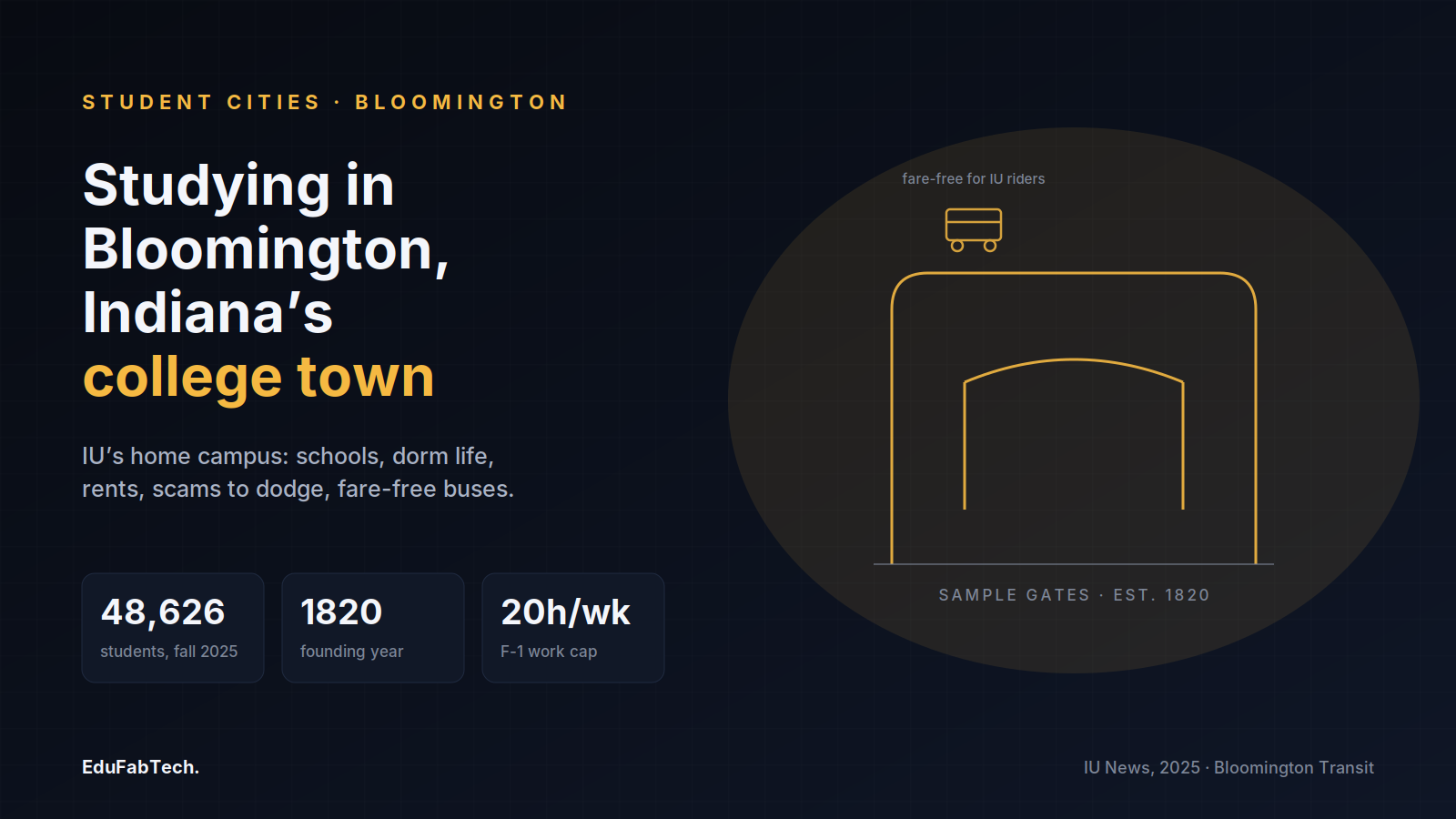
Indiana University Bloomington traces its founding to 1820, when a state legislative act established a seminary that grew into the university; the institution marks that year as its Founders Day, according to IU's own history page. The oldest part of the grounds is still called the Old Crescent, the crescent of early buildings reached through the Sample Gates, which were dedicated in 1987. In autumn 2025 the campus enrolled a record 48,626 students, including an incoming class of 10,127 beginning students, the largest in its history, IU News reported in 2025. It is a genuinely large, residential campus, which is worth picturing before you arrive: you will spend a lot of time walking or riding between buildings.
Among its schools, the Luddy School of Informatics, Computing, and Engineering is the one many international applicants in computing will know. The School of Informatics was established in 2000 as the first school of its kind in the United States, and the Luddy School today describes itself as "one of the largest and most comprehensive technology, information, and engineering schools in the world," per its own about page. Its Bloomington departments span computer science, informatics, data science, intelligent systems engineering and information and library science, so the school covers both the technical and the human sides of computing. If you are weighing where to live, listings near it are gathered at /near/indiana-university-luddy-school-of-informatics-computing-and-engineering.
The Hutton Honors College is not a separate campus but an honors programme open to students across IU Bloomington's schools. It was founded in 1966 as the University Honors Division and renamed in 2004 for Edward L. Hutton, according to the college's history page. It runs discussion-based seminars, grants and residential community rather than its own degrees, so it is something you apply to or are invited into, not a school you enrol in directly. Listings near its base are at /near/hutton-honors-college.
Where students live, and when to start looking
Housing in Bloomington divides roughly into three worlds. First-year students mostly live in IU's residence halls, clustered in neighbourhoods the university labels Central, Northeast, Northwest and Southeast — names like Teter, Wright, Briscoe, Read, Forest and the newer Union Street apartments. Second, there is the dense band of older houses and small apartment buildings close to campus and near downtown, which is where most upper-year and graduate students end up. Third, there are larger purpose-built apartment complexes further out on the east and south sides, reached mainly by bus.
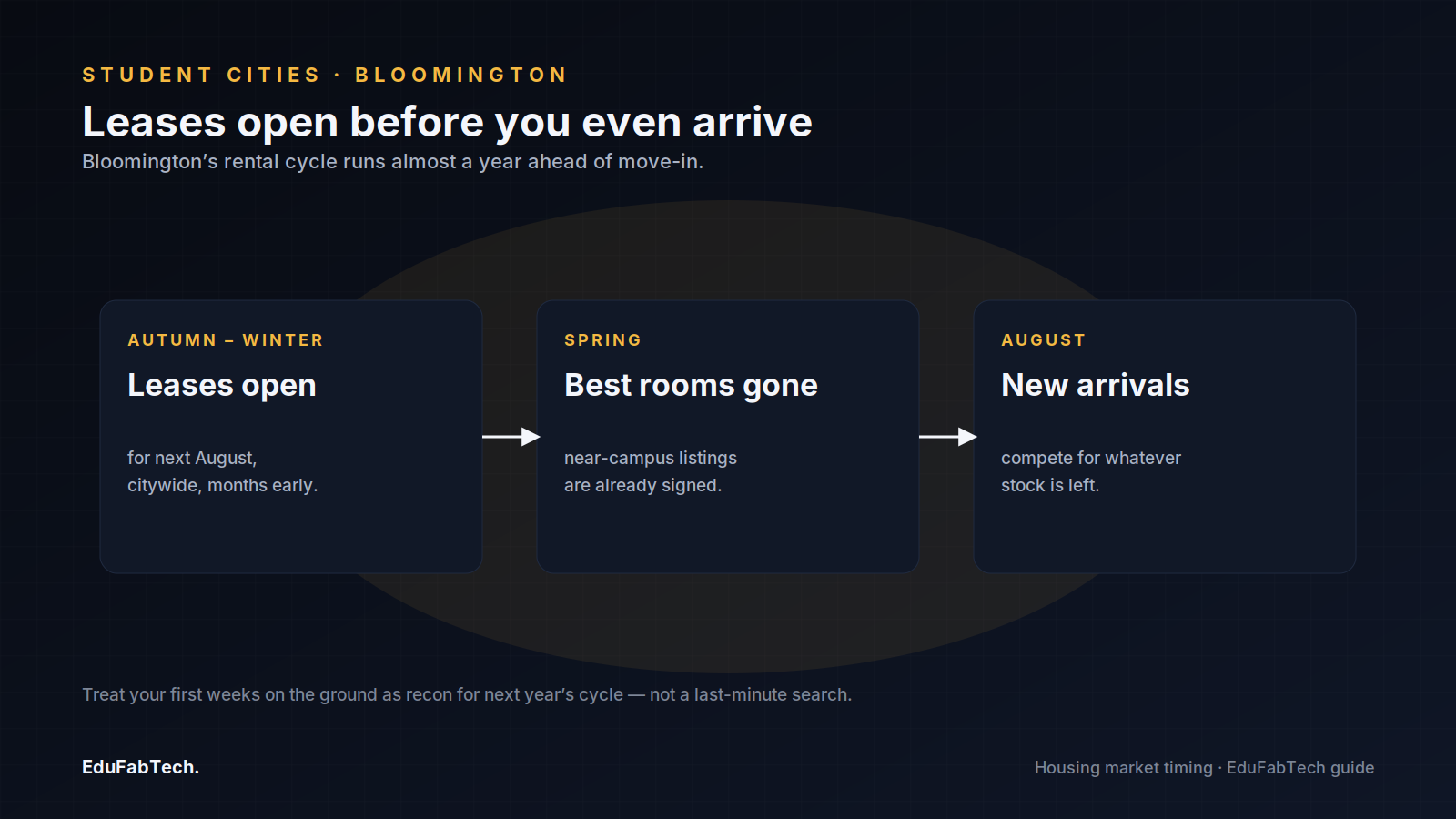
The timing in Bloomington is unusually early and catches newcomers out. The market for the following August's leases opens in the autumn and winter before it — students often sign for the next academic year many months ahead, while still living in their current place. If you arrive in August expecting to find a good room near campus for that same term, you will have missed most of the stock. Browse what is currently listed across the city at /in/united-states/bloomington and rooms specifically at /in/united-states/bloomington/rooms, and treat the first weeks as reconnaissance for the next cycle rather than a last-minute scramble.
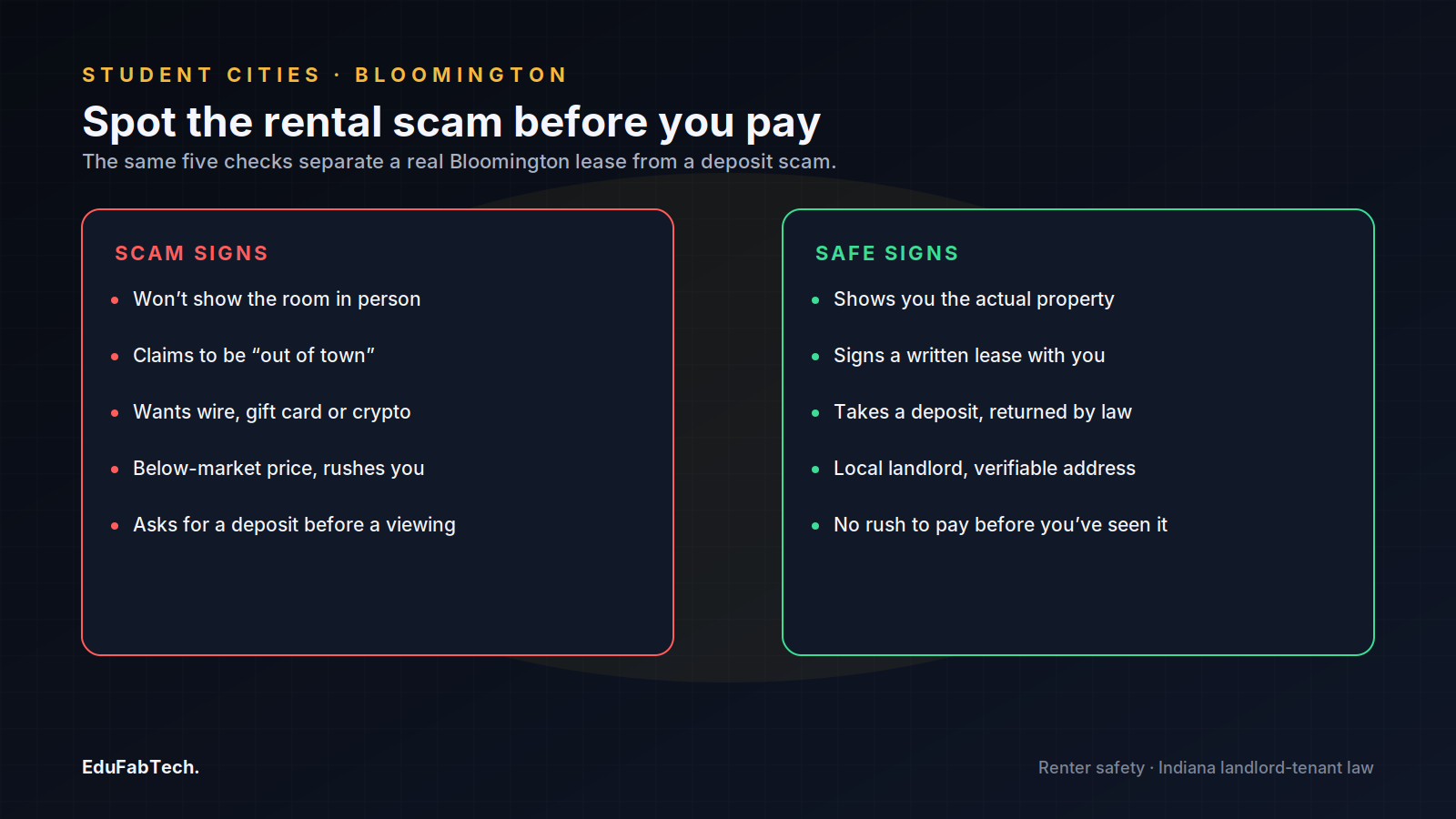
Before you pay anything, see the actual room — not a photo, the room. The most common rental scam in a university town like Bloomington is a listing for a house near campus, often priced slightly below the going rate, posted by someone who claims to be out of town and asks you to send a deposit to "hold" it before you can view it. Never send money by bank wire, gift card or cryptocurrency to secure a place you have not entered; a genuine local landlord expects to show you the property and sign a written lease. In Bloomington the normal arrangement is a signed lease with a security deposit, and Indiana law limits how long a landlord has to return that deposit after you move out, so keep every receipt and take dated photos when you move in. If a deal can only happen remotely and urgently, walk away.
Furnishing a room without overspending
You do not need to buy new. Bloomington has a steady second-hand economy, partly because thousands of students cycle through it every May and August, leaving furniture and kitchenware behind. The turnover peaks at the end of the spring term, when move-out giveaways appear all over the near-campus streets. On EduFabTech, second-hand goods in the city are collected at /in/united-states/bloomington/second-hand, larger items at /in/united-states/bloomington/furniture, and things people are simply giving away at /in/united-states/bloomington/free-stuff.
For food and the weekly rhythm of a household, the city runs the Bloomington Community Farmers' Market. It is held every Saturday from April through October at Showers Common, 401 N. Morton St., next to City Hall, from 8 a.m. to 12:30 p.m. in the warmer months, according to the City of Bloomington's farmers' market page. It is operated by the city's Parks and Recreation department and sells fruit and vegetables, eggs, meat and cheese, honey, seasonal flowers and plants from regional farms and food makers. It is also one of the easiest places to start feeling like you live somewhere rather than just study there.
Part-time work and the rules that apply
If you are an international student on an F-1 visa, the work rules are strict and worth reading from the source rather than from hearsay. Indiana University's Office of International Services states that F-1 students may work no more than 20 hours per week on campus during the fall and spring semesters, and that any exception has to be arranged with an OIS adviser before you take on the extra hours, per its on-campus employment page. Full-time enrolment is a condition of keeping that status. This is immigration guidance, not general advice, and your own situation can differ — OIS is the office that actually authorises work, so confirm anything specific with them directly.
On-campus jobs — in dining, libraries, labs and departments — are the usual starting point because they are open to international students without extra paperwork. Current openings in the city are listed at /in/united-states/bloomington/jobs. Domestic students have more options off campus, but for anyone the campus labour market is largest in late August as the term begins.
Libraries and places to study
The hub of the library system is the Herman B Wells Library at 1320 E. Tenth Street, which holds the humanities and area-studies collections and two large study areas: the Learning Commons in the West Tower, for group study and Writing Tutorial Services, and the Scholars' Commons in the East Tower, with reservable study rooms and the reference desk, as described by IU Libraries. Beyond Wells, the subject libraries and the branch collections give you a choice of quieter or busier rooms depending on the week. Because hours shift around exams and holidays, check the current schedule before a late-night session; EduFabTech also gathers student-reported study spots at /in/united-states/bloomington/study-spaces.
Getting around: fare-free buses and a walkable core
The city's public transport is run by Bloomington Transit (the Bloomington Public Transportation Corporation), and its single most useful fact for students is the price. Bloomington Transit states that "Indiana University students, faculty and staff get unlimited, fare-free rides on Bloomington Transit buses," boarding by showing a Crimson Card rather than paying, according to its how-to-ride page. Other riders pay a cash fare of $1.00 per trip or use the Umo Mobility app to load value. IU also runs its own Campus Bus service within the grounds, and the fare-free benefit applies to Bloomington Transit's fixed-route buses when you show the Crimson Card.
For a campus this size, a lot of daily life is still done on foot or by bike — the near-campus neighbourhoods, Kirkwood Avenue and downtown are within walking distance of the Old Crescent, and the B-Line Trail gives a car-free route through the middle of the city. If you live in one of the outer apartment complexes, though, the bus becomes essential, and that is a point to weigh when you choose where to sign a lease.
What things cost
The clearest dated housing figures come from IU's own residence-hall pricing. For the 2026–27 academic year, IU Housing lists standard rooms in the Northeast neighbourhood (Campus View and Tulip Tree) at $6,423 for the year, mid-range standard rooms such as Teter and Forest in a band around $8,275–$9,516, and the enhanced apartment-style options at the top — Union Street from $13,506 to $15,773 and Wells up to $14,801 — all covering the fall and spring semesters, per the 2026–27 rates page. Those figures are per person for the academic year, and the range within a building reflects how many share the room and the bathroom.
Off campus, the broader city rental market is more moderate than a coastal college town but no longer cheap. The U.S. Census Bureau's QuickFacts for Bloomington city, Indiana, report a median gross rent of $1,200 (2020–2024 American Community Survey estimate) across all households, not just student lets, on its QuickFacts table. A shared house split several ways typically costs each student well below that whole-unit figure, which is the main reason upper-year students pool into houses near campus. Beyond rent, budget for the one-off costs the housing pages do not show — a deposit, the first month up front, and setting up a furnished room.
The honest trade-offs
What is good about Bloomington as a student city is partly its scale: a serious research university with the Luddy School, the Hutton Honors College and dozens of other programmes, inside a town small enough to cross by bus or bike, with free transit for IU affiliates and a genuine second-hand economy to furnish a room cheaply. The near-campus-and-downtown core is compact and sociable, and the farmers' market and the limestone streets give the place a character that is specific rather than generic.
What is hard is mostly structural. The leasing cycle runs far ahead of the term, so newcomers who do not plan a year out are left with the worst of the market. The city is isolated — there is no passenger rail, and reaching a major airport means a drive or an intercity bus to Indianapolis — which can be a real constraint for international students travelling home. The population swings sharply with the academic year, thinning out over the summer. And the winters are properly cold and grey. None of this is a reason to avoid Bloomington; it is a reason to arrive with the housing and transport decisions already thought through.
A checklist for the first weeks
- Activate your Crimson Card and start riding Bloomington Transit fare-free; learn which routes serve your neighbourhood.
- If you are on an F-1 visa, read the Office of International Services employment rules and confirm anything specific with an OIS adviser before taking a job.
- Walk the Wells Library's Learning Commons and the subject libraries early, and find the study room that fits how you work.
- Start the search for next year's room in the autumn, not next summer — see rooms at /in/united-states/bloomington/rooms and never wire a deposit for a place you have not seen.
- Furnish from the second-hand and free listings, and make the Saturday farmers' market at Showers Common part of your week.
- Check what is happening around campus and town at /in/united-states/bloomington/events.
A quick question for readers
Do you work part-time while you study?
Many students work to pay the bills. See how common it is — and how many hours people really do.
Pick an answer, create a free account in a minute, and your vote counts. Already a member? Sign in
Source: Indiana University
Sources (5)
- Indiana University Housing. 2026–27 Rates: Rates and billing. Indiana University Bloomington, 2026. housing.indiana.edu ↗ · checked 5 Oct 2026
- Indiana University. Enrollment growth for IU: Record Bloomington class. IU News, 2025. news.iu.edu ↗ · checked 5 Oct 2026
- Bloomington Transit. How to Ride. Bloomington Public Transportation Corporation, 2025. bloomingtontransit.com ↗ · checked 5 Oct 2026
- City of Bloomington. Bloomington Community Farmers' Market. City of Bloomington Parks and Recreation, 2025. bloomington.in.gov ↗ · checked 5 Oct 2026
- Indiana University Office of International Services. On-Campus Employment for F-1 Students. Indiana University, 2025. ois.iu.edu ↗ · checked 5 Oct 2026