Studying in Boone, North Carolina: Appalachian State, housing and student life
A practical, sourced guide to studying at Appalachian State University and living in Boone — housing, second-hand finds, part-time work, study spaces, the fare-free bus and what it costs.
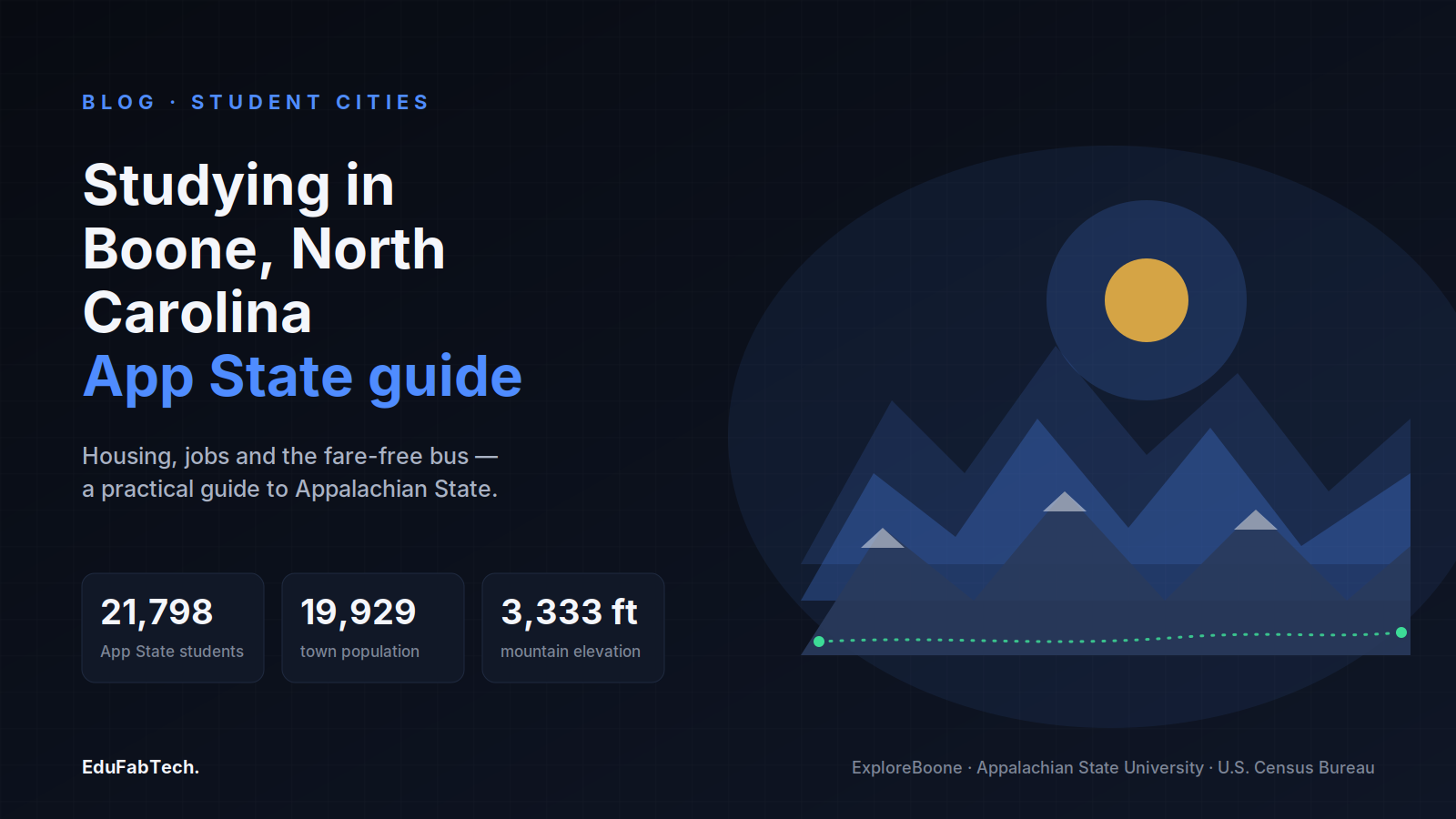
Boone sits at 3,333 feet in North Carolina's Blue Ridge Mountains, with the surrounding ridges reaching elevations of up to 5,500 feet, according to the town's tourism office, ExploreBoone (exploreboone.com). That altitude shapes everything about student life here. ExploreBoone lists average high temperatures ranging from 78°F in July to 42°F in January, with January lows near 21°F — closer to a northern winter than to the rest of the American South. Streets freeze, classes carry on through snow, and a good coat is not optional.
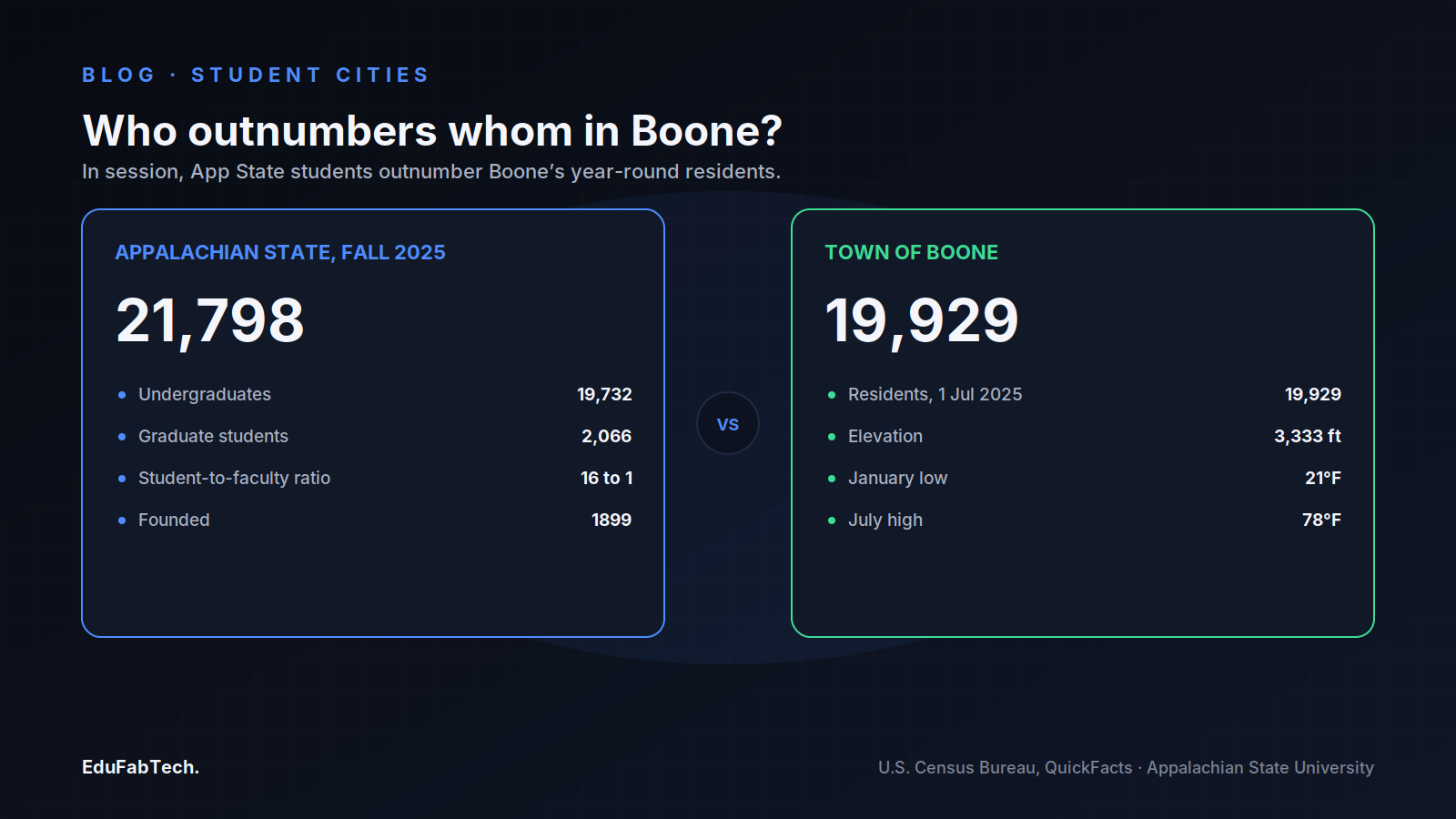
The town is small and the university is large relative to it. The U.S. Census Bureau's QuickFacts estimated Boone's population at 19,929 as of 1 July 2025 (census.gov), while Appalachian State University reports that it enrolled 21,798 students in autumn 2025 — 19,732 undergraduates and 2,066 graduate students (appstate.edu). In practice the student body outnumbers the permanent residents, and Boone is a college town in the fullest sense: when App State is in session, King Street downtown and the surrounding valleys fill up; over winter and summer breaks the place empties out.
This guide is for anyone weighing a move to Boone to study — whether from elsewhere in North Carolina, another U.S. state, or abroad. It leans on the university's and the town's own pages for every figure, and it is honest about the two hardest facts of life here: finding an affordable room, and getting through a mountain winter.
Appalachian State University and what studying here is like
Appalachian State University, founded in 1899 and based at 287 Rivers Street, is one of 17 campuses in the University of North Carolina System, with additional locations in Hickory and online (appstate.edu). The university lists more than 150 undergraduate and 80 graduate majors and reports a 16-to-1 student-to-faculty ratio. Its programmes in education, business, the health sciences, music and sustainability are long-established, and the hilly main campus runs straight into downtown Boone, so there is no hard line between "campus" and "town" the way there is at many universities.
Being a Mountaineer means living with App State's rhythms: football Saturdays at Kidd Brewer Stadium, the climb up and down the slopes between classes, and a calendar built around the mountain seasons. The compactness is a genuine academic advantage — labs, the library and most lecture buildings are within a walk of each other and of a lot of student housing. It also means the university's schedule and Boone's economy are tightly coupled, which matters when you look for a room or a job. You can browse what is currently listed for students across the city on EduFabTech's Boone page, and specifically what is near campus at listings near Appalachian State University.
Where students live
First-year students are generally housed on campus, and App State runs a large stock of residence halls — among them Belk, Cannon, Cone, White, Mountaineer, Laurel Creek, New River, Raven Rocks and Thunder Hill — in styles ranging from traditional double rooms with a common bath to suite and apartment layouts (housing.appstate.edu). The halls sit on both the main campus and the "State Farm" side reached by the campus shuttle, so where you are placed affects how much walking or bus-riding your day involves.
Beyond the halls, students spread out along the valleys and ridgelines around town: the areas off Highway 105 and Highway 421, the Bamboo and Poplar Grove roads, and the apartment clusters that the bus serves directly. Boone's terrain means "close to campus" and "a short walk" are not the same thing — a place a mile away as the crow flies can be a steep, snow-prone climb. Because the housing market turns over with the academic year, serious searching for an off-campus room for the following autumn typically begins in the winter and early spring beforehand; by late summer the good, bus-served options are largely gone. Start with the rooms currently posted on EduFabTech's Boone rooms page, and treat anything advertised cheaply at the last minute with suspicion.
Renting safely in a tight mountain market
Boone has a structural housing shortage: a lot of students, a fixed amount of buildable valley floor, and strong competition from short-term holiday rentals in a town ringed by ski resorts. That scarcity is exactly what rental scams exploit here. The most common traps are listings for rooms near campus or on an AppalCART route offered below the going rate, from someone who is conveniently "out of town for the season" and wants a deposit to "hold" the place before you have seen it.
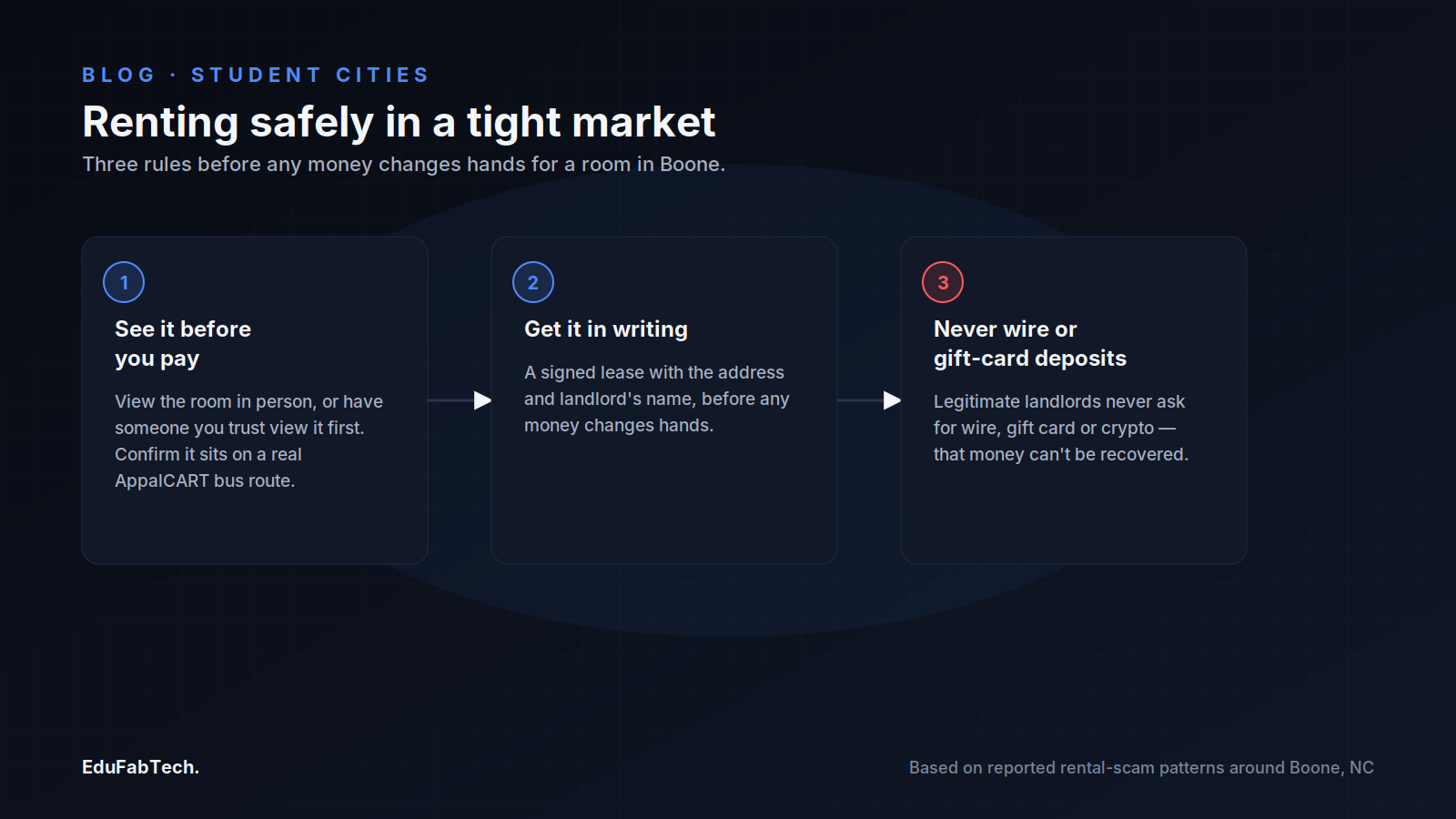
A few rules keep you safe in Boone specifically. See the actual room in person, or have someone you trust see it, before paying anything — in a town this small that is almost always possible, and refusal to allow a viewing is the clearest warning sign. Confirm the building is real and on a route you can check on the AppalCART map. Get a written lease with the address and the landlord's name before money changes hands. And never send a deposit or first month's rent by bank wire transfer, gift card or cryptocurrency to secure a room — legitimate local landlords do not require those, and money sent that way cannot be recovered. A normal arrangement is a signed lease and a security deposit paid once you have keys or a dated agreement, not a cash sprint to beat other applicants.
Furnishing a room cheaply — and the Saturday market
Because the student population churns every spring, Boone has a healthy second-hand economy. The Watauga Habitat for Humanity ReStore at 1200 Archie Carroll Road sells new and gently used furniture, appliances, home accessories and building materials, and lists shopping hours of Tuesday to Friday 10am–5pm and Saturday 10am–4pm (restore.wataugahabitat.org); it is a practical first stop for a desk, a lamp or a set of drawers. Hospitality House, the High Country's crisis agency, also runs the Welcome Home Thriftique on Boone Heights Drive, where proceeds support its housing programmes. For the things students hand over as they graduate and move out each May, the local classifieds are worth watching — see what is listed on EduFabTech for second-hand items in Boone.
For food and the feel of the town, the Watauga County Farmers' Market runs on Saturdays from 8am to 12pm (9am start in November) at Daniel Boone Park, 591 Horn in the West Drive, with its 2026 season listed as 4 April to 28 November (wataugacountyfarmersmarket.org). It is a local mountain market where growers and craftspeople sell directly — vegetables, eggs, meat, bread and handmade crafts from the surrounding county — and a cheap, pleasant way to spend a Saturday morning once the week's studying is done.
Working while you study
Term-time jobs in Boone cluster in the obvious places — campus dining and the library, downtown cafés and shops along King Street, and the ski-season businesses nearby in winter. For most students the rules are simply those of any U.S. part-time job; for international students they are stricter. Appalachian State's International Student and Scholar Services Office (ISSSO) states that F-1 students may work a maximum of 20 hours per week on campus while classes are in session, and more than 20 hours during academic breaks such as winter and summer (international.appstate.edu). The same office administers off-campus work options tied to your studies, Curricular Practical Training (CPT) and Optional Practical Training (OPT), each of which requires its approval before you begin.
This is general information, not legal advice: visa conditions change, and the authoritative word for your own case is ISSSO and the federal rules it applies, so confirm your situation with the office before accepting any work. When you are ready to look at what is available locally, EduFabTech collects current openings on its Boone jobs page.
Libraries and places to study
The Belk Library and Information Commons is the academic heart of campus. During the autumn and spring semesters it is open 24 hours a day, five days a week, with the building accessible to App State students, staff and faculty after midnight via AppCard tap entry (library.appstate.edu). Its third floor is the designated quiet floor, and the building also has bookable group study rooms, a makerspace and a recording studio for audio and video (library.appstate.edu) — a useful spread whether you need silence for exams or a space to work on a project with others.
Beyond the library, the compact campus means lecture-building lounges and downtown cafés along King Street absorb a lot of study hours, especially in the small gaps between classes. For quieter alternatives and bookable desks around town, EduFabTech lists study spaces in Boone.
Getting around on AppalCART
Boone's great practical advantage for students is its bus. AppalCART — the Appalachian Campus Area Rapid Transit — provides fare-free fixed-route service within the Town of Boone and Watauga County, with routes serving the Appalachian State campus, apartment complexes around town, downtown and the main shopping areas (appalcart.com). There is no ticket, no pass and no fare card to buy; you board and ride. Service follows the university calendar, running most frequently during the autumn and spring semesters — including late-night "Night Owl" routes — and on a reduced schedule over breaks.
A free, reliable bus matters more here than in a flatter town. Winter ice and steep grades make walking and cycling genuinely hard for several months, and parking on and near campus is limited. Choosing a room on a well-served AppalCART route is one of the single best decisions you can make for both your budget and your winter commute.
What it costs — and the honest trade-offs
On-campus housing figures come straight from the university. For 2026–2027, App State lists a double room with a common bath in first-year halls such as Belk, Cannon and White at $3,250 per semester, or $6,500 for the year; apartment-style rooms in halls like New River, Raven Rocks and Thunder Hill run up to $4,209 per semester, or $8,418 for the year, with rates covering electricity, water and maintenance (housing.appstate.edu). Off campus, the Census Bureau's QuickFacts puts Boone's median gross rent at $1,111 a month for 2020–2024, slightly below North Carolina's $1,228 (census.gov). The same source lists a median household income of just $30,065 in 2024 dollars for 2020–2024 — a figure pulled far below the state's $72,388 precisely because so many of Boone's households are students, which is a reminder that the official rent figure sits alongside a lot of shared, student-packed housing.
The honest picture, then. In Boone's favour: a walkable college town where campus and downtown blend together, a genuinely free and useful bus, cool summers, and a strong second-hand economy that makes setting up a room cheap. The hard parts: a tight, expensive-for-what-you-get rental market driven by scarcity and holiday-rental competition; a winter with real snow and ice at 3,333 feet that disrupts travel and demands proper clothing; and a small town that goes quiet over breaks and can feel isolated, roughly 95 miles from Winston-Salem over mountain roads. For students who want mountains, the outdoors and a close-knit campus, the trade is worth it; for those who want a big-city job market within walking distance, it is a stretch.
A checklist for your first weeks
- Sort housing before you arrive, and see it first. Confirm any off-campus room in person and never wire a deposit to "hold" a place — pay only against a signed lease once you have keys or a dated agreement.
- Learn your AppalCART route. Check which fare-free route serves your building and campus on appalcart.com, and note the break and Night Owl schedules.
- Furnish second-hand. Start at the Watauga Habitat ReStore and Hospitality House's Welcome Home Thriftique, and watch the local classifieds for second-hand furniture and free giveaways as students move out.
- International students: see ISSSO early. Confirm your 20-hour on-campus work limit and any CPT or OPT steps with the International Student and Scholar Services Office before taking any job.
- Claim a study spot. Get your AppCard working for after-midnight entry to the 24/5 Belk Library and find your floor — the third is the quiet floor, with group rooms elsewhere in the building.
- Dress for the mountain. Budget for a real winter coat and boots before January; snow and ice here are normal, not exceptional.
- Make Saturday mornings count. From April to late November the Watauga County Farmers' Market is a cheap, local way to eat well and get to know the town.
A quick question for readers
Rate these parts of student life this term
Rate each one from 1 (very poor) to 5 (very good). Together the results show where students struggle most.
Rate 5 things →Comments 3
Comment-
The number that actually tells you something is the $30,065 median household income against the state's $72,388. The article is upfront that…
-
The piece flags the median household income ($30,065 vs. the state's $72,388) as an artifact of the student population and tells you not to…
-
The two income figures side by side say more than either one alone: $30,065 median household income against the state's $72,388, explicitly…
Join free to read the full comments and reply Comments are between members; an account takes a minute.
Source: Appalachian State University
Sources (5)
- Appalachian State University. About App State. Appalachian State University, 2026. appstate.edu ↗ · checked 2 Nov 2026
- Appalachian State University Housing. Residence Halls and 2026-2027 Rates. Appalachian State University, 2026. housing.appstate.edu ↗ · checked 2 Nov 2026
- AppalCART. Fixed-Route Service. AppalCART (Watauga County), 2026. appalcart.com ↗ · checked 2 Nov 2026
- U.S. Census Bureau. QuickFacts: Boone town, North Carolina. U.S. Census Bureau, 2025. census.gov ↗ · checked 2 Nov 2026
- Watauga County Farmers' Market. Market Days, Hours and Season. Watauga County Farmers' Market, 2026. wataugacountyfarmersmarket.org ↗ · checked 2 Nov 2026