Studying in Boston: universities, housing and student life
A practical, sourced guide to Boston's universities, where students live, how to find a room safely, what it costs, and the honest trade-offs of studying in one of the world's densest college towns.
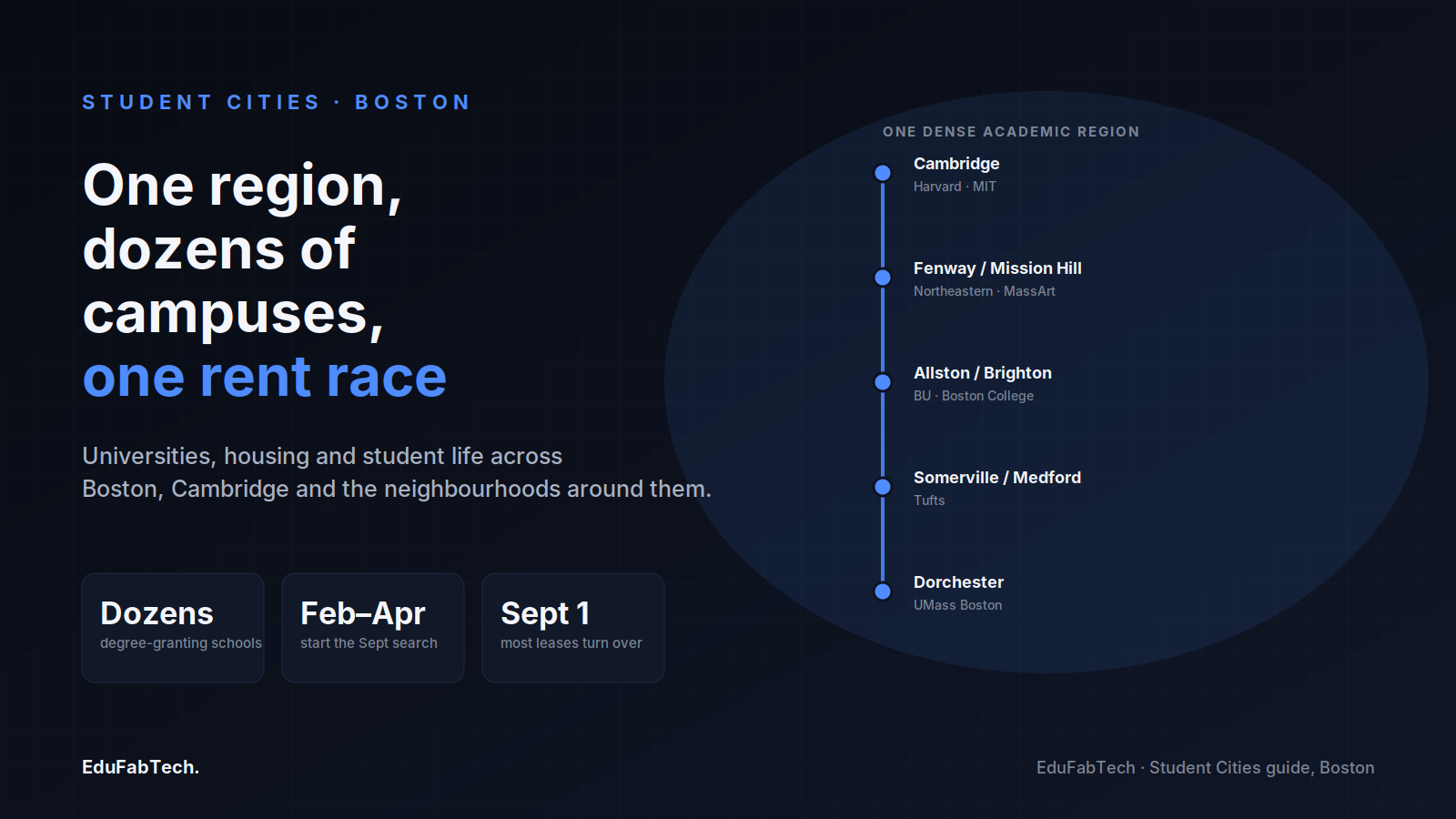
Few places on Earth concentrate as many students into as little space as Boston. The city proper is small — you can walk across much of it in an afternoon — yet together with neighbouring Cambridge, Somerville, Brookline and the inner suburbs it holds dozens of degree-granting institutions and a student population large enough to reshape the rental market every autumn. The result is a metro that is unusually built around learning: bookshops, lecture series, cheap pizza, late-opening libraries, and a transit map whose stops read like a syllabus.
That density is the city's gift and its difficulty. You can hear a Nobel laureate speak, find a lab partner, and change your whole plan over coffee — but you will pay for the privilege in rent and compete for every room. This guide is for anyone weighing a move to Boston to study, whether from the next town or the far side of the world. It names the institutions you asked about, maps the neighbourhoods students actually live in, and sticks to figures that can be sourced.
One orientation note before the details: "Boston" for a student rarely means only the city limits. The Harvard University campus and the Massachusetts Institute of Technology both sit across the Charles River in Cambridge; Tufts University straddles Medford and Somerville; Wellesley College is a train ride west. Think of it as one dense academic region rather than a single town.
The universities, and what studying here is like
Boston's reputation rests partly on its oldest neighbours in Cambridge. Harvard University, around Harvard Square, is the country's oldest institution of higher learning and runs the gamut from the undergraduate Harvard College to its professional schools; its extension and summer offerings, including the Harvard Summer School, bring short-term students into the same square. Nearby, the Massachusetts Institute of Technology anchors the Kendall Square area, a cluster so thick with biotech and software firms that the walk to class doubles as a tour of an industry.
Inside the city, the student presence is just as strong. Boston University stretches along Commonwealth Avenue past the Fenway; Northeastern University, also near the Fenway, built its identity on cooperative education, in which students alternate terms of study with paid, full-time work placements — a signature programme the university places at the heart of a Northeastern education. Berklee College of Music fills Back Bay with contemporary and jazz musicians; Massachusetts College of Art and Design, a public art and design college, sits on Huntington Avenue's "Avenue of the Arts" alongside Wentworth Institute of Technology, a hands-on engineering, design and technology school near Roxbury Crossing and Mission Hill. Boston College, a Jesuit university, occupies a leafy campus at Chestnut Hill on the city's western edge, while the public University of Massachusetts Boston looks out over the harbour from Columbia Point in Dorchester, near Savin Hill.
Downtown and in Back Bay you will find Suffolk University on Beacon Hill and Emerson College, known for communication and the arts, by the Theater District. Several specialist and graduate institutions round out the map: The Fletcher School of Law and Diplomacy, the graduate school of international affairs on the Tufts campus; the William James College for psychology; Lesley University near Harvard Square, strong in education and the arts; and Bentley University, a business-focused university in Waltham. The harder-to-reach Salem State University and the Newton-area Lasell University extend the region further still.
Other universities and schools in and around Boston
- Harvard-affiliated units: the Harvard School of Dental Medicine in the Longwood Medical Area near Mission Hill, and the Center for International Development at Harvard University, a research centre rather than a degree school.
- Tufts health and engineering schools: the Tufts University School of Dental Medicine on the downtown health-sciences campus, and the Tufts University School of Engineering on the main Medford/Somerville campus.
- Northeastern units: the Northeastern University School of Journalism and the Northeastern University School of Pharmacy, both part of the Fenway-area campus.
- A BU programme: the Boston University Science and Engineering Program, offered within the university's Charles River campus.
- Health career college: Labouré College of Healthcare, a nursing and allied-health college now based south of the city near Milton.
- Merged or historic names you may still see: the New England School of Art and Design is today part of Suffolk University; the Leland Powers School was a long-closed Boston school of speech and broadcasting; Aquinas College, a former junior college in the Newton area, has closed; and Middlesex University, a medical and veterinary school once in Waltham, closed in the 1940s — its campus became today's Brandeis University, which still sits in Waltham alongside Bentley.
Where students actually live
Because campuses are scattered, there is no single "student quarter." Where you land depends on which institution you attend and how much rent you can bear.
Allston and Brighton are the classic student districts west of the Fens: dense triple-decker housing, cheap food, a loud music scene, and easy reach of Boston University and Boston College. Rooms here are among the more affordable in the city and lease turnover is constant. Fenway and Mission Hill sit next to Northeastern, Wentworth and MassArt; they are central and walkable but command a premium for that convenience, and Mission Hill's steep streets are packed with students sharing apartments.
Cambridge — especially around Central, Harvard and Porter Squares — serves Harvard and MIT students who want to walk or bike to class; it is pricey but superbly connected. Somerville and Medford, north of Cambridge, suit Tufts students and anyone priced out of Cambridge proper; the recent extension of the light-rail Green Line has made parts of Somerville far easier to reach. Jamaica Plain, south-west of the centre, is quieter and greener, popular with graduate students who commute in by subway. Farther out, Quincy and Malden trade a longer commute for noticeably lower rent and are common fallback options when the inner neighbourhoods fill.
Finding a room without getting burned
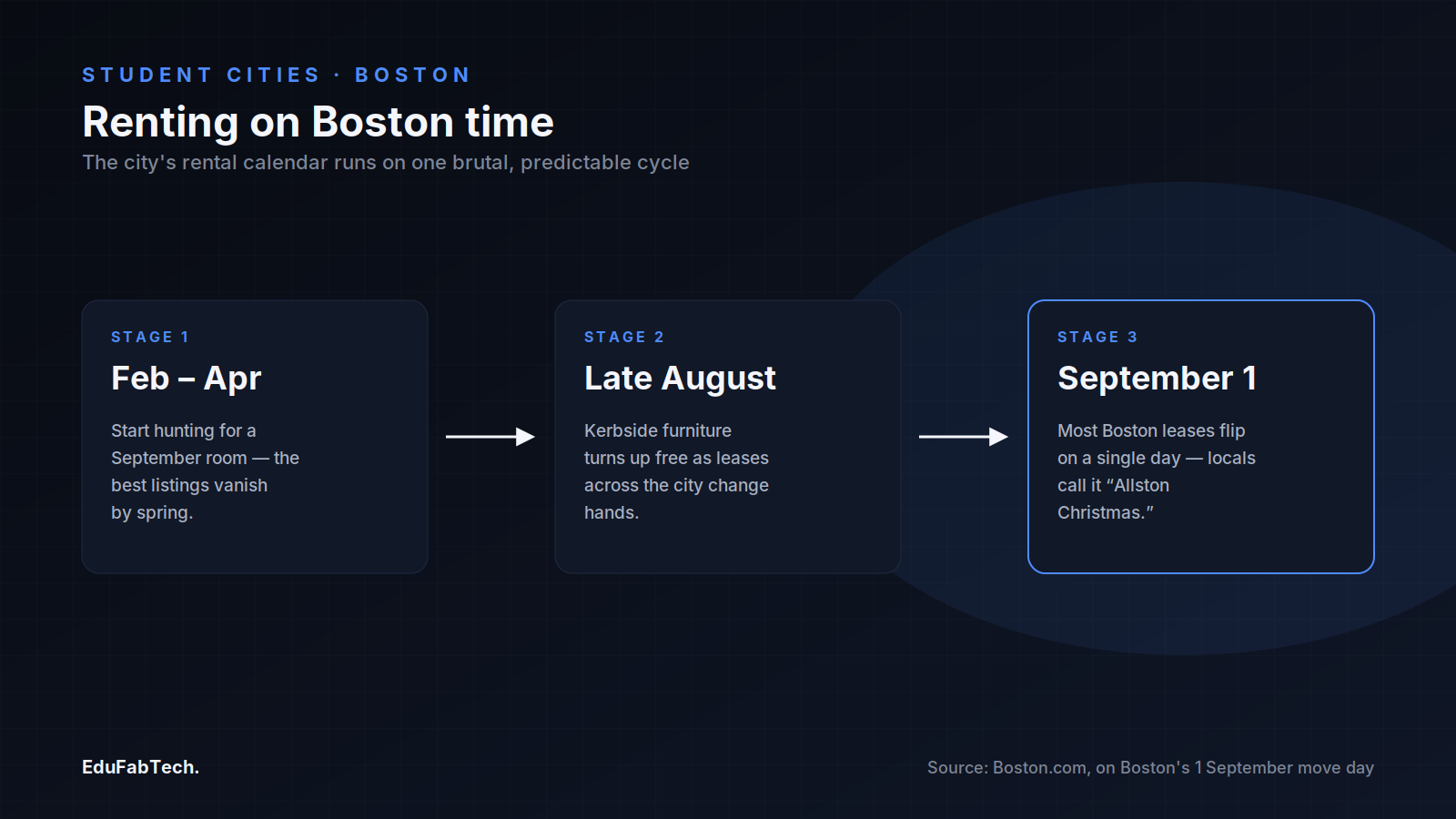
Boston's rental calendar is brutally seasonal. A very large share of the city's leases turn over on a single day — 1 September — producing the annual chaos that locals half-jokingly call "Allston Christmas," when sidewalks overflow with discarded furniture and every moving truck in the region is booked, as Boston.com has documented. The practical consequence: the best rooms for a September start are listed and gone by the spring before. Begin looking in February to April for an autumn move, and expect to decide quickly.
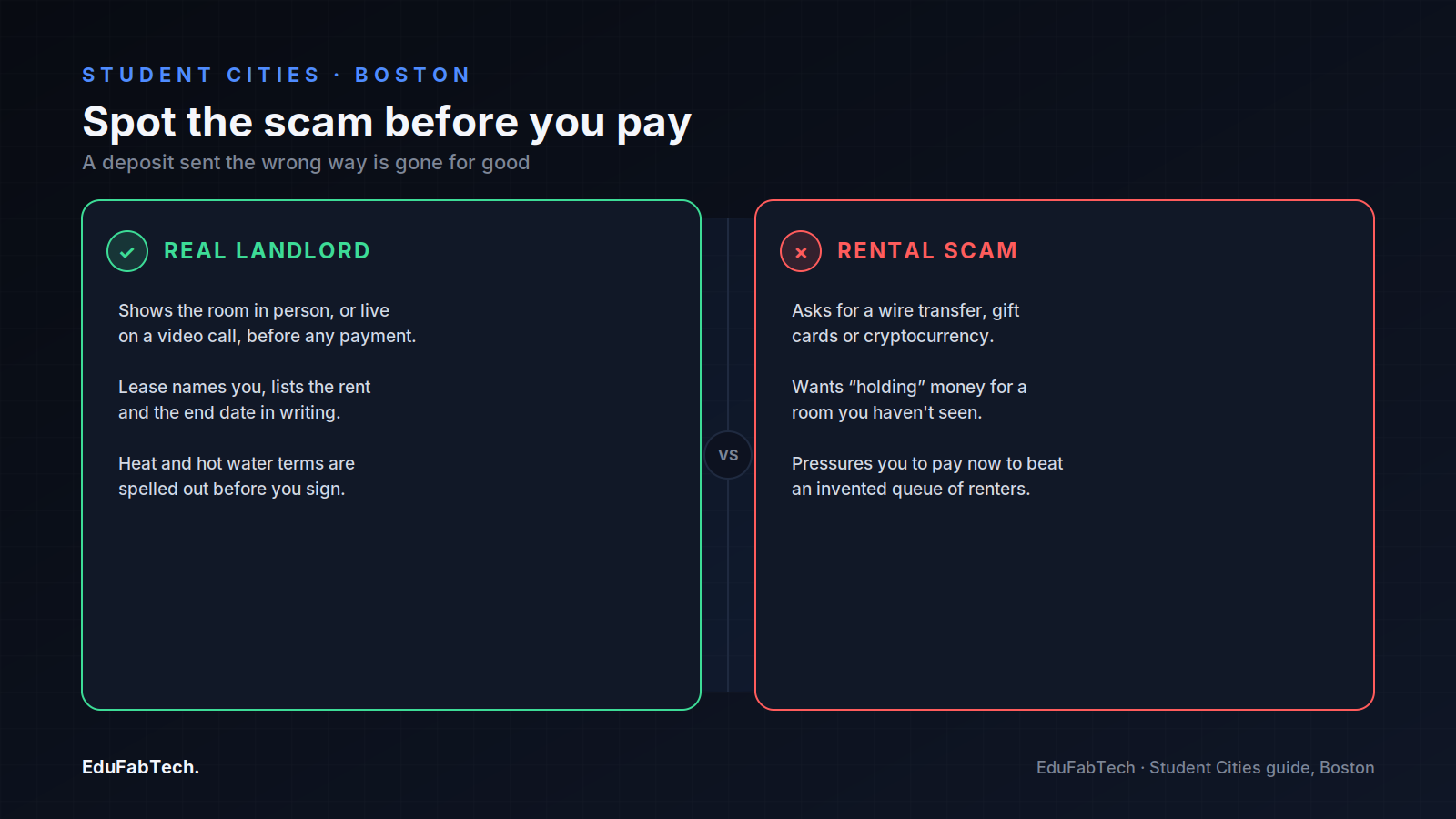
Before you pay anything, check the basics: that the person showing the room actually controls it, that the lease names you and lists the rent and end date, that heat and hot water arrangements are written down, and — in older triple-deckers — that windows, locks and smoke detectors work. Ask who pays for heating; New England winters make this a real line in your budget.
On scams, be strict. See the place in person, or on a live video call where the person walks you through it in real time, before you send money. Never wire a deposit by bank transfer, pay in gift cards or cryptocurrency, or hand over "holding" money to someone you have not met to secure a room you have not seen — these are the classic patterns of rental fraud, and a deposit sent that way is gone. A legitimate landlord will not pressure you to pay instantly to beat an invented queue. EduFabTech's own rooms listings for Boston and the broader Boston student listings are a place to start, including rooms near Boston University if you are tied to a particular campus.
Furnishing a room for next to nothing
The same 1 September churn that makes housing stressful makes furniture almost free. In the last days of August, perfectly usable desks, chairs, lamps and bookshelves appear on kerbs across Allston, Brighton, Mission Hill and Somerville. Check that upholstered items are clean and dry before taking them indoors, and you can furnish a room for the cost of carrying it home.
For planned second-hand shopping, the SoWa Vintage Market in the South End — an indoor flea market open on Sundays — is the best-known hunting ground for clothes, furniture and oddments, part of the larger SoWa open-air market that runs from spring into late autumn. Across the river, Cambridge's long-running weekend flea markets and the city's many thrift and consignment shops fill the gaps. For the digital version, EduFabTech lists second-hand things — from furniture to items being given away free — around the city.
Working while you study
Rules for part-time work depend entirely on your immigration status, and this is an area where you should read the official source rather than trust word of mouth. International students on the main study visa category (F-1) may generally take on-campus work subject to limits, with off-campus and post-study employment — such as curricular and optional practical training — requiring specific authorisation arranged through their institution's designated school official. The precise conditions, hour limits and timing are set by the federal immigration authority, whose official guidance on students and employment you should read directly and confirm with your university's international student office. Nothing here is legal advice. For on-campus and local openings, EduFabTech collects jobs and part-time work in the city.
Libraries and places to study
Boston takes libraries seriously. The Boston Public Library was, by its own account, the first large free municipal library in the United States, established in 1848 and committed from early on to being "free to all"; its grand Central Library in Copley Square, with the hushed, cathedral-like Bates Hall reading room, is open to anyone and makes a superb free study space. Branch libraries across the neighbourhoods extend that to wherever you live.
On top of that, each university runs its own libraries and study halls, many open late during term, and the dense café culture of Cambridge, the South End and Jamaica Plain offers endless table-and-outlet corners. When term-time demand peaks and seats run short, EduFabTech also lists bookable study spaces and desks.
Getting around
The regional transit system — subway, bus, commuter rail and ferry — is the practical way to cross the metro, and students lean on it heavily. A single subway ride costs US$2.40 with a stored-value card, and a monthly subway-and-bus pass US$90.00, according to the regional transit authority's 2026 fares. Most degree-granting colleges and universities in Greater Boston participate in a semester pass programme that the transit authority states gives an 11% fare discount, arranged through your school's transportation or student-affairs office — some institutions add further subsidy on top. Within the inner city, though, walking and cycling are often faster than waiting for a train; Boston rewards students who live close enough to go on foot.
What it costs, honestly
Boston is expensive, and housing is the reason. As an independent benchmark, Apartment List's August 2026 data put the median one-bedroom rent in Boston at US$2,418 and the median two-bedroom at US$2,546 — which is why students almost always share. For a sense of a full budget from an institution's own accounting, Boston University's 2026–2027 cost-of-attendance figures estimate housing and food at US$16,250 for the nine-month academic year, before tuition, with separate allowances for transport, books and personal spending. Treat such figures as orientation, not a promise: what you actually pay turns on your neighbourhood, how many people you share with, and whether you cook. Where you can, beat the cost down by sharing further out, buying second-hand, and cooking from the city's markets rather than eating out.
The honest ledger: what's good, what's hard
What's good: the sheer concentration of universities, labs, hospitals and companies means opportunity is unusually close at hand — co-ops, research posts, talks and collaborators are often a short walk or subway ride away. The city is compact, walkable and genuinely beautiful in parts, with free world-class libraries and a dense, international student culture. Nobody here will find it strange that you study for a living.
What's hard: cost first and foremost — rent consumes a large share of most student budgets, and the 1 September lease crunch adds stress and scam risk to every housing search. Winters are long and cold, and the older housing stock can be draughty and poorly heated. Crowding is real: popular neighbourhoods and transit lines fill, and commutes from the affordable fringe can be long. Go in clear-eyed about the money and the calendar, and Boston repays the effort.
A checklist for the first weeks
- Confirm your term dates and your institution's international or student-services contacts before anything else.
- Start the room search months ahead of a September move; see every place in person or on a live video walkthrough before paying.
- Never send a deposit by wire transfer, gift card or crypto to "hold" an unseen room.
- Get a stored-value transit card and ask your school's transport office about the discounted semester pass.
- Register for a free Boston Public Library card and scout a study spot near home and near campus.
- If you are an international student, read the official work-authorisation rules and confirm them with your university before taking any job.
- Furnish from the kerbs in late August and from the city's second-hand markets as the term begins.
- Budget for heating in winter and for the possibility of a longer commute if you live on the affordable edge of the metro.
A quick question for readers
What is your biggest monthly expense as a student?
Knowing where the money really goes helps new students plan. Your answer helps someone budget.
Pick an answer, create a free account in a minute, and your vote counts. Already a member? Sign in
- Massachusetts Bay Transportation Authority. Subway Fares and College Student Semester Passes. MBTA, 2026. link
- Boston University. Cost of Attendance for 2026-2027. Boston University, 2026. link
- Apartment List. How Much Is Rent in Boston? (August 2026 data). Apartment List, 2026. link
- Boston Public Library. BPL History. Boston Public Library, 2026. link
- U.S. Citizenship and Immigration Services. Students and Employment. USCIS, 2026. link
- Northeastern University. Cooperative Education. Northeastern University, 2026. link