Studying in Bournemouth: universities, housing and student life
A practical, sourced guide to Bournemouth's three universities, where students live, what a room costs in 2026/27, getting around on the Unibus, and the honest trade-offs of studying by the Dorset coast.
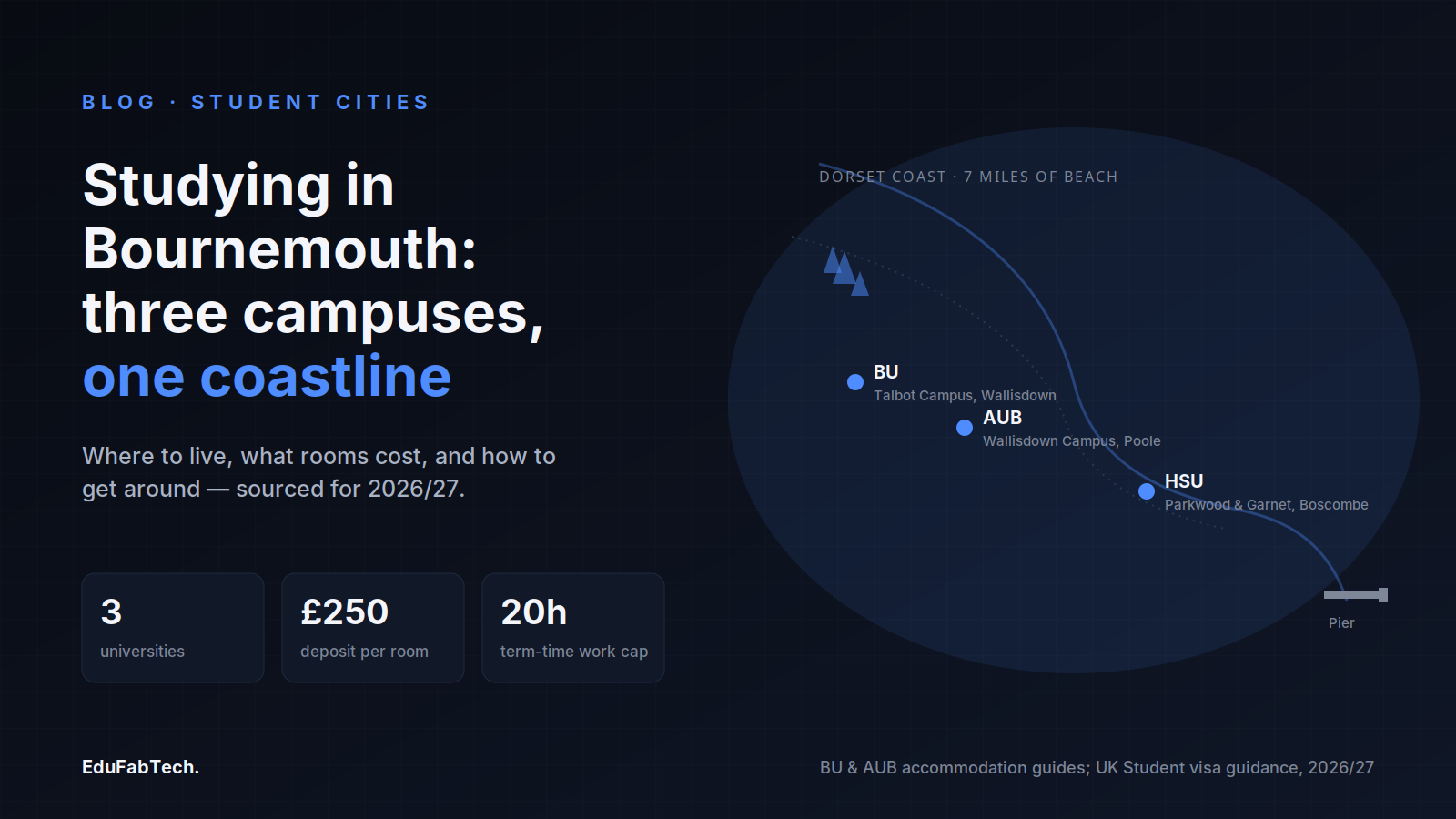
Bournemouth is a seaside town on the Dorset coast of southern England, built along seven miles of sandy beach between the cliffs of Southbourne and the harbour at Poole. The Victorians laid it out as a health resort around pine-filled valleys called the Chines, and that inheritance still shapes it: gardens running down to the pier, a dense centre around the Square and the Lansdowne, and residential suburbs — Winton, Charminster, Boscombe, Southbourne — spreading inland. For a town of its size it carries an unusual number of students, spread across three separate universities that sit within a few miles of one another.
This guide covers all three, plus the practical questions that decide whether a year here works: where students actually find rooms, what those rooms cost in 2026/27, how to avoid a rental scam, where to work and study, and how to get around. Every figure below names its source and the year it refers to. For current local listings while you read, EduFabTech keeps a Bournemouth page at /in/united-kingdom/bournemouth.
Three universities between the pines and the sea
Bournemouth University is the largest. Its main site, Talbot Campus, sits at Fern Barrow on the Wallisdown Road boundary between Bournemouth and Poole, and holds the students' union and the main library. According to Bournemouth University's own facilities and campuses pages, Talbot houses the Faculty of Media & Communication and the Faculty of Science & Technology, with TV studios, editing suites, a sound stage and motion-capture facilities; the university is known for media, animation and computing. Its second site, Lansdowne Campus, is near the town centre and is where most Faculty of Health & Social Sciences teaching happens, in the Bournemouth Gateway Building with its healthcare simulation suites.
Arts University Bournemouth — AUB — is a specialist art-and-design university whose campus is actually in Poole, at Wallisdown, immediately next door to BU's Talbot site. AUB's own pages describe a compact campus of specialist workshops; its best-known courses are in fields such as film production, animation, acting, costume, graphic design, illustration and architecture. The two institutions share a neighbourhood but are entirely separate.
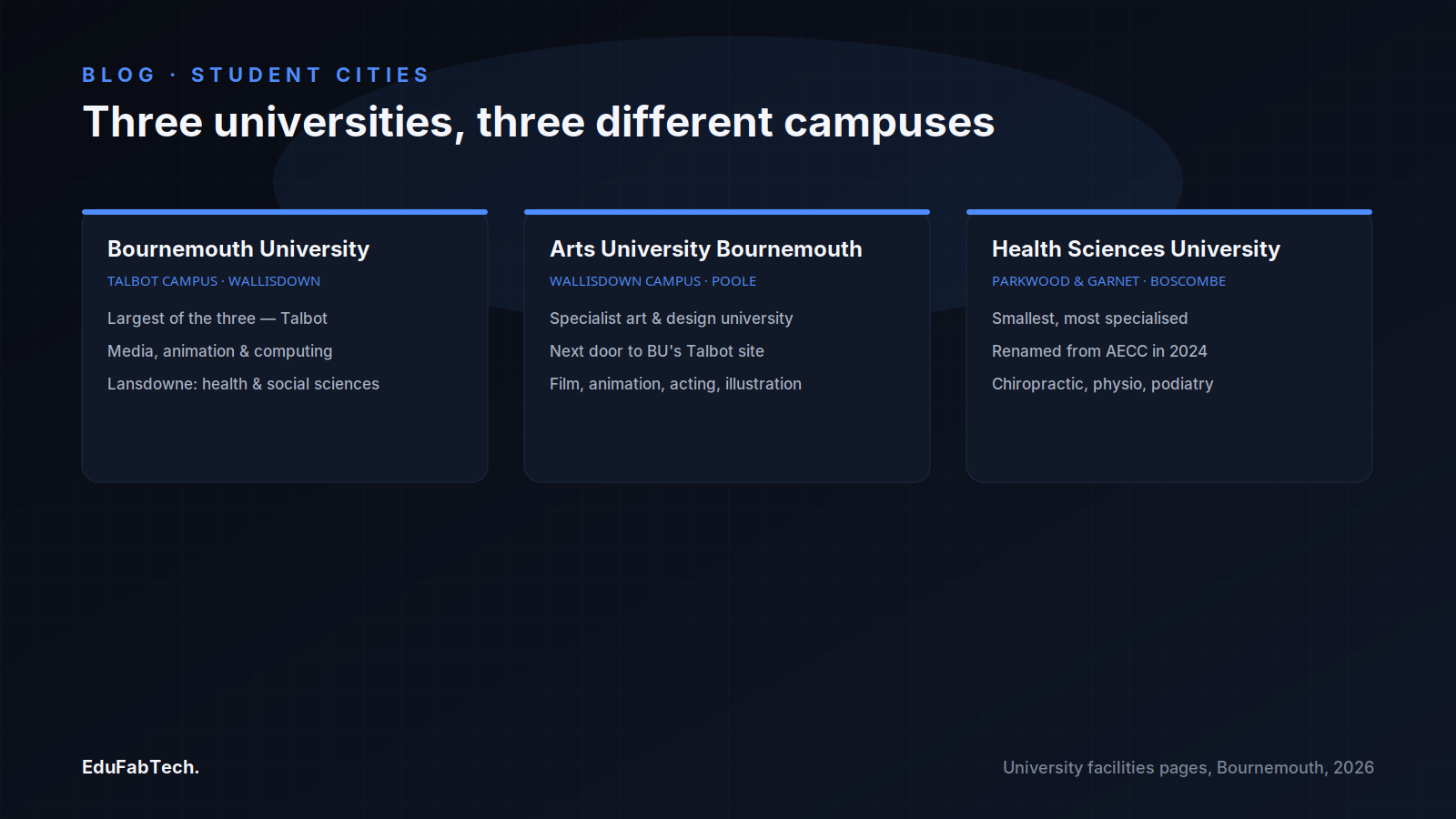
Health Sciences University is the smallest and most specialised of the three. It was renamed from AECC University College in 2024 and, as its Study in Bournemouth pages set out, it occupies the Parkwood and Garnet campuses on Parkwood Road in the Boscombe part of Bournemouth. It grants degrees in health disciplines — chiropractic (the MChiro), radiography and medical imaging, physiotherapy, podiatry and health sciences among them — and runs teaching clinics open to the public. If you have an offer here, you are joining a small cohort in an east-side neighbourhood rather than a sprawling campus.
Further education colleges sit alongside the universities and matter to some students: Bournemouth and Poole College has campuses in Poole and central Bournemouth, Brockenhurst College is out in the New Forest, and Moorlands College is at New Milton. They are worth knowing if you are doing an access course, a foundation year or a franchised degree, but the bulk of degree study in the area runs through the three universities above.
Where students settle
Where you live depends heavily on which campus you are tied to. For Bournemouth University and AUB students, the gravitational pull is westward and inland toward Wallisdown and Talbot, and into the terraced suburbs that feed them. Winton, strung along Wimborne Road north of the centre, is the classic student area: cheap takeaways, a long high street and a short bus ride to Talbot. Charminster, just east of Winton around Charminster Road, is similar in feel and closer to the Lansdowne. Both are dominated by converted Victorian houses split into shared rooms (houses in multiple occupation).
Closer to Talbot itself, the streets around Wallisdown and Ensbury Park put you within walking or cycling distance of campus but further from the sea and nightlife. Lansdowne, at the top of the town, is the purpose-built corner: tall blocks of private student accommodation cluster here near BU's health campus and the train station. Boscombe and Southbourne, to the east, are where Health Sciences University students and those who want to be near the beach tend to look; Boscombe is cheaper and rougher around the edges, Southbourne quieter and more residential. Poole, to the west, suits AUB students who want to be on the harbour side of Wallisdown.
Most first-years take a university-managed room and move into a shared house in second year. Rooms and shared houses are listed on EduFabTech at /in/united-kingdom/bournemouth/rooms, and listings tied to the main campus at /near/bournemouth-university.
Renting without losing a deposit
The safe default for a first year is a managed hall. Bournemouth University's halls are a mix of university-owned buildings (Dorchester House, Student Village) and partner-operated blocks run by providers such as Unite, Student Roost, Campus Living Villages and Yugo; all are booked through the university, and the published payment to secure a room for 2026/27 is a £250 deposit or advance rent instalment, according to the Bournemouth University accommodation price guide 2026/27. AUB's Campus Halls, per its Campus Halls page, also list a £250 deposit for 2026/27. Book directly through the university's accommodation portal and you are dealing with a named provider on a regulated contract.
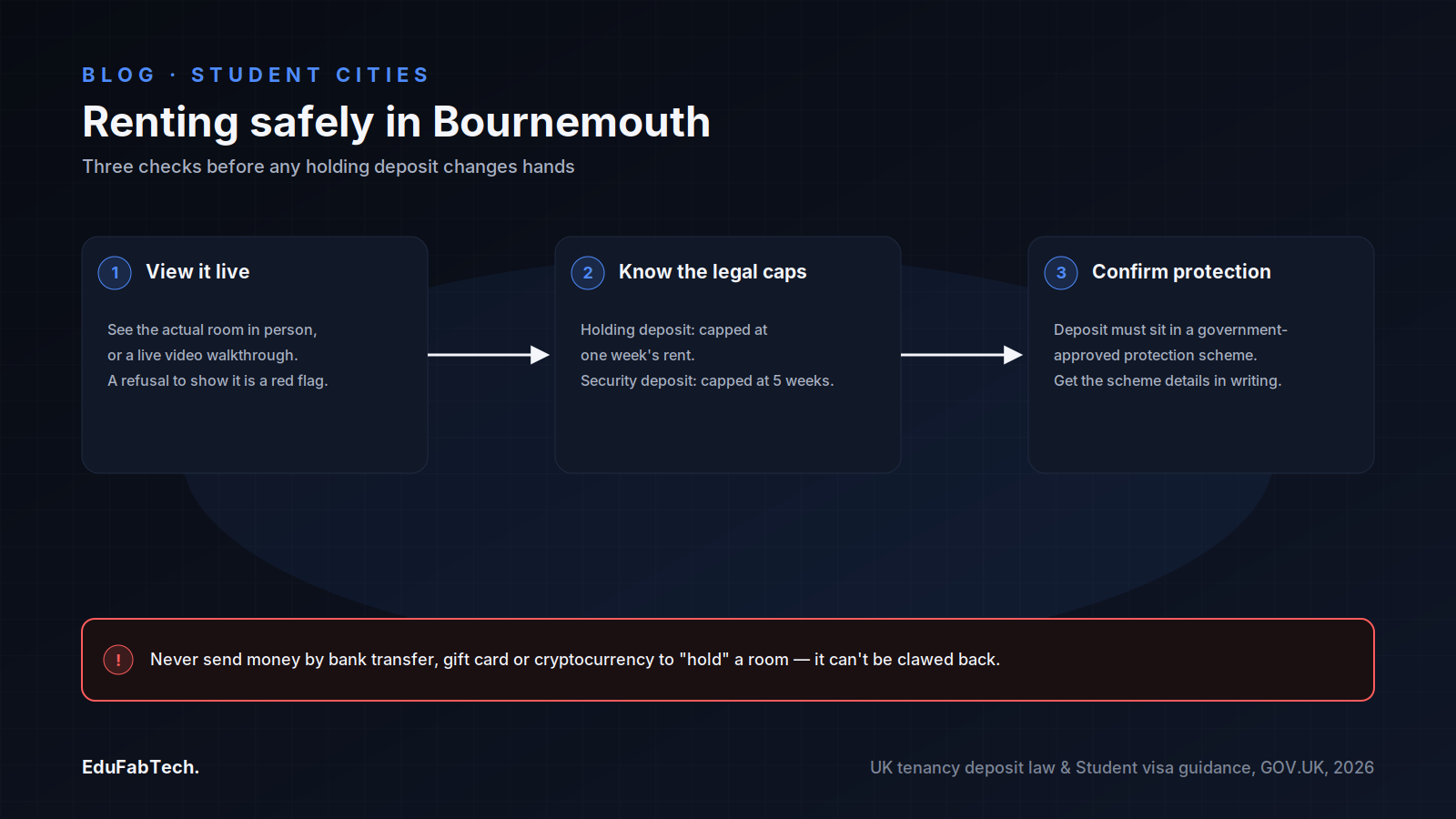
The private market is where care is needed. Bournemouth has a large stock of HMO shared houses in Winton, Charminster and Boscombe, and demand peaks sharply before the September intake, which is exactly when scams appear. The pattern is familiar: an advert for a room that is cheaper or nicer than everything around it, a "landlord" who is conveniently abroad or too busy to show you the place, and pressure to pay a holding deposit fast. Treat any of that as a warning. See the room in person — or on a live video call where someone walks through the actual flat — before any money moves. A genuine Bournemouth landlord or agent will let you view a Winton terrace; one who refuses is telling you something.
Never send money to "hold" a room by bank transfer, gift card or cryptocurrency — none of those can be clawed back, and no legitimate letting in Bournemouth needs them. In England, a holding deposit on an assured shorthold tenancy is capped by law at one week's rent, and a security deposit at five weeks' rent for most tenancies; a demand far above that is a red flag. Deposits on an assured shorthold tenancy must by law be placed in a government-approved protection scheme, and you should get the scheme details in writing. If a deal feels rushed, slow it down.
Furnishing a room on a student budget
Second-year houses often come part-furnished at best, and kitting out a room cheaply is a rite of passage. Bournemouth's most useful resource for this is the charity-shop stretch of Wimborne Road in Winton, which carries an unusual density of them within a few hundred metres. Among those currently listed on the charities' own shop finders are a British Heart Foundation furniture and electrical store at 470–472 Wimborne Road — the kind of place that sells pre-loved sofas, desks and kettles — plus Sue Ryder at number 419 and Barnardo's at 385. Charity-shop stock changes week to week, so the trick is to visit often rather than once.
Boscombe, around the precinct and Christchurch Road, is the other hunting ground, with a scruffier mix of charity and second-hand shops. Bournemouth does not have a single famous permanent flea market the way some cities do, so for furniture and household basics the practical route is charity shops, student "everything must go" sales at the end of each summer, and the local second-hand and giveaway listings. EduFabTech gathers these at /in/united-kingdom/bournemouth/second-hand, with furniture specifically at /in/united-kingdom/bournemouth/furniture and free items at /in/united-kingdom/bournemouth/free-stuff. Buying second-hand close to the end of the academic year, when departing students clear out, is when the best things appear.
Working while you study
Bournemouth's tourism and hospitality economy means term-time bar, café, retail and events work is genuinely available, and the summer season swells it further. If you are an international student, though, your right to work is set by the conditions on your visa, not by what an employer offers. The UK government's Student visa guidance states that whether you can work "depends on what you're studying and whether you're working in or out of term-time". In practice, students on degree-level courses at a higher education provider are commonly permitted to work up to 20 hours a week during term time, with no limit outside term time — but the exact limit is printed on your own visa or eVisa, and that document is the authority. Working more hours than your visa allows is a serious immigration breach, so check your own conditions and keep to them rather than relying on hearsay.
This is not legal advice; it is a pointer to where the rules live. For home students there is no such cap, and the usual balance is simply not letting shifts eat your contact hours. Current local vacancies are listed at /in/united-kingdom/bournemouth/jobs, and your students' union and the universities' careers services advertise part-time and on-campus roles that fit around timetables.
Libraries and places to read
Each university runs its own libraries. Bournemouth University's main library is at Talbot Campus, with the Weston Library at Lansdowne serving the health and business faculties; both offer long opening hours and bookable study space, with extended hours around exams. AUB and Health Sciences University each have their own specialist libraries geared to their subjects. Your student card is the key to all of this, and it is where most people do serious work.
Beyond campus, Bournemouth Library in the town centre, run by BCP Council, is a free public option with desks and Wi-Fi, useful in holidays when university buildings quieten down. The town's many independent cafés double as informal study spots, and in warm weather the beachfront and gardens become open-air reading rooms — pleasant, if not the place for heads-down revision. Quiet desks, co-working spots and bookable rooms around the town are collected at /in/united-kingdom/bournemouth/study-spaces.
Getting around, and the Unibus pass
Bournemouth, Poole and Christchurch form one continuous built-up area, and local buses tie it together. The university bus network, Unibus, runs in partnership with the operator morebus; its U1 to U4 routes link the campuses, town and halls, and a Unibus pass is valid across the wider morebus Zone A network covering Bournemouth, Poole and Christchurch, as described on Bournemouth University's public transport pages. If you live in BU halls you can bundle an annual bus pass into your rent and pay it in instalments; the Bournemouth University accommodation price guide 2026/27 values that optional annual pass at £319.
Distances are short enough that many students cycle or walk — Talbot to Winton is a walkable stretch, and the seafront is flat and continuous. Bournemouth railway station, at the Lansdowne end of town, puts Southampton, Poole and London Waterloo within direct reach by South Western Railway. For a town this size, a car is more burden than help: parking near the centre and the campuses is tight and charged. Decide your transport around where you live, and buy the pass that matches the routes you will actually use.
What a year costs
Housing is the biggest line in any student budget here, and for once the numbers are published precisely. The Bournemouth University accommodation price guide 2026/27 lists managed rooms from about £152.32 a week for a Unilet room and £154.49 for a value non-en-suite room in Student Village, rising through en-suite rooms in the mid-£170s to £190s, up to £238.90 a week for a premium studio in Dorchester House and £274.12 for a two-bed family bungalow — all inclusive of bills and the ResLifeBU programme, and most including the optional bus pass. At AUB, the Campus Halls page lists single en-suite rooms at £207 a week on a 42-week tenancy running 5 September 2026 to 26 June 2027, and studios at £236 a week on a 51-week tenancy from 12 September 2026 to 4 September 2027.
For the private market the benchmark comes from the Office for National Statistics, whose data put the average monthly private rent across Bournemouth, Christchurch and Poole at £1,400 in September 2026 — an increase from £1,369 in September 2025, a 2.2% annual rise, according to the ONS private-rent figures. The same source gives a one-bedroom average of £918 and a two-bedroom average of £1,170 a month in September 2026. Those are whole-property figures, not per-room, so a room in a shared Winton house typically lands well below them — but they show the direction of the market and are a reality check against any advert that looks suspiciously cheap.
What's good, what's hard, and a first-weeks checklist
The good is easy to state. Few university towns put a sandy beach, a national park and a compact nightlife within the same bus zone, and Bournemouth does. The three institutions give the area a real student population without the scale that makes a city anonymous, and the beach genuinely is on your doorstep rather than a day trip. The subjects on offer — media and animation at BU, art and design at AUB, health specialisms at HSU — draw people who came for something specific.
The hard parts are equally real. Housing is tight and priced like a prosperous south-coast town, not a cheap student outpost, and the pre-September scramble rewards those who start early. Winter on an exposed coast is grey, windy and wet, and the summer tourist crowds that fill the beaches also fill the buses and push up the cost of a good time. Public transport is decent within the conurbation but thins out in the evenings and further afield, so an evening shift or a late library session needs planning. None of this is unusual for a seaside university town; it is simply worth knowing before you arrive.
A checklist for your first weeks
- See it before you pay. View any private room in person or on a live walk-through video, and never transfer money to "hold" a place by bank transfer, gift card or crypto.
- Check the deposit. On an assured shorthold tenancy, confirm your deposit is registered with a government-approved protection scheme and get the paperwork.
- Sort transport first. Decide whether a Unibus/morebus pass fits your routes before buying anything else; bundle it with halls rent if you are in managed accommodation.
- Register with a GP and find your nearest pharmacy in your neighbourhood — Winton, Boscombe and the town centre all have them.
- If you are an international student, read the work conditions on your own visa via the official GOV.UK Student visa page before taking any job, and keep within them.
- Furnish gradually. Walk the Wimborne Road charity shops in Winton and watch the local free and second-hand listings rather than buying everything new in week one.
- Find your desk early. Get your campus library card activated and scout one quiet backup spot for exam season.
A quick question for readers
Do you work part-time while you study?
Many students work to pay the bills. See how common it is — and how many hours people really do.
Pick an answer, create a free account in a minute, and your vote counts. Already a member? Sign in
Comments 2
Comment-
Bundling the £319 annual bus pass into halls rent is sold as a convenience, but the piece never gives a standalone fare to check it against.…
-
The ONS numbers are the one spot where the sourcing slips a little. £1,400 average monthly rent for Bournemouth, Christchurch and Poole in S…
Join free to read the full comments and reply Comments are between members; an account takes a minute.
Source: Bournemouth University
Sources (5)
- Bournemouth University. Accommodation price guide 2026/27. Bournemouth University, 2026. bournemouth.ac.uk ↗ · checked 10 Nov 2026
- Arts University Bournemouth. Campus Halls. Arts University Bournemouth, 2026. aub.ac.uk ↗ · checked 10 Nov 2026
- Office for National Statistics. Private rent and house prices: Bournemouth, Christchurch and Poole. Office for National Statistics, 2026. ons.gov.uk ↗ · checked 10 Nov 2026
- GOV.UK. Student visa: work. UK Government, 2026. gov.uk ↗ · checked 10 Nov 2026
- Health Sciences University. Study in Bournemouth. Health Sciences University, 2026. hsu.ac.uk ↗ · checked 10 Nov 2026