Studying in Braunschweig: universities, housing and student life
A practical, sourced guide to the Lion City's universities, dormitory rents, flea markets, part-time-work rules, study spaces and the Deutschlandsemesterticket — with the honest trade-offs.
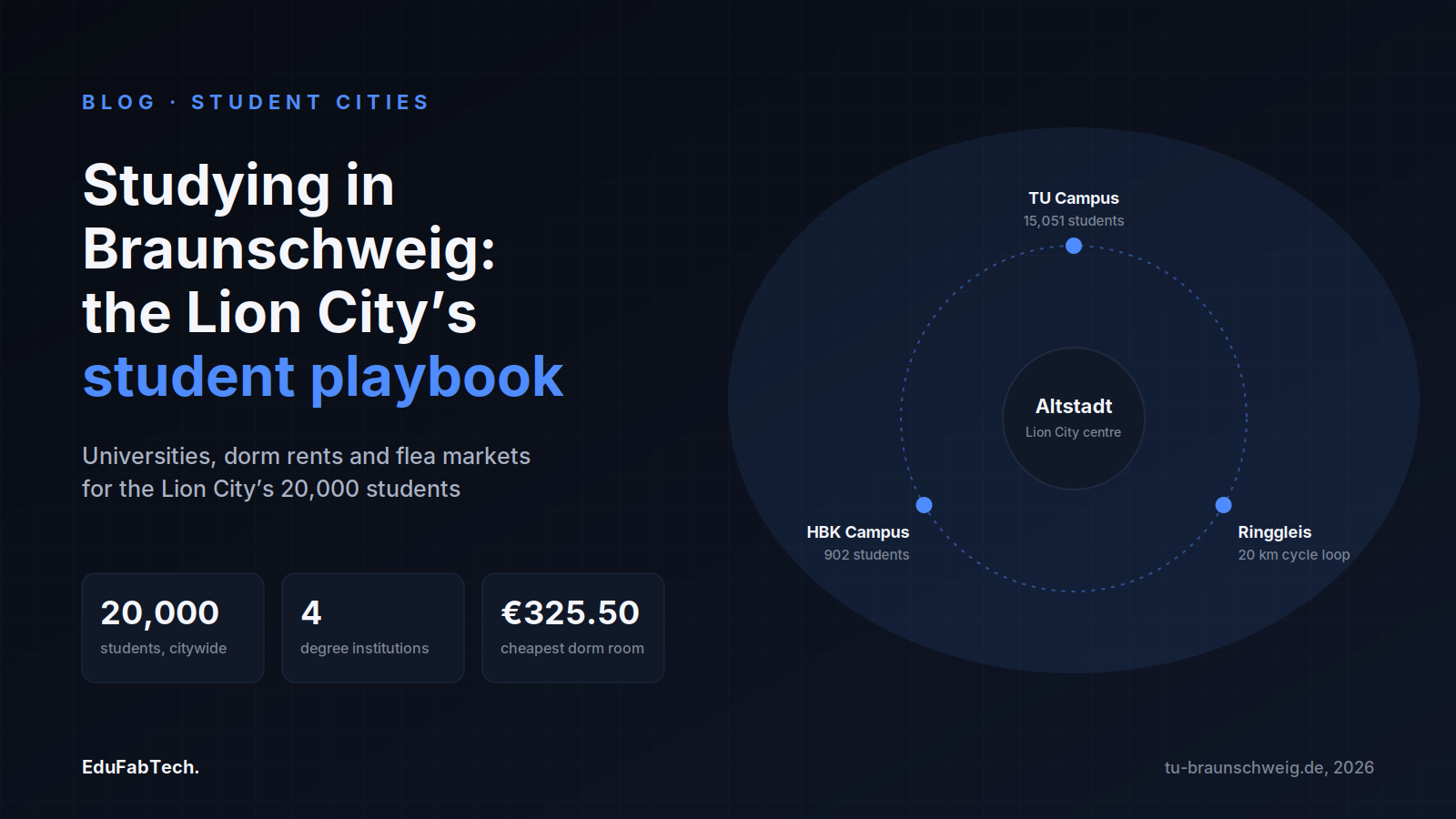
Braunschweig sits in the east of Lower Saxony, a mid-sized city of around 250,000 people that TU Braunschweig calls the Lion City, after the bronze lion Henry the Lion set up by the castle in the twelfth century (tu-braunschweig.de, 2026). Its centre still carries the medieval settlement pattern — the half-timbered Magniviertel around the Magnikirche, the Burgplatz, the Dom — but the surrounding ring is unmistakably an engineering town, laced with research institutes and a 20-kilometre greened cycle route, the Ringgleis, built along a former railway loop.
For students the city is compact and legibly built around its two universities. TU Braunschweig says roughly 20,000 students study in Braunschweig across the technical university and the art school, in a city it describes as part of one of the most research-active regions in Europe (tu-braunschweig.de, 2026). It is a place where the maths faculty is named after an alumnus — Carl Friedrich Gauß was among the early students — and where term life concentrates in a handful of central districts rather than sprawling across a metropolis.
Four institutions, two of them in the city itself
TU Braunschweig is the anchor. In the winter semester 2025/26 it enrolled 15,051 students, organised into six faculties spanning the Carl-Friedrich-Gauß-Faculty, life sciences, architecture and civil engineering, mechanical engineering, electrical engineering and physics, and the humanities and educational sciences (tu-braunschweig.de, 2026). The main campus is central, at Universitätsplatz just north-east of the old town, with a second cluster — the north campus — a short ride away. The university traces itself to 1745, when Duke Carl founded the Collegium Carolinum, which TU Braunschweig describes as the first foundation in Germany laid for a technical university (tu-braunschweig.de, 2026). Its strengths are what you would expect from that lineage: mobility and vehicle engineering, aerospace, metrology and the sciences.
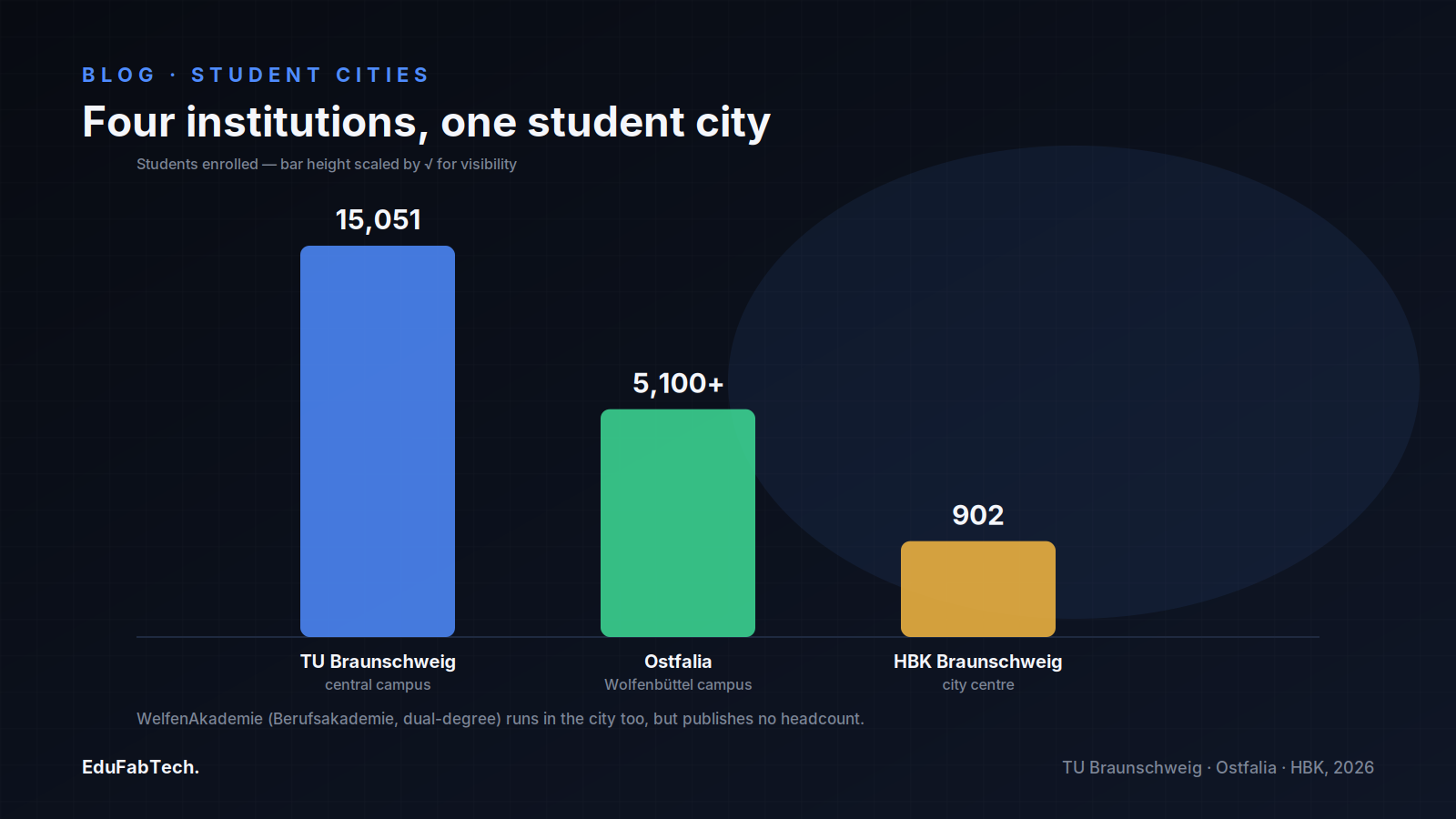
Braunschweig University of Art (Hochschule für Bildende Künste, HBK Braunschweig) is the second degree-granting institution inside the city. The Lower Saxony study portal lists it with 902 students across 15 study programmes in fine art, art education, performing arts, design, art history and media studies, with some 5,000 square metres of workshop and lab space (studieren-in-niedersachsen.de, 2026). Its library occupies a distinctive building assembled from parts of the Mexican pavilion of Expo 2000, realised in consultation with its original architect, Ricardo Legorreta — a landmark worth seeing even if you never study art.
Ostfalia University of Applied Sciences carries Braunschweig in its full name but its largest campus is in Wolfenbüttel, roughly a dozen kilometres south and a short regional-train or bus hop away. Ostfalia says more than 5,100 students study at Wolfenbüttel, across two sites — the Salzdahlumer Straße campus and the Am Exer campus — covering electrical engineering, computer science, mechanical engineering, the Brunswick European Law School, social work and supply engineering (ostfalia.de, 2026). It runs further campuses, including one in Salzgitter. Finally, the Welfenakademie Braunschweig (WelfenAkademie), on Salzdahlumer Straße in the city, is a state-recognised Berufsakademie running three-year dual degrees — a Bachelor of Arts in business administration and a Bachelor of Science in business informatics — that alternate theory blocks with paid practice at a partner company (welfenakademie.de, 2026). If you want applied sciences inside the city limits, Ostfalia is a commute; the degree-granting campuses in Braunschweig proper are TU and the HBK.
Where students live, and how the dormitory route works
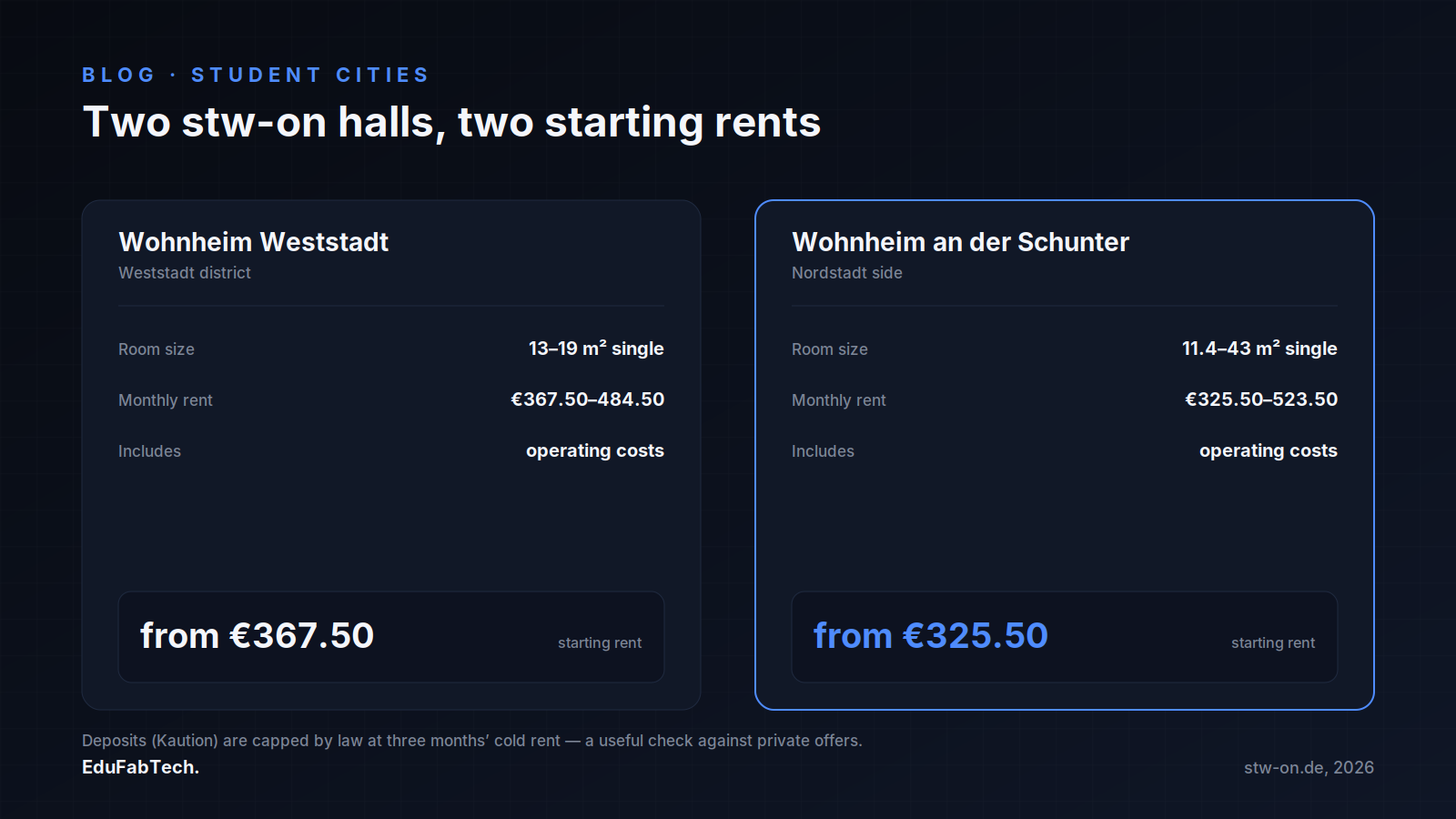
Housing in Braunschweig is easier than in Munich or Freiburg but not frictionless, and the single most useful institution to know is the Studierendenwerk OstNiedersachsen (stw-on), the public body that runs the halls of residence, the Mensa and student financial services for the region. Its dormitories are the cheapest reliable option, and the rents are published. At the Wohnheim Weststadt, furnished single rooms of 13–19 m² in shared flats cost between 367.50 € and 484.50 € a month including operating costs, with a 43 m² double apartment at 998 € (stw-on.de, 2026). At the Wohnheim an der Schunter, single rooms start at 325.50 € for an 11.4 m² room and run to 523.50 € for a larger apartment, again including operating costs (stw-on.de, 2026). Those are current, dated figures from the provider's own pages — a useful anchor when a private offer is quoted to you.
Geographically, students cluster where the rent and the ride make sense: the Weststadt to the west, the Nordstadt and the belt around the central and north campuses, and the inner districts near the Magniviertel for those who want the bars and cafés on their doorstep. Dormitory places are allocated by application and waiting list, not first-come on the day, and the standard advice holds here: apply to stw-on as early as you can confirm your place, ideally months before the semester, because the cheapest rooms are also the most contested. On the private market you are looking for a WG-Zimmer (a room in a shared flat) or a small apartment; browse what is listed for the city on EduFabTech's Braunschweig rooms page and the general Braunschweig listings, and for TU students the listings near TU Braunschweig and near the HBK narrow the search to walkable distance.
Paying only for a room you have actually seen
Rental fraud in German university cities follows a pattern, and Braunschweig is no exception: an attractive room is advertised below the going rate, the "landlord" is conveniently abroad, and you are asked to wire a deposit or a first month to "reserve" it before any viewing. Do not. The honest test is physical presence — see the room, or have someone you trust see it, and meet whoever is letting it before any money moves. A normal German deposit (Kaution) is capped by law at three months' cold rent and, for a genuine let, is paid into a separate deposit account after you have signed, not transferred to hold a listing. Never send money by bank transfer to an unseen landlord, and never by gift card or cryptocurrency — no legitimate Braunschweig letting asks for those. The stw-on halls remove most of this risk because the counterparty is a public institution; on the private market, treat any pressure to pay fast, sight unseen, as the warning it is.
Furnishing a room for little: the Schützenplatz flea market and the weekly stalls
Once you have the room, you have to fill it, and Braunschweig rewards patience over new furniture. The city runs ten weekly markets with fourteen market days a week; the Altstadtmarkt trades on Wednesday and Saturday from 8:00 to 13:00, and a smaller market sets up at the Magnikirchplatz on Thursday afternoons from 14:00 to 18:00 (braunschweig.de, 2026). Those are food markets — the cheapest route to fresh produce near the centre — rather than furniture sources, but they are where the rhythm of the week is set.
For second-hand goods and the inevitable desk, lamp and shelf, the city's long-running flea market on the Schützenplatz (Hamburger Straße, in the Nordstadt) is the obvious hunting ground; markets like it turn over household items at a fraction of retail. Opening days and admission arrangements for privately run flea markets change, and the Schützenplatz itself closes to the market when the spring and autumn fairs take over, so check the current schedule before you set out rather than trusting a figure from last year. For a faster start, EduFabTech's second-hand things, second-hand furniture and free-stuff pages for Braunschweig collect what students in the city are selling or giving away as they move out — the end of each semester is the best time to furnish an empty room almost for nothing.
Working alongside your studies
Many students take a part-time job, and for international students the rules are set nationally, not by the city. The DAAD states that students from non-EU countries may work 140 full days or 280 half days per year, and that academic assistant posts — the university HiWi jobs — are an exception, with no limit on the number of days (daad.de, 2026). EU and EEA students are not subject to that annual cap. These figures change with federal law and individual circumstances differ, so treat the DAAD page as the reference and confirm your own situation with the Ausländerbehörde (the immigration authority) in Braunschweig when you register — this is not legal advice. An engineering city with a dense research sector and nearby automotive industry does generate working-student and assistant roles; current local openings are gathered on EduFabTech's Braunschweig jobs page.
Libraries, reading rooms and late desks
Study space is one of Braunschweig's quiet strengths. The Universitätsbibliothek Braunschweig, at Universitätsplatz 1 beside the main campus, keeps long hours — Monday to Friday 07:00 to 24:00, Saturday 10:00 to 22:00 and Sunday 10:00 to 17:00 — with reading rooms and open-access areas across its old and new buildings (tu-braunschweig.de, 2026). The service desk keeps shorter hours than the building, so time borrowing and enquiries for weekdays. The HBK's library in the Legorreta pavilion serves the art and design side. Faculty libraries and the TU's learning-space network add desks closer to particular departments, and in exam season those fill early in the day. For rooms, cafés and bookable desks beyond the main library, EduFabTech lists study spaces in Braunschweig.
Trams, bikes and the Deutschlandsemesterticket
Braunschweig has a tram and bus network run by the Braunschweiger Verkehrs-GmbH, and because the city is flat and compact, cycling is genuinely the default mode for many students — the Ringgleis and a broad cycle-path network make the bike faster than the car for most campus trips. For public transport, TU Braunschweig students pay into the Deutschlandsemesterticket as part of the compulsory semester contribution. For the winter semester 2026/27 the AStA lists the ticket at 226.80 € within a total Semesterbeitrag of 472.50 € (astatubs.de, 2026). The ticket is the student version of the nationwide Deutschlandticket: it covers local and regional public transport across Germany — all local buses, trams, U- and S-Bahn and RE/RB regional trains — but not long-distance ICE or IC services (astatubs.de, 2026). In practice that one card carries you around Braunschweig, out to the Ostfalia campus in Wolfenbüttel, and onward to Hannover, Hamburg or Berlin on regional lines without a further fare.
What a month actually costs
The fixed, knowable costs are the semester contribution and rent. The Semesterbeitrag of 472.50 € for winter 2026/27 is paid once per semester and breaks down into the Deutschlandsemesterticket (226.80 €), the student-services and administrative fees (together 225.00 €) and a small student-body budget (20.70 €), as the AStA itemises it (astatubs.de, 2026). On top of that comes rent: a dormitory single room runs roughly from the low-to-mid 300s to the high 400s of euros a month including operating costs on the stw-on pages cited above, which is the cheapest dependable band in the city. Food, phone, insurance and the rest sit outside any single sourced figure, so budget them from your own research rather than a number invented here — but the two big line items, ticket and rent, are published and checkable, and they are what most shapes a month in Braunschweig.
The balance: what is easy here, and what is not
What is good is tangible. Braunschweig is affordable by German-city standards, physically compact, and strong in exactly the fields — engineering, mobility, metrology, the applied sciences — that draw many students to Germany in the first place. The bike infrastructure is real, the one semester ticket reaches far, and a public Studierendenwerk takes most of the danger out of finding a first room. The old town and the Magniviertel give the place a genuine social centre rather than a commuter-campus feel.
What is hard is honest too. It is a mid-sized city, not a metropolis: the nightlife and the international scene are smaller than in Berlin or Hamburg, and some students find winters grey and the pace quiet. The cheapest dormitory rooms are contested and waiting lists are real, so late applicants land on the pricier private market. If you study at Ostfalia, your campus is in Wolfenbüttel, which means a daily commute even if you live in Braunschweig. And the usual German bureaucracy — registration, residence permits, insurance — still has to be navigated on arrival.
A checklist for the first weeks
- Apply for a stw-on dormitory place as early as your admission allows, and keep a private-market search running in parallel through EduFabTech's Braunschweig rooms listings.
- Never pay a deposit for an unseen room; view it or have someone view it first, and expect a Kaution paid into a deposit account after signing, never by transfer, gift card or crypto to "hold" a place.
- Register your address (Anmeldung) at the Bürgerbüro and, if you are from outside the EU, sort your residence permit with the Ausländerbehörde; confirm your work allowance against the DAAD rules.
- Pay the Semesterbeitrag to activate enrolment and your Deutschlandsemesterticket, then plan on the bike as your main way across a flat, compact city.
- Furnish from the end-of-semester second-hand flow and the Schützenplatz flea market rather than buying new; shop fresh food at the Altstadtmarkt.
- Learn the library hours early — the Universitätsbibliothek runs late on weekdays, which matters once exams arrive.
A quick question for readers
Do you work part-time while you study?
Many students work to pay the bills. See how common it is — and how many hours people really do.
Pick an answer, create a free account in a minute, and your vote counts. Already a member? Sign in
Comments 3
Comment-
The flea market line is the weak joint here: markets like the Schützenplatz one turn over goods 'at a fraction of retail' - no source, no nu…
-
The Semesterbeitrag breakdown is the kind of sourcing I want everywhere in this piece: 226.80 + 225.00 + 20.70 actually sums to the stated 4…
-
The number that actually undercuts the affordability pitch is the dormitory price spread, not the headline low-to-mid 300s: Weststadt single…
Join free to read the full comments and reply Comments are between members; an account takes a minute.
Source: Technische Universität Braunschweig
Sources (5)
- Technische Universität Braunschweig. TU Braunschweig in Figures / About TU Braunschweig. TU Braunschweig, 2026. tu-braunschweig.de ↗ · checked 16 Nov 2026
- Studierendenwerk OstNiedersachsen. Wohnheim Weststadt and Wohnheim an der Schunter (rent pages). Studierendenwerk OstNiedersachsen, 2026. stw-on.de ↗ · checked 16 Nov 2026
- AStA TU Braunschweig. Semesterbeitrag (Wintersemester 2026/27). AStA der TU Braunschweig, 2026. astatubs.de ↗ · checked 16 Nov 2026
- DAAD. Side jobs: working alongside your studies. Deutscher Akademischer Austauschdienst, 2026. daad.de ↗ · checked 16 Nov 2026
- Stadt Braunschweig. Wochenmärkte (weekly markets). Stadt Braunschweig, 2026. braunschweig.de ↗ · checked 16 Nov 2026