Studying in Bremen: universities, housing and student life
A practical, sourced guide to Bremen's universities, where students live, what a room costs, part-time work rules, libraries, markets and getting around — with the honest trade-offs.
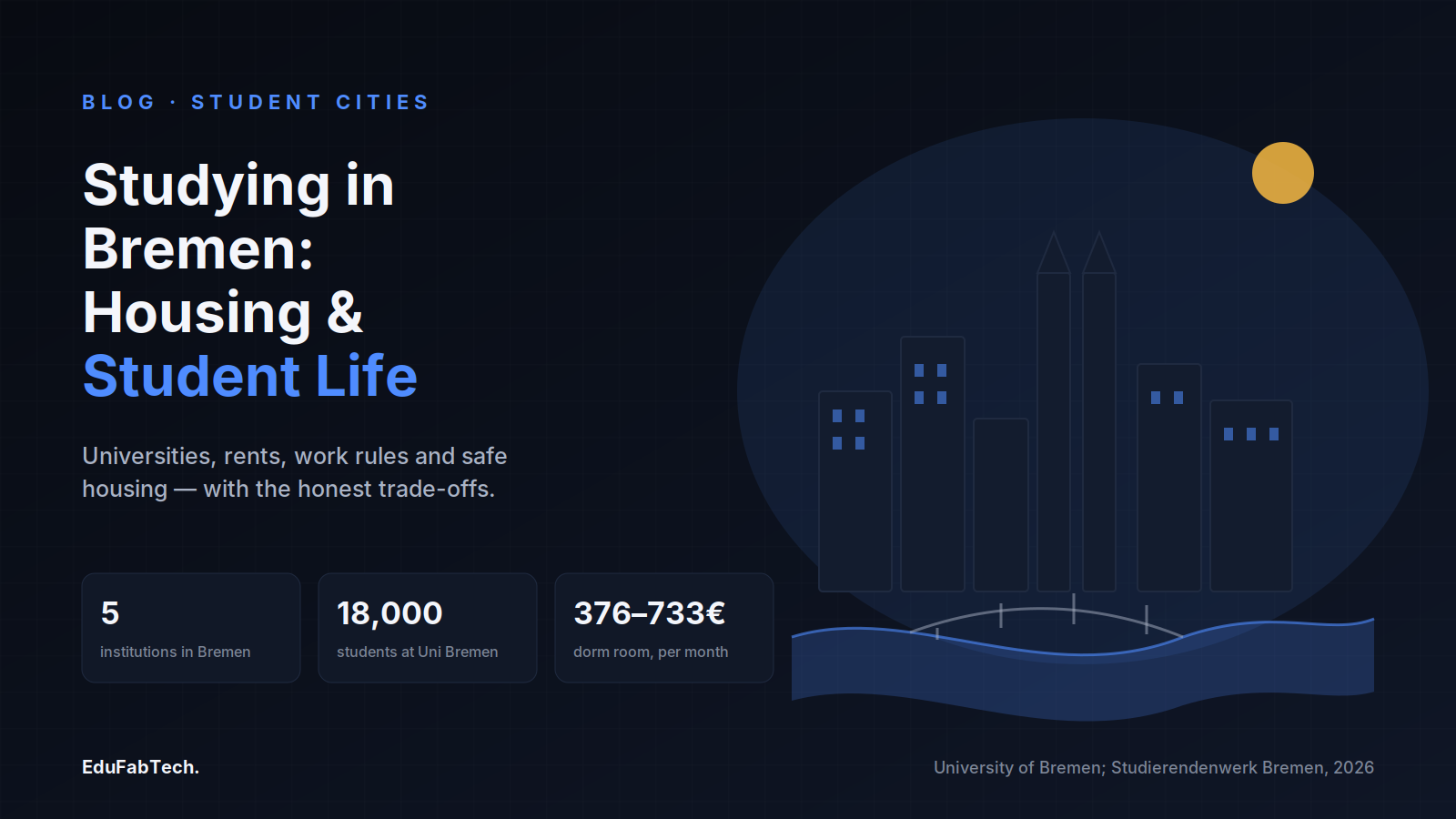
Bremen is a city-state as much as a city: together with Bremerhaven, 60 kilometres down the river, it forms the Free Hanseatic City of Bremen, the smallest of Germany's sixteen federal states. The Weser cuts the city into an older right bank, where the medieval Marktplatz, the cathedral and the Schnoor lanes sit, and a left bank built later around the Neustadt. For students, the geography matters in a concrete way — the main university campus is tucked into the north-east corner near the Bürgerpark, while one of the city's degree-granting institutions sits a half-hour train ride north, in a district most Bremen residents rarely visit.
That spread is the first thing to understand about studying here. There is no single "university quarter" that holds everyone. Where you choose to live depends heavily on which institution you attend and whether you want to be near the lively cafés of Das Viertel or close to a quiet campus lake.
This guide walks through the universities by name, where students actually find rooms and how to do it without being cheated, what a room costs with figures you can check, furnishing it second-hand, the rules on working, libraries and study spaces, transport, and the parts of Bremen that are genuinely hard as well as the parts that are good.
Five institutions, pulling in different directions
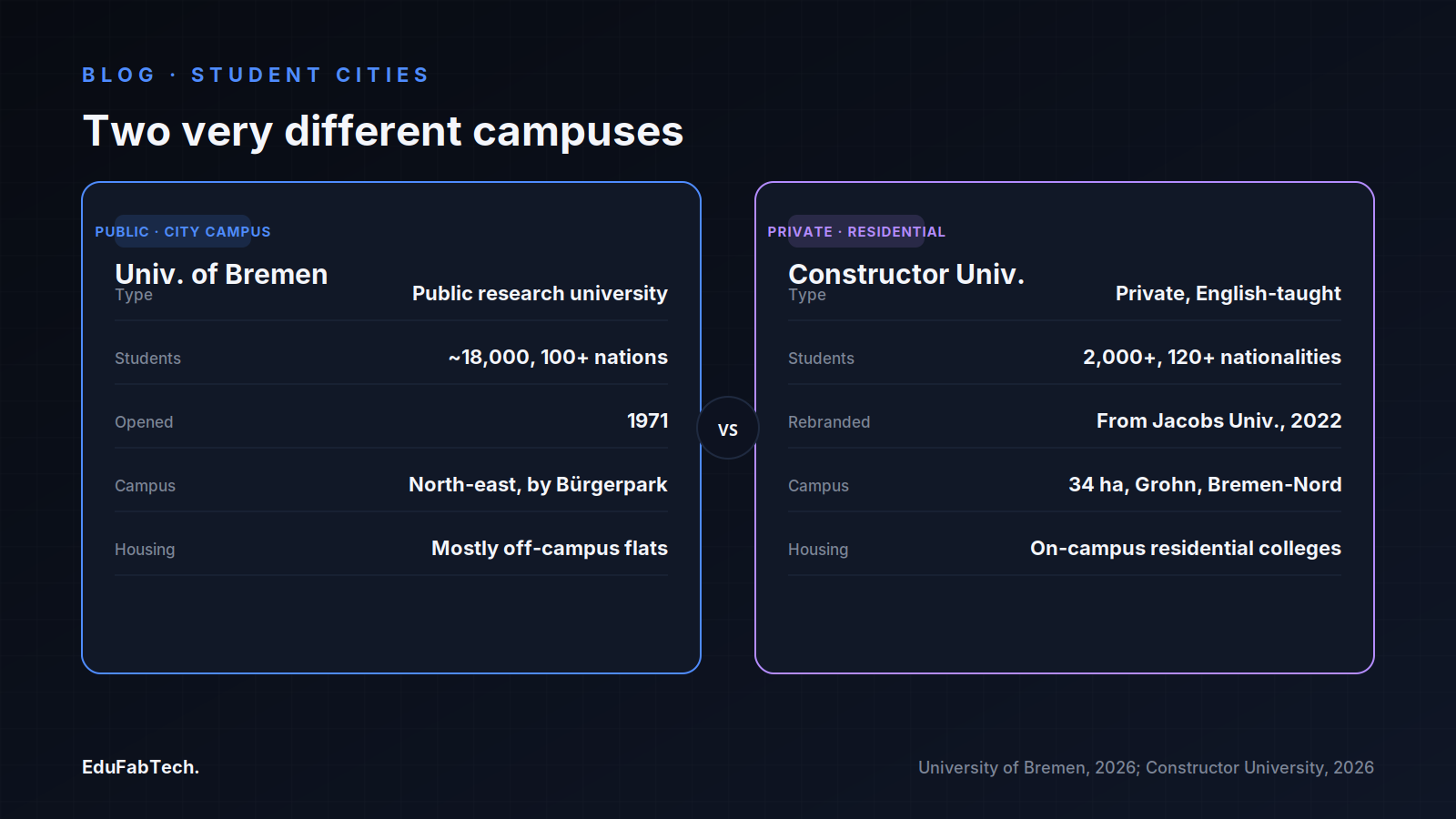
The anchor is the University of Bremen. Its own profile page reports around 18,000 students and people from more than 100 nations, that it opened in 1971, and that it held the national "University of Excellence" title from 2012 to 2019 (University of Bremen, 2026). Its twelve faculties span the sciences, engineering, law, social sciences and humanities, and the same page lists marine, polar and climate research among its flagship research areas — fitting for a port city, and the reason the campus sits beside the MARUM centre and the Technologiepark in the north-east, next to the Unisee lake and the Bürgerpark.
Very different in character is Constructor University Bremen, the private, English-taught, residential campus in Grohn, in the Vegesack area of Bremen-Nord, on the site of the former Roland barracks. Known until 2022 as Jacobs University Bremen, it rebranded as Constructor University; its about page describes more than 2,000 students, over 120 nationalities, a 34-hectare green residential campus and over 50 degree programmes across business, social and decision sciences, computer science and engineering, and the sciences (Constructor University, 2026). Undergraduates generally live on campus in residential colleges, so the experience is closer to a small international village than a city university.
Three further institutions grant degrees in the city. Bremen University of Applied Sciences (Hochschule Bremen) has nearly 9,000 students across more than 70 degree programmes and some 360 partner universities worldwide, with its main campus on the Neustadtswall on the left bank in the Neustadt (Hochschule Bremen, 2026); study-abroad and practical semesters are built into most of its courses. The University of the Arts Bremen (Hochschule für Künste Bremen) is small and specialised: at the start of the 2024/25 winter semester it reported 1,037 enrolled musicians and artists, 49 per cent of them international (idw / HfK Bremen, 2024). Its two faculties sit apart in the city — the Faculty of Music near the cathedral on Dechanatstraße in the old town, and the Faculty of Art and Design in the Speicher XI warehouse in the Überseestadt docklands. Finally, the Academy for public administration Bremen (Hochschule für Öffentliche Verwaltung Bremen) is the city-state's own college for training public-sector staff, running dual bachelor's programmes in public administration.
You can browse current student listings for the city on EduFabTech's Bremen page, and what is near the main campus via listings near the University of Bremen.
Where students settle, and why it isn't the campus
Few University of Bremen students live right beside the campus — the surrounding Horn-Lehe district is leafy and quiet rather than cheap and central. The popular student neighbourhoods are a bus or bike ride away. Das Viertel (the Ostertor and Steintor quarters, strung along Ostertorsteinweg and "Vor dem Steintor") is the bohemian heart: cafés, cinemas, late bars and old flats, and the first place many students want to be. Findorff, wedged between the Bürgerpark and the Hauptbahnhof, is calmer and close to campus by bike. Across the river, the Neustadt suits Hochschule Bremen students and has become steadily more sought-after, while Walle and parts of Gröpelingen toward the docks are generally more affordable. Constructor students, by contrast, mostly stay in Bremen-Nord, with the regional train line linking Vegesack to the centre.
Bremen is flat and compact, so a bike widens your options more than in most German cities — a room 20 minutes' ride from campus is normal, not a hardship.
Finding a room before you arrive — without being cheated
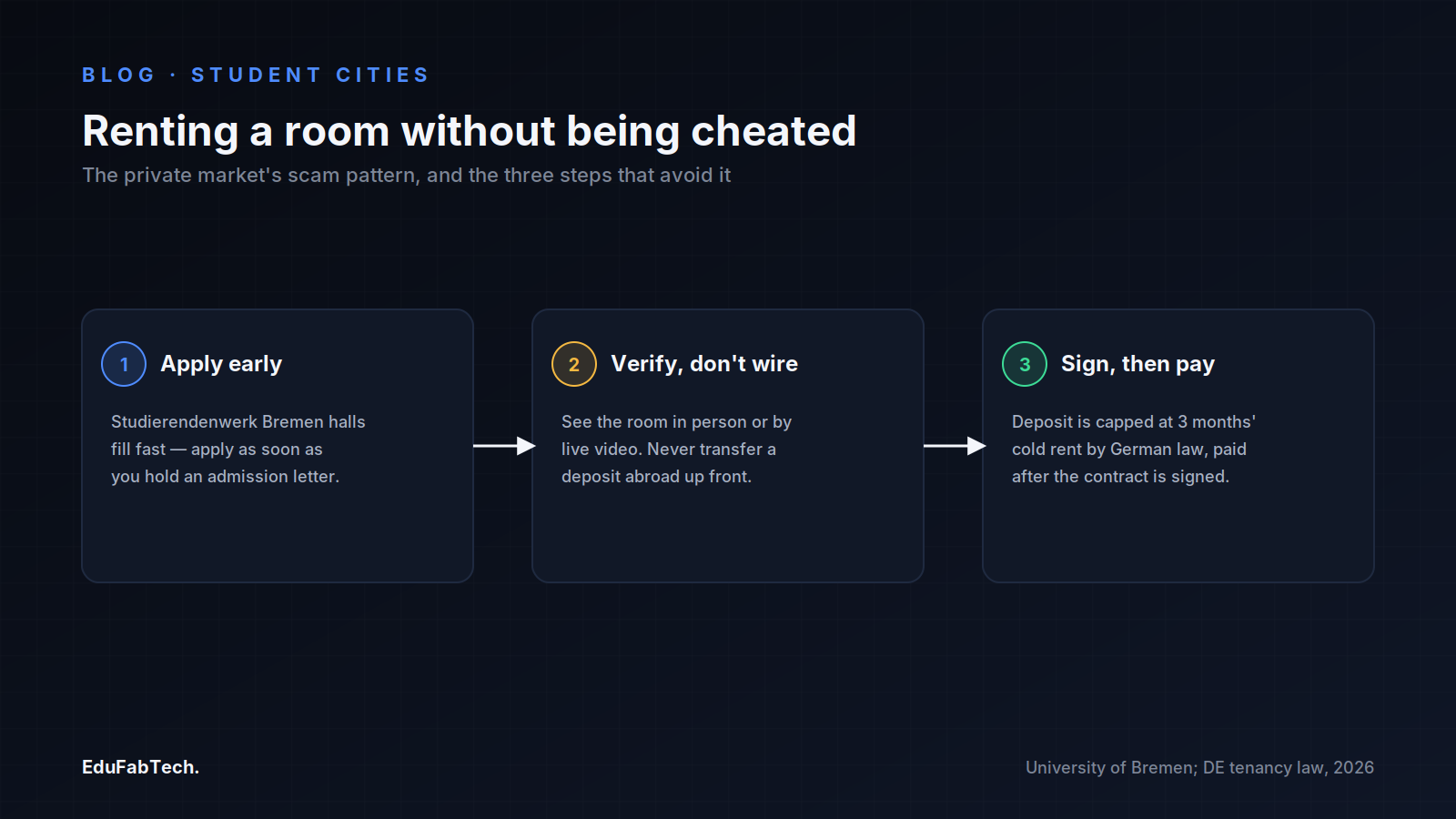
The safest starting point is the Studierendenwerk Bremen, the public student-services body that runs the halls of residence. Its places are limited and demand is high, so apply as early as you can — ideally as soon as you have an admission letter, months before the semester, since rooms do not appear on demand in September.
The private market is where caution matters. The University of Bremen's own housing page carries a blunt warning: "If you are offered housing on the private market and are asked to transfer larger sums in advance, it could be a rental scam. Scammers especially target international students who are not yet in Germany" (University of Bremen, 2026). The pattern in Bremen is the familiar one — an attractive flat in Das Viertel or the Neustadt at a suspiciously low rent, a "landlord" who is conveniently abroad, and a request to wire a deposit or the first month to "hold" the room before you can see it.
A few rules keep you safe. See the place first, in person or by a live video walk-through; a real landlord will allow it. Never send a deposit by bank transfer to an account abroad, and never by gift card or cryptocurrency — no legitimate German landlord asks for either. In Germany a deposit (Kaution) is capped by law at three months' cold rent and is normally paid only after you sign a contract, often into a separate deposit account, not as a pre-booking fee. If something cannot be verified, the International Office will look at it before you pay. You can also compare genuine openings through EduFabTech's Bremen rooms listings rather than chasing offers that demand money up front.
What a room actually costs
Dormitory rents are the figures you can pin down. For the Studierendenwerk Bremen "Campus" residence, the provider's own current price page lists one-room apartments at 376–414 € per month and two-room apartments at 586–733 € per month (Studierendenwerk Bremen, 2026). Those are among the dearer public rooms because they are self-contained flats; shared-flat places in other residences run lower. On the private market, rents in central districts have risen in step with the national squeeze on student housing, and a room in a shared flat (WG) will often cost more than a basic hall place once you add a deposit and the one-off agency or registration costs.
Beyond rent, budget for the compulsory semester contribution, most of which pays for your transport ticket (below), plus health insurance, which is mandatory to enrol. Treat any single "average cost of living" number with care — your rent, which dominates the total, swings widely between a Studierendenwerk room and a private flat in Das Viertel.
Furnishing a room for very little
Bremen is a good city for kitting out an empty room cheaply, because it has a genuine flea-market culture rather than a single tired car-boot sale. The city's tourism service describes a large flea market every Sunday, held outdoors on the Bürgerweide behind the Hauptbahnhof from May to September and moving indoors to the Hansa-Carré on Pfalzburger Straße from September to mid-April, selling furniture, kitchenware, clothes and bikes (WelcomeToBremen, 2026) — exactly the four things a new student needs. For food and household basics there are weekly markets, including the long-running Domshof market in the city centre and the neighbourhood Findorffmarkt.
Second-hand furniture, kitchen gear and the free "to give away" boxes that appear on Bremen pavements will stretch a budget further than any new-furniture shop. EduFabTech keeps city-specific listings for second-hand furniture in Bremen, worth checking before you buy anything new.
Working alongside your studies
Many students take a part-time job, and the headline rule for non-EU students is set nationally, not by Bremen. The DAAD states that international students from non-EU countries may work 140 full days or 280 half days per year, and that working as an academic assistant at the university has no such day limit, though you must inform the foreigners' office (DAAD, 2026). Students from the EU, Iceland, Liechtenstein, Norway and Switzerland have the same access to the job market as German students, so the day cap does not apply to them.
This is a general orientation, not legal advice, and the limits are the kind of thing that changes — Germany revised the allowance in 2024. Check the binding current rules on the federal "Make it in Germany" portal and confirm your own residence-permit conditions with the Migrationsamt Bremen, the city's immigration office, before you sign a work contract. For what students are actually hiring for locally, see part-time jobs in Bremen.
Libraries and places to study
The Staats- und Universitätsbibliothek Bremen (SuUB) is both the university library and the state library, and it is the natural study hub. Its central building stands on the campus at Bibliothekstraße 9, and the library runs several locations across the universities in Bremen and Bremerhaven, mixing silent individual desks with group-work areas, a lounge and a rooftop terrace. For students who do not want to commute to campus, the city's public libraries and the quieter café corners of Findorff and the Neustadt serve as fallback desks; EduFabTech also tracks bookable study spaces in Bremen. During exam periods the central library fills early, so arriving before late morning is the difference between a desk and a corridor.
Getting around: trams, the train north, and a lot of bikes
Public transport is run by the BSAG (Bremer Straßenbahn AG), whose trams and buses cover the city, with regional trains linking Vegesack and Bremen-Nord to the centre. The crucial fact for students is the semester ticket. The AStA of the University of Bremen lists the Deutschland-Semesterticket at 208.80 € for the winter semester 2025/2026 — about 34.80 € a month — valid nationwide on local and regional public transport, while excluding long-distance ICE, IC and EC trains and private coaches such as FlixBus (AStA Universität Bremen, 2026). Because it is folded into the compulsory semester fee and now works across all of Germany's regional network, it is one of the better-value parts of studying here.
For day-to-day movement, though, most Bremen students cycle. The city is flat, distances are short, and the bike network is extensive; a second-hand bike from the Sunday flea market is often the fastest way to and from campus.
The honest trade-offs
What is good about Bremen: it is affordable by the standards of Munich, Frankfurt or Hamburg; it is small enough to cross by bike yet has a real nightlife and arts scene concentrated in Das Viertel; the big university is research-strong and genuinely international; and the semester ticket now takes you across the country. The maritime setting — the Weser, the Überseestadt docks being redeveloped, the park and lake by campus — gives the city an unhurried, green feel.
What is hard: student housing is tight, as it is across Germany, and good rooms in central districts go quickly, so arriving without one secured is stressful. The weather is northern and grey — wet, windy and dark through a long winter, which newcomers from sunnier places feel. The campus's position in the north-east means a commute for most students, and Constructor's location in Bremen-Nord leaves its students somewhat apart from city life unless they make the train trip. And parts of the west toward the docks, while cheaper, are further from the student centre of gravity.
A short checklist for the first weeks
- Apply to Studierendenwerk Bremen for a hall place the moment you are admitted; do not wait for the semester to start.
- Never transfer a deposit before seeing a room in person or on a live video call — and never by gift card or cryptocurrency.
- Register your address (Anmeldung) at a Bürgeramt within the required window after moving in; you will need it for almost everything else.
- Enrol with a statutory health insurer and keep the confirmation — you cannot matriculate without it.
- Activate your semester ticket and, if you cycle, buy a second-hand bike early (the Sunday flea market is a good place).
- Get a library card for the SuUB and scout a study spot before the exam-season rush.
- If you are a non-EU student planning to work, confirm your permit's conditions with the Migrationsamt Bremen before signing anything.
- Go to the orientation-week events in your first fortnight — they are the easiest time to meet people.
A quick question for readers
Do you work part-time while you study?
Many students work to pay the bills. See how common it is — and how many hours people really do.
Pick an answer, create a free account in a minute, and your vote counts. Already a member? Sign in
Comments 3
Comment-
The cost section has a hole in the middle of it. You get a clean, sourced number for the dearer self-contained dorm flats, 376 to 733 euros,…
-
The DAAD figure (140 full days/280 half days) is the one piece of "evidence" here that's actually a national rule, not a Bremen fact, and th…
-
The 140 full days / 280 half days figure is useful precisely because it's a national rule, not a Bremen one - but the piece undercuts its ow…
Join free to read the full comments and reply Comments are between members; an account takes a minute.
Source: University of Bremen
Sources (5)
- University of Bremen. Profile. University of Bremen, 2026. uni-bremen.de ↗ · checked 14 Nov 2026
- Constructor University. About Constructor University. Constructor University, 2026. constructor.university ↗ · checked 14 Nov 2026
- Studierendenwerk Bremen. Campus — Wohnanlagen Bremen. Studierendenwerk Bremen, 2026. stw-bremen.de ↗ · checked 14 Nov 2026
- AStA der Universität Bremen. Semesterticket / Semester Ticket. AStA Universität Bremen, 2026. asta.uni-bremen.de ↗ · checked 14 Nov 2026
- DAAD. Side jobs. Deutscher Akademischer Austauschdienst, 2026. daad.de ↗ · checked 14 Nov 2026