Studying in Bridgeport: universities, housing and student life
A practical, sourced guide to studying and living in Connecticut's largest city — its campuses, neighbourhoods, rooms, second-hand markets, work rules, transport and real trade-offs.
A working port on Long Island Sound
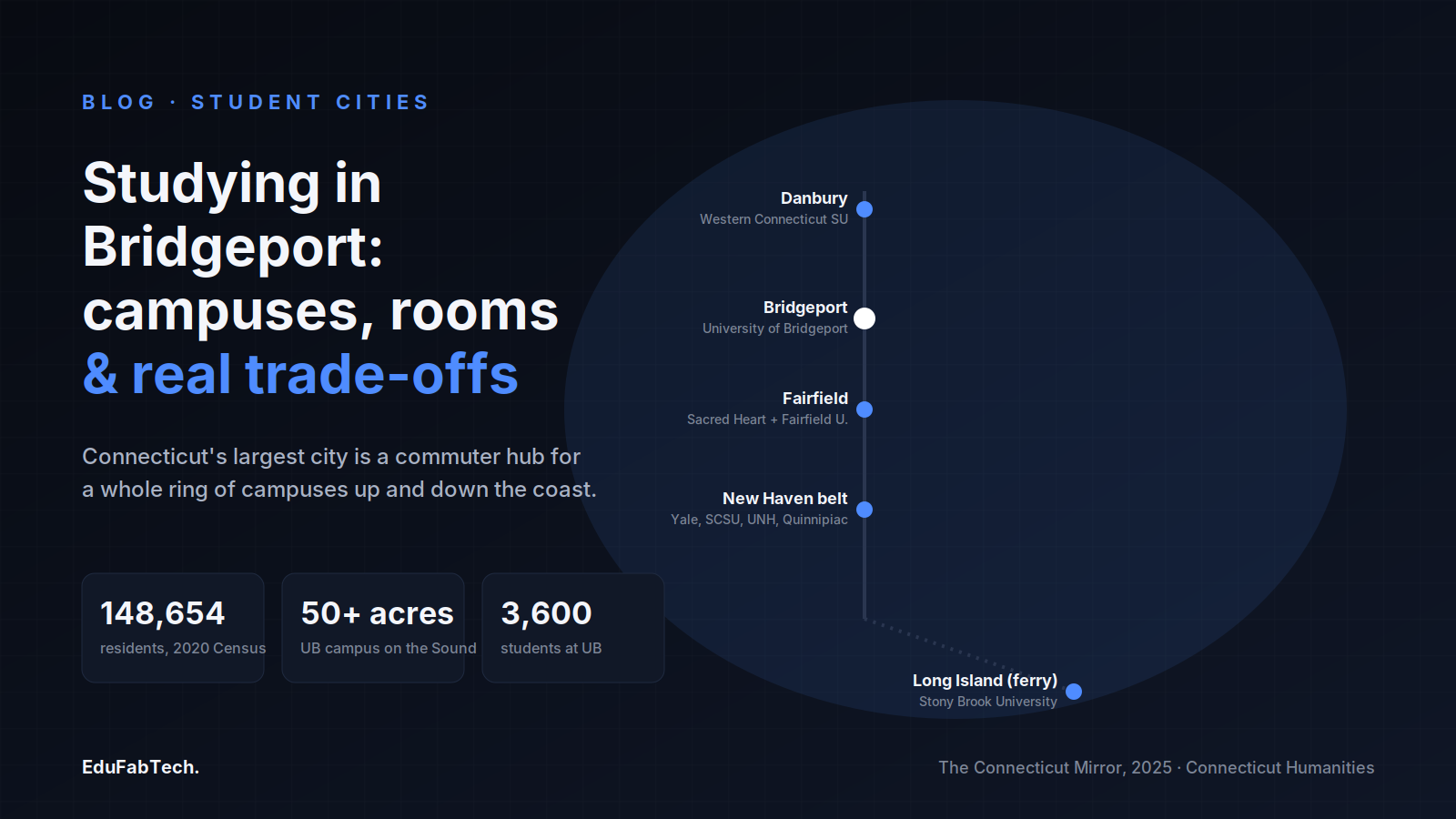
Bridgeport is a port city on the north shore of Long Island Sound, set where the Pequonnock River meets a working harbour, roughly halfway along the busy coastal corridor between New York City and New Haven. It is the most populous city in Connecticut: the 2020 US Census counted 148,654 residents, a little ahead of Stamford and New Haven, as The Connecticut Mirror reported in 2025. That makes it a real city rather than a college town, with the texture — and the problems — that come with a post-industrial manufacturing centre still finding its footing.
Its nickname, the "Park City", is earned. As Connecticut Humanities records, the showman and one-time mayor P. T. Barnum and his neighbours donated the shoreline land that became Seaside Park, and both Seaside and Beardsley parks were laid out by the firm of landscape architect Frederick Law Olmsted. For a student that shoreline matters: cheap, open, walkable green space is one of the genuine upsides of the city, and several campuses sit within sight of the water. You can browse what is currently on offer locally — rooms, jobs, second-hand goods — on EduFabTech's Bridgeport listings.
Bridgeport is above all a hub. The railway, long-distance trains, local buses and an interstate ferry all meet downtown, which is why "studying in Bridgeport" in practice means studying somewhere in a ring of campuses reachable from the city — some inside it, some a short train ride along the coast, and one across the Sound by boat. Rents here are generally lower than in neighbouring Fairfield or Stamford, which is the main reason students and young commuters choose it.
The universities in and around Bridgeport
The city's own institution is the University of Bridgeport. Its 50-plus-acre campus sits on Long Island Sound beside Seaside Park, on land that was once part of Barnum's estate; the university began in 1927 as a junior college and became a four-year university in 1947. Today it is a small, career-focused, independent university — the university reports enrolment of roughly 3,600 students across associate, bachelor's, master's and doctoral programmes — with strengths in health sciences, engineering and technology, business and nursing. It is also the most practical choice if you actually want to live in Bridgeport itself.
Just over the line in the town of Fairfield, within the Greater Bridgeport Planning Region, are two larger private universities. Sacred Heart University is a Catholic university founded in 1963 on a campus off Park Avenue; it is one of the larger private universities in New England and is strong in nursing, health professions, business, communications and computing. A few minutes away, Fairfield University is a Jesuit institution founded in 1942 on a wooded coastal campus, known for business, nursing, engineering and the liberal arts. Both draw students who want a quieter, leafier setting while staying close to Bridgeport's transport and cheaper rooms.
A short train ride east brings you to the New Haven belt, the densest cluster of higher education in the state. Yale University, founded in 1701, is the anchor: undergraduates belong to Yale College and are sorted into residential colleges — among them Branford College, Davenport College, Grace Hopper College and Jonathan Edwards College, clustered around the historic Old Campus. In the same city, Southern Connecticut State University is a public university founded in 1893 near Westville, with a long teacher-training tradition and a growing research profile. On the hill just across the municipal border in West Haven, the University of New Haven is a private university known for engineering, criminal justice and forensic science. North of the city in Hamden, Quinnipiac University sits at the foot of Sleeping Giant State Park and is well regarded for health sciences, communications and law.
Two more belong on any honest map of the region. Inland to the northwest, in Danbury, Western Connecticut State University runs a downtown Midtown campus and a larger Westside campus linked by shuttle, with a notable school of visual and performing arts. And across the water — reachable by the ferry that docks in Bridgeport — is Stony Brook University, New York's flagship public research university on the north shore of Long Island, whose huge campus includes the Jacob K. Javits Lecture Center, one of its main teaching halls. Its medical programmes, now organised under the Renaissance School of Medicine but long known as the Stony Brook University School of Medicine, are based in the Setauket–East Setauket area nearby. For most Bridgeport-based students Stony Brook is a weekend-trip neighbour rather than a daily commute, but the ferry makes it genuinely part of the regional picture.
Where students actually live
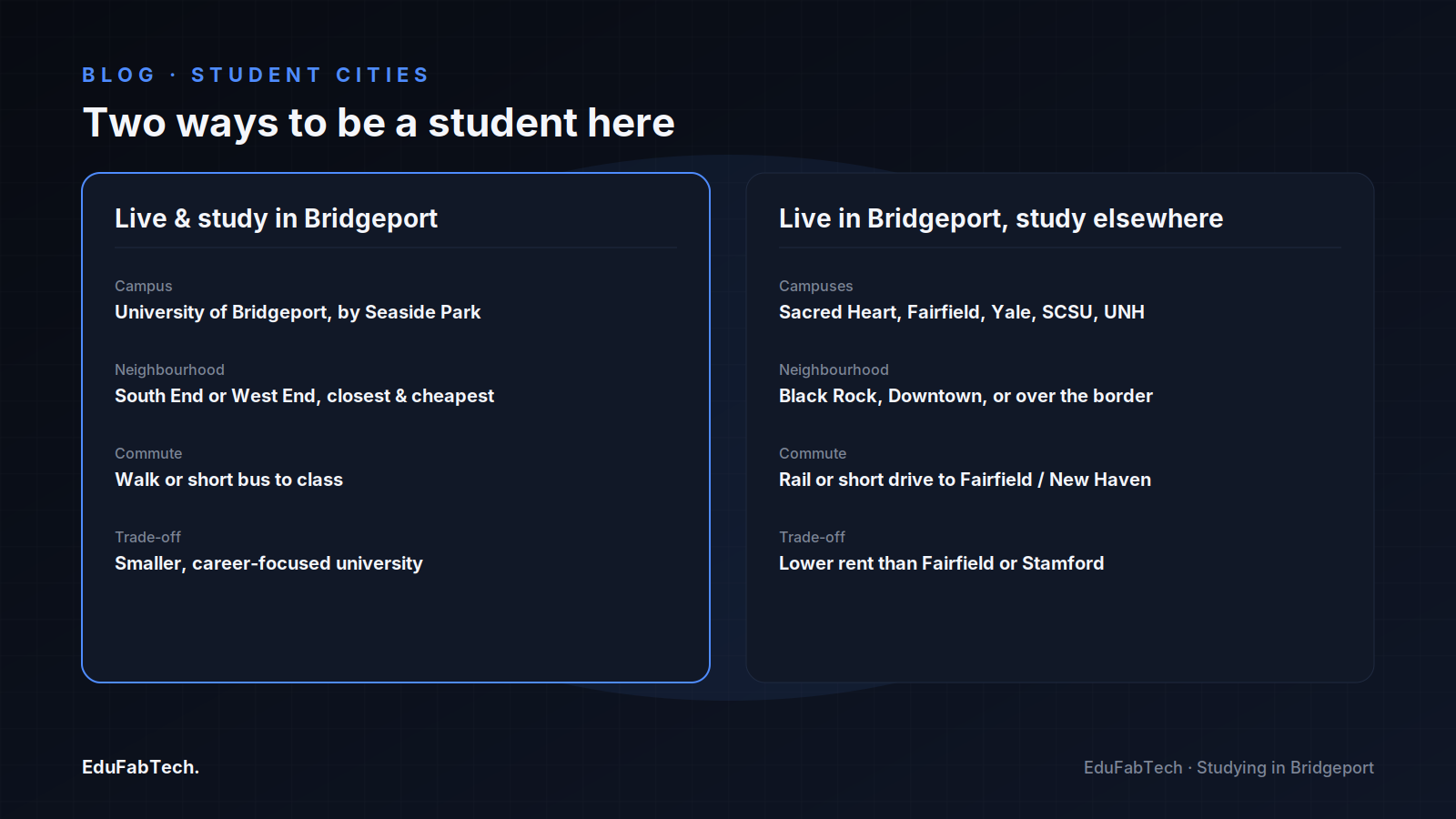
Bridgeport is a city of strongly defined neighbourhoods, and which one suits you depends mostly on which campus you are heading to and how much you want to pay.
Black Rock, in the south-west along the Sound, is the neighbourhood students and young professionals most often name first. It is a waterfront district with a walkable stretch of Fairfield Avenue full of cafés and small restaurants, the Ash Creek walkway and a seawall park. It is among the more desirable — and therefore more expensive — parts of the city, but it is well placed for the Fairfield campuses and has a real neighbourhood feel.
Downtown is the obvious choice if you rely on trains or buses, since the transportation centre is right there; converted historic buildings around the Arcade and Main Street offer apartments, and the area is slowly adding food and arts venues, though it still empties out in the evenings. The West End / West Side, inland from Black Rock, is more affordable and close to the University of Bridgeport. The South End wraps around the university and Seaside Park and holds much of the student housing closest to that campus. The North End is a quieter, more suburban residential district — more common among graduate students and families — and borders Trumbull. The East Side and East End, home to Beardsley Park and Connecticut's only zoo, are among the cheapest areas but also among the most uneven block to block. Many students who study at the Fairfield, Hamden, West Haven or New Haven campuses skip the question entirely and live just over the border in Fairfield or Stratford, trading a little more rent for a shorter commute.
Finding a room without getting burned
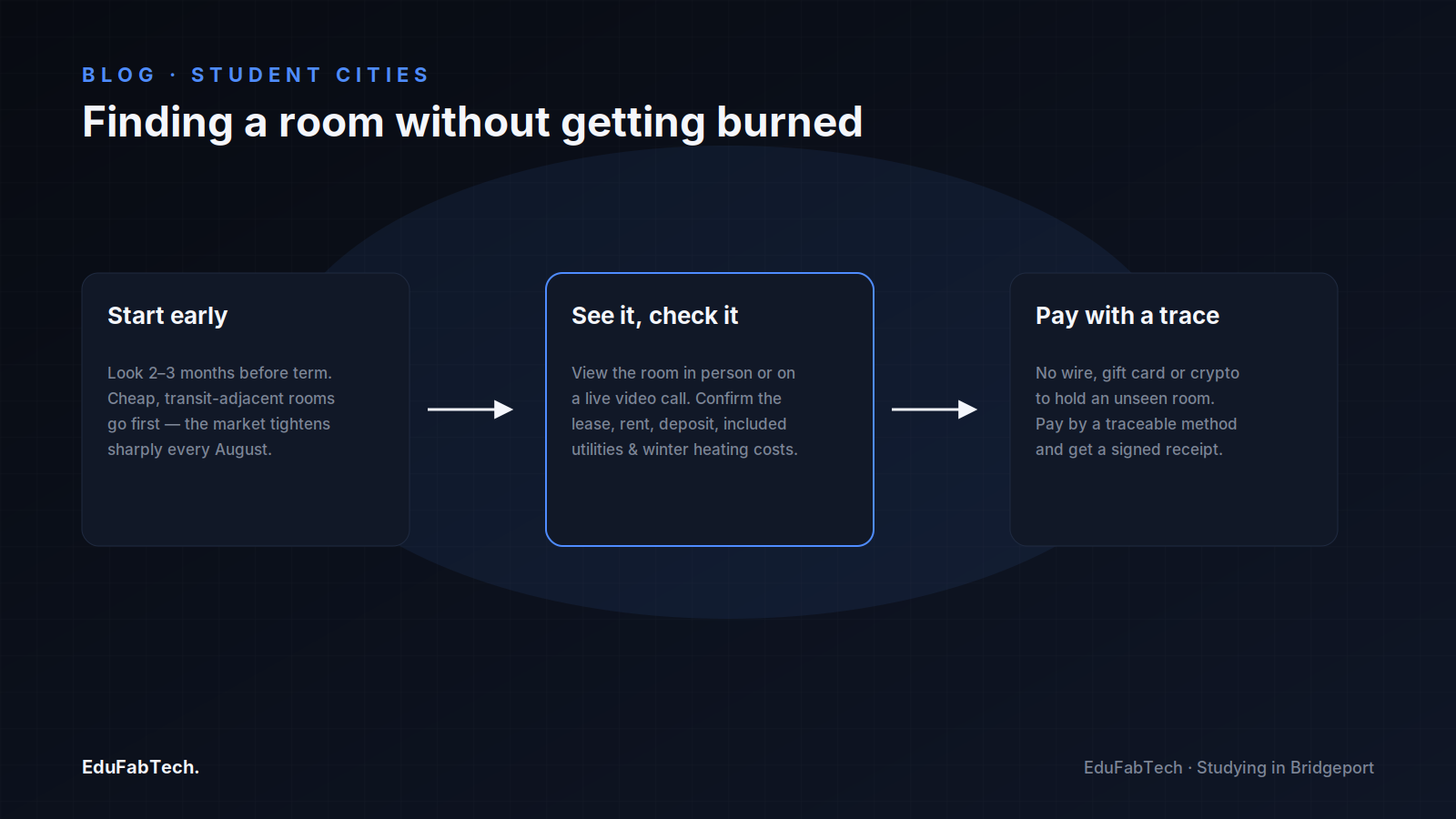
Most student housing here is one of three kinds: a dorm or university-managed residence, a room in a shared apartment or multi-family house, or a whole small flat split with others. Bridgeport's housing stock is dominated by older multi-family houses, so a "room in a three-family" is a very normal arrangement. Start looking early — ideally two to three months before term — because the good, cheap, transit-adjacent rooms go first, and the market tightens sharply in August.
Before you pay anything, see the actual room, check that the lease names you and lists the rent, deposit and what utilities are included, and ask what heating costs in winter (it is not trivial on the Sound). Confirm who the other tenants are, test the heat and water, and look for damp. You can begin your search with rooms listed on EduFabTech, and if you are tied to a particular campus it is worth filtering by proximity — for example listings near Sacred Heart University or near Yale University.
On scams: never send money to "hold" a room you have not seen in person or over a live video call, and never pay a deposit by bank transfer, wire, gift card or cryptocurrency to someone you have not met. A listing with a below-market price, a landlord who is conveniently "abroad" and cannot show the place, or any pressure to pay immediately to beat other applicants are the classic warning signs. Pay by a method that leaves a trace, and get a signed receipt.
Furnishing a room for next to nothing
You do not need to buy anything new. Bridgeport has a solid second-hand scene, and the University of Bridgeport keeps a useful local thrift guide. Monger's Market, an indoor flea market in an 1890s factory building at 1155 Railroad Avenue, runs on Sundays and is the place for furniture, glassware, tools and salvage. For clothing, kitchenware and household basics there is a Goodwill on Ocean Terrace, a Salvation Army store on Huntington Turnpike, and the Penny Lane thrift shop on East Main Street. Between them you can furnish a room for a fraction of retail.
It is also worth checking what other students are selling or giving away at the end of each term, when leases turn over and furniture needs to disappear fast. EduFabTech lists second-hand goods, furniture and things given away free in the city; a desk lamp, a chair and a set of pots from three different pickups usually beats one trip to a big-box store.
Part-time work and the money side
If you are an international student, the rules on work are strict and worth getting exactly right. Students in F-1 status may generally work on campus while school is in session, but — per the official US government guidance — not more than 20 hours per week during term, with full-time hours allowed only during official breaks; off-campus work normally requires separate authorisation tied to your programme. This is not legal advice, and the details depend on your status and your school; always confirm with your university's international-student adviser and read the primary source, the US government's Study in the States guidance on working in the United States, before accepting any job.
On pay, Connecticut sets a statewide minimum wage that adjusts every January. The State of Connecticut has confirmed it is $16.94 per hour in 2026, rising to $17.48 on 1 January 2027 — among the higher state minimums in the country, which helps, because the local cost of living is not low. On-campus jobs, library and dining work, and roles tied to your department are the usual student options; you can also browse part-time work listed on EduFabTech.
Libraries, study spaces and getting around
Each university runs its own library — Quinnipiac's Arnold Bernhard Library and the campus libraries at the University of Bridgeport, Sacred Heart and the others are the natural first stop for enrolled students. Beyond campus, the Bridgeport Public Library operates a network of branches — the Burroughs-Saden main library downtown plus the Black Rock, Newfield, North and Beardsley branches — which give you free, quiet, heated desk space and public computers without a campus ID. Opening hours vary by branch and several close on Sundays, so check before you travel. For a cross-city view of desks and bookable spaces, EduFabTech also lists study spaces.
Getting around is Bridgeport's quiet strength. The downtown transportation centre, as Amtrak describes, is a genuine intermodal hub: the commuter railway along the shoreline connects New York and New Haven, long-distance trains stop here, local buses radiate out, and the interstate ferry to Port Jefferson on Long Island docks beside the station. That ferry, run by one of the oldest continuously operating ferry companies in the country, is the practical link to the Stony Brook side of the Sound. Local buses are run by Greater Bridgeport Transit, and students get a real break: as GBT explains, full-time University of Bridgeport students ride free with the proper pass, students at participating public colleges ride free statewide through the U-Pass CT programme, and everyone else can buy a discounted 31-day youth pass for $45. A bicycle plus the train covers most student journeys along the coast.
What is good, and what is hard
The honest case for Bridgeport is cost and connection. Rooms are cheaper than in the wealthier towns around it, the train puts New York and New Haven within reach, and the shoreline parks are a genuine amenity. For context on where rents sit, the US federal housing authority's Fair Market Rent schedule for fiscal year 2025 put the Bridgeport-area figures at $1,572 for a one-bedroom and $1,967 for a two-bedroom, as published in the 2025 Fair Market Rent tables. Those are area benchmarks, not student-room prices — a shared room costs much less — but they tell you the baseline.
| Unit (Bridgeport area) | FY2025 Fair Market Rent (USD/month) |
|---|---|
| Studio | 1,349 |
| 1-bedroom | 1,572 |
| 2-bedroom | 1,967 |
| 3-bedroom | 2,439 |
The hard parts are real too. Bridgeport is a post-industrial city with uneven blocks: a street can change character quickly, so where you live matters more than in a compact college town, and it is worth walking a neighbourhood by day and after dark before signing. Winters on the Sound are cold and heating bills add up. The city's own university is small, so if you want a large campus social scene you will likely be commuting to Fairfield, Hamden or New Haven, which eats into time and money even with cheap transit. And the housing stock is old — charming multi-family houses, but also draughty windows and tired kitchens. Go in clear-eyed and the trade-off is a fair one; go in expecting a polished student district and you will be disappointed.
A checklist for your first weeks
- Confirm your campus and term dates, and if you are an international student, meet your designated school official before doing anything about work.
- See any room in person or on a live video call before paying, and never wire a deposit to hold an unseen place.
- Sort out transport on day one: get your University of Bridgeport or U-Pass CT bus pass, or a 31-day youth pass, and learn your nearest train station.
- Furnish from Monger's Market, Goodwill, the Salvation Army store or other students' end-of-term giveaways before buying anything new.
- Register for a free Bridgeport Public Library card for study space and computers off campus.
- Budget for winter heating, not just rent, and check what your lease includes.
- Walk your neighbourhood at different times of day, and note your closest library, pharmacy and 24-hour transport option.
Bridgeport rewards students who treat it as what it is: an affordable, well-connected base in an expensive corner of the country, within easy reach of a remarkable density of universities. Plan the commute, choose the block carefully, and the city gives you far more room — financial and physical — than its glossier neighbours.
A quick question for readers
Rate these parts of student life this term
Rate each one from 1 (very poor) to 5 (very good). Together the results show where students struggle most.
Rate 5 things →- U.S. Department of Housing and Urban Development. FY 2025 Schedule of Metropolitan and Non-Metropolitan Fair Market Rents. HUD User, 2024. link
- U.S. Department of Homeland Security. Working in the United States (F and M students). Study in the States, 2025. link
- State of Connecticut, Office of the Governor. Governor Lamont Announces Connecticut's Minimum Wage Will Increase to $17.48 on January 1, 2027. portal.ct.gov, 2026. link
- Greater Bridgeport Transit. For Students: U-Pass CT and student fares. gogbt.com, 2026. link
- University of Bridgeport. Top Thrift Stores Near Bridgeport CT. bridgeport.edu, 2024. link
- Amtrak. Bridgeport, CT (BRP) station. Great American Stations, 2023. link
- Connecticut Humanities. The Park City? Who Knew!. ConnecticutHistory.org, 2020. link
- Jacqueline Rabe Thomas. Is Stamford catching up to Bridgeport in population?. The Connecticut Mirror, 2025. link