Studying in Brighton: universities, housing and student life
A practical, sourced guide to studying in Brighton — its two universities and music college, where students live, how to rent without being scammed, markets, jobs, study spaces, transport and real costs.
Brighton is a narrow city folded between the English Channel and the chalk ridge of the South Downs National Park, and that geography shapes almost everything about student life here. There is very little flat land: the seafront and the two Victorian piers mark the southern edge, the Downs rise sharply to the north, and the centre is a dense weave of Regency terraces, steep lanes and the pedestrianised shopping quarters known as the Lanes and the North Laine. Most students spend their time along one axis — the Lewes Road corridor running north-east from the city centre up towards the university campuses at Moulsecoomb and Falmer.
It is a small city with an outsized reputation for music, independent shops, LGBTQ+ life and a certain anti-establishment streak, and it sits close enough to London that some staff and students commute. That closeness is part of the appeal and part of the cost problem: Brighton carries near-London rents on a seaside town's footprint.
This guide covers the three places that grant degrees in the city, where students actually end up living, how to rent without losing money to a scam, how to kit out a room from the city's famous markets, the rules on part-time work, study spaces, transport and what a term realistically costs. Figures are dated and attributed so you can check them yourself.
Three very different places to study
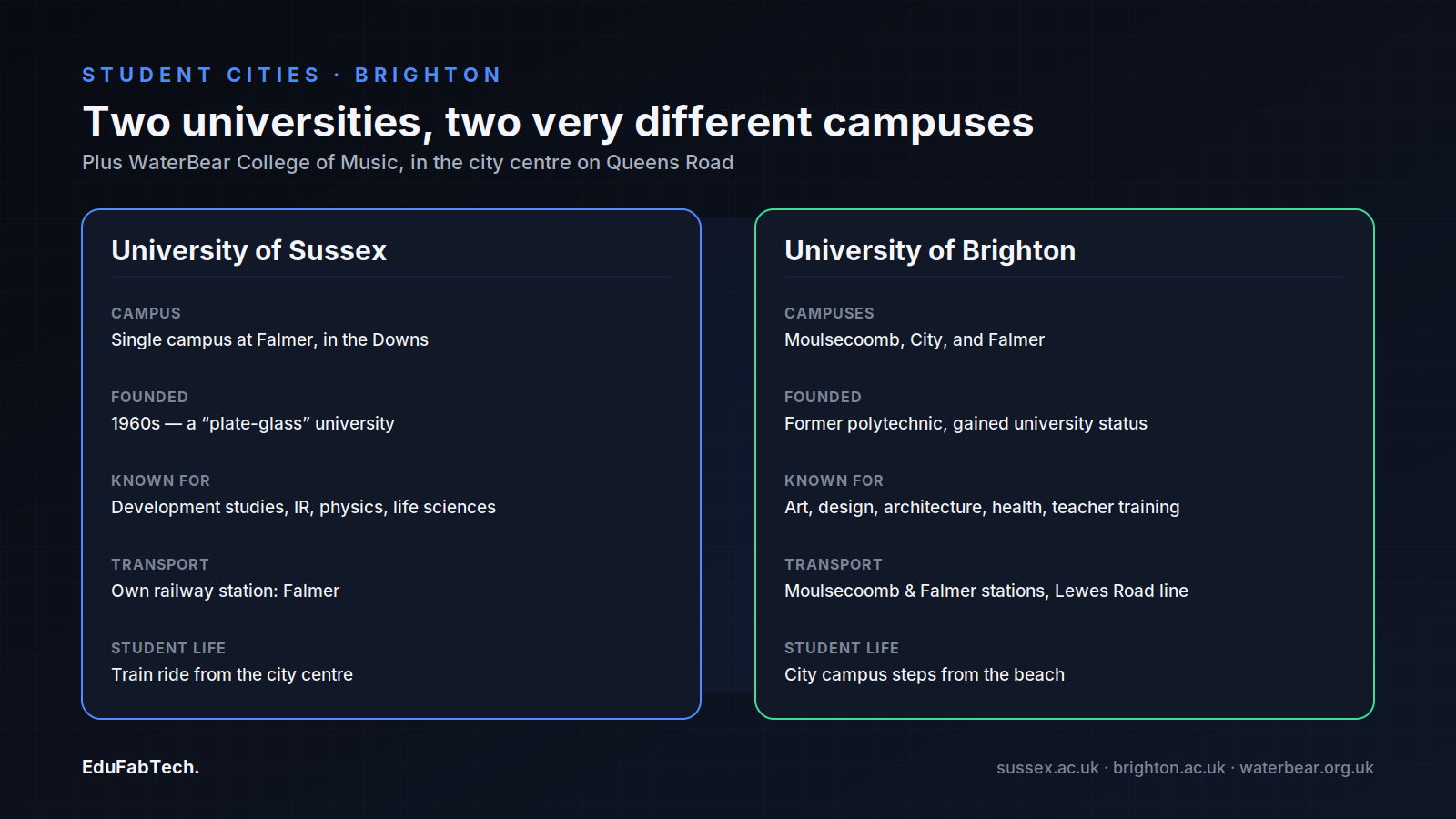
The University of Sussex is the city's research-intensive university. Its single campus sits at Falmer, on the north-eastern edge of the city; the university's own site describes it as "located at Falmer on the outskirts of Brighton, within easy reach of London and major international airports at Gatwick and Heathrow" (sussex.ac.uk). The campus is tucked into a valley against the South Downs, with its own railway station, Falmer, on the south side. Sussex says on its about page that "for over 60 years our teaching, research and culture have stimulated and challenged" (sussex.ac.uk/about); it was one of the wave of plate-glass universities founded in the 1960s and is known for subjects such as development studies, international relations, physics and life sciences.
The University of Brighton is larger and more spread out, a former polytechnic that gained university status and is strong in art and design, architecture, health professions and teacher training. Its own campuses page lists Moulsecoomb — "our biggest campus and student village" — a City campus "in the cultural heart of Brighton, a short stroll from the beach and the pier", and a Falmer campus "on the edge of the South Downs National Park, just four miles from Brighton seafront" (brighton.ac.uk). Moulsecoomb and Falmer both sit on the Lewes Road line and have their own stations.
WaterBear the College of Music is a specialist popular-music college in the city centre at Hanover House, 118 Queens Road — a few minutes' walk from Brighton railway station (waterbear.org.uk). Its degrees are delivered, in its own words, "in partnership with Falmouth University", which validates the awards; courses span performance, songwriting, music production, electronic music and music business. It is a much smaller institution than the two universities, built around Brighton's live-music scene.
The neighbourhoods students settle into
First-year students at both universities usually start in halls and then move into shared houses for later years. The gravitational centre of student housing is the Lewes Road corridor and the districts beside it — Moulsecoomb, Coldean and the streets around Elm Grove — because they are on the bus and rail lines to campus and the rents are a little lower than the seafront. Hanover, the warren of steep terraced streets east of the Level, is popular with Sussex and Brighton students who want to be near the centre and the pubs.
Kemptown (Kemp Town), east along the coast, draws students who want to be near the sea and the city's nightlife; Hove, to the west, is calmer, a bit greener and often slightly cheaper for a room in a shared flat; and Preston Park and the roads around London Road station suit people who want a quieter base with a quick train into town. Living on the Falmer campus itself puts you next to Sussex teaching but a train or bus ride from the city's social life — a trade-off worth thinking about if you came to Brighton for Brighton.
Renting here without losing your deposit
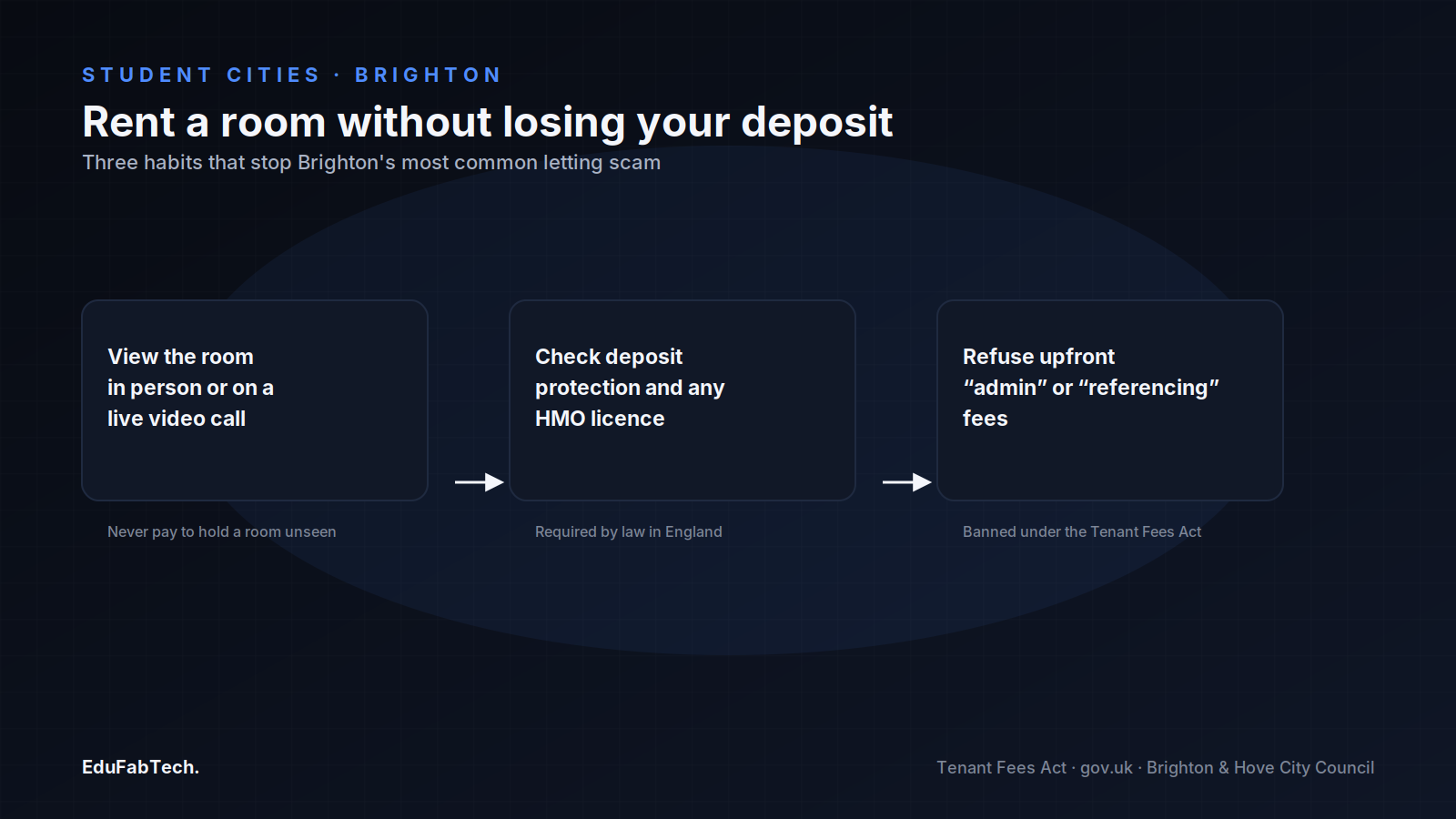
Brighton's private market is tight and fast-moving, and that is exactly the condition scams exploit. The most common trap students hit is an advert — often for a too-cheap, too-central room — where a supposed landlord asks you to transfer a deposit or a "holding fee" before you have seen the place, sometimes claiming to be abroad. Never send money by bank transfer, gift card or cryptocurrency to hold a room you have not viewed; a genuine landlord or agent will let you see the property first, in person or on a live video call, and will not pressure you to pay instantly to beat other applicants.
A few Brighton-specific habits protect you. View the actual room, not just the building, and check damp — the city's old terraces near the sea are prone to it. Ask whether the property has a required HMO licence (houses in multiple occupation are licensed by Brighton & Hove City Council). In England your deposit must by law be protected in a government-approved tenancy deposit scheme, and under the Tenant Fees Act most up-front fees other than rent and a capped deposit are banned — if someone asks for an "admin fee" or "referencing fee", that is a red flag. Where possible, start looking only once you are in the city or have a trusted contact who can view for you, and be wary of listings that reappear under different names. The typical rhythm is to secure halls for first year and to search for a shared house for the following year around the new calendar year, not the summer.
You can browse rooms and places to stay in the city on EduFabTech's Brighton rooms listings, and all student listings in the city sit under the Brighton hub; listings close to each campus are grouped at near University of Sussex and near University of Brighton.
Furnishing a room from the Lanes and the markets
Brighton is an unusually good city for furnishing a room second-hand, because the trade is part of its identity. Snoopers Paradise, in Kensington Gardens in the North Laine, describes itself as "a huge indoor fleamarket" "host to over 90 utterly unique stalls and cabinets" across 7,000 square feet (snoopersparadise.co.uk) — the place to find a lamp, crockery, a desk chair or a record player without paying retail. The surrounding North Laine is wall-to-wall with vintage and independent shops.
For food, plants and household basics, the Open Market near London Road is a covered market owned by Brighton & Hove City Council, which reopened in its rebuilt form on 19 July 2014 with "45 permanent market stalls around the central square" selling fresh food, crafts, services and garden goods (brighton-hove.gov.uk). Weekend car-boot sales around the city are the cheapest source of furniture and kitchenware if you can carry it home. For the things students give away or sell cheaply when they move out — common in Brighton each June and September — browse second-hand listings and free items on EduFabTech.
Part-time work and the visa rules
Brighton's economy is heavy on hospitality, retail, tourism, events and care, which means term-time and vacation shifts exist — but they are competitive, because thousands of students chase them. If you are an international student, how much you may work is a condition of your visa, not a choice. The University of Brighton's guidance states plainly that "if you are studying a degree course at the university you will be permitted to work a maximum of 20 hours per week during term time", with a lower limit of 10 hours a week below degree level (brighton.ac.uk). The "week" and what counts as term time are defined by the Immigration Rules and your course calendar, and the rules are set by UK Visas and Immigration — check your own visa conditions on the official government Student visa page (gov.uk/student-visa) and your university's international student office rather than relying on what a friend did. This is general information, not legal advice.
EduFabTech collects local openings at Brighton jobs and part-time work; WaterBear students near the station can also check listings near the college.
Libraries, desks and quiet corners
Both universities run their own libraries — Sussex's library sits at the heart of the Falmer campus, and Brighton has libraries on its Moulsecoomb and City campuses — open to their own students with long hours in term. When you want somewhere to work in the city centre, the public Jubilee Library on Jubilee Street, between the North Laine and the Lanes, is the main option; Brighton & Hove City Council marked its twentieth anniversary in 2025, noting it opened in 2005 (brighton-hove.gov.uk). The award-winning building has free public desks, Wi-Fi and study seating, and it fills up fast in exam season. Cafés across the North Laine and Kemptown double as informal study spots. For a running list of desks and rooms, see study spaces in Brighton.
Getting around, and what a term costs
Brighton is compact enough to walk much of, though its hills are real exercise. The main operator is Brighton & Hove Buses, whose network covers the Lewes Road campuses densely. The University of Sussex's living-costs page (figures correct as of April 2026) lists a 12-month network saver bus ticket at £654 and a one-day city saver at £4.40 (sussex.ac.uk). Brighton & Hove City Council has confirmed that young people's fare offers continue into 2026: up to four under-19s accompanied by a fare-paying adult travel free, and unaccompanied under-19s "will still pay just 50p for a single off-peak journey", while it also noted that "BSIP supported student fare offers will come to an end on 1 January" (brighton-hove.gov.uk) — so confirm the current student discount directly with the operator before budgeting.
Trains serve the city heavily: Falmer and Moulsecoomb stations sit on the line between Brighton and Lewes, and Brighton station reaches central London in around an hour, which is why a 16–25 Railcard (listed at £35 on the Sussex living-costs page) pays for itself quickly. Many students cycle or use the shared-bike scheme, though the hills and sea winds are not for everyone.
On housing costs, the figures are specific and current. For 2026/27, University of Sussex campus residences range from £123.20 a week for a room in Norwich House up to £235.69 for West Slope, with rent covering "utilities, cleaning and contents insurance" (sussex.ac.uk). University of Brighton halls for 2026-27 run from £173 a week for a standard shared-bathroom room at Varley Park to £270 for a premium room at Mithras, with bills, broadband, contents insurance and communal cleaning included (brighton.ac.uk). In the private market, the Office for National Statistics put the average monthly private rent across Brighton and Hove at £1,816 in September 2026, with one-bedroom homes averaging £1,194 and two-bedroom homes £1,525 (ons.gov.uk) — figures that explain why most students share.
The honest trade-offs, and a first-weeks checklist
What is good about Brighton is hard to fake: a genuine sea-and-Downs setting, a dense cultural and music scene, independent shops and markets, an open and diverse social culture, and fast trains to London. What is hard is mostly money and space. Rents are high for a city this size, as the ONS figures above show; the housing market is tight and competitive; the hills make a bike or a bus near-essential; and the seaside weather is changeable, with damp older housing stock to watch for. The student population is large relative to the city, so popular neighbourhoods and the best-value rooms go quickly. None of this should put you off — but go in with a realistic budget and start your housing search early.
A short checklist for the first weeks:
- Register with a local GP and confirm your university enrolment and student ID.
- If you are on a Student visa, read your work conditions on gov.uk and your university's international pages before taking any shift.
- Set up a transport plan: compare a Brighton & Hove Buses saver against pay-as-you-go, and get a 16–25 Railcard if you will use the trains.
- Never pay a deposit or holding fee for a room you have not viewed, and check your deposit is in a government-approved protection scheme.
- Furnish from Snoopers Paradise, the Open Market, car-boot sales and local second-hand listings before buying new.
- Find your study base early — your campus library and the Jubilee Library both fill up near deadlines.
- Walk the Lewes Road corridor and your nearest neighbourhoods to learn the bus and train stops you will actually use.
For events, meet-ups and more local listings as you settle in, see what's on in Brighton on EduFabTech.
A quick question for readers
Do you work part-time while you study?
Many students work to pay the bills. See how common it is — and how many hours people really do.
Pick an answer, create a free account in a minute, and your vote counts. Already a member? Sign in
Comments 3
Comment-
The transport section buries an actual timeline detail that matters more than the £654 bus pass: the BSIP student fare offer ends 1 January,…
-
The ONS figure is the one solid stat in a sea of marketing copy, and it quietly undercuts the halls pricing right next to it. £1,194 average…
-
The Jubilee Library detail is the one I'd clock first: a 2005 building hitting its twentieth anniversary and still described as filling up f…
Join free to read the full comments and reply Comments are between members; an account takes a minute.
Source: Office for National Statistics
Sources (5)
- Office for National Statistics. Private rent and house prices, Brighton and Hove. ONS, 2026. ons.gov.uk ↗ · checked 8 Nov 2026
- University of Sussex. Campus accommodation (2026/27 residence fees). University of Sussex, 2026. sussex.ac.uk ↗ · checked 8 Nov 2026
- University of Brighton. Our halls (2026-27 accommodation fees). University of Brighton, 2026. brighton.ac.uk ↗ · checked 8 Nov 2026
- Brighton & Hove City Council. Young people's bus fare offers to continue into 2026. Brighton & Hove City Council, 2025. brighton-hove.gov.uk ↗ · checked 8 Nov 2026
- University of Brighton. Student Route visa and right to work. University of Brighton, 2026. brighton.ac.uk ↗ · checked 8 Nov 2026