Studying in Brookings: universities, housing and student life
A practical, sourced guide to living and studying in Brookings, South Dakota — the prairie town built around South Dakota State University, with real figures for housing, transit and work.
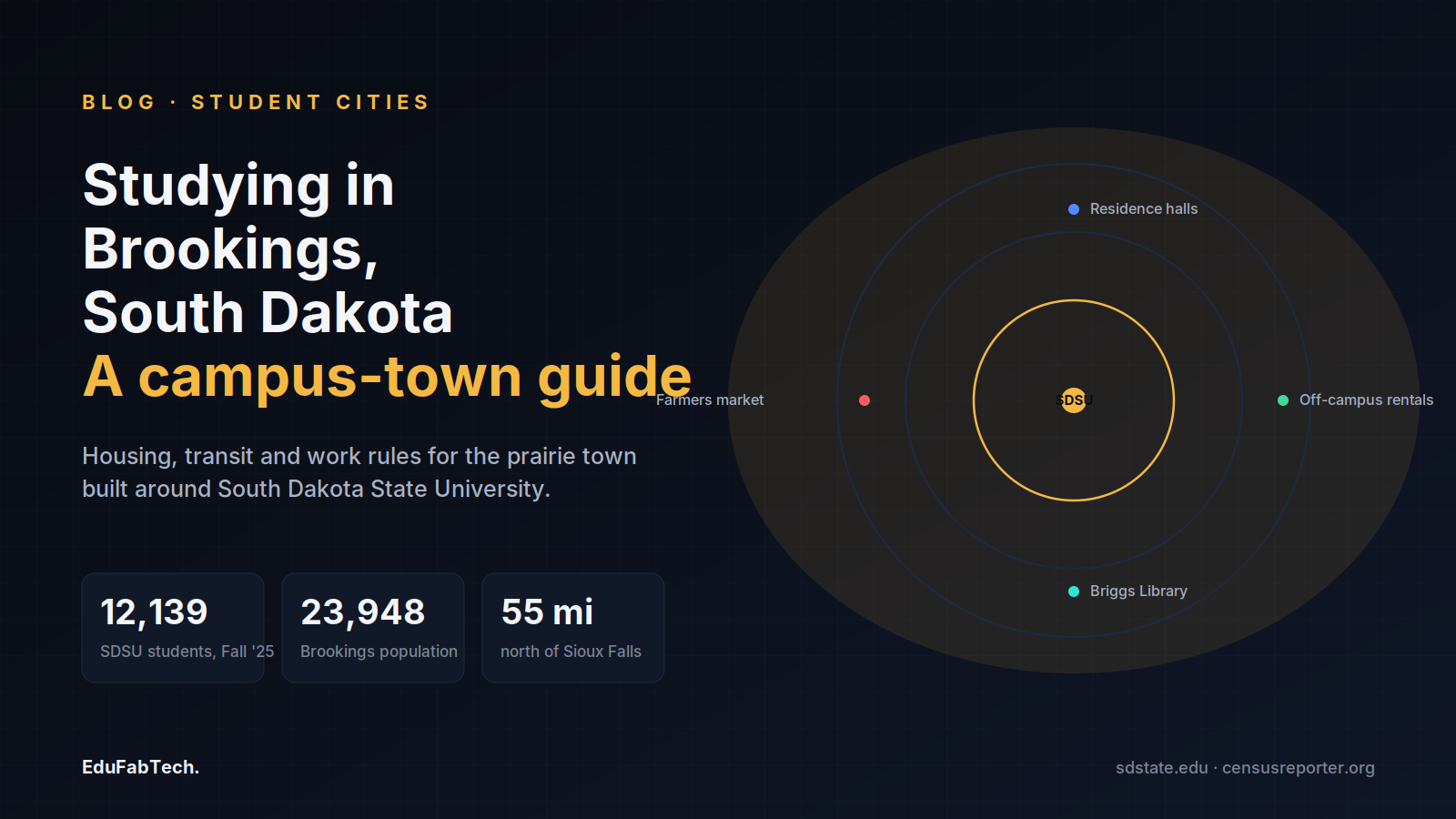
Brookings sits on the flat farmland of eastern South Dakota, close to the Minnesota line and, by South Dakota State University's own reckoning, about 55 miles north of Sioux Falls (sdstate.edu/about-us). It is a small city — Census Reporter puts the population at 23,948 in the American Community Survey 2024 five-year estimates (censusreporter.org) — and the kind of place where the university is not one institution among many but the engine of the whole town. Term dates shape the traffic, the rental market and the Saturday crowds.
For a student, that concentration cuts both ways. Everything you need is close and walkable, and the campus is genuinely the centre of life rather than a commuter annexe. But the choices are narrower than in a big metro: fewer landlords, fewer buses, one dominant employer, and winters on the northern plains that are long and cold. This guide sets out what can be checked against a named source, and says plainly where it cannot.
If you are weighing the move, it helps to start from the one thing everyone in Brookings orbits: the Jackrabbit campus itself.
South Dakota State University, the Jackrabbit campus
South Dakota State University traces its founding to 21 February 1881, when the territorial governor signed the law creating Dakota Agricultural College, which later became SDSU (sdstate.edu/sdsu-archives-special-collections/sdsu-history). It is a public land-grant university established under the 1862 Morrill Act, and it describes itself as the state's largest and most comprehensive higher-education institution (sdstate.edu/about-us).
The same page reports Fall 2025 enrolment of 12,139 students drawn from 48 states and 78 countries, across nine colleges that offer 86 majors, 39 master's programmes, 17 Ph.D. programmes and two professional doctorates, with roughly $94 million in research expenditure (sdstate.edu/about-us). The agricultural and engineering roots run deep, and the athletics teams — the Jackrabbits — compete in NCAA Division I in the Summit League. If a single event tells you how town and gown blur here, it is Hobo Day, the homecoming that SDSU says has run for more than a century; the university listed the 2026 celebration for 24 October 2026 (sdstate.edu/student-life/hobo-day).
The campus is compact and sits on the north side of town, which matters for where you choose to live: most undergraduates can reach lectures on foot or by bike, and a car is a convenience rather than a necessity for day-to-day study.
Where students live
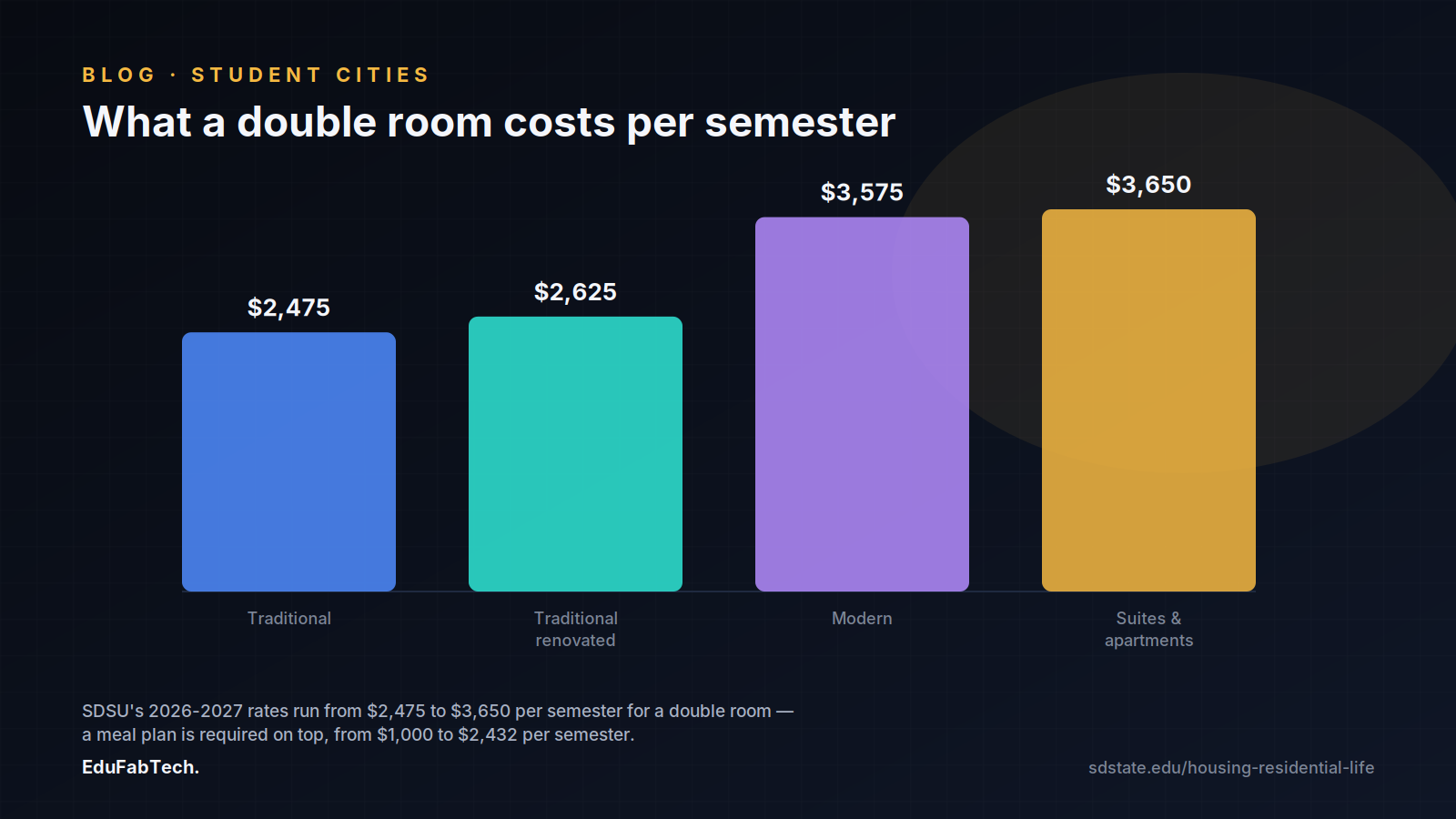
First-year students typically start in the residence halls, and SDSU runs a spread of them from older traditional buildings to newer suites and apartments. The university publishes rates openly, which makes budgeting easier than in cities where you have to prise numbers out of agents. For the 2026-2027 year, SDSU lists residence-hall rooms billed per semester as follows (sdstate.edu/housing-residential-life/housing-meal-plan-costs):
| Hall type | Single (per semester) | Double (per semester) |
|---|---|---|
| Traditional | $3,400 | $2,475 |
| Traditional renovated | $3,600 | $2,625 |
| Modern | $4,600 | $3,575 |
| Suites and apartments | $4,750 | $3,650 |
Those figures are per semester, not per year, so a double room in a traditional hall works out to $2,475 each term under the 2026-2027 schedule. Students in on-campus housing are required to carry a meal plan, which SDSU prices separately on the same page — from $1,000 per semester for the West Flex plan up to $2,432 for the Premier plan for 2026-2027 (sdstate.edu/housing-residential-life/housing-meal-plan-costs). The page also sets a deadline — the last day to change a fall 2026 meal plan was 28 August 2026 — so the calendar matters as much as the price.
Many second- and third-year students move off campus into apartments and shared houses in the blocks around the university and along the town's main grid. Brookings is small enough that "off campus" rarely means a long commute. For a sense of the wider rental market, Census Reporter lists a median household income of $63,493 for Brookings in the ACS 2024 five-year data (censusreporter.org), a reminder that this is a modest-income town where student budgets are the norm, not the exception. You can browse current student listings for the city on EduFabTech's Brookings page and, more specifically, its rooms listings and listings near South Dakota State University.
Signing a lease without losing your deposit
Rental fraud follows students everywhere, and the pattern in a town like Brookings is predictable: a listing that looks too cheap for the autumn rush, an "owner" who is conveniently out of state, and pressure to send money before you have seen the place. The single rule that defeats almost all of it is simple — see the room in person, or have someone you trust see it, before any money changes hands. Brookings is small and walkable, so viewing in person is realistic even if you are arriving from abroad a few days before term.
Never wire a deposit, buy gift cards, or send cryptocurrency to "hold" a room; no legitimate landlord in Brookings needs payment by those irreversible methods, and a request for them is the clearest sign of a scam. Get the lease in writing, check that the name on it matches the person you are dealing with, and keep a dated record of what you paid. If you are coming through the university, SDSU's housing office and international staff can confirm whether a provider is real before you commit. EduFabTech's Brookings rooms and the broader city listings are a starting point, not a substitute for seeing a place and reading what you sign.
Furnishing a room and the Saturday market
Furnishing a first apartment cheaply is a rite of passage, and a town this size rewards patience over a single big shop. The Brookings Farmers Market runs May through October on Saturdays from 9 a.m. to noon, on the 300 block of 6th Avenue between the library and the courthouse, with a smaller winter schedule at the Brookings Activity Center (visitbrookingssd.com). It is mostly food — produce, eggs, honey, baked goods — rather than furniture, but it is the weekly civic gathering where you will meet people and learn the town.
For household goods and second-hand furniture, Goodwill of the Great Plains, which says it serves all of South Dakota (goodwillgreatplains.org), runs a thrift store in Brookings on Main Avenue; confirm its current address and hours before making a trip, as these change. Downtown Main Avenue also carries a cluster of independent resale and antique shops. Rather than name specific private shops whose current status is hard to confirm, the practical route is EduFabTech's own local boards: second-hand things and things given away free — the last of which fills up at the end of each semester when students clear out dorms.
Part-time work and the F-1 rules
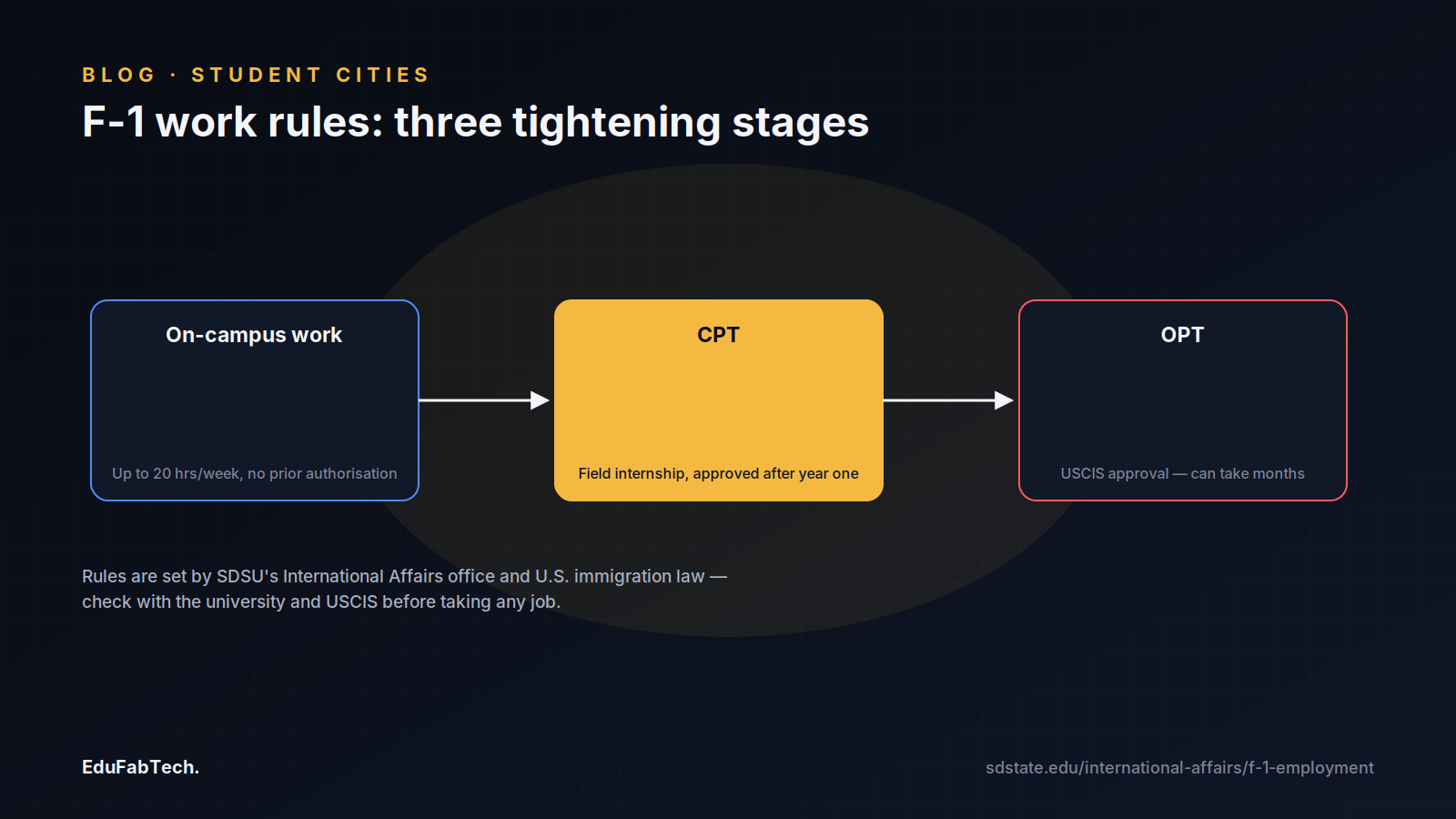
If you are an international student on an F-1 visa, the rules on working are set by U.S. immigration law and administered through SDSU's International Affairs office, not by individual employers — so read the official guidance before you take any job. SDSU states that F-1 students may work on campus up to 20 hours per week while school is in session, and full-time (40-plus hours) during official breaks, and that on-campus work does not require prior authorisation from the international office (sdstate.edu/international-affairs/f-1-employment).
Off-campus work is more tightly controlled. The same page explains that students must generally complete their first academic year before most off-campus options open, that Curricular Practical Training (CPT) covers field-related internships approved by an international student adviser, and that Optional Practical Training (OPT) and economic-hardship authorisations require approval from U.S. Citizenship and Immigration Services, which can take months (sdstate.edu/international-affairs/f-1-employment). None of this is legal advice; treat the university office and USCIS as the authorities and ask them directly about your own case. Local and campus openings that students actually use are collected on EduFabTech's Brookings jobs board.
Libraries and study spaces
The academic heart for studying is the Hilton M. Briggs Library on campus, built in 1977 and holding more than 700,000 volumes across three floors, with over 40 public computers, printers and scanners, bookable study rooms on the top floor, and the Senator Thomas A. Daschle Congressional Research Study (sdstate.edu/buildings/hilton-m-briggs-library). It is the default place to settle in for a long session, and the floors are arranged quiet-to-busy as you move between levels.
Off campus, the Brookings Public Library at 515 3rd Street is a genuine alternative, with meeting rooms, individual study rooms and a Maker Lab; it publishes hours of Monday to Thursday 9:30 a.m. to 8:00 p.m., Friday and Saturday 9:30 a.m. to 5:30 p.m., and Sunday 1:00 p.m. to 5:00 p.m. (brookingslibrary.org). Its Sunday afternoon opening is useful when campus buildings keep shorter weekend hours. Between the two libraries, downtown cafés and the campus commons give you a change of scene when you need one.
Getting around Brookings
Brookings is flat and compact, which makes walking and cycling the realistic default for a campus-centred life. Public transport is run by the Brookings Area Transit Authority (BATA), which operates a scheduled door-to-door service rather than a conventional fixed-route network: rides are booked through BATA's MyRide app or by phone during dispatch hours, and the fare within the city limits is $4.00 per person per ride, with a same-day option at $10 when available (batabus.com/services).
For students specifically, BATA runs the Rabbit Ride, which it describes as free for SDSU students and visitors on Friday and Saturday nights from 9 p.m. to 2:30 a.m. on the academic-calendar schedule, operated in partnership with the SDSU Wellness Center and others (batabus.com/services). That late-night weekend service is the one transit perk aimed squarely at the student population; outside those hours, budget for the standard fare, a bike, or a car if you plan to leave town. BATA also runs regional service to Volga and Aurora and a Sioux Falls Shuttle, a practical way to reach the nearest large airport without a car.
Costs, climate and the honest trade-offs
The strongest case for Brookings is that the numbers are legible and the town is built to student scale. SDSU publishes its housing and meal rates openly for 2026-2027 (sdstate.edu/housing-residential-life/housing-meal-plan-costs), the campus is walkable, and a modest-income town — median household income $63,493 in the ACS 2024 five-year data (censusreporter.org) — keeps everyday prices grounded. Community pride is real and visible, nowhere more than on Hobo Day.
The hard parts are the other side of the same coin. The rental market is small, so the best rooms go early and choice is limited; public transport is a booked service, not a turn-up-and-ride network, so without a bike or a car you will plan around it. Winters on the eastern South Dakota prairie are long and cold, and the nearest big-city amenities are an hour's drive south in Sioux Falls. If you want anonymity and a dense nightlife, this is not that place. If you want a close campus, a walkable grid and a town that revolves around the university, it fits well.
A checklist for the first weeks
- Lock housing against the calendar. Note SDSU's meal-plan and housing deadlines on the housing costs page, and never pay a deposit before seeing the room or sending anyone gift cards, wires or crypto.
- Check in with International Affairs early if you are on an F-1 visa, and read the F-1 employment rules before accepting any job.
- Get a library routine. Walk both the Briggs Library and the Brookings Public Library in week one and note which hours suit you.
- Sort out getting around. Install BATA's booking app, learn the $4.00 in-town fare and the free weekend Rabbit Ride (batabus.com/services), and consider a second-hand bike.
- Furnish slowly and locally. Watch the end-of-semester giveaways and the second-hand and free-stuff boards before buying new.
- Meet the town. Spend a Saturday morning at the farmers market and get to know the downtown grid.
A quick question for readers
Do you work part-time while you study?
Many students work to pay the bills. See how common it is — and how many hours people really do.
Pick an answer, create a free account in a minute, and your vote counts. Already a member? Sign in
Comments 0
CommentNo comments yet. Members start the conversation.
Source: South Dakota State University
Sources (5)
- South Dakota State University. 2026-2027 Housing and Meal Plan Costs. South Dakota State University, 2026. sdstate.edu ↗ · checked 24 Oct 2026
- South Dakota State University. About Us. South Dakota State University, 2025. sdstate.edu ↗ · checked 24 Oct 2026
- South Dakota State University International Affairs. F-1 Employment. South Dakota State University, 2026. sdstate.edu ↗ · checked 24 Oct 2026
- Brookings Area Transit Authority. Services. BATA, 2026. batabus.com ↗ · checked 24 Oct 2026
- Census Reporter. Brookings, SD (ACS 2024 5-year). Census Reporter, 2024. censusreporter.org ↗ · checked 24 Oct 2026