Studying in Brooklyn: universities, housing and student life
A practical, sourced guide to Brooklyn's universities, the neighbourhoods students actually live in, how to find a room safely, what it costs, and getting around the borough.
Brooklyn is not a college town in the way a single campus dominates a small city. It is a borough of New York City large enough to be a major city on its own, and its universities are woven into its neighbourhoods rather than set apart from them. A student here might attend a design studio in Clinton Hill, a pharmacy lecture off DeKalb Avenue, or a medical rotation in East Flatbush — and then commute under the East River to classes in Manhattan. The result is that "student life" in Brooklyn is mostly city life, shared with everyone else on the subway platform.
That shapes almost every practical decision you will make: where to live, how long your commute will be, how much rent eats into your budget, and where you can find a quiet desk when your apartment is too small. This guide walks through the universities based in the borough, the Manhattan institutions many Brooklyn residents commute to, and the mechanics of housing, work, study space, transport and cost — with every figure tied to the source that published it.
If you want to see current listings while you read, EduFabTech keeps Brooklyn pages for everything in the city, for rooms, and for part-time work.
The universities based in Brooklyn — and the ones across the river
Several degree-granting institutions have their main campuses inside the borough. New York University Tandon School of Engineering sits in the MetroTech complex in Downtown Brooklyn, and its about page traces the engineering school's origins to 1854.
Pratt Institute is the borough's best-known art and design school. Its 25-acre main campus is in historic Clinton Hill at 200 Willoughby Avenue, according to Pratt's campuses page, which also lists a smaller Manhattan location at 144 West 14th Street for associate and continuing-education programmes. The Brooklyn campus is unusual for a New York art school in having real lawns and a sculpture-filled quad.
Long Island University runs its LIU Brooklyn campus in Downtown Brooklyn, home to the Arnold and Marie Schwartz College of Pharmacy; LIU Pharmacy describes itself as the first and only Doctor of Pharmacy programme in Brooklyn. The university's study-abroad-centred LIU Global programme is also administered from the borough.
SUNY Downstate College of Medicine anchors health-sciences education in East Flatbush. SUNY Downstate calls itself "the only academic medical center in Brooklyn" and teaches through five schools — the College of Medicine, School of Public Health, College of Nursing, School of Health Professions and School of Graduate Studies — on its about page, at 450 Clarkson Avenue.
The public CUNY system has a large presence too. New York City College of Technology (City Tech) is CUNY's designated college of technology, offering 58 associate and bachelor's degree programmes at 300 Jay Street "at the foot of the Brooklyn Bridge", per its about page. Brooklyn College sits in Midwood, Medgar Evers College in Crown Heights, and St. Francis College is at 179 Livingston Street in Downtown Brooklyn, per its about page. Many Brooklyn residents also commute to Manhattan institutions — chiefly New York University in Greenwich Village and Columbia University in Morningside Heights — which is why so much housing demand in north Brooklyn is really demand for a short train ride into Manhattan.
The neighbourhoods, from Downtown Brooklyn to Midwood
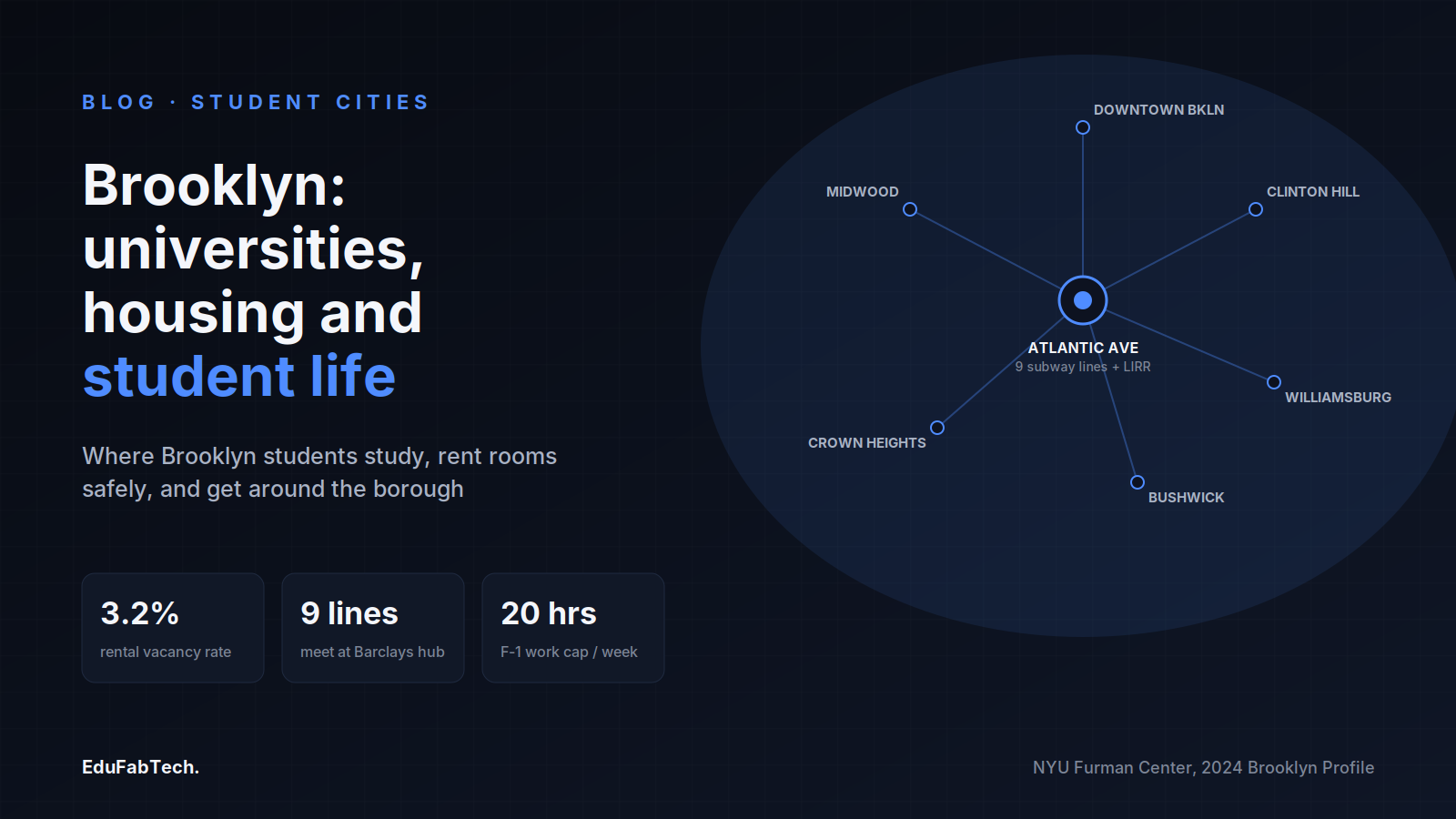
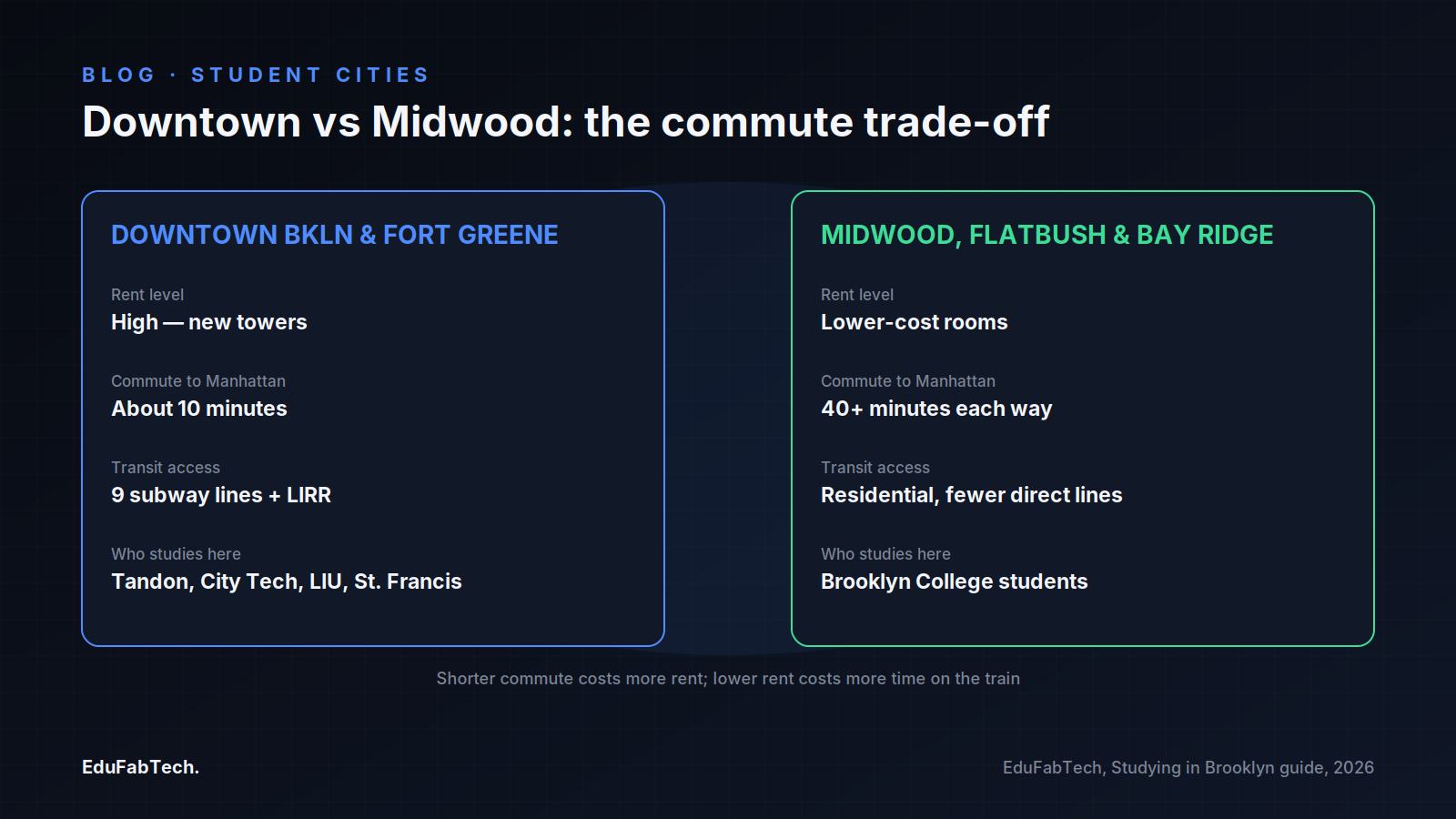
Downtown Brooklyn and Fort Greene. This is the centre of gravity for Tandon, City Tech, LIU and St. Francis students, and one of the densest transit hubs in the borough — Atlantic Avenue–Barclays Center alone links nine subway lines and the Long Island Rail Road. Rents are high and towers are new; the trade-off is that you can often walk to class and reach Manhattan in ten minutes.
Clinton Hill and Bedford-Stuyvesant. Clinton Hill wraps around Pratt, with brownstone blocks and a steady art-school population; neighbouring Bed-Stuy is larger, historically Black, and still somewhat cheaper the further east you go from the G and C trains. Both put you a short ride from Downtown Brooklyn.
Williamsburg and Greenpoint. Fashionable, waterfront, and expensive, served mainly by the single L train into Manhattan and the G up the Brooklyn–Queens spine. Students here are usually sharing to afford it, drawn by nightlife, the waterfront and the weekend markets.
Bushwick. Further out on the L, J and M lines, Bushwick has absorbed much of the creative overflow from Williamsburg. Share rooms are more attainable, the commute is longer, and the character is industrial-turned-residential.
Crown Heights and Prospect-Lefferts Gardens. Close to Medgar Evers College and to the green edge of Prospect Park and the Brooklyn Public Library's Central Library, these diverse neighbourhoods remain relatively more affordable than the waterfront while keeping good 2, 3, 4 and 5 train access.
Midwood, Flatbush and Bay Ridge. Southern Brooklyn is residential, family-oriented and shaped by immigrant communities; Brooklyn College students in particular live around Midwood. Rooms cost less here, but the commute to Downtown Brooklyn or Manhattan is long — plan on 40 minutes or more each way.
Renting a room in Brooklyn's tight market, and the scams to watch
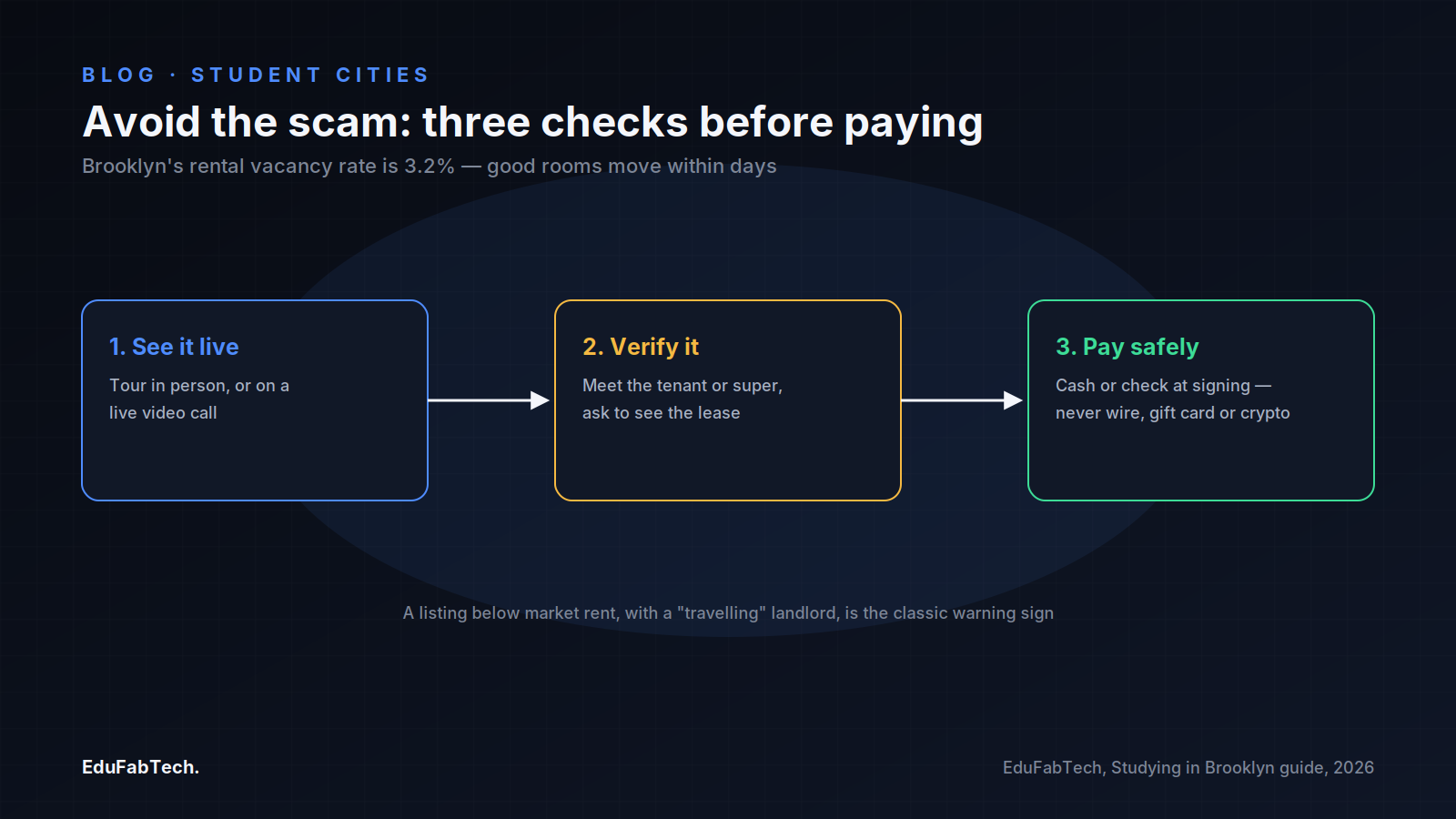
Brooklyn's rental market is fast and tight: the NYU Furman Center's 2024 Brooklyn profile reported a rental vacancy rate of 3.2% and found that 28.1% of renter households in the borough were severely rent-burdened, spending at least half their income on rent (NYU Furman Center, 2024). In that environment, good rooms move within days, which is exactly what scammers exploit.
Most student housing here is a shared room in a private apartment, sublets within an existing lease, or a room passed between graduating and arriving students. University dormitories exist at Pratt, Tandon and LIU but are limited; the CUNY colleges are largely commuter schools. Start looking four to eight weeks before term, not earlier for a sublet and not later for September, when demand peaks as the city's leases turn over.
The scams in Brooklyn follow a pattern. A listing shows a bright apartment well below the going rate; the "landlord" is travelling, cannot show it in person, and asks you to wire a deposit to "hold" it. Do not. See the room in person or on a live video call, meet the person already living there or the building superintendent, and ask to see the actual lease. Expect to pay a first month's rent plus a security deposit; never send money by bank wire, gift card or cryptocurrency to reserve a place you have not stood inside. If a broker is involved, ask up front who is paying the fee. When you compare what is offered, EduFabTech's Brooklyn rooms listings are a sensible place to gauge what a realistic price looks like before you commit.
Furnishing a room on a budget: markets and second-hand Brooklyn
Furnishing cheaply is a Brooklyn skill. The borough is known for its outdoor markets: Brooklyn Flea runs seasonal weekend markets — in Williamsburg at Marsha P. Johnson State Park, 90 Kent Avenue, on Saturdays, and at Prospect Park's Breeze Hill on Sundays from spring through autumn — plus a year-round location in DUMBO, according to the operator's locations page. These are stronger for vintage clothing, records and small homewares than for a bed frame.
For furniture, the pragmatic route is second-hand within your own neighbourhood: stoop giveaways, end-of-lease sell-offs in August, and student handovers around Pratt and Tandon. Carrying a dresser up four walk-up flights is a genuine consideration, so buy close to home. EduFabTech lists second-hand furniture and things given away free in the borough, which is often where a desk and a chair actually come from.
Working while you study
If you are an international student on an F-1 visa, the rules on work are strict and worth getting right. The U.S. Department of Homeland Security's Study in the States service states that an F-1 student in on-campus employment "may not work more than 20 hours per week when school is in session" (DHS, Study in the States). Any employment must be authorised, and your school's Designated School Official (DSO) is the person who approves it; the same page warns that a DSO who learns of unauthorised work must report it through SEVIS. Off-campus training options such as CPT and OPT are also arranged through your DSO. This is a summary, not legal advice — confirm your own situation with your DSO and the official page before you take any job. Local part-time openings aimed at students are listed on EduFabTech's Brooklyn jobs page.
Libraries and places to study
Beyond your own university's library, the Brooklyn Public Library is the borough's great free study resource, with its Central Library at 10 Grand Army Plaza and dozens of branches. A library card is free for "anyone who lives, works, pays property taxes or goes to school in New York state", per the library's card application page — which covers essentially every student in the borough. Branches offer reading rooms, free wifi and bookable study space, and the neighbourhood branches near Prospect Park and Downtown Brooklyn fill up fast during exam weeks. For quieter paid or reservable desks, EduFabTech tracks study spaces around the city.
Getting around
Brooklyn runs on the subway and bus network operated by the Metropolitan Transportation Authority (MTA). The MTA sets the base fare for most riders at $3 on subways and local buses, with express buses at $7.25, according to its fares page. The practical saving for frequent riders is the OMNY fare cap: tap with the same contactless card or phone all week and, the MTA says, you "won't spend more than $35 a week on subway and local bus fares", because once you reach that total the remaining rides that week are free. The MTA notes you could no longer buy or refill a MetroCard as of 1 January 2026, so OMNY is now the way to pay. There is no general discount for university students — the MTA lists reduced fares (half the base fare) only for seniors and people with disabilities — so budget for the full fare or the weekly cap.
Practically, your rent-versus-commute calculation is a transit calculation. A room in Bushwick or Flatbush is cheaper precisely because it is further from the Manhattan-bound express lines; a room in Downtown Brooklyn costs more because nearly every line passes through it.
What it costs, and the honest trade-offs
Brooklyn is expensive, and the figures bear it out. The NYU Furman Center's 2024 Brooklyn profile put the borough-wide median monthly gross rent at $1,900, and $1,780 for studios and one-bedrooms (NYU Furman Center, 2024). On the dormitory side, Pratt Institute's published 2025–2026 rates charge first-year students $6,200 per semester for a double room in its Emerson Place, Pantas and Stabile halls, with higher rates for singles and transfer-student halls, per Pratt's housing options and costs page. Most students who rent privately bring that per-person cost down by sharing.
The good side of studying here is real: a density of universities, museums, employers and internships that few places match, a transit system that runs all night, and neighbourhoods varied enough that you can find a community whatever your background. The hard side is equally real — high rent, a tight market with a 3.2% vacancy rate, small apartments, long commutes from the cheaper south and east, crowded trains, and winters cold enough that a 15-minute walk to the subway matters. Nobody should arrive expecting a quiet campus bubble; Brooklyn gives you a city instead.
A checklist for your first weeks
- Register with your university and, if you are an international student, check in with your DSO before doing anything work-related.
- Set up OMNY (tap a contactless card or phone) and let the $35 weekly cap do the saving; MetroCards are no longer sold.
- Get a free Brooklyn Public Library card — you qualify as a student in New York State — for study space and wifi beyond your campus.
- Never wire a deposit for a room you have not seen; view it in person or by live video, meet the current tenant or super, and read the lease.
- Choose your neighbourhood by commute as much as by rent: price the train ride to your campus, not just the room.
- Furnish from your own area — stoop finds, August sell-offs and local second-hand listings beat carrying furniture across the borough.
- Walk your route to campus and your nearest library branch in the first week, and settle in before term fully starts.
A quick question for readers
Do you work part-time while you study?
Many students work to pay the bills. See how common it is — and how many hours people really do.
Pick an answer, create a free account in a minute, and your vote counts. Already a member? Sign in
Source: NYU Furman Center
Sources (5)
- NYU Furman Center. State of New York City's Housing and Neighborhoods — Brooklyn. NYU Furman Center, 2024. furmancenter.org ↗ · checked 7 Oct 2026
- Metropolitan Transportation Authority. Subway and bus fares. MTA, 2026. mta.info ↗ · checked 7 Oct 2026
- Pratt Institute. Apply for Housing: Options and Costs (2025–2026). Pratt Institute, 2025. pratt.edu ↗ · checked 7 Oct 2026
- U.S. Department of Homeland Security, Study in the States. Working in the United States. U.S. Department of Homeland Security, 2025. studyinthestates.dhs.gov ↗ · checked 7 Oct 2026
- SUNY Downstate Health Sciences University. About. State University of New York, 2026. downstate.edu ↗ · checked 7 Oct 2026