Studying in Buffalo: universities, housing and student life
A practical, sourced guide to studying in Buffalo, New York — its universities, where students live, how to rent without being cheated, work rules, study spaces, transport and the honest trade-offs.
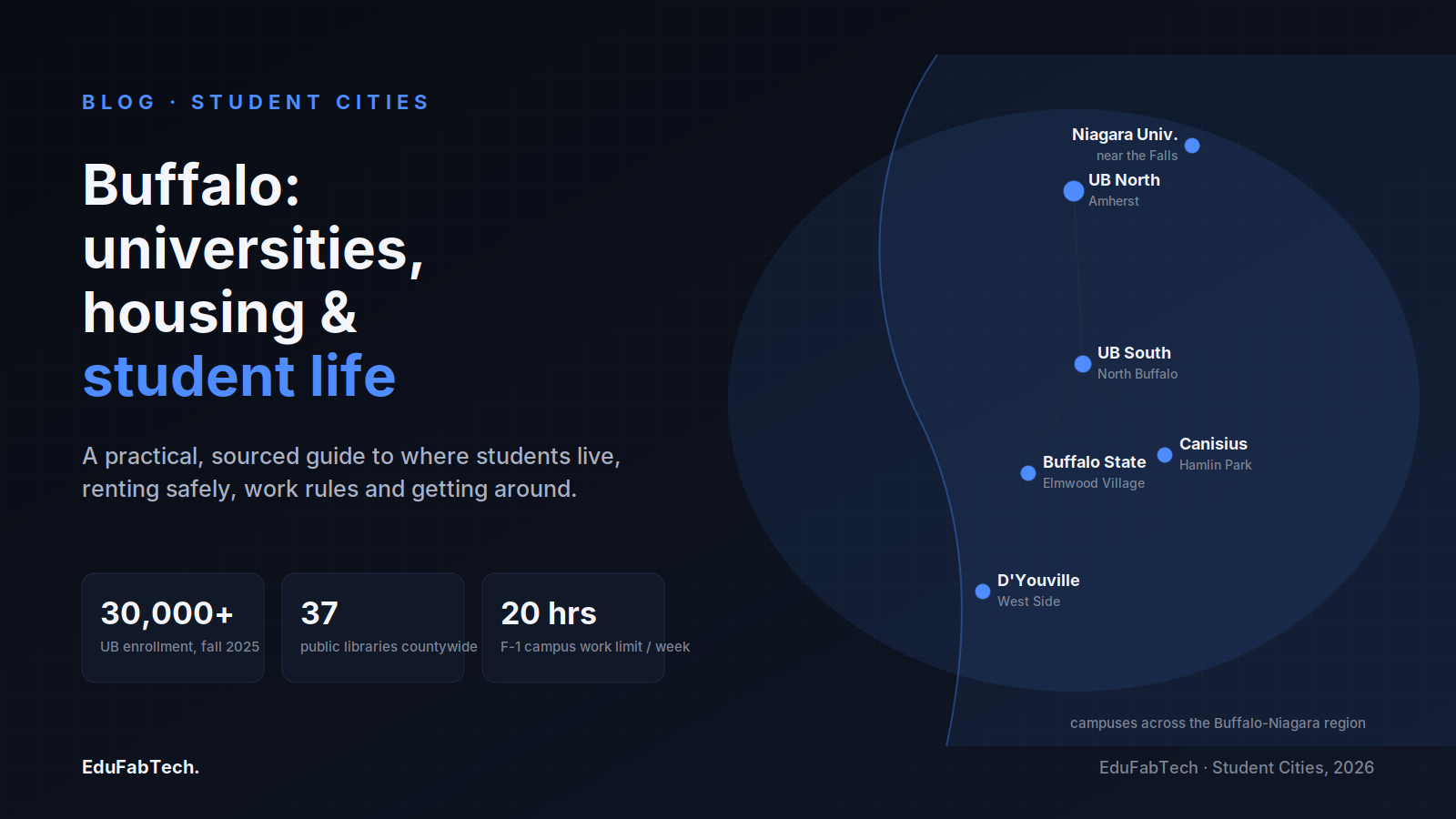
Buffalo sits at the eastern end of Lake Erie, at the point where the lake narrows into the Niagara River and runs north toward the falls and the Canadian border. It is the second-largest city in New York State, and it wears that fact plainly: a grid of nineteenth-century neighbourhoods, a compact downtown, grand parks laid out by Frederick Law Olmsted, and a ring of suburbs where much of the region now lives. For a student, the first thing to understand is that "studying in Buffalo" can mean several quite different places — a suburban research campus in Amherst, a small college on Elmwood Avenue, a health campus on the West Side, or a Catholic campus up near Niagara Falls.
The second thing to understand is the trade the city offers. Compared with downstate New York or the large coastal cities, rent and day-to-day costs are low, the campuses are real and walkable, and people are genuinely used to newcomers, including international students. In exchange, you accept long, grey, snowy winters and a region spread out enough that getting around without a plan takes effort. This guide works through the universities, where students live and how to rent safely there, furnishing a room, work rules, libraries, transport and costs — with each figure tied to a source you can open yourself. You can browse current student listings across Buffalo on EduFabTech as you read.
The campuses, from Amherst to the West Side
The University at Buffalo (UB) is the giant here. It runs three campuses: the North Campus in the suburb of Amherst, which is the largest and where most undergraduates study and live; the South Campus on Main Street in North Buffalo; and a growing Downtown Campus in the city's medical corridor, as the university's own campuses page describes. UB is the largest and most comprehensive public research university in the State University of New York (SUNY) system, with annual research expenditures that exceed US$400 million, according to its About the University page. UB announced it expected total enrolment above 30,000 students for a seventh consecutive year and a record first-year class for fall 2025, according to a 2025 university news release. It is strong in engineering, medicine and the sciences; the North Campus is self-contained and modern, while the South Campus connects to downtown by light rail.
Beyond UB, the city has a cluster of smaller institutions. Canisius University is a Jesuit, Catholic university at 2001 Main Street in the Hamlin Park neighbourhood, listed on its contact page. Buffalo State University, part of SUNY, sits at 1300 Elmwood Avenue on a 125-acre campus in the museum district next to Delaware Park, and describes itself as the largest comprehensive "university college" in SUNY on its about page. D'Youville University is on the West Side, where it opened a Health Professions Hub in 2021 focused on nursing, pharmacy and allied health, per the university's own description. Niagara University, founded by the Vincentian community in 1856, lies on a 160-acre campus in Lewiston, about four miles north of Niagara Falls, and enrols more than 4,000 students across undergraduate and graduate programmes, according to its history page. Two smaller institutions round out the area: Daemen University on Main Street in Amherst, and Hilbert College, a Franciscan college in Hamburg roughly ten miles south of the city.
Neighbourhoods where students settle
Where you live depends almost entirely on which campus you attend. For UB undergraduates, two worlds exist: on-campus residence halls and apartments in Amherst, and the student rental belt of University Heights around the South Campus — streets such as Winspear, Heath and Englewood, lined with old wooden double-houses that have been subdivided for students for generations. The South Campus connects to downtown and to North Campus by the UB Stampede shuttle and the Metro Rail, so some students live near South and commute. Those at Canisius and Buffalo State tend to cluster in North Buffalo, the Elmwood Village and Allentown, dense walkable districts of shops and apartments, while D'Youville students are on the West Side, a mixed, heavily immigrant part of the city.
If you are deciding sight-unseen from abroad, remember that Amherst (and the suburb of Eggertsville next to it, where Daemen sits) is spread out and suburban: convenient to North Campus but often needing a bus or car for daily errands. The older city neighbourhoods are cheaper and more walkable but vary block by block. It helps to look at listings tied to a specific campus — for example, rooms near the University at Buffalo, near Canisius or near Niagara University — rather than searching the whole metro at once. EduFabTech also lists rooms and places to stay across the city.
Renting a house in University Heights without losing a deposit
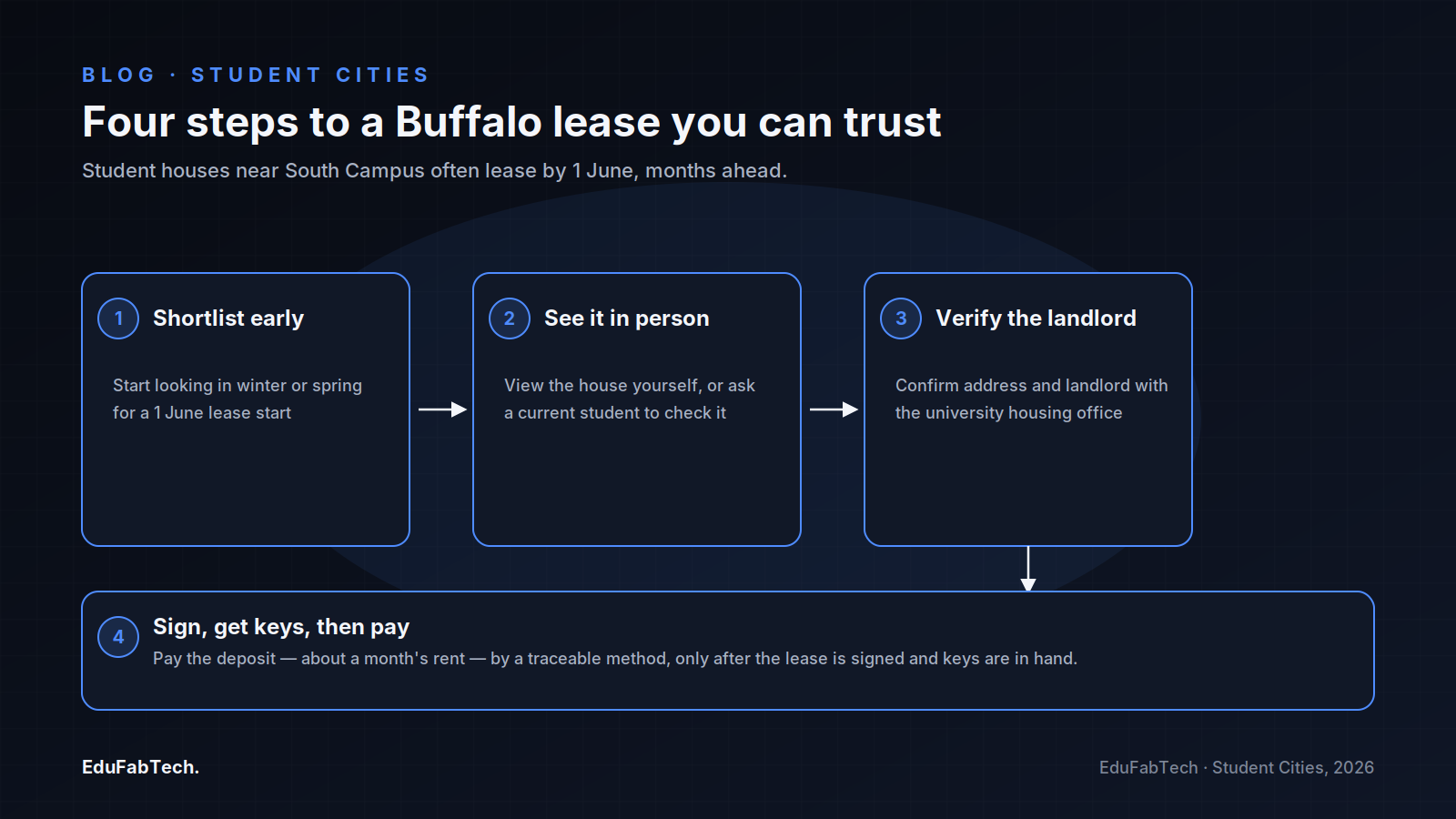
The student rental year in Buffalo runs early. Many houses near South Campus and in the Elmwood and Allentown areas are leased months ahead, with a lot of leases starting on or around 1 June, so students looking for the best houses often sign in the preceding winter or spring. Most student housing here is in subdivided older homes rather than purpose-built blocks, which means condition varies enormously — check the heating (winters are long), the state of the windows, and whether utilities are included before you commit. Expect to be asked for a security deposit, usually about a month's rent.
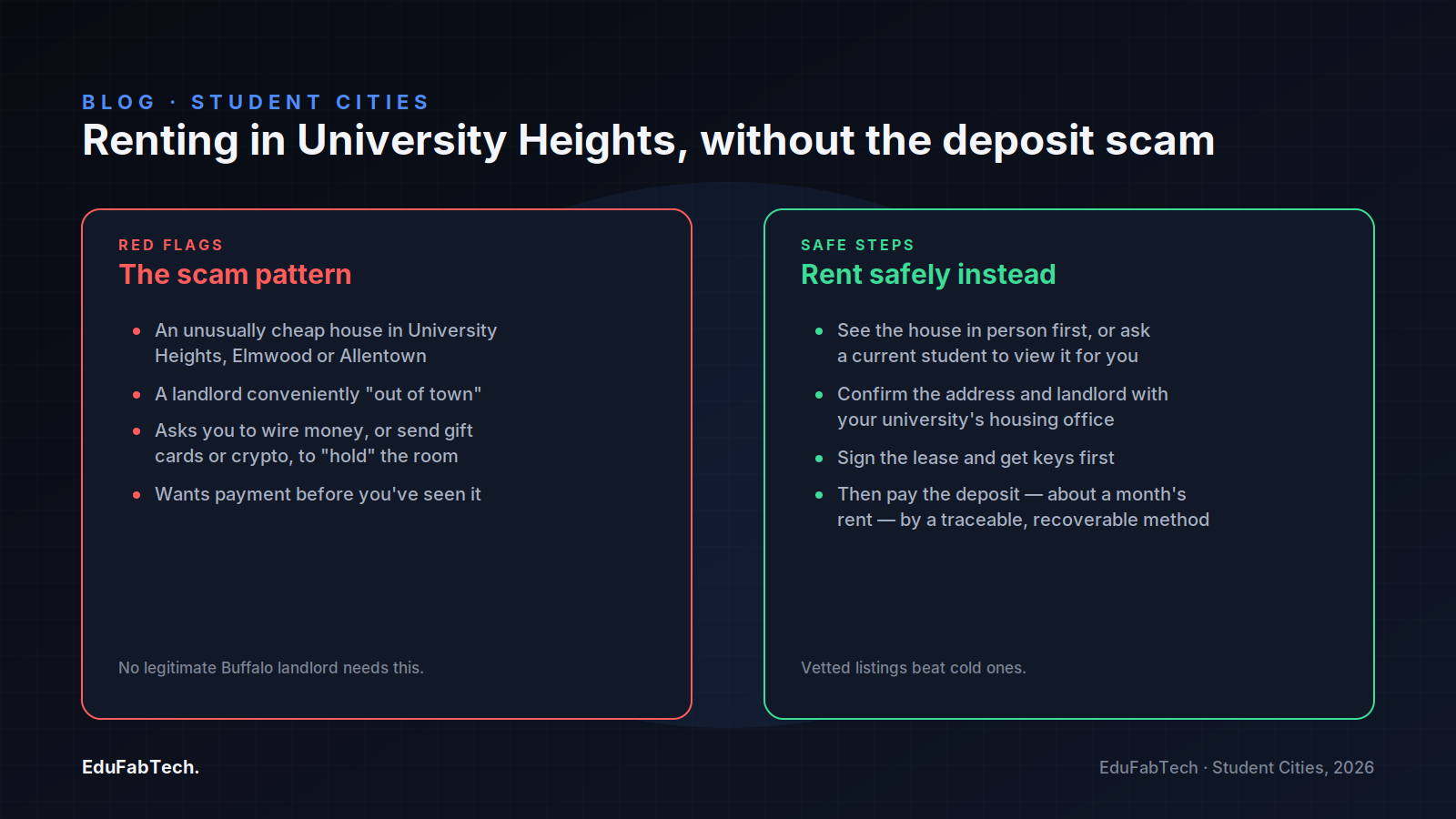
The scams in Buffalo follow a predictable pattern: an unusually cheap "student house" in University Heights, Elmwood or Allentown, a landlord who is conveniently out of town, and a request to wire a deposit or send gift cards or cryptocurrency to "hold" the room before you can see it. Do not. No legitimate Buffalo landlord needs a deposit by bank wire, gift card or crypto to reserve a place. See the house in person first; if you are still abroad, ask a current student, a classmate already in the city, or your university's off-campus housing office to view it and confirm the address and the landlord are real before any money moves. Pay deposits in a traceable, recoverable way once you have a signed lease and keys in hand. You can start from vetted rooms listed on EduFabTech rather than cold listings.
Furnishing a room second-hand: the Broadway Market and the West Side Bazaar
Buffalo is a good city for setting up a room cheaply, partly because students cycle through the same houses every year and leave furniture behind. For food and local colour, the Broadway Market, an indoor public market first established in 1888 in the historically Polish Broadway-Fillmore district on the East Side, still runs with around thirty vendors and is busiest around Easter, as described by the state's Broadway Market Revitalization project. On the West Side, the West Side Bazaar — an incubator for immigrant- and refugee-run businesses operated by the Westminster Economic Development Initiative — reopened in a larger space at 1432 Niagara Street, according to New York State Homes and Community Renewal; it is better known for food and crafts than furniture, but it is part of how the city shops. For the practical business of kitting out a room, browse second-hand things, used furniture and items given away free on EduFabTech, and watch for end-of-semester giveaways in University Heights.
Working while you study
This is general information, not legal advice; always confirm your own situation with your university's international student office. International students on an F-1 visa may generally work on campus up to 20 hours per week while school is in session, and full time during official breaks, without separate authorisation, as U.S. Immigration and Customs Enforcement explains on its Students and Employment page. Off-campus work, and training tied to your field of study through Curricular Practical Training (CPT) or Optional Practical Training (OPT), has stricter rules and must be approved first by your Designated School Official. The authoritative source is that ICE/SEVP page and your campus international office — not a landlord, employer or forum. Domestic students face no such limits; for openings, see part-time jobs listed on EduFabTech.
Libraries and places to study
The public anchor is the Buffalo & Erie County Public Library, whose Central Library on Lafayette Square downtown runs to more than 400,000 square feet and heads a system of 37 libraries across the county, per the library's Central Library page — a free, warm, central place to study that any resident can use. On campus, UB's main North Campus research library is the Lockwood Memorial Library, with a separate undergraduate library; Buffalo State has E. H. Butler Library; and Canisius has the Andrew L. Bouwhuis Library. In winter especially, having a reliable indoor study spot near where you live matters more than it sounds; EduFabTech lists study spaces and desks around the city.
Getting around, and the winter
Public transport is run by the Niagara Frontier Transportation Authority (NFTA). Its Metro Rail is a single light-rail line of about 6.4 miles running along Main Street from Canalside downtown to University Station at UB's South Campus; the downtown stretch runs above ground and is free to ride. Standard Metro fares for ages 10–64 are US$2.00 for a single ride, and the NFTA caps spending so you ride free after US$5 in a day, US$25 in a week or US$75 in a calendar month using its MetGo smart card, according to the NFTA Fare Info page (cash fares on buses are single-ride only and are not eligible for capping). UB also runs its Stampede shuttle between its campuses. That said, the region is built for cars, and in Amherst in particular many students find they rely on buses, lifts or a car for groceries and errands.
Then there is the snow. Winters here are long and heavily lake-effect, and a single storm can drop huge amounts in a matter of days: the December 2022 blizzard left 51.9 inches at Buffalo Niagara International Airport over the storm, as the National Weather Service in Buffalo recorded in its winter summary. Budget for warm clothing and expect occasional campus closures and disrupted buses in deep winter.
What it costs
For on-campus living, UB's Campus Living publishes rates by hall and room type. For the 2026–2027 academic year, a double room in the Ellicott, Governors or South Campus halls is US$10,375.68 per student for the year, a single is US$11,536.00, and the cheapest "Value-Bull" triple is US$8,400.00, with a US$300 housing deposit, all listed on the UB housing rates page; those figures include utilities, internet and laundry. Off campus, the U.S. Census Bureau's QuickFacts (drawing on the 2020–2024 American Community Survey) puts the median gross rent in the city of Buffalo at US$1,046 a month, per its Buffalo city QuickFacts — low by the standards of large U.S. cities, though student houses near campus vary widely and a shared house usually works out cheaper per person. For transport, the NFTA's US$75 monthly fare cap is a useful upper bound on routine bus and rail spending.
The good and the hard
What is good: Buffalo is affordable, especially next to downstate New York; the campuses are real places with their own life; the city is used to international students and newcomers; Niagara Falls and the Canadian border are close; and the food and neighbourhood culture — from the Broadway Market to the West Side — reward curiosity. What is hard: the winters are long, dark and genuinely snowy, which affects commuting and mood; the metro is spread out, so without a transport plan the suburbs can feel isolating; parts of the East Side carry the marks of decades of disinvestment; and the part-time job market is smaller than in a bigger metro. None of this is a reason to stay away — it is a reason to arrive prepared.
Your first weeks: a short checklist
- Report to your university's international student office and your Designated School Official before doing anything with work or immigration paperwork.
- If you have no housing yet, book short-term accommodation and view places in person before paying; never wire a deposit to "hold" a room.
- Get a MetGo card and learn your nearest Metro Rail stop or bus route to campus.
- Get a Buffalo & Erie County Public Library card — it is free and the Central Library is a reliable study base.
- Furnish from second-hand and free listings before buying new, and check end-of-semester giveaways in University Heights.
- Buy real winter clothing early; the first lake-effect storm can arrive before you expect it.
- Note term dates and the start of the June leasing season if you plan to move off campus next year.
For current rooms, jobs, second-hand goods, study spaces and events across the city, start from the Buffalo listings on EduFabTech and narrow down by campus.
A quick question for readers
Do you work part-time while you study?
Many students work to pay the bills. See how common it is — and how many hours people really do.
Pick an answer, create a free account in a minute, and your vote counts. Already a member? Sign in
Source: University at Buffalo Campus Living
Sources (5)
- University at Buffalo Campus Living. 2026–2027 Housing Rates. University at Buffalo, 2026. buffalo.edu ↗ · checked 5 Oct 2026
- NFTA-Metro. Fare Info. Niagara Frontier Transportation Authority, 2026. metro.nfta.com ↗ · checked 5 Oct 2026
- U.S. Census Bureau. QuickFacts: Buffalo city, New York. U.S. Census Bureau, 2024. census.gov ↗ · checked 5 Oct 2026
- U.S. Immigration and Customs Enforcement. Students and Employment. U.S. Department of Homeland Security, 2026. ice.gov ↗ · checked 5 Oct 2026
- University at Buffalo. About the University. University at Buffalo, 2025. buffalo.edu ↗ · checked 5 Oct 2026