Studying in Burlington: universities, housing and student life
A practical guide to studying in Burlington, Vermont — its universities, where students live, how to rent safely, what it costs, and the honest trade-offs of a small lakeside city.
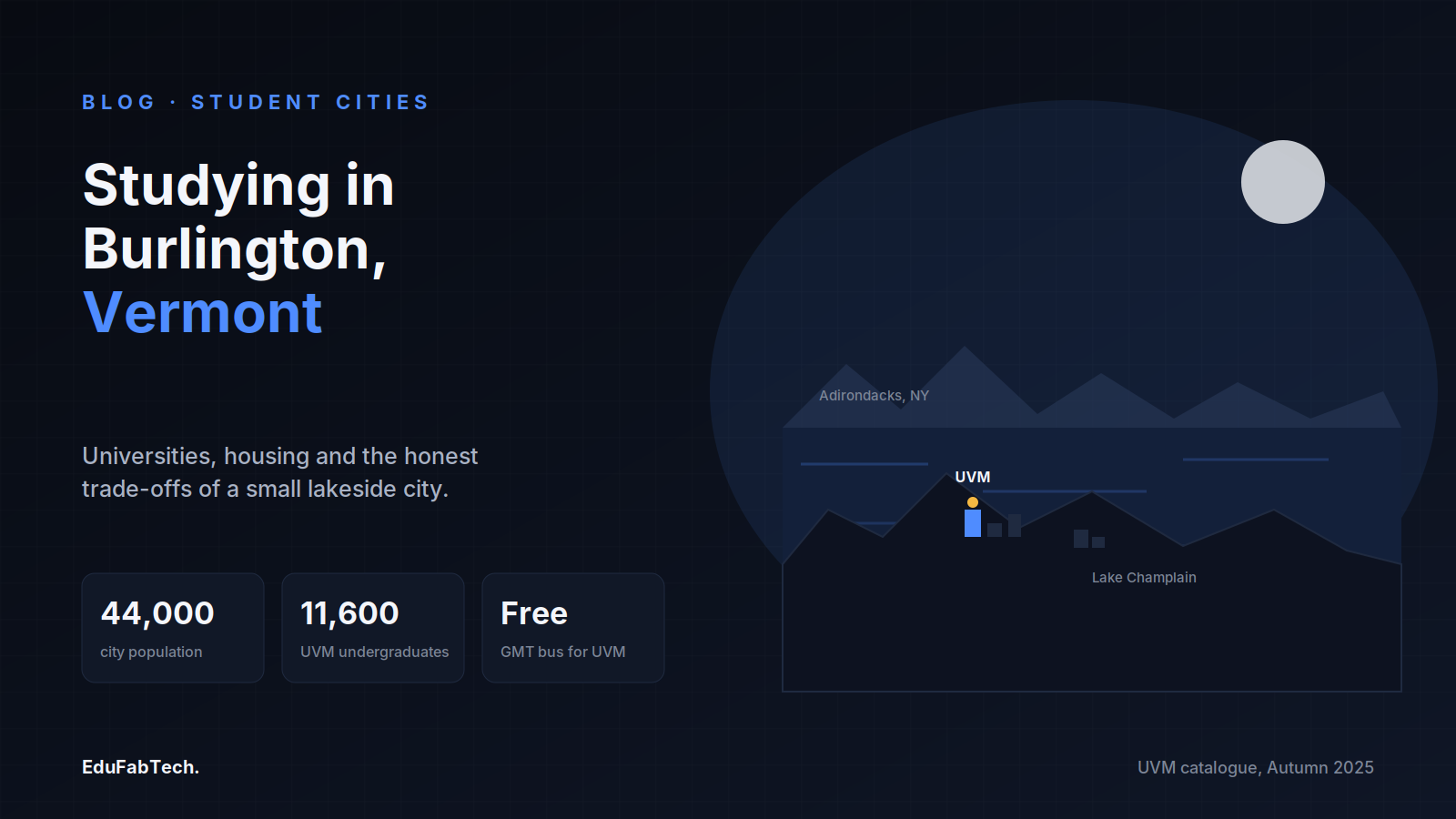
Burlington sits on a hillside that runs down to Lake Champlain, facing the Adirondack Mountains of New York across the water and backing onto Vermont's Green Mountains. It is the largest city in one of the least populous states in the country, with a population of roughly 44,000 — closer in size to a large town than to the metros where most big universities sit. Montreal is about 100 miles north and Boston about 200 miles to the south-east, as the University of Vermont's own catalogue notes. For a student, that scale shapes everything: the campus and downtown are a short walk apart, the lake is part of daily life, and winter is long and genuinely cold.
The city's identity is tied to its university. The University of Vermont climbs the hill above downtown, Champlain College occupies the blocks just below it, and the two together give Burlington a student population out of all proportion to its size. This guide is for anyone — Vermonter, out-of-state, or arriving from abroad — trying to work out where to live, what it costs, and what the year actually feels like.
Everything below is attributed to a named source, and every figure carries the institution and the year that produced it. You can find more local listings for the city on EduFabTech's Burlington page.
The universities on the hill
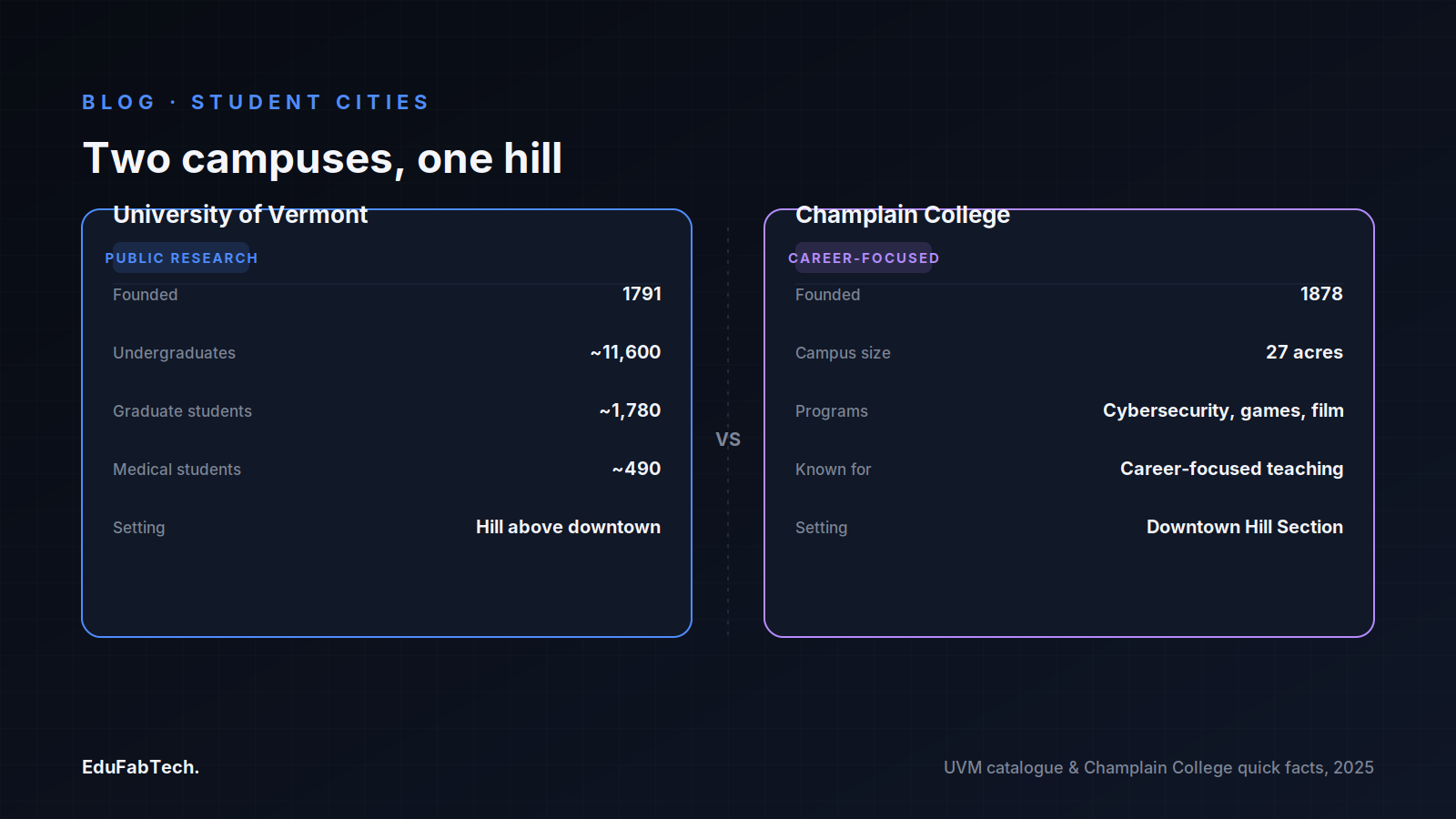
The University of Vermont is the anchor. Chartered in 1791, the same year Vermont became the fourteenth state, it enrolled roughly 11,600 undergraduate students, 1,780 graduate students and 490 medical students in the autumn of 2025, according to its catalogue. The main campus spreads along University Row and the green above Main Street, with the historic Old Mill building and the Fleming Museum of Art among its landmarks. It is a public research university with a strong footing in the environmental and health sciences — the UVM Medical Center shares the campus's eastern edge.
Within UVM, the Rubenstein School of Environment and Natural Resources is worth naming on its own. The university traces forestry teaching back to the nineteenth century, but the School of Natural Resources was established in 1973 and renamed in 2003 as the first named and endowed academic unit at UVM, per the school's own account. It has been housed in the George D. Aiken Center since 1982, and its majors run from environmental sciences and forestry to wildlife and fisheries biology and parks, recreation and tourism. Fieldwork is central: the lake, the Green Mountains and the surrounding forests are effectively the classroom. Listings close to campus are collected on EduFabTech under University of Vermont and the Rubenstein School.
Champlain College sits just downhill, on a 27-acre campus in the city's historic Hill Section, a few minutes' walk from the waterfront. According to its quick facts page, Champlain is a career-focused college known for campus programmes in cybersecurity, game production, filmmaking and business; it was founded in 1878, originally as a business school, and teaches out of a mix of converted Victorian houses and modern buildings. It is far smaller than UVM, and its downtown setting means its students are woven tightly into city life. Nearby rooms and desks are gathered under Champlain College.
Where students settle
Burlington is compact enough that neighbourhood choice is really a choice about walking distance and noise. The Hill Section, between the two campuses, is the classic student quarter: big old houses subdivided into rentals, steps from class, and correspondingly in demand. The Old North End, downhill to the north, is the city's most mixed and generally more affordable district, a short bus ride or a longish walk from campus. The South End, around Pine Street, has become an arts-and-workshop district with some apartments. Downtown puts you on top of Church Street but at a premium.
Many students also look across the city line. Winooski, a small, dense city immediately north-east across the river, and South Burlington to the south both sit on Green Mountain Transit bus routes and tend to offer newer or cheaper stock than the Hill. The trade-off is a commute and, in winter, more time waiting for a bus in the cold.
First-year students at UVM live on campus, and much of the second year too, so the private market mostly matters from the second year onward and for graduate and Champlain students. The academic-year lease cycle here is early: the best Hill Section houses are spoken for months ahead, and students commonly sign for the following autumn during the preceding winter or early spring. Start looking well before you think you need to, and see the rooms listings for what is currently on offer.
Renting in a tight market without being cheated
Burlington's rental market is small and perennially short of supply, which is exactly the condition in which rental scams thrive. The pattern to watch for is a listing — often forwarded through a student group, a classifieds post or a social-media page — for a Hill Section or downtown apartment priced suspiciously below everything else, from someone who says they are out of state and cannot show it in person but will "hold" it for a deposit sent immediately.
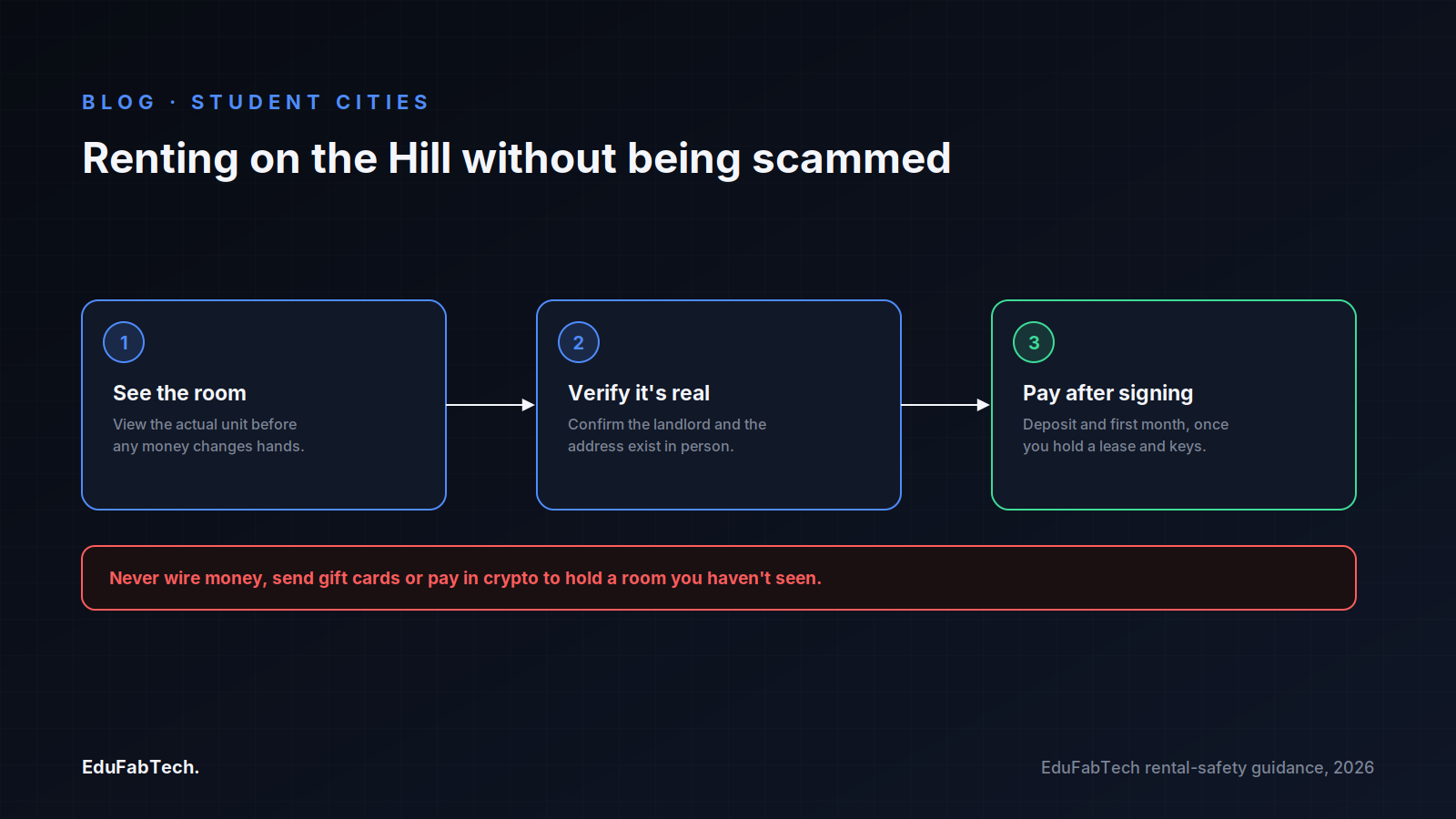
The defences are local and concrete. See the actual room before you pay anything: in a city this walkable, a genuine landlord can arrange a viewing, and an address you can stand in front of is the single best check. Confirm the unit and the person letting it are real before money changes hands. A security deposit and often the first month's rent are normal to pay once you have a signed lease and keys in hand — but never send money by bank wire, gift card or cryptocurrency to reserve a place sight unseen. Those methods are irreversible, and no legitimate Burlington landlord needs them to hold a room. If a deal only works if you pay before you can see it, treat that as the warning it is.
Furnishing a room cheaply
A subdivided Hill Section apartment usually arrives empty, and Burlington is unusually good for furnishing one secondhand. ReSOURCE, a Vermont reuse nonprofit, runs a store at 339 Pine Street in the South End selling secondhand furniture, household goods and building materials; per its store page, it is open Tuesday, Thursday, Friday and Saturday from 10am to 5pm, with proceeds funding workforce-training programmes. For a desk, a bed frame or a set of chairs, it is the obvious first stop.
The city's warm-season rhythm helps too. The Burlington Farmers Market runs outdoors on Saturdays from May through October, on Pine Street in the South End, as the local paper Seven Days describes; a smaller winter edition moves indoors on alternating Saturdays between November and April, as WCAX reported in 2025. The market itself is for cheap produce; the furniture bargains come from the city's end-of-term churn, when graduating students sell off or give away what they cannot take home. EduFabTech's own second-hand, furniture and free-stuff listings are worth watching in late spring and at the August move-in, when turnover peaks.
Part-time work, and what it means on a student visa
Term-time jobs cluster where students already are: campus dining and the libraries, the cafés and shops of Church Street, and the downtown restaurants. The practical constraint for international students is immigration status, not the local labour market.
If you hold an F-1 student visa, the U.S. Department of Homeland Security's Study in the States guidance states that on-campus employment "may not work more than 20 hours per week when school is in session," with more hours allowed during scheduled breaks, and that you must clear it with your school's designated school official before you start. Off-campus work carries separate and stricter rules. This is a summary of an official source, not legal advice: confirm your own situation with your DSO and the primary DHS pages before you accept any job. Current local openings are listed under jobs.
Libraries and places to study
UVM's main academic library is the David W. Howe Memorial Library at 538 Main Street, with bookable group rooms for two to ten people alongside open seating; the health-sciences-focused Dana Health Sciences Library on Colchester Avenue adds group rooms and quiet study pods near the medical campus. Hours shift by term, so check the UVM Libraries calendar before a late night.
Off campus, the Fletcher Free Library at 235 College Street is the city's public library — free to join and open to everyone, which matters for Champlain students and for anyone who wants to study away from their own campus. The Church Street end of downtown is also dense with cafés that tolerate a laptop and a long coffee. For a running list of desks, quiet rooms and bookable spaces, see study spaces.
Getting around
The single best piece of transport news for a UVM student is that the bus is free. The regional operator is Green Mountain Transit (GMT), and UVM's transportation office confirms "fare-free, unlimited access to the GMT system for all UVM full-time students, staff and faculty," accessed through the Ride Ready By GMT app. Several local routes serve the campus directly, along with commuter lines reaching further into Chittenden County.
That said, Burlington rewards walking and cycling far more than driving. The core — two campuses, downtown, the waterfront, Church Street — fits inside a walkable square, and parking on the Hill is scarce and restricted. The honest caveat is the climate: from roughly December to March the hills are snowbound and the walk down to the lake is bitterly cold, so winter boots and a real coat are not optional. A bike is excellent from April to November and far less so in January.
What it costs, and the honest trade-offs
On-campus housing figures are published and precise. For the 2026–2027 academic year, the University of Vermont lists a Standard-tier traditional double room at $9,614 and a traditional quad (the cheapest option) at $6,492 for the year, rising to $12,596 for a private single in its Premium halls. Those are room charges before any meal plan.
Off campus, a reliable public benchmark comes from the City of Burlington, which cites the U.S. Department of Housing and Urban Development's Fair Market Rent — published in August 2024 and effective 1 October 2024 — at $1,476 a month for a one-bedroom and $1,936 for a two-bedroom, including all utilities. Those are metro-wide figures, and desirable Hill Section apartments shared between students can land above or below them; they are a floor for your planning, not a quote.
The balance sheet for a student is roughly this. In its favour, Burlington is safe-feeling, small enough to cross on foot, set against a lake and mountains that make the outdoors genuinely accessible, and generous with free transit and secondhand supply. Against it: housing is tight and not cheap, the student lease cycle starts early and punishes latecomers, the city is far from any large metro, and the winter is long and severe in a way that catches newcomers off guard. None of these is a dealbreaker, but all of them reward planning ahead.
A checklist for the first weeks
- Register for the free Green Mountain Transit pass through the Ride Ready By GMT app with your university email as soon as you arrive.
- Get a Fletcher Free Library card — it is free and open to all residents, not only UVM students.
- If you are living off campus next year, begin the search in winter or early spring; the best rooms go months ahead.
- Never pay a deposit before you have seen the place and signed a lease, and never by wire, gift card or crypto.
- International students: confirm the on-campus 20-hour term-time work rule with your designated school official before taking a job.
- Furnish from ReSOURCE on Pine Street and watch end-of-term giveaways; buy a serious winter coat and boots before December.
- Learn which libraries stay open late in your term by checking the UVM Libraries calendar, and scout a backup study spot downtown.
Burlington is a small city that happens to be built around learning, and its best feature for a student is how little stands between you and the rest of it — the lake, the mountains, the market, the bus. Plan for the cost and the cold, and the rest is unusually easy to reach. You can browse what is happening locally through EduFabTech's events listings.
A quick question for readers
Do you work part-time while you study?
Many students work to pay the bills. See how common it is — and how many hours people really do.
Pick an answer, create a free account in a minute, and your vote counts. Already a member? Sign in
Comments 0
CommentNo comments yet. Members start the conversation.
Source: University of Vermont
Sources (5)
- University of Vermont. Costs — Housing and Dining (Academic Year 2026–2027). University of Vermont, 2026. uvm.edu ↗ · checked 10 Oct 2026
- University of Vermont. About the University. University of Vermont Catalogue, 2025. catalogue.uvm.edu ↗ · checked 10 Oct 2026
- U.S. Department of Homeland Security. Working in the United States — Students. Study in the States, 2026. studyinthestates.dhs.gov ↗ · checked 10 Oct 2026
- City of Burlington. Fair Market & Affordable Rents. City of Burlington, Vermont, 2024. burlingtonvt.gov ↗ · checked 10 Oct 2026
- Champlain College. Quick Facts. Champlain College, 2026. champlain.edu ↗ · checked 10 Oct 2026