Studying in Cape Coral: universities, housing and student life
Cape Coral has no campus of its own, so student life here is built around Florida Gulf Coast University across the river, a car-shaped grid of canals, and a rental market made for homeowners.
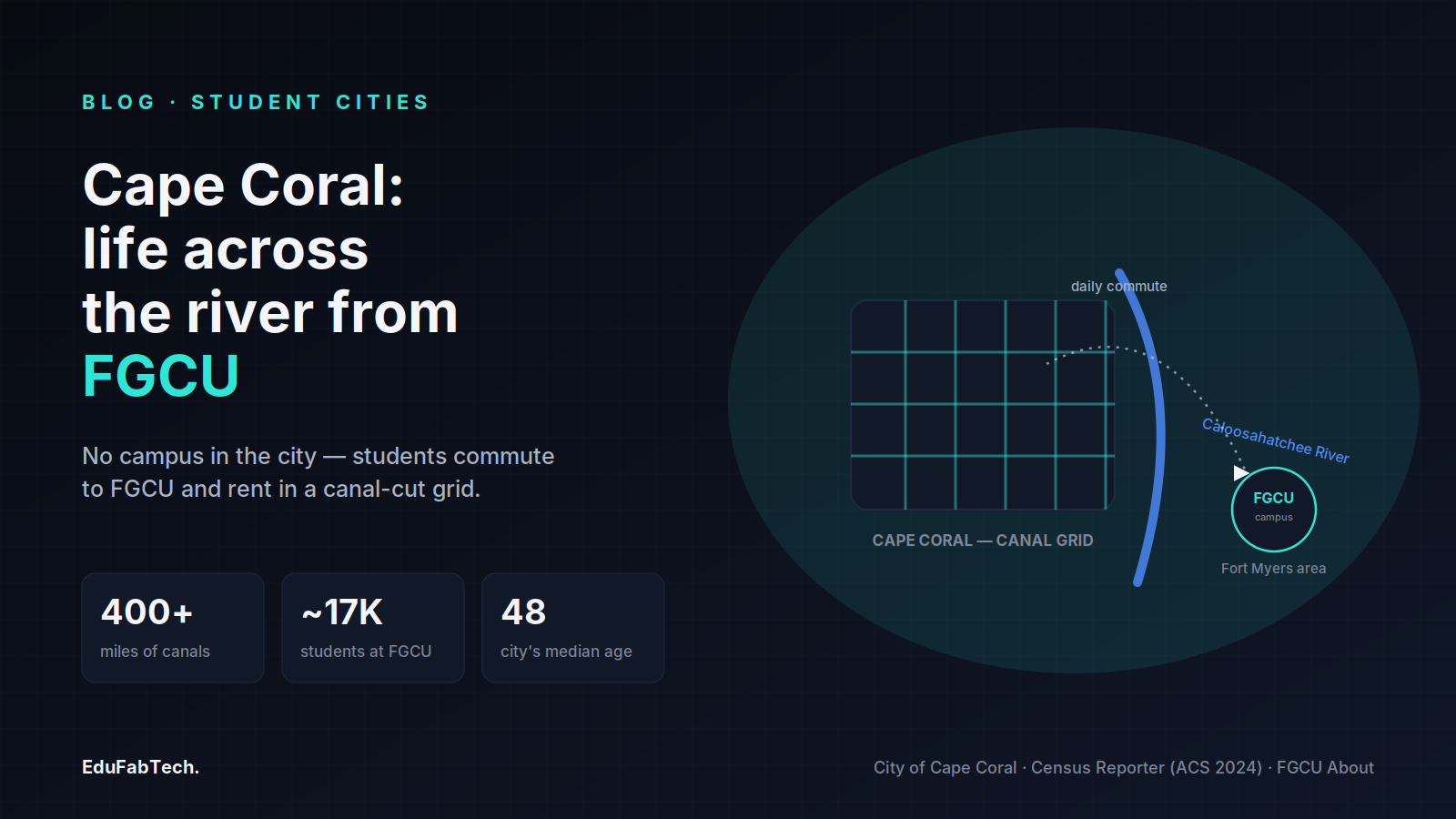
Cape Coral is one of the largest cities in Florida that most people outside the state have never heard of, and it is an odd place to arrive as a student. It was laid out in the late 1950s as a vast grid of single-family lots threaded with water: the City of Cape Coral says on its own boating page that the city has more than 400 miles of canals, many with direct access to the Caloosahatchee River. That history still shapes daily life. The city is spread out, built around the car, and designed for families who own their homes rather than for twenty-year-olds renting a room for nine months.
The census bears that out. According to the U.S. Census Bureau's American Community Survey 2024 one-year estimates, compiled by Census Reporter, Cape Coral had a population of about 233,025, a median household income of US$85,584, and a median age of 48 — older and more settled than a typical college town. There is no public university inside the city limits. The campus that defines student life in this corner of Southwest Florida sits across the river, in the Fort Myers area to the south-east.
So studying "in Cape Coral" usually means one of two things: living in Cape Coral and commuting to Florida Gulf Coast University, or being based in the city for an online or state-college programme and using Cape Coral as an affordable, quiet place to live. Either way, the trade-offs are specific to this city, and worth understanding before you sign anything.
Florida Gulf Coast University, on the far side of the river
Florida Gulf Coast University (FGCU) is the degree-granting university that serves the Cape Coral–Fort Myers area. On its About page, FGCU describes itself as founded in 1991 as the tenth state university in Florida, with classes beginning in 1997, on an 800-acre campus where half the land is preserved or restored natural habitat. The same page lists nearly 17,000 students and more than 100 undergraduate and master's degree programmes across its six colleges and five schools. One of those schools is The Water School, which FGCU describes as an interdisciplinary hub for environmental studies — a natural fit for a region defined by water.
FGCU is also one of the few public universities to require service-learning for graduation, so undergraduate life here comes with a built-in expectation of community work. Athletically it fields 15 men's and women's varsity teams in NCAA Division I as a member of the Atlantic Sun (ASUN) Conference, and its men's basketball team reached the Sweet 16 in the 2013 NCAA Tournament, the run that earned the nickname "Dunk City." The campus is not in Cape Coral itself; its address is 10501 FGCU Blvd. S., on the southern side of Lee County, which means Cape Coral students cross the Caloosahatchee into Fort Myers and head south to get there.
Living in a city of canals and cul-de-sacs
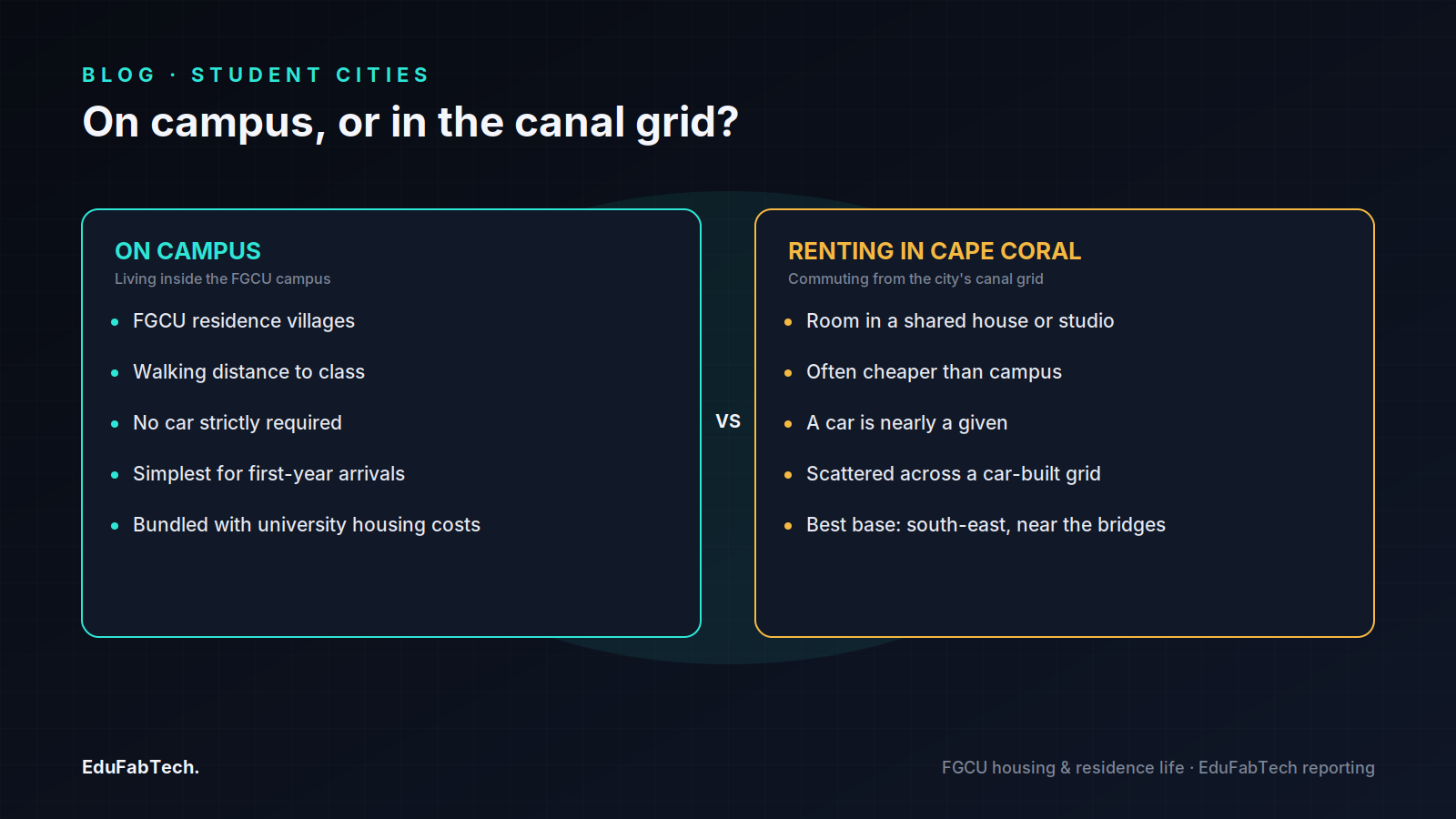
Students here split broadly into two groups, and the housing choice follows from which one you are in. If you want to live on campus, FGCU runs its own residence villages, and that is the simplest option for a first-year student from out of town — everything is in one place and you are not negotiating with a landlord. The alternative is renting a room or sharing a house in Cape Coral and commuting, which is what many local and budget-conscious students do, because rooms in the city's residential grid can be cheaper than campus and a car is nearly a given anyway.
What Cape Coral mostly offers is single-family houses, not purpose-built student blocks. That means your realistic options are a room in a shared house, a garage or in-law suite converted to a studio, or a small apartment in one of the complexes along the main arteries such as Del Prado Boulevard, Santa Barbara Boulevard, Pine Island Road and Cape Coral Parkway. The north and north-west of the city are newer, more spread out and further from the bridges; the south-east quadrant, near downtown and the Cape Coral Bridge, puts you closest to the crossings into Fort Myers and is the most practical base if you commute to FGCU. Start looking early — the winter season brings an influx of seasonal residents to Southwest Florida and pushes up demand for short-term rooms, so a place that is easy to find in August can be scarce by November.
Paying a deposit without getting burned
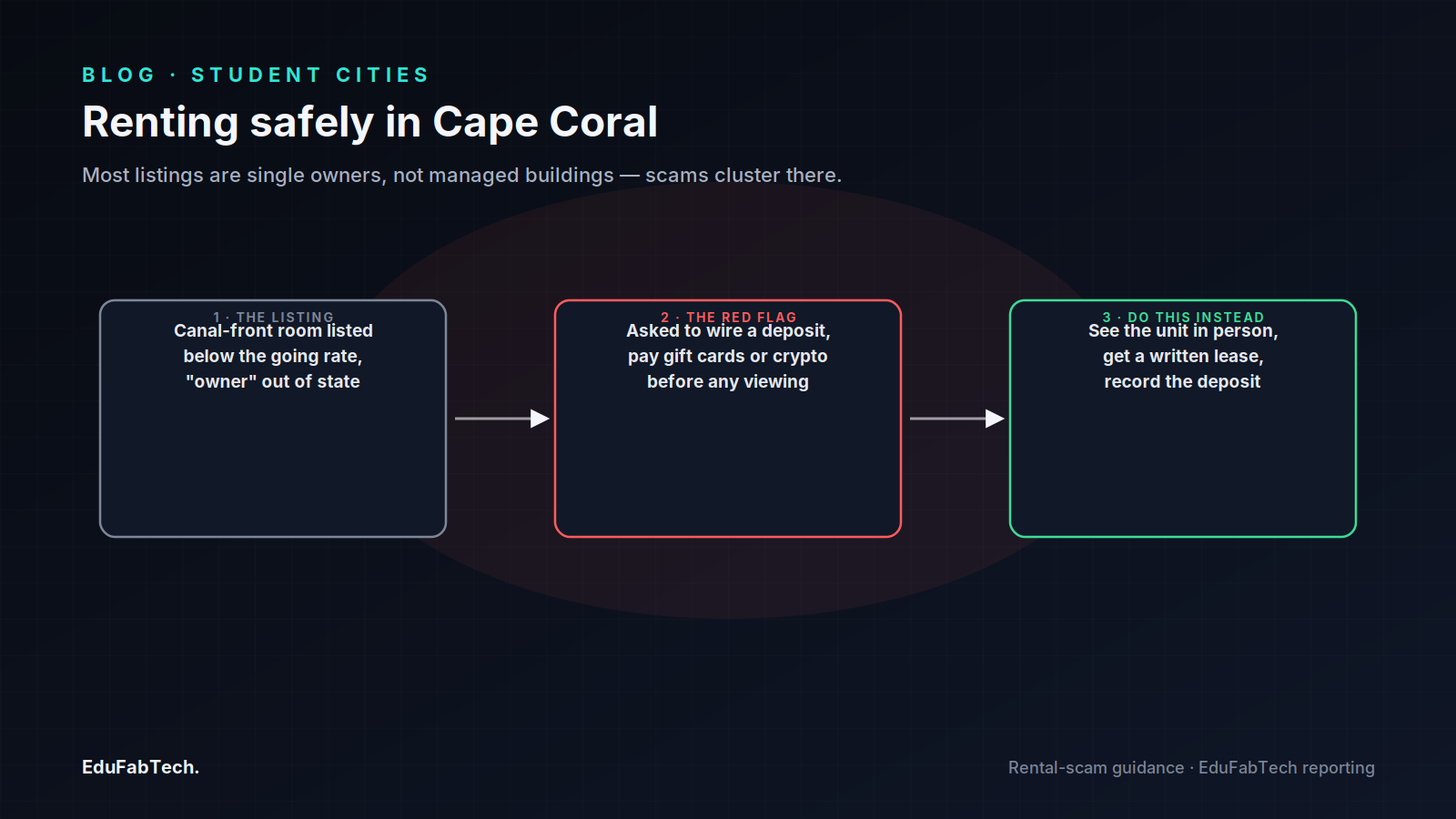
Because Cape Coral's rental stock is scattered houses rather than managed buildings, most listings you will see are posted by individual owners, and that is exactly where rental scams cluster. The pattern is familiar in waterfront Florida cities: an attractive canal-front house or room is advertised below the going rate, the "owner" is conveniently out of state or travelling, and you are asked to send a deposit to hold it before you can view it. Do not. A legitimate Cape Coral landlord will let you see the actual unit — or have someone show it — before any money changes hands.
Treat any request to wire a deposit, buy gift cards, or pay in cryptocurrency to "reserve" a room as a scam, full stop; no normal local tenancy works that way. See the place in person, confirm the person collecting rent is tied to the property, get a written lease, and keep a record of what the deposit covers and how it is returned. If you are arriving from abroad and cannot view in person, ask a current student or someone you trust to visit for you, and lean on EduFabTech's own rooms listings for Cape Coral and the broader city page rather than paying a stranger sight-unseen.
Furnishing a room: Goodwill, a ReStore and the Saturday market
Furnishing cheaply is one thing Cape Coral does well, partly because it is a city of homeowners constantly turning over furniture. Goodwill of Southwest Florida operates several thrift stores inside the city, including its North Cape Coral store at 2040 NE Pine Island Road, plus further Goodwill stores on Chiquita Boulevard and in the south of the city — good first stops for a desk, a lamp or kitchenware. For larger items, the nearest Habitat for Humanity ReStore sits just over the Caloosahatchee in North Fort Myers and sells donated furniture and household goods with the proceeds going to local home-building.
For food and the weekend rhythm of the city, the Cape Coral Farmers' Market runs on Saturday mornings. The Chamber of Commerce of Cape Coral lists it in Club Square, around the intersection of SE 47th Terrace and SE 10th Place downtown, from 8:00 AM to 1:00 PM, and describes it as a Saturday-morning fixture that has run for 37 years with more than 125 vendors. For the cheapest route of all, check EduFabTech's second-hand, furniture and free-stuff pages, where other students pass things on when they move out.
Working while you study
If you are an international student, work rules are set by federal immigration policy, not by Cape Coral or by the university. For F-1 students, the U.S. Immigration and Customs Enforcement Student and Exchange Visitor Program states on its Students and Employment page that a student may work on campus up to 20 hours per week while school is in session, and full-time during periods when school is not in session or during the annual vacation. The same page explains that an F-1 student automatically has permission to work on campus but must still work with a Designated School Official (DSO) to confirm the job qualifies. Off-campus work, including training such as CPT and OPT, has separate conditions and approvals. None of this is legal advice — check your own status with your DSO and the official ICE guidance before you accept any job.
In practice, on-campus jobs at FGCU are the straightforward option for students on a visa. Local part-time work in Cape Coral itself leans heavily toward retail, food service and the seasonal hospitality that picks up in winter; because the city is so spread out, a job's distance from where you live and from your classes matters as much as the pay. EduFabTech keeps a jobs and part-time work page for Cape Coral if you want to see what is going locally.
Libraries and quiet desks
The public library is the most reliable free study space in the city. The Cape Coral-Lee County Public Library, part of the Lee County Library System, is at 921 SW 39th Terrace; its branch page lists hours of 9:00 a.m. to 8:00 p.m. Monday to Wednesday, 9:00 a.m. to 6:00 p.m. Thursday, and 9:00 a.m. to 5:00 p.m. Friday and Saturday, closed Sunday. That is a genuinely useful set of evening hours for anyone revising after work. FGCU students also have the university's own library on campus, which is the better bet for research databases and longer stretches. Beyond those, the city's cafés and the study areas students share change often, so it is worth checking EduFabTech's study-spaces listings for desks and quiet corners that are current.
Getting around: LeeTran, the TropiCard and the bridge question
Public transport in the area is run by LeeTran, Lee County's bus operator, which runs fixed routes across Cape Coral and Fort Myers. LeeTran sells reduced-fare passes to full-time students who carry its TropiCard fare card, which you obtain by bringing proof of enrolment and one photo ID to the Rosa Parks Transportation Center in Fort Myers; current fares and student pass prices are on LeeTran's fares and discounts page. Be honest with yourself, though: Cape Coral is a low-density grid, bus frequencies are limited, and reaching FGCU from most of the city means a trip into Fort Myers and a transfer. Most students here rely on a car.
That is where geography becomes a cost. Cape Coral is nearly surrounded by water, and leaving it toward Fort Myers and the university means crossing the Caloosahatchee on one of the bridges — the Cape Coral Bridge in the south and the Midpoint Memorial Bridge in the centre — so your commute is shaped by which quadrant you live in and how traffic sits at the crossings during the day. If you plan to commute daily to FGCU, pick housing on the river side of the city rather than the far north-west.
What it costs, and what to weigh
The clearest dated housing figures come from FGCU's own residence rates. On its South Village page, FGCU lists per-person, per-semester rates for Fall 2026/Spring 2027: a two-bedroom single room in Biscayne, Everglades or Palmetto Hall at US$3,681, and a one-bedroom private room in those halls at US$3,934, among other options. That is per semester, not per month, and does not include a meal plan — useful as a benchmark when you compare it against a shared room in a Cape Coral house. For context on the wider local economy, remember the median household income of US$85,584 from the Census Bureau's 2024 estimate: this is not a cheap-housing town by national standards, and a city built for homeowners does not always have budget rooms sitting empty.
The honest balance for a student looks like this. In Cape Coral's favour: it is spacious, safe-feeling, warm year-round, and furnishing a room is cheap thanks to constant turnover and three Goodwill stores in town. Against it: there is no university or real student quarter inside the city, so campus life happens across the river; the place is built for cars, not for people without one; the daily commute to FGCU crosses a river on a limited number of bridges; and summer brings heat, humidity and the Atlantic hurricane season, when Southwest Florida takes storms seriously. If you want a walkable college-town atmosphere, this is not that. If you want affordable space and quiet and do not mind driving, it works.
A checklist for your first weeks
- Sort transport first. Decide early whether you can manage without a car; if you can't, factor the bridge commute to FGCU into where you rent. If you can, get a LeeTran TropiCard and learn your nearest route.
- View before you pay. See any Cape Coral room in person (or have someone you trust see it), get a written lease, and never wire a deposit or pay by gift card or crypto to "hold" a place.
- Confirm your work status. If you are on an F-1 visa, talk to your DSO at FGCU before taking any job, and read the ICE employment rules yourself.
- Set up your study base. Get a Lee County Library card and note the Cape Coral branch's evening hours; add the campus library if you are at FGCU.
- Furnish cheaply. Start with Goodwill, the Saturday market at Club Square and the EduFabTech second-hand listings before buying anything new.
- Know the season. Learn your evacuation zone and have a plan before hurricane season peaks; it is a normal part of the local calendar here.
For everything that changes week to week — rooms, jobs, furniture and local events — the city hub at EduFabTech's Cape Coral page and the listings near Florida Gulf Coast University are the places to keep checking.
A quick question for readers
Do you work part-time while you study?
Many students work to pay the bills. See how common it is — and how many hours people really do.
Pick an answer, create a free account in a minute, and your vote counts. Already a member? Sign in
Comments 3
Comment-
The number worth pausing on is the FGCU housing rate: $3,681 to $3,934 per semester, and the piece is careful to flag that's semester not mo…
-
The only hard housing number in this whole piece is FGCU's own dorm rate, $3,681 to $3,934 per semester, and that's precisely the option mos…
-
The bridge detail is the real cost here, not the rent. Housing on the north-west side might look cheap until you realise every single day yo…
Join free to read the full comments and reply Comments are between members; an account takes a minute.
Source: Florida Gulf Coast University
Sources (5)
- Florida Gulf Coast University. About FGCU. Florida Gulf Coast University, 2026. fgcu.edu ↗ · checked 31 Oct 2026
- Florida Gulf Coast University. South Village Housing Rates (Fall 2026/Spring 2027). Florida Gulf Coast University, 2026. fgcu.edu ↗ · checked 31 Oct 2026
- U.S. Census Bureau. Cape Coral, FL — American Community Survey 2024 1-year profile (via Census Reporter). Census Reporter, 2026. censusreporter.org ↗ · checked 31 Oct 2026
- U.S. Immigration and Customs Enforcement. Students and Employment. Student and Exchange Visitor Program, 2026. ice.gov ↗ · checked 31 Oct 2026
- Lee County Library System. Cape Coral-Lee County Public Library branch. Lee County Library System, 2026. leelibrary.librarymarket.com ↗ · checked 31 Oct 2026