Studying in Cardiff: universities, housing and student life
A practical, sourced guide to the three universities in Wales's capital, the terraced streets students rent in, part-time work rules, markets, transport and what it honestly costs.
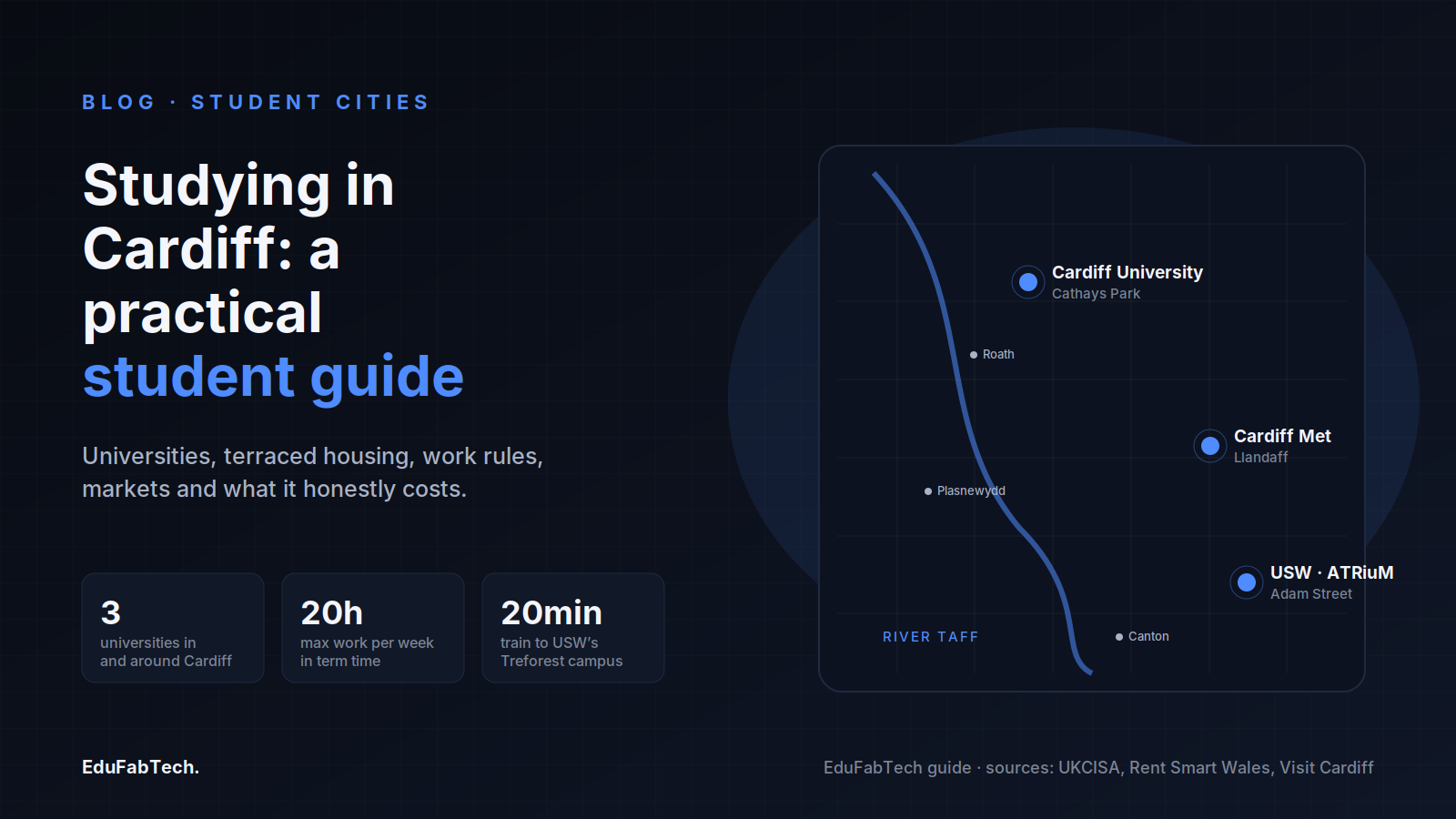
Cardiff — Caerdydd in Welsh — is the capital of Wales and one of the most walkable cities in the United Kingdom to study in. The civic centre, the main university buildings, the shopping arcades and the River Taff all sit within a square mile or so of flat ground, and the terraced streets where most students rent begin a few minutes north of the campus gates. You can live here without ever needing a car, and many students do.
Three universities grant degrees in and around the city, and they are different enough that the student experience depends a great deal on which one you join and which side of the River Taff you end up on. What follows is a practical guide: the institutions by name, the neighbourhoods people actually live in, how to rent without being cheated, where to furnish a room cheaply, the part-time work rules, study spaces, transport, and an honest look at what the city costs.
The universities, named
Cardiff University is the largest of the three and the only Welsh member of the Russell Group of research-intensive universities. Its main campus is in Cathays Park, the Edwardian civic centre just north of the city centre, where the original white Portland-stone buildings from its 1883 founding still house many of its schools. A second cluster sits at the Heath, around the University Hospital of Wales, where medicine, dentistry, nursing and healthcare subjects are taught. The two sites shape where students live: arts, law, engineering and science students gravitate to Cathays and Roath; healthcare students often head for the Heath.
Cardiff Metropolitan University — known as Cardiff Met, and before 2011 as the University of Wales Institute, Cardiff (UWIC) — teaches across two campuses north-west of the centre. Llandaff, on Western Avenue, is home to its schools of art and design, management, technologies, and sport and health sciences; Cyncoed, further out, houses education and social policy alongside sport. It is a more vocational, smaller-feeling institution than Cardiff University, strong in art and design, sport and teacher training.
University of South Wales (USW) is based at Treforest in Pontypridd, about a 20-minute train ride north of Cardiff, with a further campus in Newport. For students who want to be in the capital itself, USW runs a city-centre Cardiff campus — the ATRiuM, on Adam Street near Queen Street station — which houses its creative industries courses: film, animation, music, games and media. If your course is at the ATRiuM you will live a Cardiff student life; if it is at Treforest you are really a Pontypridd commuter.
Where students settle
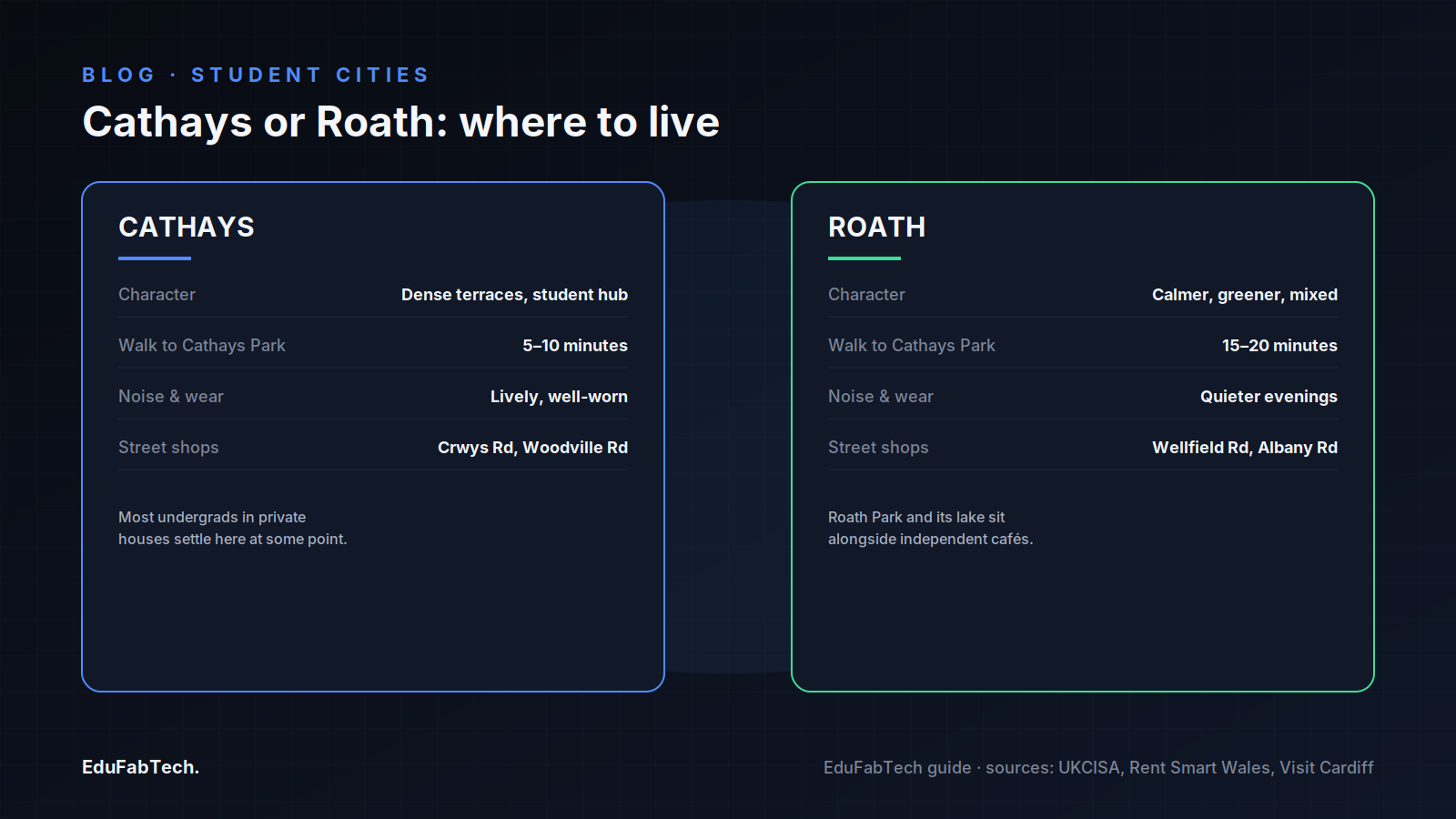
Cathays is the student heartland — a dense grid of Victorian terraces pressed right up against Cardiff University's Cathays Park buildings, with Cathays railway station, cheap takeaways and corner shops along Crwys Road and Woodville Road. Most undergraduates in private houses end up here at some point; it is convenient and lively, and correspondingly noisy and well-worn.
Roath, just east, is the other classic choice: still mostly terraced and student-heavy, but calmer, greener and more mixed, with Roath Park and its lake, the independent cafés of Wellfield Road, and Albany Road for groceries. It suits people who want to walk to Cathays Park in 15–20 minutes but come home to somewhere quieter.
Plasnewydd, the area around City Road and Mackintosh Place between Cathays and Roath, is a leafier, more diverse pocket popular with postgraduates and later-year students who want independent food and a bit of distance from first-year nightlife while staying within walking range of campus.
The Heath and Birchgrove, north of the centre, draw medical, dental and nursing students who want to be near the University Hospital of Wales and Cardiff University's Heath Park site; they are more residential and family-oriented, a little further from the bars but close to parkland and the Heath railway halt.
Llandaff and Llandaff North, in the north-west, are where many Cardiff Met students look, because they sit close to the Llandaff campus and Plas Gwyn halls; the cathedral village feel is pleasant and prices there can run higher than in Cathays. Canton and Pontcanna, west of the Taff along Cowbridge Road East, are more grown-up and sought-after — good for sharers who want cafés and the vast green of Bute Park nearby, usually at a small premium over Cathays.
Finding a room without losing your deposit
First-year students at Cardiff University and Cardiff Met almost always start in university-managed halls; you apply through each university's accommodation service after you accept an offer, and the deadlines fall in the summer before you arrive. From second year onwards most people move into a shared house in Cathays or Roath, and the hunt for those houses starts early — often in the November-to-February window of the preceding academic year, which is earlier than newcomers expect.
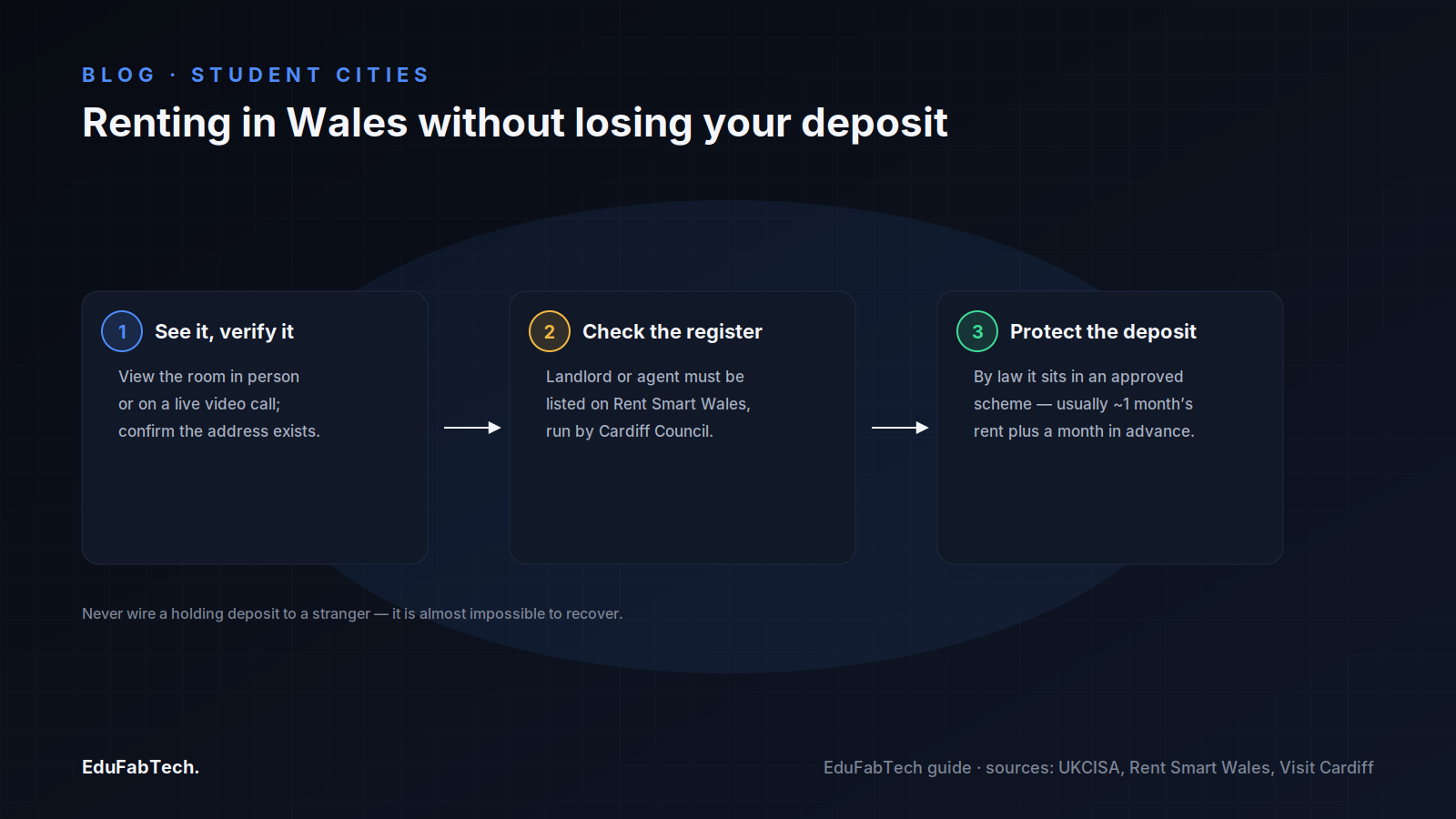
Whatever you rent, a few checks matter in Cardiff specifically. Houses in multiple occupation — most shared student terraces here — require a licence from Cardiff Council, and all private landlords and agents in Wales must be registered and licensed with Rent Smart Wales, the national scheme run by Cardiff Council on behalf of the Welsh Government; you can check a landlord or agent on its public register before you sign anything. By law in Wales your deposit must be protected in a government-approved tenancy deposit scheme, and most student lets ask for roughly a month's rent as a deposit plus a month in advance.
Rental scams in Cardiff usually surface in the same places as everywhere students cluster: listings on social-media housing groups and marketplace sites promising a cheap room in Cathays or Roath, a landlord who is conveniently "abroad", and a request to transfer a holding deposit before you have seen the property. See the actual room in person or on a live video call, meet whoever holds the keys, and confirm the address exists. Never send money by bank transfer, gift card or cryptocurrency to "hold" a room — a legitimate Cardiff landlord or a Rent Smart Wales-registered agent will not demand that, and a transfer to a stranger is almost impossible to recover.
Furnishing a room cheaply, and the city's markets
A second-year move into an unfurnished or half-furnished house means hunting for cheap furniture and kitchen kit fast. Cardiff's best-known indoor market is Cardiff Market (Cardiff Central Market), the Victorian covered hall in the Castle Quarter of the city centre; according to Visit Cardiff it has traded in the city since the 1700s, opens Monday to Saturday from 08:00 to 17:00 and sells everything from fresh produce to vintage clothing and second-hand records. It is better for cheap homeware, records and food than for furniture, but it is the obvious first stop and a genuine piece of the city's character.
For second-hand furniture and household goods, charity shops cluster along Albany Road and Wellfield Road in Roath, Cowbridge Road East in Canton, and Crwys Road in Cathays, and the city has long-running antiques and vintage markets near Cardiff Central station. Students also pass furniture on directly at the end of each academic year, when Cathays and Roath streets fill with give-aways in June and July. EduFabTech keeps local listings for exactly this: browse second-hand things in Cardiff and second-hand furniture before you buy anything new.
Working part-time while you study
If you are an international student, how much you can work is set by your immigration permission, not by your employer or university, and the authority is UK Visas and Immigration (part of the Home Office). The official starting point is the GOV.UK Student visa work page, which explains that whether and how much you can work depends on your course and whether it is term time. For most people on a full-time degree-level course, the independent advice body UKCISA states that the Student visa allows work of up to 20 hours a week during term time and full time outside term time (in vacations, on placements, before the course starts and after it ends), with the 20 hours counted Monday to Sunday and not averaged. Your visa sticker or eVisa states your own condition, and some jobs — such as working as a professional sportsperson — are not permitted; check your own status against the official pages before you take a job, and treat this paragraph as orientation rather than legal advice.
Cardiff's student job market runs on the city centre's shops, cafés, bars and the hospitality around the stadium and the Bay, plus campus jobs through each students' union and the universities themselves. Current openings and casual work are listed on EduFabTech's Cardiff jobs page.
Libraries and places to study
Cardiff University runs a network of subject libraries, the largest being the Arts and Social Studies Library on Colum Drive at the edge of Cathays Park, which opens around the clock to students with a valid university ID card; the Health Library at the Heath serves medical and healthcare students. Cardiff Met's learning centres at Llandaff and Cyncoed also offer extended and overnight access for its students during busy periods.
You do not have to be enrolled to use the city's public libraries. Cardiff Council's Central Library Hub, in the Hayes in the middle of town, combines a large public library with free study space and council advice services, and there are branch libraries and community hubs across the neighbourhoods. Independent cafés in Roath, Plasnewydd and Pontcanna are the informal overflow when the exam-season libraries fill up. For a current list of desks and bookable rooms, see EduFabTech's Cardiff study spaces.
Getting around, and what it costs
Most student journeys in Cardiff are on foot or by bike, because the campuses, the centre and the terraced neighbourhoods are so close together. For everything else the main bus operator is Cardiff Bus (Bws Caerdydd), which sells single, day, week and longer tickets through its app and its "iff" smartcard; local trains are run by Transport for Wales on the Valley Lines network, with handy student stations at Cathays, Queen Street, Heath and — for USW's Treforest campus — a direct line up the valley.
The strongest saving is national rather than city-specific. Under the Welsh Government's trial scheme described by Transport for Wales, people aged 5 to 21 travelling by bus in Wales pay £1 for a single journey or £3 for a day ticket, with 16-to-21-year-olds needing a mytravelpass to qualify; Cardiff Bus is one of the participating operators. Older students who miss that age band pay standard adult fares, so for them a bike or a season ticket usually works out cheaper than daily buses.
On housing costs, the clearest recent figure comes from the Office for National Statistics, which put the average monthly private rent in Cardiff at £1,179 in September 2026, up 3.2% from £1,143 a year earlier. That is a whole-property, whole-city average rather than a student rate; sharers in a Cathays or Roath terrace typically pay well below it per person, but it shows the direction of travel. For a sourced dormitory price, Cardiff Metropolitan University lists its Plas Gwyn halls in Llandaff (CF5 2XJ) at between £156 and £175 per week on 42-week self-catered contracts with bills included. Cardiff University runs its own residences, such as the large Talybont complex north of Cathays — check its accommodation pages for the current year's weekly rates. Rooms across the city are collected on EduFabTech's Cardiff rooms page.
The honest balance — and a first-weeks checklist
What is good about Cardiff for students is real: it is compact and mostly flat, so you walk or cycle most places; and it is a genuine capital with a national museum, a stadium at the centre of town, Bute Park, and a coastline and the Brecon Beacons within easy reach. The downsides are honest too. Cathays and Roath are crowded, and the best shared houses go early, so a late start can leave you with a long commute or a poor house. It rains a lot — Cardiff is one of the wetter UK cities — and the city empties and quietens noticeably outside term and on international-rugby weekends, when the centre is given over to crowds. Rents are rising, and the city-wide average now sits close to four figures a month.
A short checklist for the first weeks:
- Register with a local GP surgery near your address, and bring any repeat prescriptions.
- Open or confirm a UK bank account and set up your rent and bills; confirm your deposit is in a Welsh government-approved scheme.
- If you are on a Student visa, set up your UKVI account to access your eVisa, and read your exact work condition on the official GOV.UK pages before taking a job.
- Get a mytravelpass if you are 16–21, and download the Cardiff Bus and Transport for Wales apps.
- Activate your university library and ID access, and find your nearest 24-hour study space before exam season.
- Check your prospective landlord or agent on the Rent Smart Wales register, and never pay a holding deposit by bank transfer, gift card or cryptocurrency to someone you have not met.
For listings across the city — rooms, jobs, second-hand goods, study spaces and events — start at EduFabTech's Cardiff page.
A quick question for readers
Do you work part-time while you study?
Many students work to pay the bills. See how common it is — and how many hours people really do.
Pick an answer, create a free account in a minute, and your vote counts. Already a member? Sign in
Comments 3
Comment-
The checklist buries the one number that should lead: average private rent in Cardiff hit £1,179 a month in September 2026, up 3.2% in a yea…
-
The ONS number is the one that'll actually land for a reader skimming this: £1,179 average monthly rent, up 3.2% year on year. Fine as far a…
-
The part-time work section is the one that needs underlining twice: 20 hours a week in term time, counted Monday to Sunday and not averaged.…
Join free to read the full comments and reply Comments are between members; an account takes a minute.
Source: Office for National Statistics
Sources (5)
- Office for National Statistics. Private rent and house prices, Cardiff. Office for National Statistics, 2026. ons.gov.uk ↗ · checked 7 Nov 2026
- Cardiff Metropolitan University. Plas Gwyn Campus accommodation. Cardiff Metropolitan University, 2026. cardiffmet.ac.uk ↗ · checked 7 Nov 2026
- Transport for Wales. Children and young persons' £1 bus fare. Transport for Wales, 2026. tfw.wales ↗ · checked 7 Nov 2026
- UKCISA. Student work. UK Council for International Student Affairs, 2026. ukcisa.org.uk ↗ · checked 7 Nov 2026
- Visit Cardiff. Cardiff Market. Visit Cardiff, 2026. visitcardiff.com ↗ · checked 7 Nov 2026