Studying in Carlisle: universities, housing and student life
A practical, honest guide to studying in Carlisle — the University of Cumbria's two campuses, where students live, how to rent safely, study spaces, buses, part-time work and the costs you can actually source.
Carlisle sits in the far north-west corner of England, closer to Glasgow than to Manchester and only a short drive from the Scottish border. It is the largest city in Cumbria, a cathedral and former Roman settlement built where the rivers Eden, Caldew and Petteril meet, with a castle, a pedestrianised centre and the Lake District fells beginning just to the south. For students that geography shapes almost everything: this is a compact, walkable northern city where a single institution — the University of Cumbria — dominates the student scene, and where living costs tend to sit below those of the big university cities further south.
That makes Carlisle an unusual place to study. There is no second large university competing for rooms, no sprawling student quarter, and term-time nightlife is modest rather than frantic. What you get instead is a cathedral city you can cross on foot in twenty minutes, rail links in every direction, and a university with real strengths in health, education and the creative arts. This guide walks through the universities, where students live, how to rent safely, furnishing a room cheaply, study spaces, transport, work rules and the honest trade-offs.
The University of Cumbria, across two Carlisle campuses
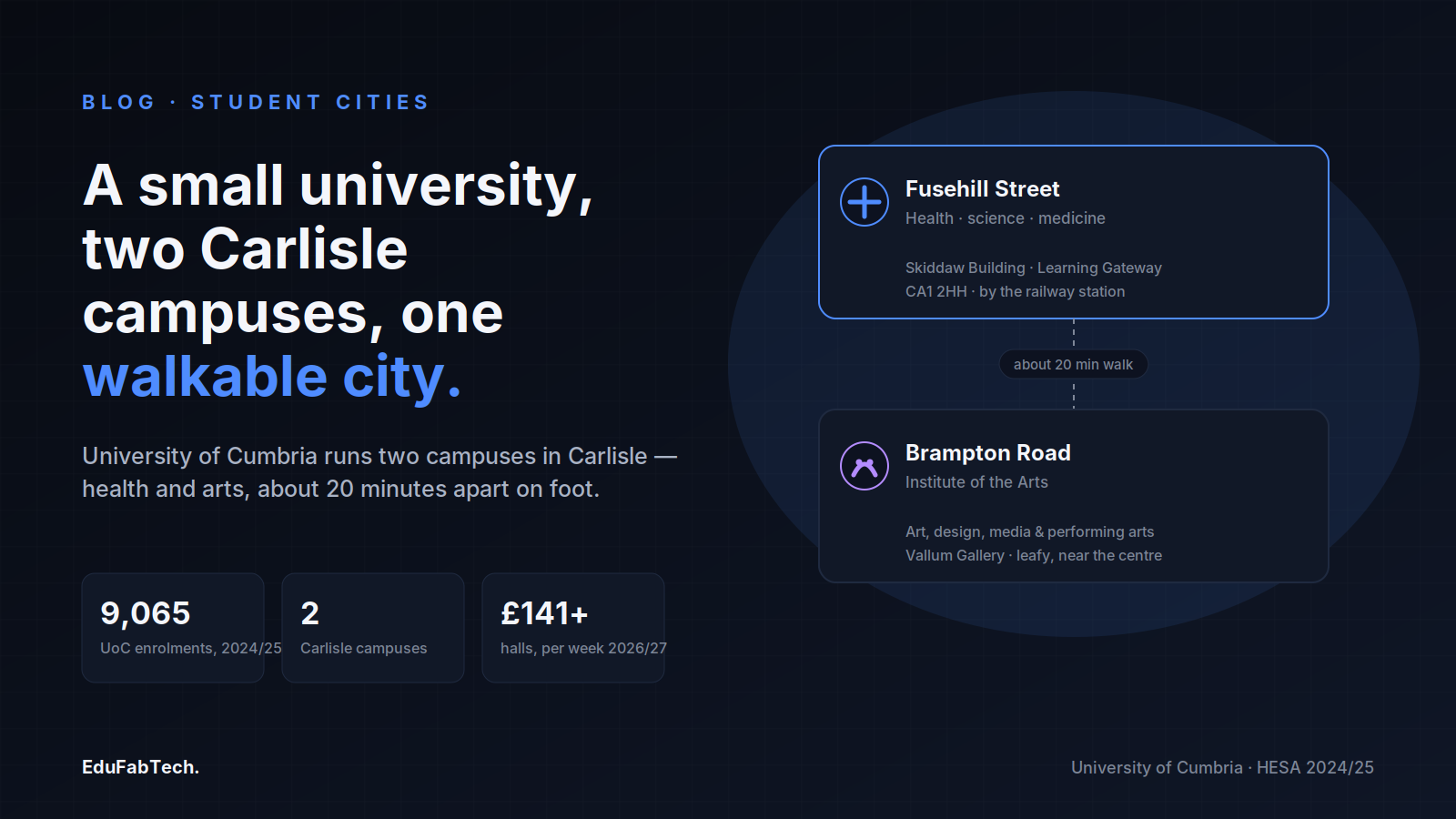
The University of Cumbria is England's newest university in this region: according to the university's own history page, it was formed in 2007 by the merger of St Martin's College, the Cumbria Institute of the Arts and the University of Central Lancashire's Cumbria sites, with the Privy Council confirming the change of name to University of Cumbria with effect from 1 August 2007. It is a multi-campus institution spread across Carlisle, Lancaster, Ambleside, Barrow-in-Furness, Workington and London. Across all of its sites, the Higher Education Statistics Agency (HESA) records 9,065 student enrolments for 2024/25 — a small university by UK standards, which is part of why Carlisle feels more like a working city with students in it than a classic student town.
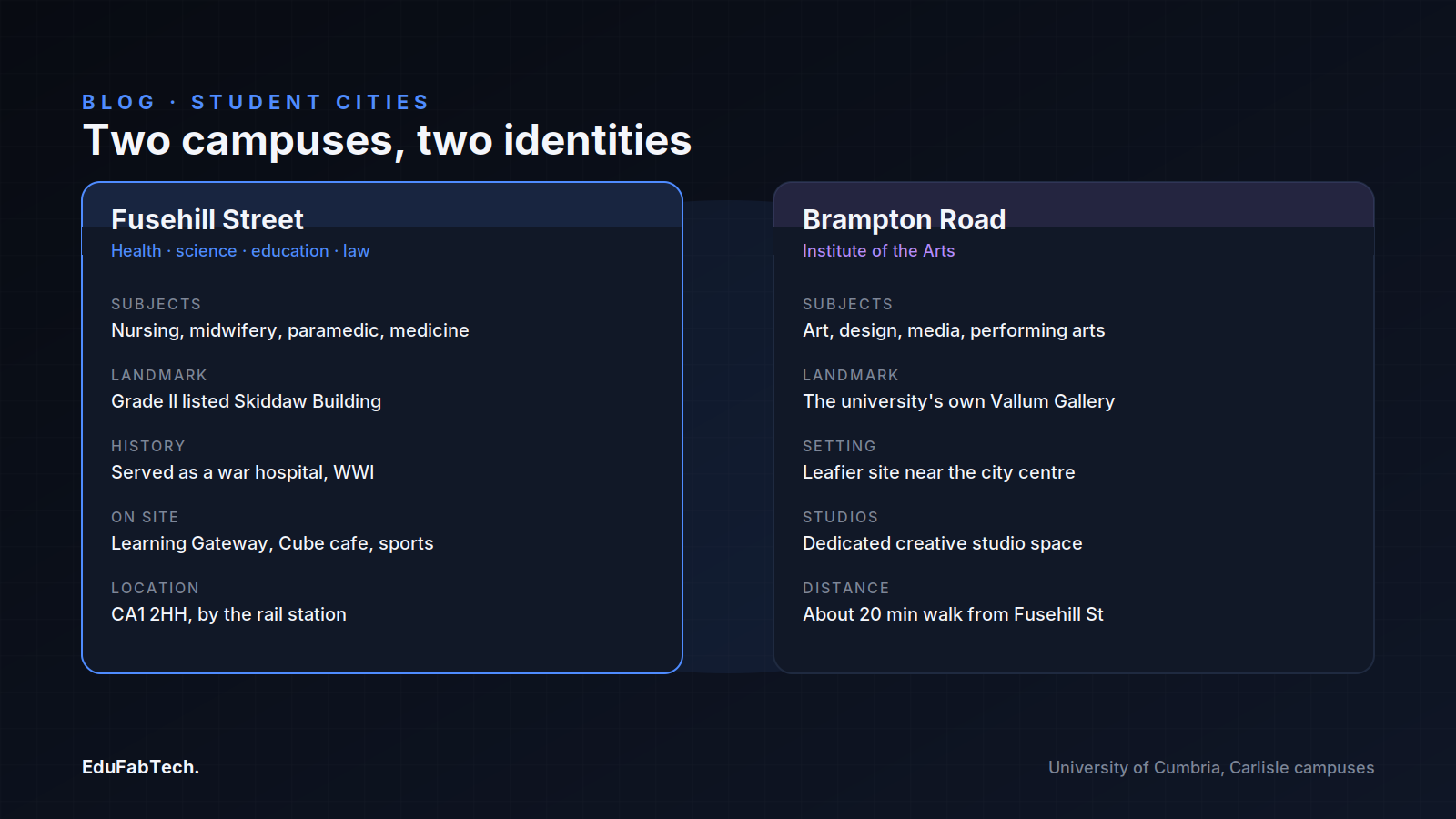
In Carlisle the university runs two campuses with distinct characters. The Fusehill Street campus, at CA1 2HH, is a short walk from the railway station and the city centre and concentrates on health, science, education, business, law and policing; the university states it is home to nursing, midwifery, paramedic and allied-health teaching, and it has recently become the base of the Pears Cumbria School of Medicine. Its central building is the Grade II listed Skiddaw Building, and the Fusehill Street site itself served as a war hospital during the First World War; the campus keeps that health-and-science identity today, with a three-floor Learning Gateway, the Cube café and a sports complex. The second site, the Brampton Road campus in a leafier setting near the centre, houses the Institute of the Arts and its creative studios, including the university's own Vallum Gallery; its subject areas run across art and design, media and performing arts. If you are weighing Carlisle against somewhere larger, it is worth being clear-eyed: the course menu is narrower than at a big civic university, and the strengths are concentrated rather than broad.
Where students sleep: halls first, then the neighbourhoods
The simplest and safest first-year option is university-managed accommodation, and the figures are published. On the university's Carlisle accommodation page, Carrock Hall — on the Fusehill Street campus itself — offers 85 en-suite bedrooms in flats shared between five and seven students, priced at £146 per week for 2026/27, with water, electricity, central heating and contents insurance included. A short distance away, the Denton Holme development lists 249 rooms across 25 townhouses at £141.46 per week for 2026/27, again with water, electricity and central heating included, and the university describes it as roughly a 20-minute walk from Fusehill Street. Those are dated, sourced housing figures you can plan around; they also set a useful benchmark for judging private rents.
Because the university is small, purpose-built private student blocks are far fewer here than in Leeds or Nottingham, and many students — especially after first year, and most mature and local students — rent ordinary shared houses. The neighbourhoods students gravitate to are the ones within walking distance of Fusehill Street and Brampton Road: Denton Holme and Caldewgate to the west of the centre, the terraced streets around Botchergate and Currock to the south, and Stanwix across the river Eden to the north. These are mixed residential areas, not a student bubble, so you will be living alongside families and long-term residents. For a sense of what is on the market, the university points students to its own StudentPad listings service, and you can browse rooms and shared houses in the city on EduFabTech's Carlisle rooms page and the wider Carlisle listings.
Renting privately in Carlisle without losing a deposit
Carlisle's private rental market is small, which cuts both ways: rents are gentler than in big cities, but good shared houses near the campuses get taken quickly around the start of the academic year, and scarcity is exactly what rental scams exploit. The classic fraud is the same everywhere — a too-good room, a landlord who is conveniently "abroad" or "working away", and pressure to pay a deposit immediately to "hold" it before you have seen inside. In a city this size, where you can physically walk to most streets, there is rarely a good reason to pay before viewing.
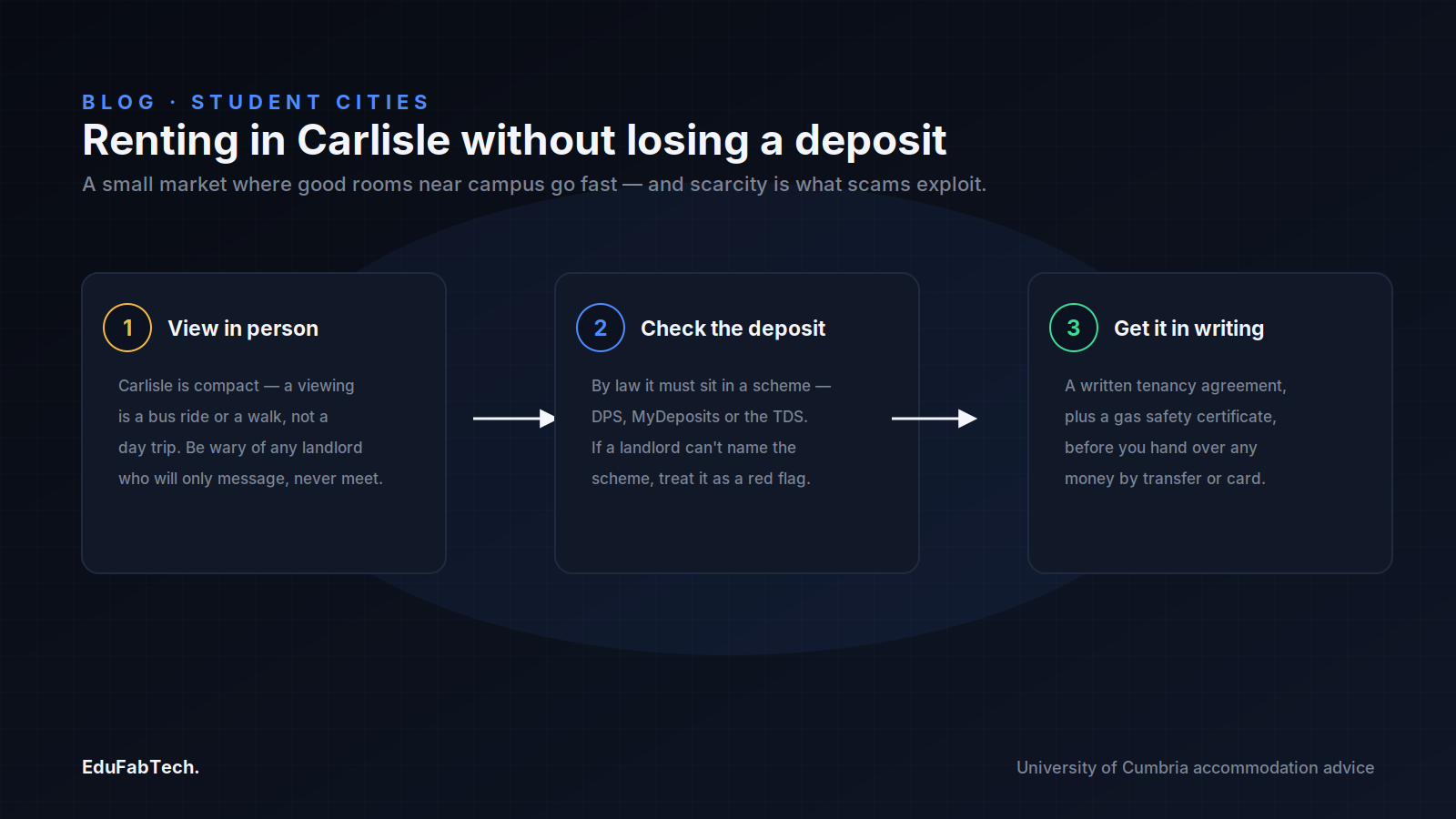
A few Carlisle-specific habits keep you safe. View the actual room in person — the city is compact enough that a viewing is a bus ride or a walk, not a day trip — and be wary of any "landlord" who will only communicate by message and refuses a viewing. Never send money by bank transfer, gift card or cryptocurrency to reserve a room you have not stood inside; those payments are effectively impossible to recover. For an assured shorthold tenancy in England, your deposit must by law be protected in a government-approved scheme (such as the Deposit Protection Service, MyDeposits or the Tenancy Deposit Scheme), and you should receive the scheme details in writing — if a landlord cannot name the scheme, treat that as a red flag. Get a written tenancy agreement and insist on a gas safety certificate before you hand over anything. The university's own accommodation team can sanity-check a private offer, and the EduFabTech Carlisle rooms listings are a starting point rather than a substitute for seeing the place.
Furnishing a room for very little
A room in a private Carlisle house often comes part-furnished or unfurnished, which is where the city's markets and charity shops earn their keep. At the heart of the centre is Carlisle Market Hall, which Cumberland Council describes as one of the few covered Victorian markets remaining in the country, open Monday to Saturday from 8am to 5pm; it reopened in late 2025 after a major refurbishment, and its traders run from fresh food to haberdashery, cards and cafés. Carlisle's pedestrianised core also has a dense run of charity shops along and around English Street and Botchergate, which are the practical place to pick up crockery, lamps, kettles and small furniture cheaply.
For bigger items — a desk, a chair, a set of drawers — buying second-hand from other students at the end of the year is usually cheapest of all, and things are often given away free simply to clear a house before a tenancy ends. EduFabTech keeps local pages for exactly this: second-hand things in Carlisle, second-hand furniture, and things being given away free. A sensible move is to arrive with the minimum, then furnish in the first fortnight once you know what your room actually lacks.
Libraries and places to study
Your main academic library is on campus. The Fusehill Street library occupies the top floor of the Skiddaw Building, with collections weighted towards health, education, social sciences and law, and both group and silent study areas; outside staffed hours it operates on swipe-card access, and group study rooms can be booked online. Opening hours shift through the year, so check the posted term-time schedule rather than assuming. Arts students at Brampton Road have their own studio and workshop space, and the Learning Gateway at Fusehill Street adds flexible study areas beyond the library itself.
Carlisle also gives you a strong public alternative. Carlisle Library reopened in August 2026 after a £3.3 million transformation funded through the UK Government's Carlisle Town Deal with additional investment from Cumberland Council; Cumberland Council says the refurbished building now offers modern study spaces with private desks and charging points, adult-learning classrooms and an upgraded home for the historic Jackson Collection archive. For a quiet desk off campus — useful during long vacations when campus hours drop — it is the obvious choice. More informal spots are listed on EduFabTech's Carlisle study-spaces page.
Getting around Carlisle and beyond
Carlisle's great advantage is that most student life is within walking distance. Both campuses sit near the centre, the main shops are pedestrianised, and you can cross the city on foot in well under half an hour. For longer hops the local bus operator is Stagecoach (Stagecoach Cumbria & North Lancashire), which runs the city and regional services; it offers young-person and student discounts on request with a valid student ID, though exact fares change through the year, so check current prices before you buy a pass. The most reliable number to plan around is the national cap: under the Department for Transport's £3 bus fare cap, most single bus fares in England are capped at £3 until the end of 2026, and the government has announced the cap will fall to £2 from 1 January 2027.
Where Carlisle punches above its weight is the railway. Carlisle station is a junction on the West Coast Main Line with direct trains north to Glasgow and south towards Preston, Manchester and London, plus the scenic Settle–Carlisle line to Leeds and the Tyne Valley line east to Newcastle. For a student, that means weekend travel across northern England and into Scotland is genuinely easy, and a 16–25 Railcard is worth having. Day trips to the Lake District and to Hadrian's Wall start from the same station. Events and what's on locally are collected on EduFabTech's Carlisle events page.
Working while you study
A small city with a hospital, a university, retail and hospitality has steady demand for part-time staff, and term-time jobs in care, retail and cafés are the common routes for students here. If you are an international student, your right to work is set by the conditions printed on your visa, not by your employer or your university. The rules are published by the Home Office: on the official GOV.UK Student visa pages, whether and how much you can work depends on what you are studying and whether it is term-time or a vacation. In practice, degree-level students at a higher education provider are usually limited to up to 20 hours of paid work per week during term time, with full-time hours allowed in official vacations — but you must follow exactly what your own visa states, and this guide is not legal advice. Confirm your conditions on GOV.UK and with the university's international student advisers before taking a job. Local openings are listed on EduFabTech's Carlisle jobs page.
What is good, and what is hard
The good: Carlisle is affordable by UK standards, walkable, and free of the housing frenzy that grips larger student cities, and the published hall rents give you a firm number to budget against. The university has genuine strengths in nursing, teaching and the creative arts, class sizes are small, and you are minutes from the Lake District, Hadrian's Wall and the Scottish border, with excellent rail connections for a city this size. For students who want to study somewhere calm and get outdoors easily, that combination is hard to beat.
The hard: it is a small place. The student population is modest, so nightlife and the range of societies are smaller than in a big civic university, the course choice is narrower, and a single institution means fewer options if your subject is niche. Cumbria is one of the wetter, cooler parts of England, and winters are dark and damp. Evening and Sunday bus services are thin, so a car or a bike helps if you live out of the centre, and the private rental market is small enough that the best houses near campus go early. None of this is a dealbreaker — but it is the honest picture, and it rewards students who value quiet and the outdoors over big-city buzz.
A short checklist for your first weeks
- If you want a hall, apply early and use the university's accommodation page for current prices before committing to anything private.
- For private rooms, view in person, never pay a deposit by bank transfer, gift card or crypto to "hold" a place, and confirm your deposit is in a government-approved protection scheme with a written tenancy agreement.
- Register with a local GP and bring your enrolment details; the Fusehill Street campus is a short walk from the station if you arrive by rail.
- Furnish gradually from second-hand and free listings, the Market Hall and the city-centre charity shops rather than buying everything new.
- Sort your travel: a 16–25 Railcard for trips out of the city, and check current Stagecoach fares against the £3 (soon £2) national cap for local buses.
- International students: read your work conditions on GOV.UK and speak to the university's international advisers before taking any job.
A quick question for readers
Do you work part-time while you study?
Many students work to pay the bills. See how common it is — and how many hours people really do.
Pick an answer, create a free account in a minute, and your vote counts. Already a member? Sign in
Comments 3
Comment-
The one figure that needed a harder look is the £146/week Carrock Hall rent, because the article never says what it's being measured against…
-
The 9,065 HESA figure is doing more rhetorical work than it should. That's enrolments across the whole institution — Carlisle, Lancaster, Am…
-
The number I'd actually hold onto is the HESA figure: 9,065 enrolments across six sites, not just Carlisle. That's genuinely tiny, and it ex…
Join free to read the full comments and reply Comments are between members; an account takes a minute.
Source: University of Cumbria
Sources (5)
- University of Cumbria. Carlisle Fusehill Street Campus — accommodation. University of Cumbria, 2026. cumbria.ac.uk ↗ · checked 11 Nov 2026
- HESA. Table 3 — HE student enrolments by HE provider and age group 2014/15 to 2024/25. Higher Education Statistics Agency, 2025. hesa.ac.uk ↗ · checked 11 Nov 2026
- Cumberland Council. A New Chapter Begins: Hundreds Welcome Reopened Carlisle Library. Cumberland Council, 2026. cumberland.gov.uk ↗ · checked 11 Nov 2026
- Department for Transport. £3 national bus fare cap. GOV.UK, 2026. gov.uk ↗ · checked 11 Nov 2026
- University of Cumbria. Our History. University of Cumbria, 2026. cumbria.ac.uk ↗ · checked 11 Nov 2026