Studying in Champaign: universities, housing and student life
A practical, sourced guide to studying in Champaign, Illinois — the University of Illinois, where to live, how leases and deposits work, part-time work, libraries, the MTD buses and real costs.
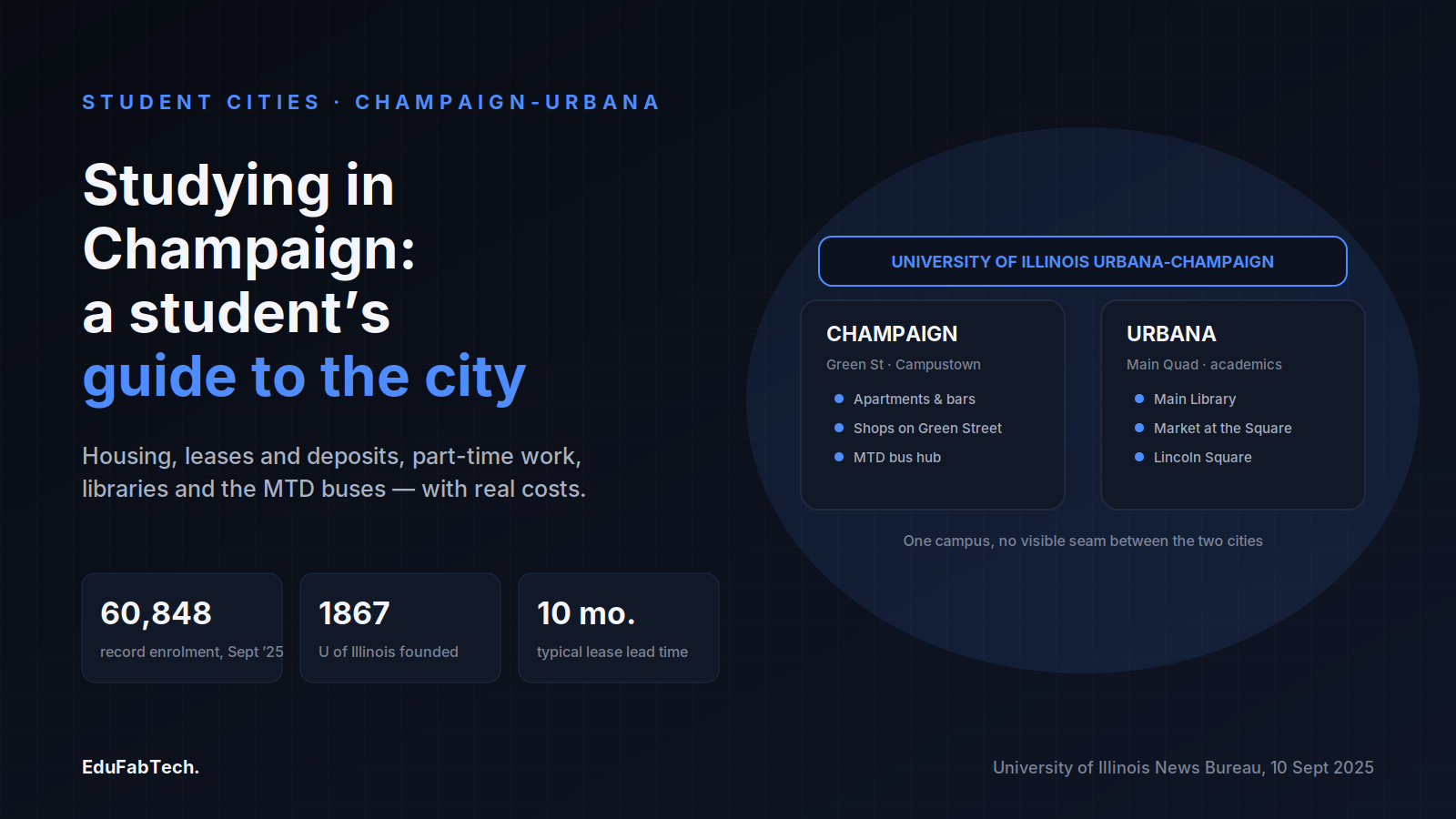
Champaign sits on flat prairie in east-central Illinois, a little over two hours south of Chicago by car, and it is almost impossible to talk about the city without its twin. Champaign and Urbana run into each other with no visible seam, and the University of Illinois campus straddles the line between them: the commercial student strip known as Campustown, along Green Street, is on the Champaign side, while the Main Quad and a large share of academic buildings are a few blocks east, across the city boundary, in Urbana. Most people simply say "Champaign-Urbana" or "C-U" and leave it at that.
What that means for a student is that the city is small, the ground is dead level, and nearly everything you need is within a bus ride or a bike ride of the Quad. The downside is the opposite of a big-city problem: Champaign is genuinely isolated, surrounded by corn and soybean fields, with winters that are long, grey and regularly below freezing and summers that are hot and humid. This guide is about living there as a student — local or from abroad — with every figure tied to a source you can open.
The university that anchors the two cities
The University of Illinois Urbana-Champaign is the reason the city has the shape it does. Founded in 1867, it is the flagship campus of the University of Illinois System and a public land-grant research university long associated with engineering, computing and agriculture. It is also very large: the University of Illinois News Bureau reported on 10 September 2025 that total enrolment reached 60,848 for the first time in the university's history, with an incoming freshman class of 9,207. A campus of that size inside a metropolitan area of roughly a quarter of a million people is what gives C-U its student-town feel — term time and the summer lull are visibly different places.
One part of that university students often encounter by name is the UIUC College of Education, a degree-granting college of the same institution rather than a separate school. It sits at 1310 S. Sixth St. in Champaign and, on its own site, lists undergraduate and graduate degrees, teacher-licensure routes, and principal and superintendent programmes; the college also states that it holds three top-10 graduate programmes in the 2026 U.S. News & World Report rankings. For most students the practical point is that "the university" is one institution spread across both cities; the campus itself is often described as the Campus of the University of Illinois Urbana-Champaign, centred on the Urbana side of the line.
Where students live, and why leases get signed in September
Housing in C-U comes in three broad kinds. First, University Housing residence halls — the undergraduate clusters students know as the Six Pack and Ikenberry Commons on the south side, and the Pennsylvania Avenue and Florida Avenue residences — which bundle a room with a dining plan. Second, Private Certified Housing: privately owned halls and houses that the university inspects and certifies. Off-Campus Community Living explains that these facilities are "independently owned and operated and certified by the University to house all students, including new freshman and transfers," and must offer dining and residence-life staff to keep that certification. Third, ordinary private apartments and houses, concentrated in Campustown and spreading north and west into Champaign's residential streets.
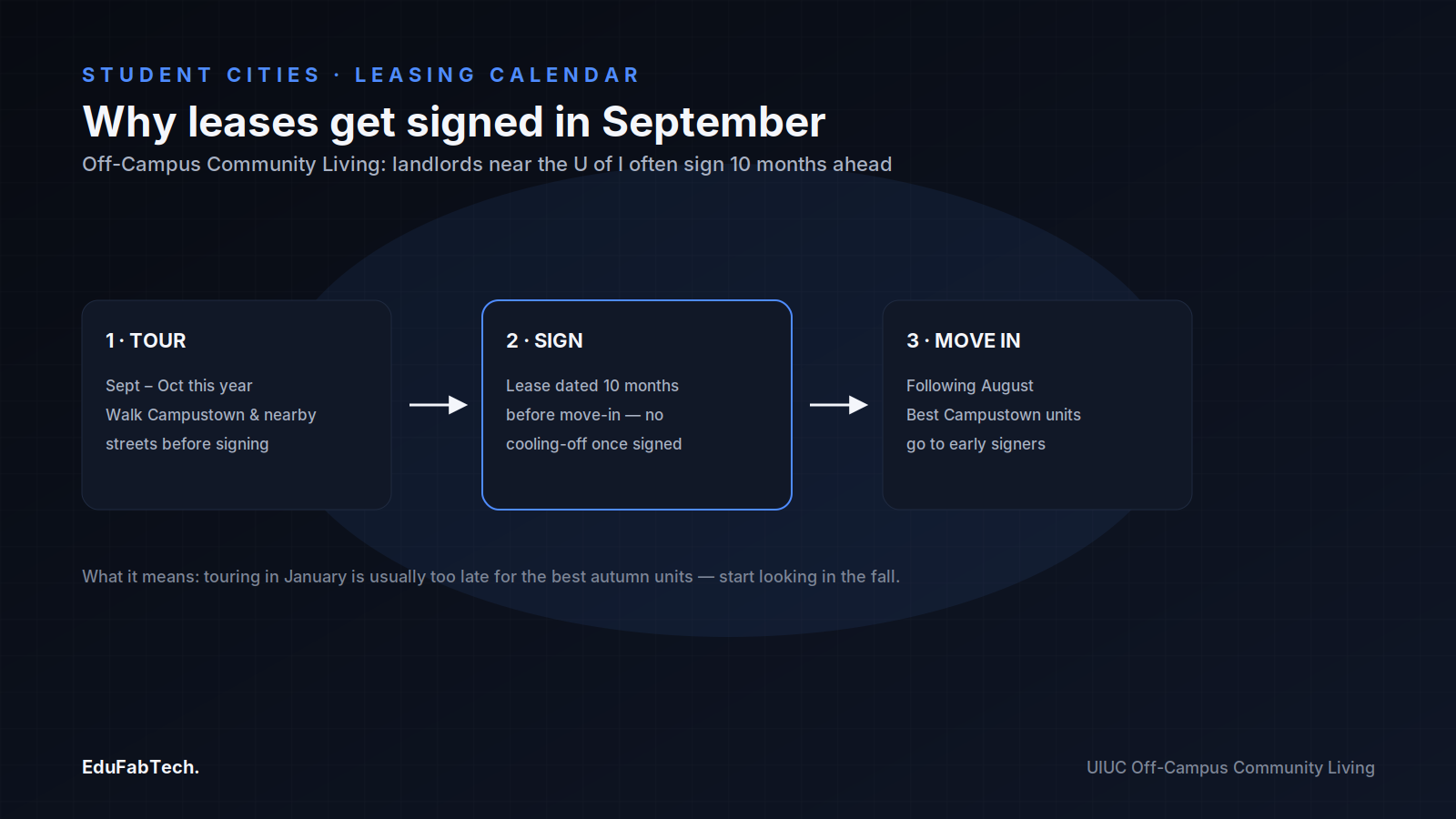
The single most important local fact is the leasing calendar. The university's Off-Campus Community Living office warns plainly that "in the area close to the University of Illinois, many landlords sign leases 10 months before they start." In practice, students touring apartments in September and October are signing for the following August. If you arrive in January expecting to find a good Campustown place for the autumn, the best units may already be gone. This is uncomfortable for anyone coming from abroad who has not yet set foot in the city — which is exactly why the next section matters.
Before committing to anything, decide how close to Green Street you actually need to be. Campustown apartments cost more and are noisier; a room a few blocks north in Champaign or east in Urbana is cheaper and still on a frequent bus route. EduFabTech keeps running local listings for rooms and places to stay in Champaign and for everything near the University of Illinois Urbana-Champaign, which is a reasonable place to compare neighbourhoods before you are on the ground.
Paying a deposit without being cheated
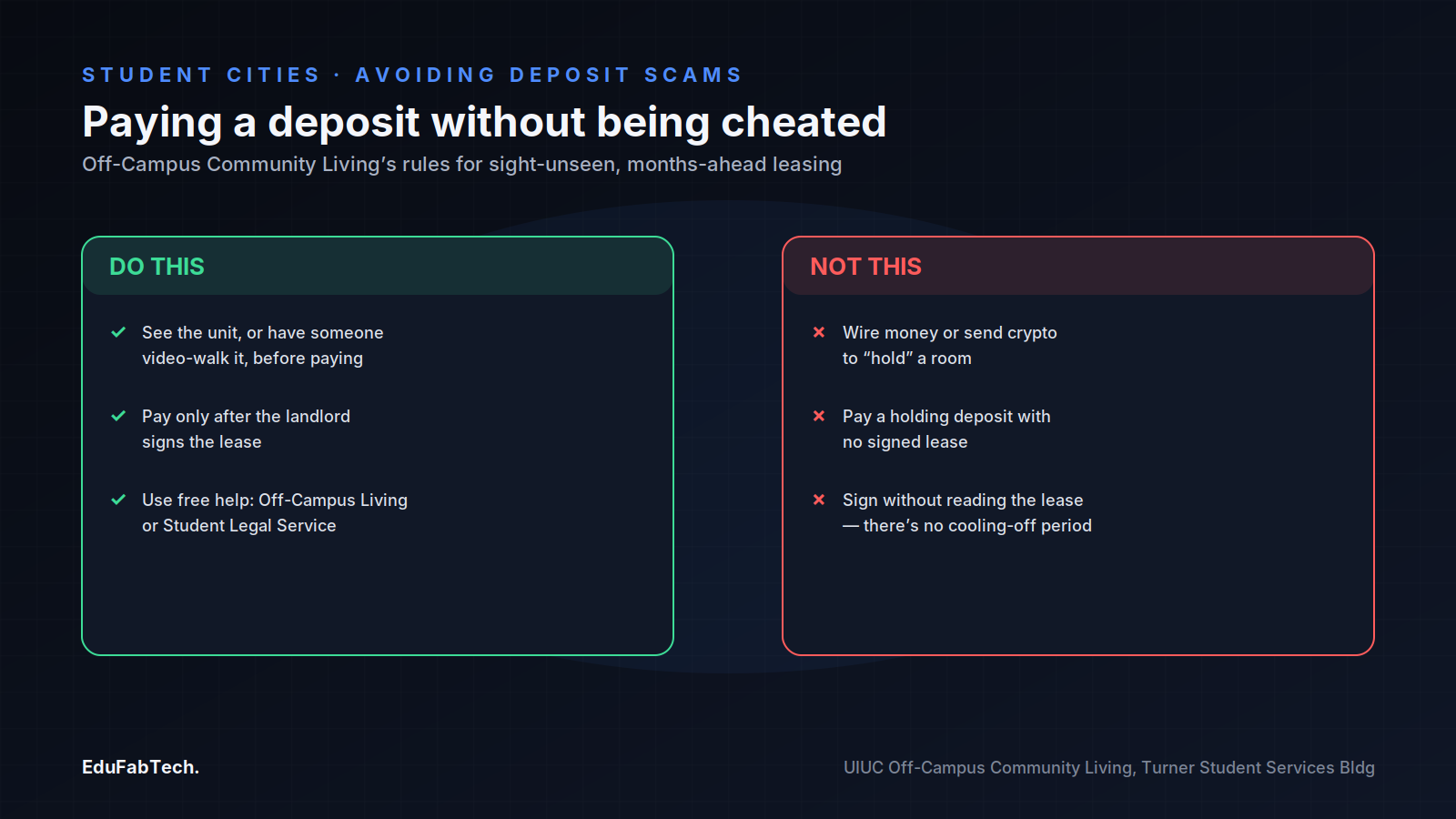
Because so much C-U leasing happens sight-unseen and months ahead, the classic trap here is pressure to send money to "hold" a place you have not seen or before anything is signed. Off-Campus Community Living's advice is explicit: "It is recommended that you do not provide any money until the landlord signs the lease," and it warns that a holding deposit means "you will lose your money if you change your mind" and that you have "nothing in writing to prove the exact apartment." Read the whole lease before signing — the same office notes there is no cooling-off period once your signature is on it.
Translate that into concrete rules for Champaign. Never wire money, buy gift cards, or send cryptocurrency to reserve a room; a legitimate landlord in C-U does not need payment by any of those methods to hold a unit. See the actual apartment, or have someone you trust see it, before money changes hands; if you are overseas, a current tenant or a friend on campus can video-walk it for you. And use the free help that already exists: Off-Campus Community Living (in the Turner Student Services Building at 610 E. John St., Champaign) reviews leases and explains deposits, and the university's Student Legal Service gives currently enrolled students free advice on landlord disputes. For non-student residents, the Champaign-Urbana Tenant Union offers similar support.
Furnishing a room for very little
A nine-month lease rewards buying second-hand and selling on before you leave. The anchor of the local calendar is Urbana's Market at the Square, a producer-only market running Saturday mornings in the Lincoln Square Mall parking lot from spring through late autumn, with a Champaign-Urbana Winter Farmers Market moving indoors for the cold months — good for food, less for furniture, but a genuine fixture of local life since 1979.
For the actual furnishing, two non-profits stand out. Salt & Light runs a community thrift store at 1512 W. Anthony Dr. in Champaign (with a second location in Urbana), selling donated clothing and household goods. The I.D.E.A. Store, a creative-reuse shop now at 125 Lincoln Square in Urbana, sells low-cost art and craft materials and odds-and-ends diverted from the bin. End-of-term move-out is its own resource: as leases turn over in late July and early August, usable furniture appears on kerbs and in giveaway groups across Campustown. EduFabTech's local pages collect second-hand things, second-hand furniture and items given away free in the city if you would rather not haul a mattress across town.
Working part-time, and the rules for international students
A large campus means a lot of on-campus jobs — dining halls, the library system, research labs, the student union — and these are the simplest to take. Pay and rules in the United States vary by job and by immigration status, so treat what follows as a pointer to the official source rather than advice. For students on an F-1 visa, the university's International Student and Scholar Services states that "you may work on-campus part-time (up to 20 hours per week) during the academic year, and full-time (over 20 hours per week) during official school vacation periods." The same office explains that off-campus work generally requires separate authorisation — Curricular Practical Training or Optional Practical Training — tied to your field of study.
If your status is anything other than a domestic student, check your own case with ISSS before accepting any paid work, including internships; getting the authorisation wrong can affect your status. Local and campus job openings also turn up on EduFabTech's Champaign jobs and part-time work page, but the legal question of whether you may take a given job is one only the immigration authorities and ISSS can answer.
Libraries and places to study
Few American campuses are as library-rich as this one. The University Library describes itself as the largest public university research library in the United States, and it is not one building but a network of subject libraries scattered across campus. For students, the practical landmarks are the Main Library and its adjoining Undergraduate Library space on the Urbana side, and the Grainger Engineering Library on the north engineering campus, which keeps long hours during term. The Illini Union and many departmental buildings add informal study space between classes.
Because the libraries are spread out, choose by where your day already takes you rather than by prestige: an engineering student loses an hour a day walking to a humanities reading room and back. In the first weeks it is worth sampling a few, then settling on one quiet spot and one caffeinated one. EduFabTech also lists study spaces and desks in Champaign beyond the campus buildings, which helps during exam crunches when the main rooms fill up.
Getting around: the MTD and beyond
Champaign-Urbana's buses are run by the Champaign-Urbana Mass Transit District (MTD), and for students this is one of the real advantages of the city. The University of Illinois i-card office confirms that "students and employees with i-cards have free access to all Champaign Urbana Mass Transit District routes and services" — you simply show your current i-card to the driver. The fare is built into student fees, which means that once you are enrolled, the whole network across both cities is effectively prepaid. Routes run dense through Campustown with high frequencies in term, plus after-dark service.
The city is also flat and compact enough that many students cycle year-round, weather permitting, and walk to class. For leaving town, the MTD hub at Illinois Terminal in downtown Champaign also serves Amtrak and intercity coaches, with trains north to Chicago; University of Illinois Willard Airport, south of the city, offers limited regional flights. None of this needs a car, which is part of why C-U works on a student budget.
What it costs, in numbers you can check
On-campus, University Housing publishes its rates openly. For the 2026-2027 academic year, its cost page lists a traditional air-conditioned double room with the Room & 12 Classic Meals plus 15 Dining Dollars plan at $14,558 for both semesters, a single at $16,564, and a triple at $13,774; rates without air-conditioning run a few hundred dollars lower. Those figures bundle a meal plan, so they are not directly comparable to a bare room off campus.
For the private market, the U.S. Census Bureau's QuickFacts for Champaign city reports a median gross rent of $1,123 a month over 2020-2024 and a median household income of $56,118 in 2024 dollars for the same period, against a 2020 census population of 88,302. City-wide medians cover family homes as well as student flats, so a shared Campustown apartment split several ways typically lands below that figure per person — but it is the best dated, verifiable rent benchmark the city has. Budget on top of rent for a winter's worth of heating and warm clothing, which newcomers from milder climates routinely underestimate.
The honest trade-offs
What is good about Champaign for students is concrete: it is affordable by American university-town standards, flat and walkable, served by free buses that actually go where students live, and built around a library system and campus that would be the envy of much larger cities. The student population is large and international, so you are unlikely to be the only person far from home.
What is hard is equally concrete. The city is remote — the "two hours to Chicago" cuts both ways, and there is little beyond the campus bubble within easy reach. Winters are long and cold with regular snow, and the flat landscape offers no shelter from wind; the first January surprises people. The leasing market moves almost a year ahead, which punishes anyone who arrives late or undecided. And in August the whole rental market churns at once, so moving day is chaotic. None of this is a reason to stay away — but it is better known before you sign.
A checklist for the first weeks
- Collect your i-card early — it is your free MTD bus pass as well as your ID, per the i-card office.
- If you will live off campus next year, start looking in autumn, because Off-Campus Community Living notes leases here are often signed ten months ahead.
- Never pay to "hold" a room by wire, gift card or crypto, and see the place before any money moves; have OCCL or Student Legal Service review the lease first.
- International students: confirm what work you may do with ISSS before accepting any job.
- Furnish second-hand at Salt & Light or the I.D.E.A. Store, and watch the late-July move-out giveaways.
- Pick one library to call home, and dress for a real winter from the start.
For a running view of rooms, jobs, second-hand goods and events in Champaign, EduFabTech's city page gathers the local listings in one place.
A quick question for readers
Do you work part-time while you study?
Many students work to pay the bills. See how common it is — and how many hours people really do.
Pick an answer, create a free account in a minute, and your vote counts. Already a member? Sign in
Comments 0
CommentNo comments yet. Members start the conversation.
Source: University of Illinois Urbana-Champaign
Sources (5)
- University of Illinois News Bureau (Thomas Bruch). Illinois sets another freshman record as enrollment tops 60,000. University of Illinois Urbana-Champaign, 2025. news.illinois.edu ↗ · checked 9 Oct 2026
- University Housing, University of Illinois. 2026-2027 Undergraduate Residence Hall Rates. University of Illinois Urbana-Champaign, 2026. housing.illinois.edu ↗ · checked 9 Oct 2026
- Off-Campus Community Living. Application & Lease. University of Illinois Urbana-Champaign, 2026. occl.illinois.edu ↗ · checked 9 Oct 2026
- International Student and Scholar Services. F-1 Employment. University of Illinois Urbana-Champaign, 2026. isss.illinois.edu ↗ · checked 9 Oct 2026
- U.S. Census Bureau. QuickFacts: Champaign city, Illinois. U.S. Census Bureau, 2024. census.gov ↗ · checked 9 Oct 2026