Studying in Charlottesville: universities, housing and student life
A practical, sourced guide to the University of Virginia, finding a room in a tight market, free buses, study spaces and what a year in Charlottesville actually costs.
A university Jefferson laid out on a hillside
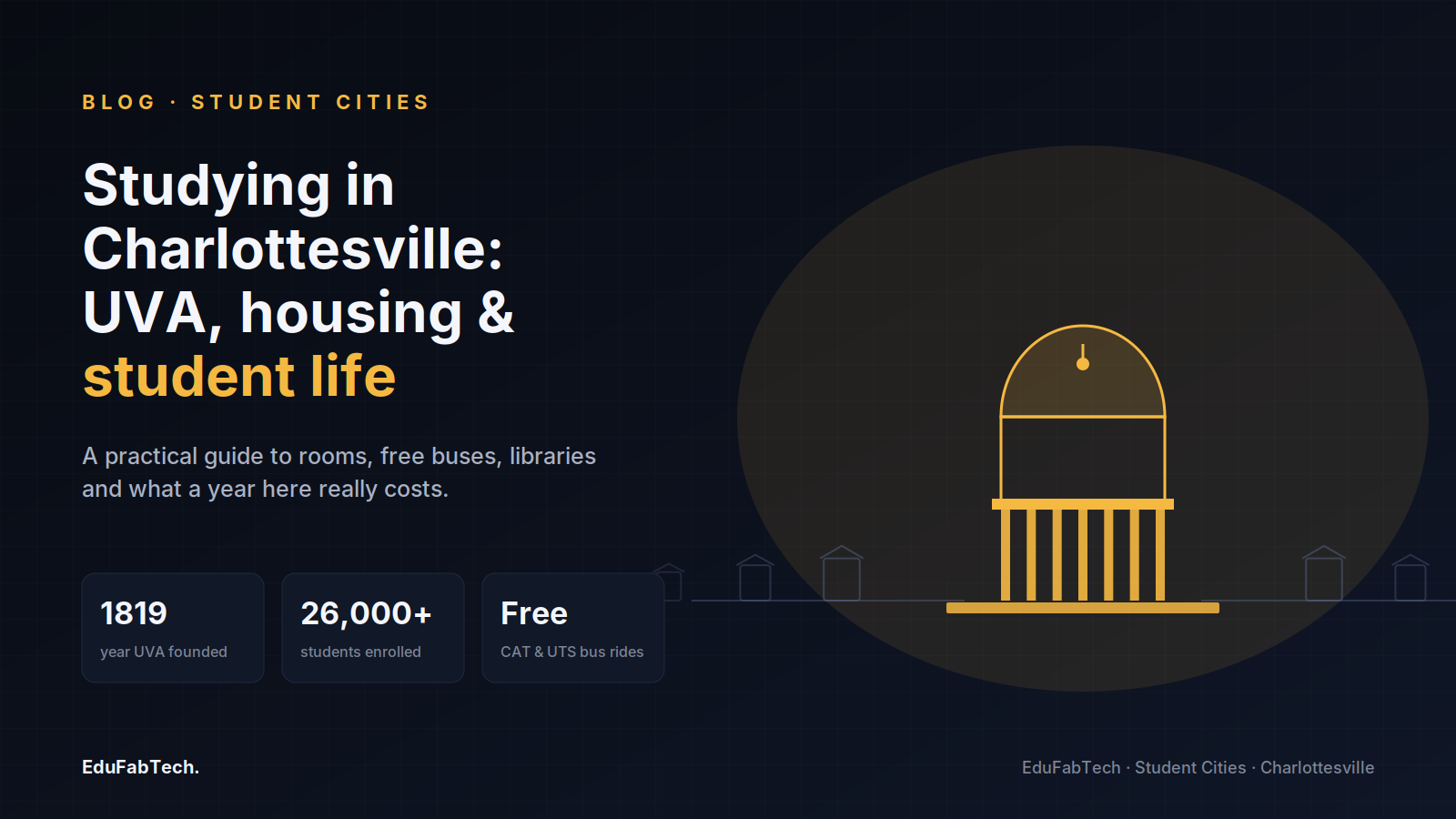
Charlottesville is a small city in the Piedmont of central Virginia, set between the Blue Ridge Mountains and the rolling farmland of Albemarle County, and its shape as a place to study is set almost entirely by one institution. The University of Virginia was founded in 1819 by Thomas Jefferson, who planned the curriculum, recruited the first faculty and designed the Academical Village — a terraced lawn lined with pavilions and student rooms — that the University's own faculty handbook notes was designated a UNESCO World Heritage site in 1987, together with Jefferson's home at Monticello.
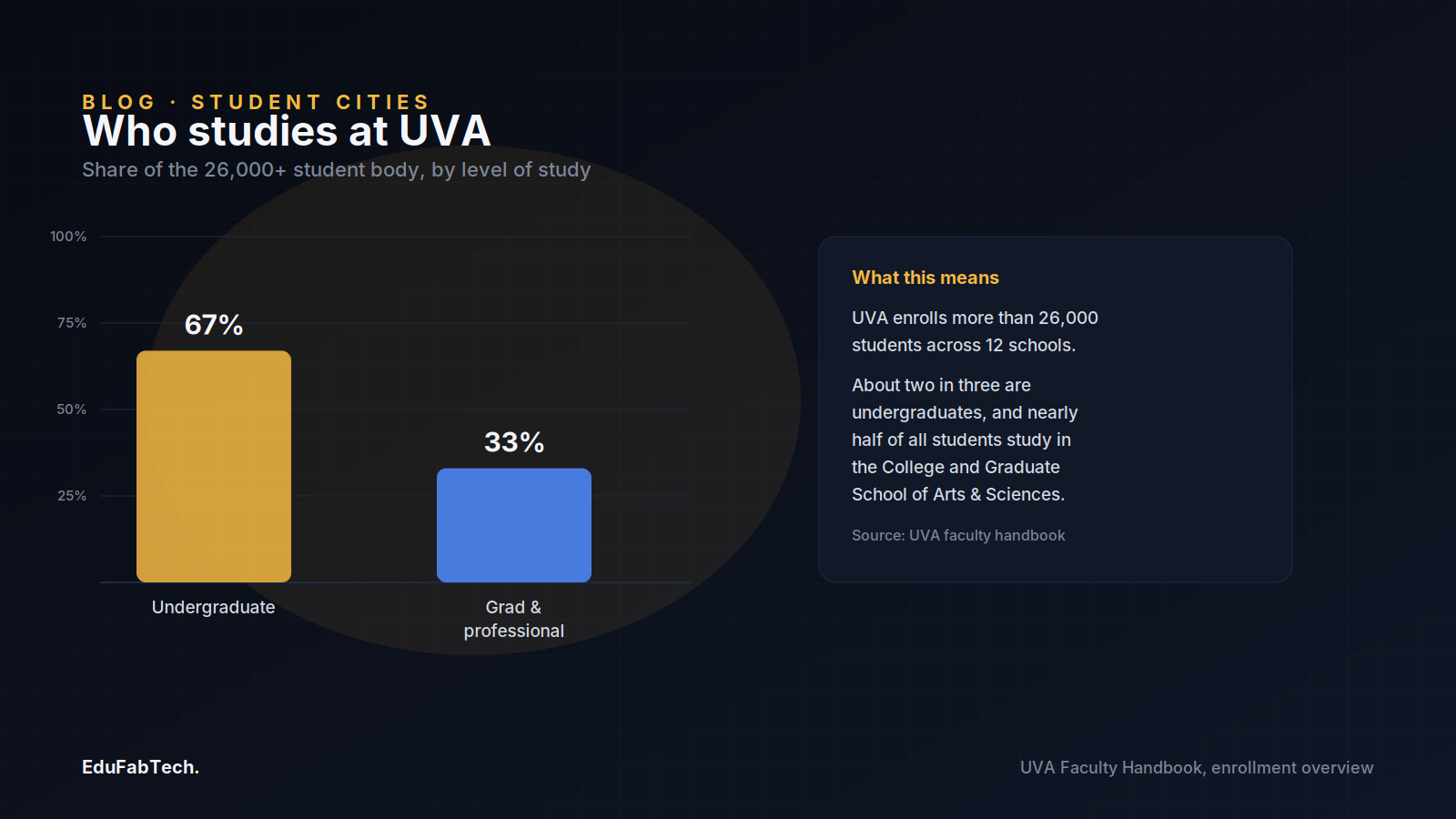
The same page records that the University now enrolls more than 26,000 students, of which about 67 percent are undergraduates, spread across twelve schools, with nearly half of all students in the College and Graduate School of Arts & Sciences. For a student arriving from abroad, that scale matters: UVA is large enough to carry a teaching hospital, big research programmes and most of the city's cultural life, but the historic core where first-years live is compact and walkable, so daily life rarely feels like a sprawling campus.
One school worth naming on its own is the Frank Batten School of Leadership and Public Policy, which sits within the University and grants its own degrees — a Bachelor of Arts in Public Policy and Leadership alongside graduate programmes such as the Master of Public Policy — and describes its aim as integrating leadership with public policy rather than teaching analysis alone. If public policy, data and government interest you, it is a concrete reason some students choose Charlottesville over a larger city.
Grounds, the Corner, and the streets students settle on
UVA calls its campus "Grounds," and the vocabulary is a useful map. First-year undergraduates are housed together, most of them in the McCormick Road and Alderman Road residence areas near the centre of Grounds, which keeps the first year deliberately close-knit. The University also runs residential colleges — among them the International Residential College, a living-learning community rather than a degree-granting school — for students who want a smaller community with faculty in residence; you can see what is listed near it on EduFabTech's International Residential College page.
After first year, most students move outward into the neighbourhoods that ring Grounds. The liveliest is "the Corner," the strip of shops and cafés on University Avenue directly across from the Rotunda, and the streets behind it — 14th Street, Wertland Street and the blocks off Rugby Road — are dense with student rentals. Jefferson Park Avenue, universally shortened to "JPA," runs south toward the hospital and is popular with graduate and medical students. A short bus ride east, the Belmont neighbourhood and the pedestrianised Downtown Mall offer a quieter, more mixed setting with the city's restaurants and the weekend market. Which of these suits you depends on whether you want to roll out of bed into a lecture or trade a ten-minute bus ride for a calmer street.
Signing a lease in a tight market — and spotting rental scams
Charlottesville's rental market is small and moves early. Leases around the Corner commonly turn over on a mid-year cycle, and it is normal for students to sign for the following August as early as the preceding autumn — far sooner than newcomers expect. Start looking the moment you have a place confirmed; the best-located rooms near Grounds are gone months in advance, and arriving in July to search is the single most common way students end up paying more for less.
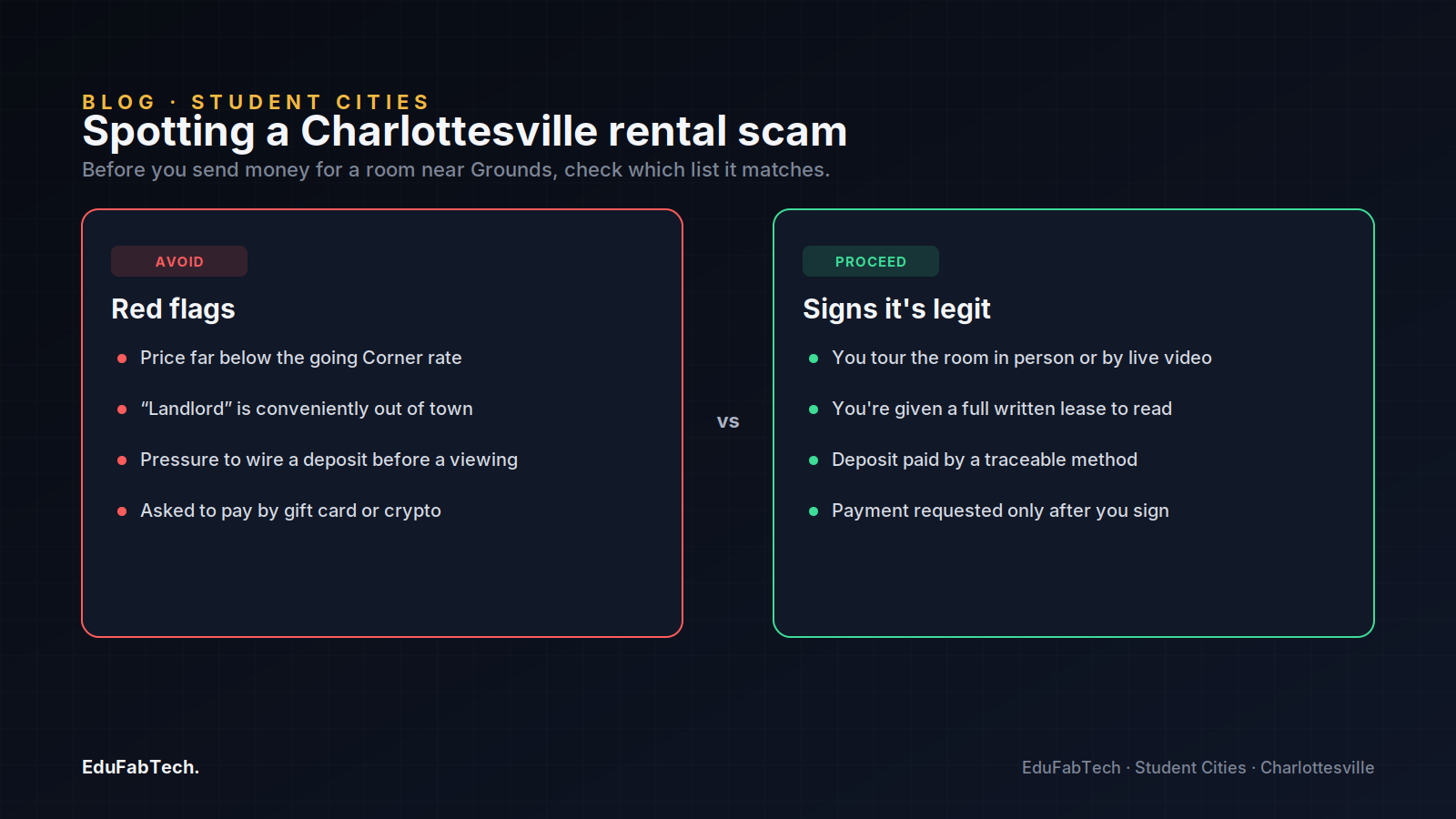
Before you pay anything, see the actual room — in person if you are already in Virginia, or by a live video walk-through with someone you trust if you are still overseas. Scams in a university town like this one tend to follow a pattern: a listing priced suspiciously below the going rate near the Corner, a "landlord" who is conveniently out of town, and pressure to send a deposit to "hold" the room before you can view it. Never send money by bank wire, gift card or cryptocurrency to secure a room you have not seen and whose lease you have not read. A legitimate landlord will let you tour the property, give you a written lease, and accept a deposit by a traceable method once you have signed. If you are comparing rooms, EduFabTech keeps city listings at rooms in Charlottesville.
Two checks save grief later. First, confirm what the rent includes — in a town of older houses, heating and water bills vary enormously, and a cheap headline rent can hide an expensive winter. Second, read the term: many Charlottesville student leases run a full twelve months even though you may leave for the summer, so budget for the months you are away or arrange to sublet.
Filling an empty room: thrift, the market and hand-me-downs
Furnishing a room cheaply is easy here if you time it with the student calendar, because every May a large cohort moves out and discards furniture. The Charlottesville City Market is the anchor of the local second-hand and maker scene: the City of Charlottesville runs it at 100 E. Water Street downtown on Saturdays from 9:00 a.m. to 1:00 p.m., April through November, selling produce, baked goods and crafts. The same city page lists Farmers in the Park at Pen Park on Wednesday afternoons from 3:00 to 6:00 p.m., May through September, and a downtown Holiday Market in late November and December — useful for cheap food and household basics once you are settled.
For furniture and kitchen kit, the thrift stores along the city's commercial corridors and the end-of-year giveaways are where students actually equip a room. EduFabTech gathers local offers at second-hand things and things given away free, which fill up fastest in May and August as leases turn over. Buying a desk, a lamp and a set of pans second-hand rather than new is the difference between a comfortable first week and a painful first bill.
Working on an F-1 visa, and finding campus jobs
International students almost always arrive on an F-1 visa, and the rules on working are strict and worth reading from the source rather than from a friend. The U.S. Department of Homeland Security's Study in the States guidance states plainly that an F-1 student in on-campus employment "may not work more than 20 hours per week when school is in session," and that the first step before taking any job is always to talk to your Designated School Official (DSO). At UVA the DSO function sits with the International Studies Office, and you should treat its advice as authoritative for your own case; nothing here is legal advice.
In practice, on-campus jobs — in the libraries, dining halls, labs and administrative offices — are the realistic route in your first year, because off-campus work requires separate authorisation that generally only becomes available later and must be approved in advance. Many of these roles are posted through the University's student employment system, and you can also browse local openings on jobs in Charlottesville. Confirm your eligibility with the International Studies Office before you accept anything.
Reading rooms: Shannon, Clemons and the public library
Charlottesville is unusually well supplied with places to study. The centrepiece is the Edgar Shannon Library, the University's main library (long known as Alderman), which the UVA Library reopened in January 2024 after a complete 100,000-square-foot restoration and a 130,000-square-foot expansion, with a range of environments from the hushed McGregor Room to open group-study spaces. Next to it, Clemons Library is the undergraduate library and tends to stay busy late into the night during exams.
Beyond Grounds, the Jefferson-Madison Regional Library is the public system serving the city, and its downtown Central Library is open to anyone — a good neutral spot when you want to study off-campus or when term-time library seats are scarce. For quieter options and desks people are sharing or subletting, EduFabTech lists study spaces in Charlottesville. A practical tip: the historic libraries fill first, so learn one or two secondary reading rooms early rather than hunting for a seat the week before exams.
Moving around a walkable town — mostly for free
This is one area where Charlottesville is genuinely generous to students. The city's bus operator, Charlottesville Area Transit (CAT), currently charges nothing: the City of Charlottesville states that a Commonwealth Transportation Board grant of $1,066,620 funds a fixed-route zero-fare model "until June 30, 2026," so every CAT route is free to ride for everyone, students included — check the city for the current status after that date. On top of that, the University runs its own free University Transit Service (UTS) around Grounds, so most students never pay a fare at all.
Because the core of the city is compact, many students walk or cycle between the Corner, Grounds and the Downtown Mall, and the free buses cover the longer hops to Belmont, the hospital or the grocery stores. You do not need a car to live here as a student, which removes one of the larger hidden costs of studying in many American cities. If you do bring one, be warned that parking near Grounds is limited and permits are restricted.
What a year actually costs
Housing is the figure that will dominate your budget, and it is worth anchoring to dated, official numbers. For living on Grounds, the University's Housing and Residence Life rates set the first-year room charge at $8,730 for the 2026–2027 academic year (a nine-month commitment), the same for all first-years regardless of room type, with utilities included; upperclass rates run higher and vary by building and room.
Off Grounds, the benchmark most students should know is the federal Fair Market Rent. For the Charlottesville, VA metropolitan area, the U.S. Department of Housing and Urban Development set the FY2026 Fair Market Rent at $1,602 a month for a one-bedroom unit (a 40th-percentile figure), effective from 1 October 2025, as listed in HUD's FY2026 schedule. That is a market-wide number, not a student deal; sharing a house near the Corner typically brings the per-person cost well below a solo one-bedroom, which is why most undergraduates share after first year. Build in the twelve-month lease term, winter heating, and the cost of furnishing a room when you compare the two paths.
The honest trade-offs, and a first-weeks checklist
What is good about studying in Charlottesville is real: a major public university on a walkable, historic campus; free local and campus buses; a genuine small-city cultural life around the Downtown Mall; and mountains and countryside within easy reach. What is hard is just as real. The rental market is small and tightly cycled, so rooms near Grounds are pricey and go early. The city is not large, which can feel either intimate or limiting depending on where you are coming from — students from major world cities sometimes find the nightlife and public transport thin after dark. And the town carries a complicated recent history, including the 2017 Unite the Right rally and its aftermath downtown.
A short checklist for the first weeks:
- Contact the International Studies Office as your DSO before doing anything work-related, and confirm your F-1 status details with them.
- If you are house-hunting for next year, start in the autumn, view every room in person or by live video, and never wire a deposit to hold an unseen room.
- Get your UVA ID early — it is your access to buildings, libraries and University transit.
- Learn two libraries, not one: Shannon and Clemons fill up, so find a backup reading room or a study space before exam season.
- Equip your room second-hand in May or August when leases turn over, and plan one Saturday trip to the City Market downtown.
- Skip the car; ride CAT and UTS for free and keep that money for rent.
Charlottesville rewards students who plan early and live close. Get the room and the paperwork right in the first month, and the rest of the city — compact, green and walkable — tends to take care of itself.
A quick question for readers
Do you work part-time while you study?
Many students work to pay the bills. See how common it is — and how many hours people really do.
Pick an answer, create a free account in a minute, and your vote counts. Already a member? Sign in
Source: University of Virginia
Sources (5)
- University of Virginia. 1.2 Historical and Current University Data — Faculty Handbook 2026–2027. University of Virginia, 2026. faculty-handbook.provost.virginia.edu ↗ · checked 5 Oct 2026
- U.S. Department of Homeland Security. Working in the United States. Study in the States (DHS), 2026. studyinthestates.dhs.gov ↗ · checked 5 Oct 2026
- City of Charlottesville. Charlottesville Markets. City of Charlottesville, 2026. charlottesville.gov ↗ · checked 5 Oct 2026
- City of Charlottesville. CAT Receives Grant to Continue Fare-Free Service to the Public. City of Charlottesville, 2021. charlottesville.gov ↗ · checked 5 Oct 2026
- University of Virginia Library. The renovation of Shannon Library. University of Virginia, 2024. library.virginia.edu ↗ · checked 5 Oct 2026