Studying in Chattanooga: universities, housing and student life
A practical guide to studying in Chattanooga, Tennessee — its downtown and mountain campuses, where students find rooms, what it costs, and how to get around a city built between a river and two ridges.
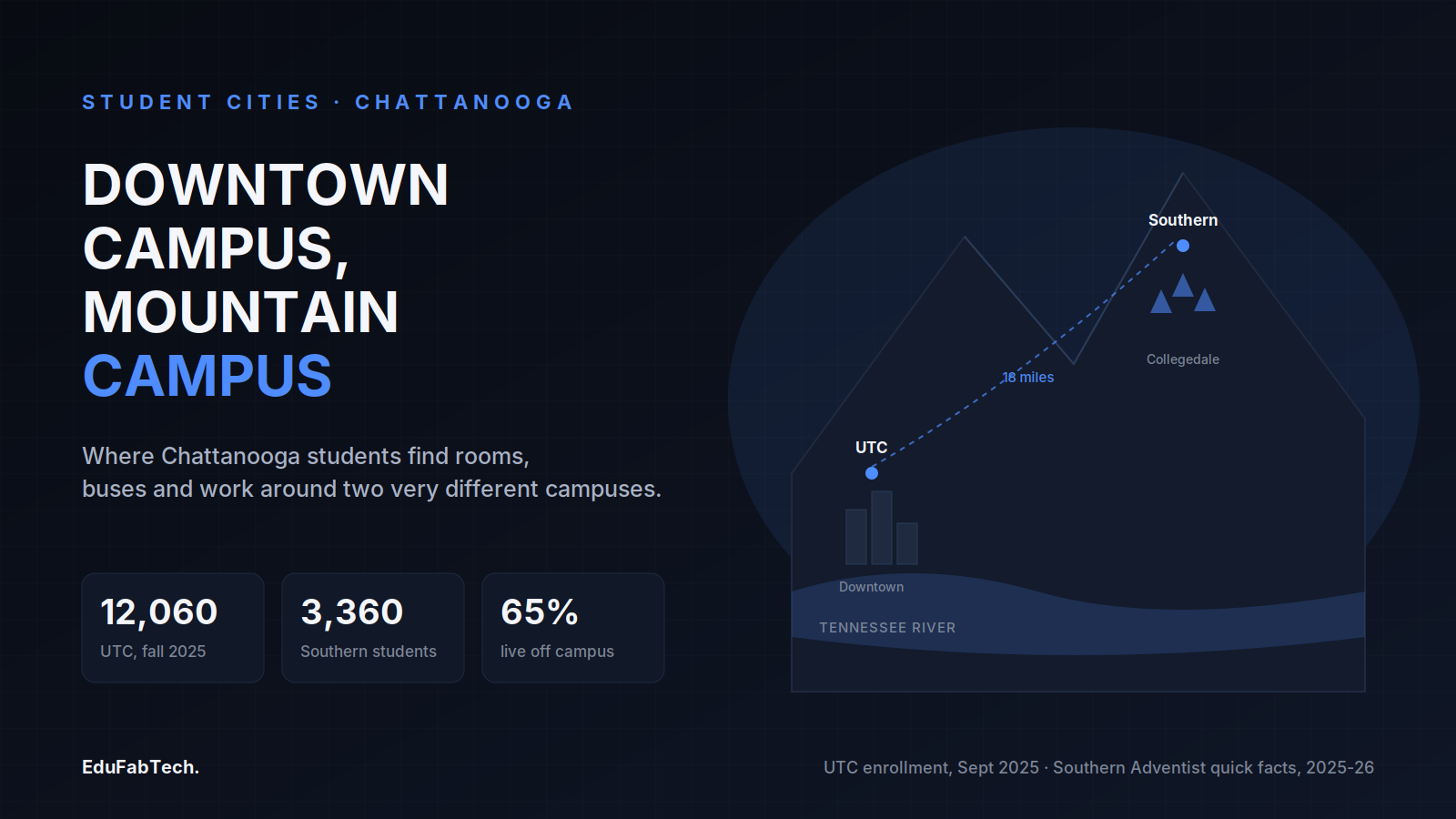
Chattanooga sits in a bend of the Tennessee River in the southeastern corner of the state, hemmed in by Lookout Mountain to the southwest and the long wall of Signal Mountain and Walden's Ridge to the north. The Georgia line is only a few miles down Interstate 75, which is why the metropolitan area officially spans two states. For a student the geography matters more than the postcard views suggest: the river and the ridges shape where you can live cheaply, how long your commute is, and whether you will need a car. The academic heart of the city is small and walkable, but the region around it is spread out and car-oriented.
Two universities grant degrees in and around the city, and they could hardly be more different in character. One is a public campus wrapped into the downtown street grid; the other is a private religious campus on more than a thousand acres of wooded ridgeland in the suburb of Collegedale. Knowing which world you are entering changes almost everything about the housing, the transport and the rhythm of the week.
This guide walks through both, then covers the practical business of living here — rooms, second-hand furniture, part-time work, study spaces, buses and costs — with every figure traced to the page it came from.
The downtown campus and the mountain campus
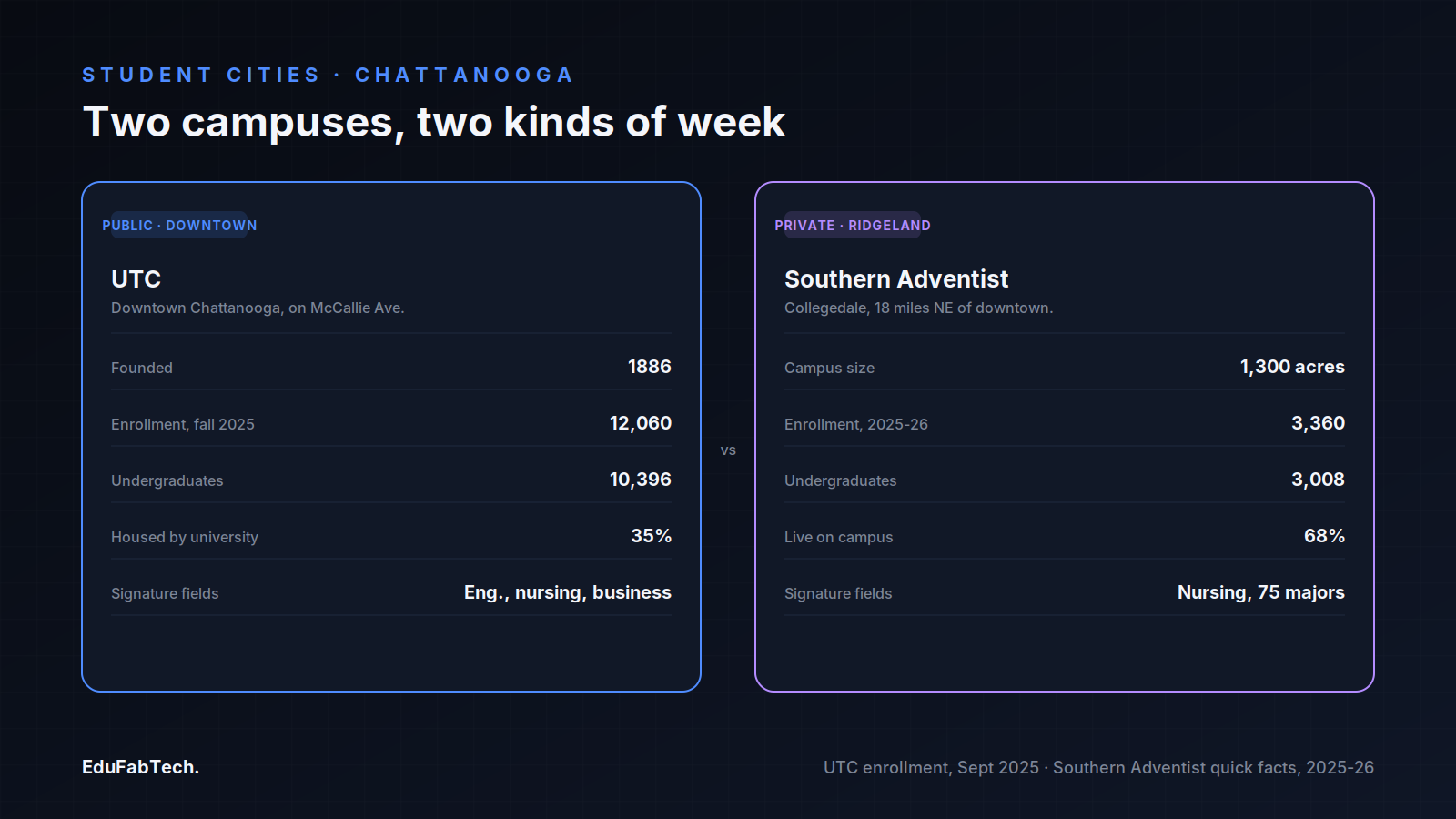
The University of Tennessee at Chattanooga (UTC) is the larger of the two and the campus most international students arrive for. It runs along McCallie Avenue just east of the central business district. UTC traces its founding to 1886 and is part of the statewide University of Tennessee system; in September 2025 it announced a record enrollment of 12,060 students, passing 12,000 for the first time, including 10,396 undergraduates and 1,664 graduate students. Students and athletics teams alike go by the Mocs. Its strengths lie in engineering and computer science, business, nursing and the health sciences — the same fields that carry extra per-credit-hour differential fees on UTC's own fee schedule.
The Southern Adventist University campus is a different place entirely. It sits in Collegedale, a small city about 18 miles northeast of downtown Chattanooga, and is owned and operated within the Seventh-day Adventist tradition. Southern's own quick-facts page describes a 1,300-acre campus with 26 major buildings and nearly 40 miles of hiking and biking trails, serving 3,008 undergraduate and 352 graduate students in 2025-2026, with 68 percent of students living on campus. The same page lists 75 baccalaureate majors and names nursing among its signature programmes. Because the week here is built around a Saturday Sabbath, the academic and social calendar will feel unfamiliar to students used to a secular timetable; it is worth understanding before you commit.
Where students live: Fort Wood, the Southside and the halls
At UTC the balance tips off campus. U.S. News's UTC profile reports that about 35 percent of students live in university-owned, -operated or -affiliated housing and 65 percent live off campus. For first- and second-year students the residence halls and university apartments are the default, and UTC publishes its rates building by building. For everyone else, the question is which neighbourhood.
The one most tied to UTC is Fort Wood, the historic district immediately east of campus, its streets lined with large Queen Anne and Revival-style houses that have been subdivided into apartments over the decades; many now serve student renters and Greek organisations within walking distance of class. South of the railway, the Southside around Main Street and the old warehouse blocks has become the city's walkable district of coffee shops and converted lofts — pleasant, but priced accordingly. Cheaper rooms tend to sit further out, in Highland Park or East Ridge, or across the river on the North Shore, where a lower rent buys a longer commute.
Start the search early. Leases in the blocks around UTC turn over on the academic cycle, and the best-located rooms in Fort Wood and the Southside are often committed months before the autumn term. If you are coming from abroad and cannot view a place in person, line up someone — a department contact, a current student, the international student office — to see it for you before any money changes hands. You can browse what is listed near campus on EduFabTech's Chattanooga rooms page, and filter to places near the University of Tennessee at Chattanooga or near Southern Adventist University.
Renting without being scammed here
The rental scams that target Chattanooga students follow a pattern. A listing for a Fort Wood house or a Southside loft appears at a rent that looks too good for the location; the "owner" says they are out of town — a common claim in a city with a lot of absentee-owned historic property — and asks you to secure it with a deposit before viewing. That request is the warning sign. Never send money by bank wire, gift card or cryptocurrency to hold a room you have not seen, and be wary of anyone who refuses an in-person or video walkthrough of the actual unit. In Tennessee a landlord can lawfully ask for a security deposit, but you should expect a written lease, a named local contact and a chance to inspect the place first. If a deal can only proceed by paying a stranger immediately, walk away — a genuine Chattanooga landlord has other applicants and can wait a day for you to verify.
Furnishing a room cheaply
Once you have a room, filling it need not cost much. The Habitat for Humanity of Greater Chattanooga ReStore at 1150 East 14th Street, in the Southside, sells donated furniture, appliances and household goods to fund local home-building. For food and makers' goods the city has two markets worth knowing. The Main Street Farmers Market runs every Wednesday afternoon, year-round, in the Finley Stadium parking lot at 522 West Main Street. The larger Chattanooga Market is a Sunday institution at the open-air First Horizon Pavilion on the Southside; the market's own site puts its 2026 opening in its 26th season, running Sundays from late April through November. For furniture and other second-hand finds between market days, EduFabTech's page for used furniture in Chattanooga is a reasonable place to start.
Working while you study
If you are on an F-1 student visa, the rules on employment are set federally, not by the university, and they are strict about hours. The U.S. Department of Homeland Security's Study in the States guidance states that an F-1 student may work on campus but may not work more than 20 hours per week when school is in session, and that off-campus employment requires separate authorisation tied to completing a full academic year and meeting specific conditions. On-campus roles do not need advance approval from immigration authorities, but you must work with your designated school official (DSO) before starting, and you will need a Social Security Number to be paid. Nothing here is legal advice — confirm your own situation with your DSO and the official DHS guidance, because the consequences of getting work authorisation wrong fall on your immigration status. Campus jobs at UTC and listings around the city appear on EduFabTech's Chattanooga jobs page.
Libraries and places to study
UTC's main study building is the UTC Library at 600 Douglas Street, a modern block near the centre of campus. Its hours page lists term-time opening from 7:45 a.m. to midnight Monday to Thursday, shorter hours on Friday and the weekend, and a 24/5 overnight study option from Sunday through Thursday — useful in exam weeks. The building has reservable group study rooms, quiet study areas and a media-making Studio.
Off campus, the Chattanooga Public Library downtown branch at 1001 Broad Street is open to anyone and adds a different kind of space. Its well-known 4th Floor is a 12,000-square-foot makerspace for design and technology, free to use without a library card, and the branch also has quiet space to work downtown. EduFabTech lists bookable desks and study spaces across Chattanooga if the libraries fill up during crunch weeks.
Getting around a car-oriented city
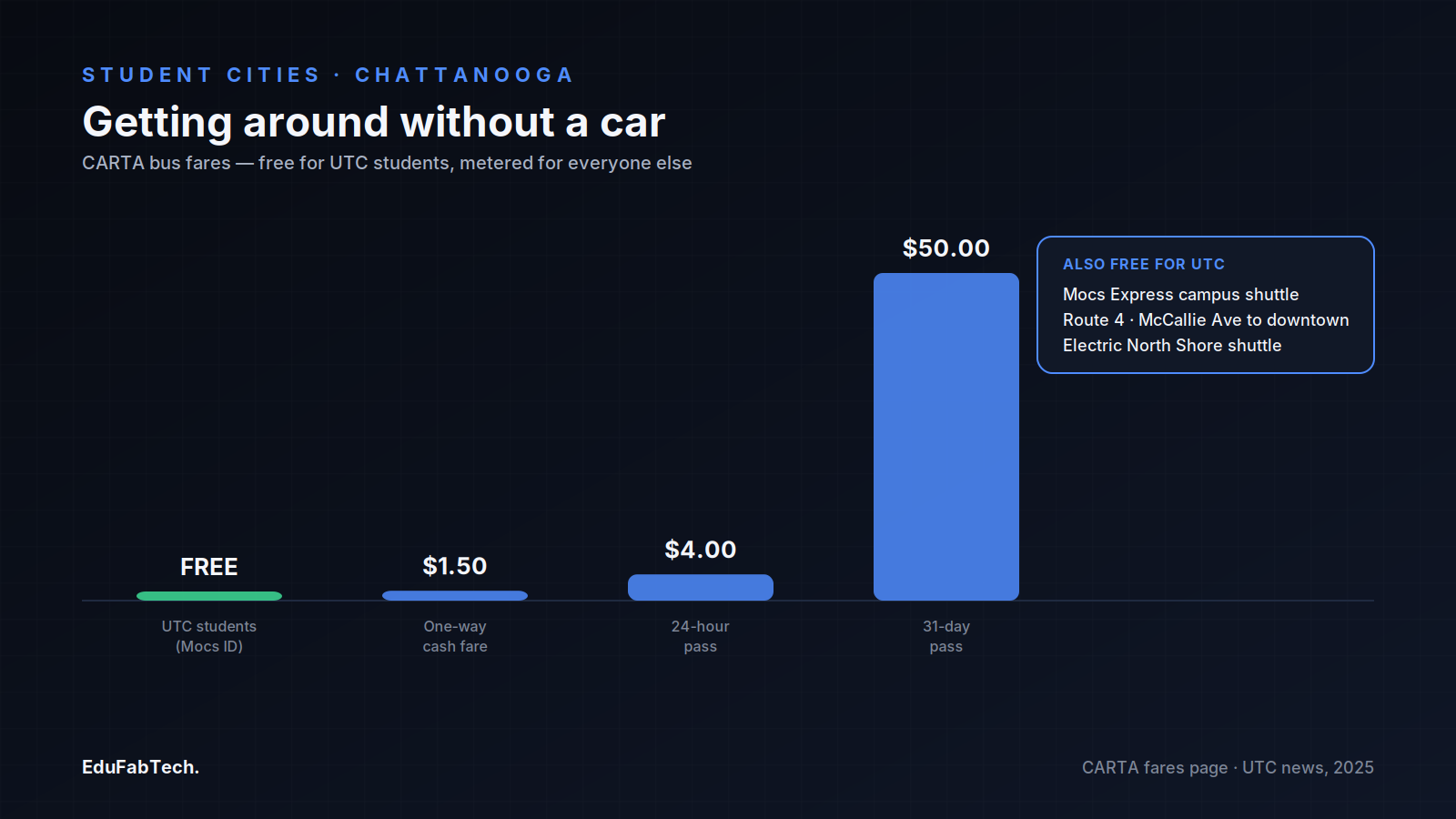
Public transport in Chattanooga is run by the Chattanooga Area Regional Transportation Authority (CARTA). For UTC students the key fact is that riding is free: a UTC news article confirms that all CARTA buses are free for UTC students with a Mocs ID, and the campus Mocs Express shuttle is free as well; the same article notes that CARTA's Route 4 along McCallie Avenue connects riders to downtown near the Tennessee Aquarium and continues out to Hamilton Place, and that an electric North Shore shuttle runs along Market Street. For anyone without a Mocs card, CARTA's fares page lists a $1.50 adult one-way cash fare, a 24-hour unlimited pass at $4.00 on a refillable card, and a 31-day pass at $50.00; the same page notes that K-12 students ride free with a Read and Ride pass.
Even so, be realistic. Outside the downtown-to-campus corridor and a handful of main routes, buses run infrequently, and much of the metropolitan area — including Collegedale — is effectively built for cars. Students at Southern, 18 miles out, will find transit of little help. Many UTC students who live in Fort Wood or the Southside manage without a car; most who live further out do not.
What it costs, and the honest trade-offs
University housing is the one cost with a clear, dated figure. UTC's FY 2025-2026 residence hall and fee schedule prices its rooms by the semester: the least expensive listed option is a shared two-bedroom unit in Lockmiller Apartments at $3,196 per semester, a shared one-bedroom in West Campus Housing runs $4,819, and a private one-bedroom in Decosimo Apartments tops the list at $5,284. The same sheet sets the required basic first-year meal plan at $2,180 per semester and a general parking permit at $262 for the full year. Off-campus rents vary too widely by neighbourhood to quote a single reliable number, so treat the university figures as the anchor and the listings above as your guide to the rest.
| Item (UTC, FY 2025-2026, per semester unless noted) | Amount (USD) |
|---|---|
| Lockmiller Apartments, 2 BR shared (cheapest listed) | 3,196 |
| West Campus Housing, 1 BR shared | 4,819 |
| Decosimo Apartments, 1 BR private (most expensive listed) | 5,284 |
| Basic required first-year meal plan | 2,180 |
| General parking permit (full year) | 262 |
What is genuinely good about Chattanooga for a student is the setting and the scale. The river, the mountains and an unusually extensive network of trails put the outdoors within reach of campus, and the compact downtown means a UTC student can live, study and socialise largely on foot or on a free bus. The cost of living is modest by the standards of larger American cities. What is harder: the metropolitan area is spread out and car-dependent once you leave the core, so students without a vehicle are tied to a few corridors; summers are hot and humid in the river valley; and the most convenient rooms near UTC, in Fort Wood and the Southside, command a premium and go early. The two campuses also offer very different lives — a secular downtown experience at UTC versus a religious, residential one at Southern — and that difference, more than any ranking, should drive the choice.
A checklist for the first weeks
- Get your Mocs ID validated as soon as you arrive — it is your free pass on every CARTA bus and the Mocs Express shuttle.
- If you are an international student, meet your DSO before taking any job, and apply for a Social Security Number once you have on-campus work lined up.
- View any off-campus room — in person or by live video — before paying, and never wire a deposit to hold a place you have not seen.
- Learn the UTC Library hours, including the 24/5 overnight option, and use the downtown Chattanooga Public Library when you need quiet space in town.
- Furnish from the Habitat ReStore on East 14th Street and check the Sunday Chattanooga Market and Wednesday Main Street Farmers Market for food and makers' goods.
- Walk Fort Wood and the Southside early in the term to get a feel for the neighbourhoods before you commit to a lease.
A quick question for readers
Do you work part-time while you study?
Many students work to pay the bills. See how common it is — and how many hours people really do.
Pick an answer, create a free account in a minute, and your vote counts. Already a member? Sign in
Comments 3
Comment-
The 65 percent of UTC students living off campus is the number that should have anchored this piece, and instead it gets waved away with "re…
-
The 35/65 on-campus split for UTC is the number that actually matters here, and the piece undersells it. Two-thirds of students are off camp…
-
The thing that jumps out is the split between UTC and Southern isn't really a housing or cost question at all, it's the Saturday Sabbath cal…
Join free to read the full comments and reply Comments are between members; an account takes a minute.
Source: University of Tennessee at Chattanooga
Sources (5)
- University of Tennessee at Chattanooga. Resident Halls, Meal Plans, Parking, and Miscellaneous Fees, FY 2025-2026. UTC Bursar's Office, 2025. utc.edu ↗ · checked 23 Oct 2026
- University of Tennessee at Chattanooga. UTC announces record fall enrollment, surpassing 12,000 for first time. UTC News, 2025. blog.utc.edu ↗ · checked 23 Oct 2026
- Chattanooga Area Regional Transportation Authority. Fares. CARTA (gocarta.org), 2026. gocarta.org ↗ · checked 23 Oct 2026
- Southern Adventist University. Quick Facts About Southern. Southern Adventist University, 2026. southern.edu ↗ · checked 23 Oct 2026
- U.S. Department of Homeland Security. Working in the United States. Study in the States, 2026. studyinthestates.dhs.gov ↗ · checked 23 Oct 2026