Studying in Chemnitz: universities, housing and student life
A practical guide to studying in Chemnitz — its universities, the Studentenwerk halls, flat-rate rents, flea markets, part-time work rules, libraries, the CVAG Deutschland-Semesterticket and the honest trade-offs.
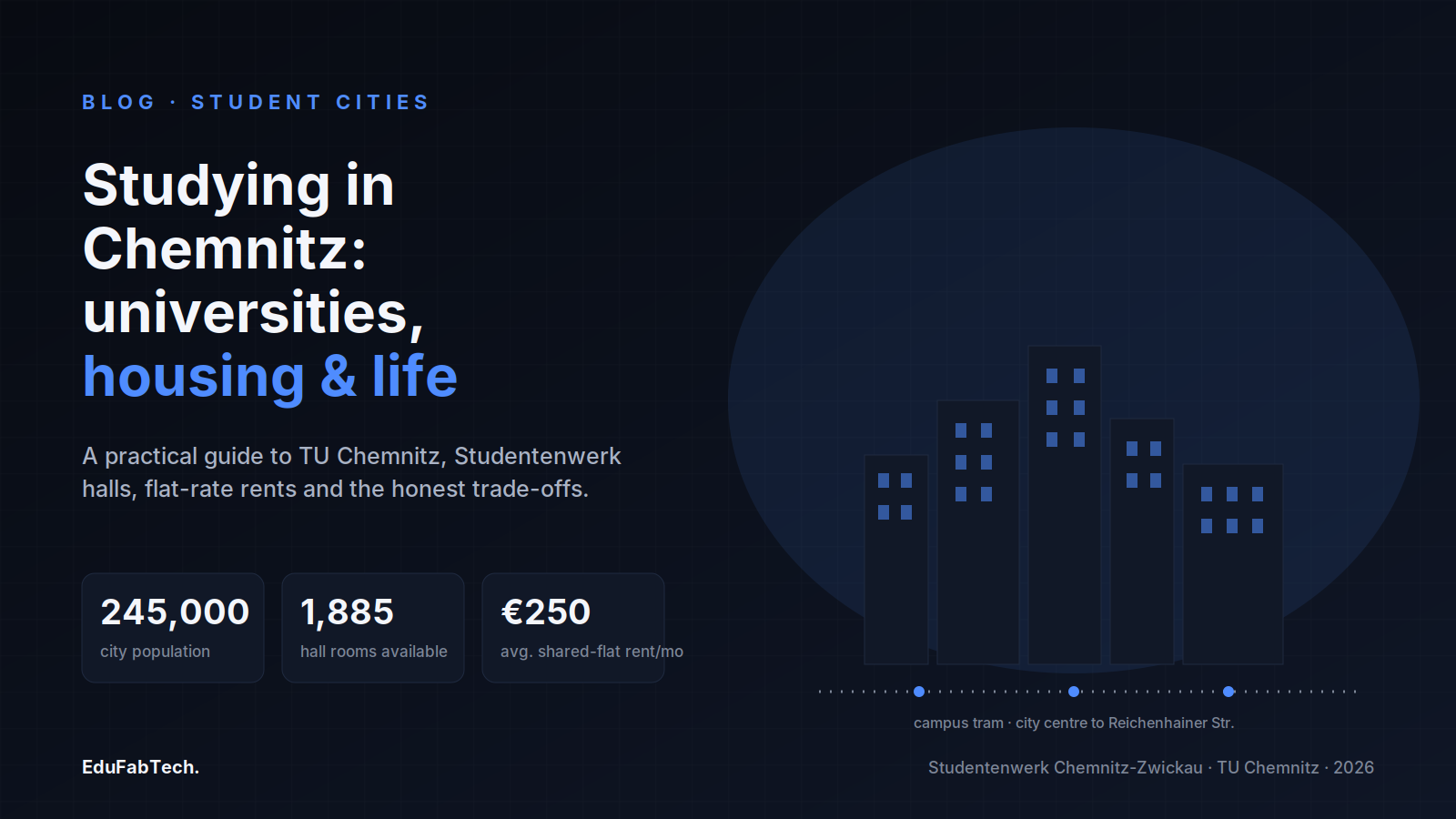
Chemnitz sits in the Ore Mountain Basin at the northern foot of the Erzgebirge, in south-western Saxony, and takes its name from the small river that rises where the Würschnitz and Zwönitz meet at the city's southern edge. With around 245,000 inhabitants it is the third-largest city in Saxony after Dresden and Leipzig. Dresden is roughly an hour away by regional train and Leipzig a little further; the Czech border and the ski slopes of the Erzgebirge are close enough for a day trip.
The city's shape is industrial. It was a machine-building and textile centre, was heavily bombed in 1945, rebuilt in the GDR era as Karl-Marx-Stadt, and still carries both the grey panel housing and the ornate Gründerzeit tenements of those two pasts on the same streets. In 2025 it held the title of European Capital of Culture under the motto "C the Unseen", shared with 38 surrounding municipalities across the Ore Mountains and Central Saxony (chemnitz.de); much of the new cultural infrastructure built for the year — reopened industrial halls, cycle routes, galleries — has stayed. For a student, the plainer point is that Chemnitz is cheap and uncrowded compared with Leipzig or the big western cities.
It is also a smaller student scene than those cities, built around one mid-sized university in the centre and a ring of specialist institutions in the surrounding towns. That changes what studying here feels like: short commutes, a real chance of a hall room, and rents that are among the lowest in Germany, set against a quieter social life and the familiar east-Saxon questions about winter weather and the far right.
The universities, in the city and around it
The Chemnitz University of Technology (Technische Universität Chemnitz, TUC) is the institution most students mean when they say they study "in Chemnitz". It traces its founding to 1836 and was raised to a technical university in 1963. Its teaching is spread over two main sites a short tram ride apart: the Straße der Nationen campus in the city centre, near the main station and bus station, and the larger Reichenhainer Straße campus in the Bernsdorf district to the south, where much of engineering, computer science and the natural sciences sit. Announcing its 2026/27 intake on 9 October 2026, TU Chemnitz said 2,525 first-year students had enrolled — about 23% more than at the same point a year earlier — and that 55% of them were in MINT (technical) subjects, up from 45% a year earlier (tu-chemnitz.de). Psychology, Web Engineering and Embedded Systems were among the most-applied-for programmes. It is a manageable size — large enough for a full range of bachelor's and master's degrees, small enough that you are not a number.
Three more institutions sit in towns around Chemnitz rather than in the city itself, and the Deutschland-Semesterticket (below) reaches all of them. The Freiberg University of Mining and Technology (TU Bergakademie Freiberg), about 30 km east in the silver-mining town of Freiberg, was founded in 1765 and describes itself as the oldest university of mining sciences in the world and "the resource university", organised around the raw-materials cycle — exploration, extraction, processing and recycling — across six faculties (tu-freiberg.de). The elements germanium and indium were both first identified there.
Hochschule Mittweida, a university of applied sciences in Mittweida to the north, has roughly 6,350 students across five faculties and around 65 degree programmes, and is known for its media, IT, engineering and forensic-science teaching, including hands-on project work from game development to forensic analysis (study-in-saxony.de). The Berufsakademie Glauchau — formally the Staatliche Studienakademie Glauchau, a campus of the Duale Hochschule Sachsen in Glauchau to the west — runs dual-study degrees in technology and business, combining theory blocks on campus with paid practice phases at partner companies (dhsn.de). As at public institutions across Saxony, none of these charge general tuition fees; students pay a semester contribution.
Finding a room: the Studentenwerk halls and the private market
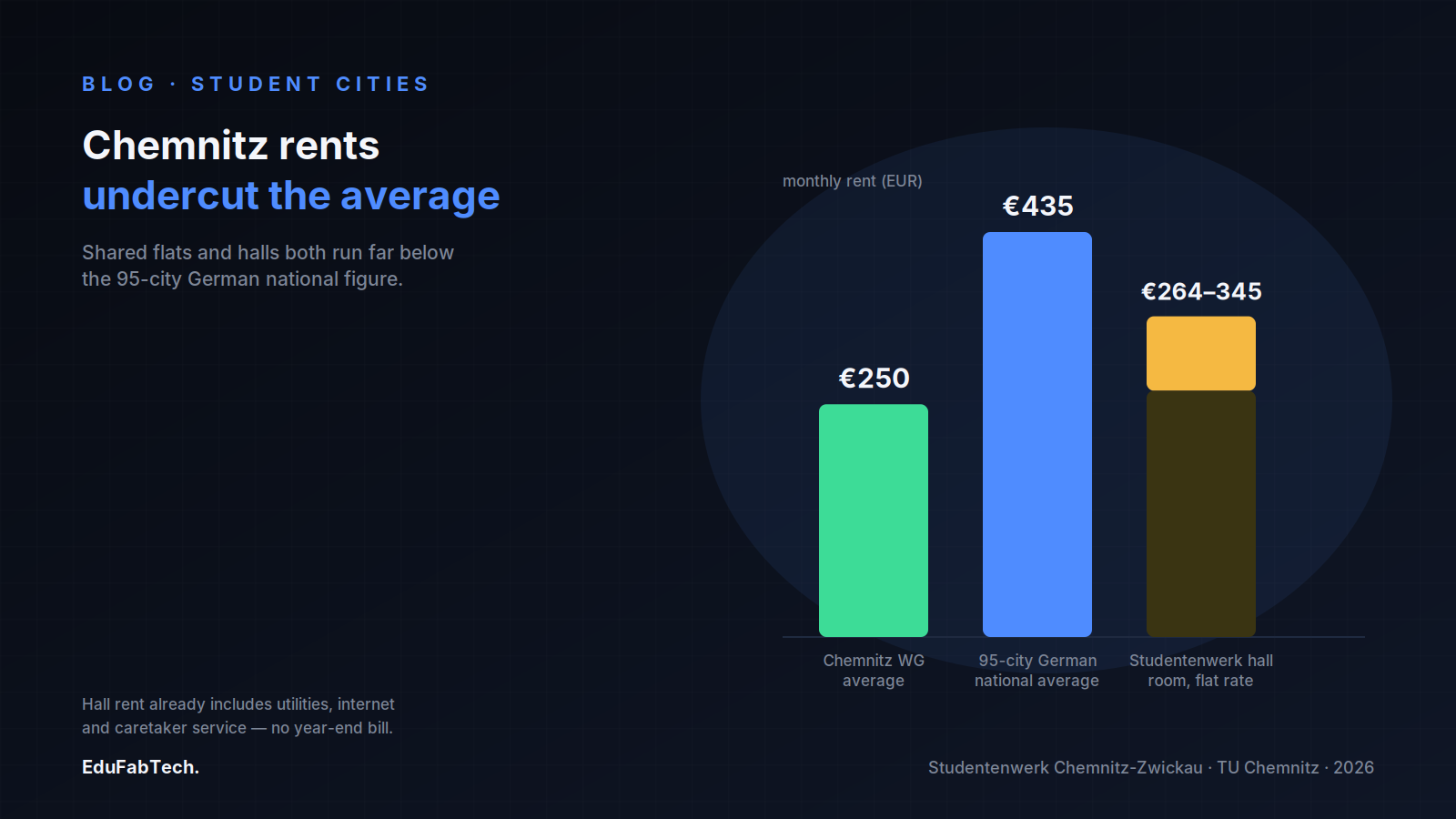
Student housing in Chemnitz is run by the Studentenwerk Chemnitz-Zwickau, which TU Chemnitz says operates 1,885 hall rooms in the city — single apartments and rooms in shared flats — with monthly rents from €264.50 to €344.50 depending on size, as of its August 2026 housing event (tu-chemnitz.de). The figure worth remembering is that the rent is a flat rate: utilities, internet and cable TV, plus a caretaker service, are already in the price, so there is no year-end utilities bill to settle, and the rooms come furnished with a bed, wardrobe, shelf, table and chair. Most of the halls cluster near the Reichenhainer Straße campus — on Reichenhainer Straße and Thüringer Weg — and in the Vettersstraße group a little to the south, so a hall room usually means a walk or a short tram ride to lectures.
Demand has risen with the recent intake, so apply early through the Studentenwerk rather than assume a place will be free in September. If you miss a hall room, the private market in Chemnitz is unusually forgiving by German standards: a 2022 report cited by TU Chemnitz — the Moses Mendelssohn-Institut's Hochschulstädte-Scoring — put the average room in a shared flat (WG) here at €250 a month, against a 95-city national average of €435 at the time (tu-chemnitz.de). Chemnitz has a genuine surplus of flats in its older districts — Kaßberg, Sonnenberg, the Brühl near the centre — which keeps whole one-room apartments within reach of a student budget in a way they rarely are in Leipzig or Dresden.
That same abundance shapes how scams work here. Because so much is advertised online and viewings are easy to arrange, the warning sign in Chemnitz is a listing that refuses one — a cheap Kaßberg flat whose "owner" is abroad and asks you to wire a deposit or buy vouchers to "reserve" it before you can see it. No legitimate Chemnitz landlord or the Studentenwerk needs money to hold a room sight unseen. See the room or hall yourself, or send someone you trust; sign a written contract (Mietvertrag); and never pay a deposit by bank transfer to an overseas account, by gift card or in cryptocurrency. A normal deposit (Kaution) is at most three months' cold rent, paid after signing, and for a furnished hall room it is modest. If you are searching from abroad, a Studentenwerk hall is the safest first booking precisely because you are dealing with a public body. EduFabTech keeps local listings for rooms in Chemnitz and a broader set near the TU Chemnitz campus.
Furnishing a room for almost nothing
If your room is unfurnished, Chemnitz's second-hand culture is strong, as it tends to be in cities with a lot of turnover and a thrifty habit. The best-known fixed event is the Nachtflohmarkt (night flea market) held at Messe Chemnitz, the city's exhibition hall at Messeplatz 1, which runs roughly once every half-year with well over a hundred indoor stalls — a reliable one-stop source for lamps, crockery and bicycles (nachtflohmaerkte.de). Smaller open-air flea markets appear seasonally around the centre and the Eissporthalle car park. Beyond markets, charity and social second-hand shops across the inner districts sell furniture and clothes cheaply, and the usual free-to-collector give-aways appear when students move out at semester's end. EduFabTech gathers local second-hand things in the city, which is often faster than a market if you need one specific thing before term starts.
Working while you study
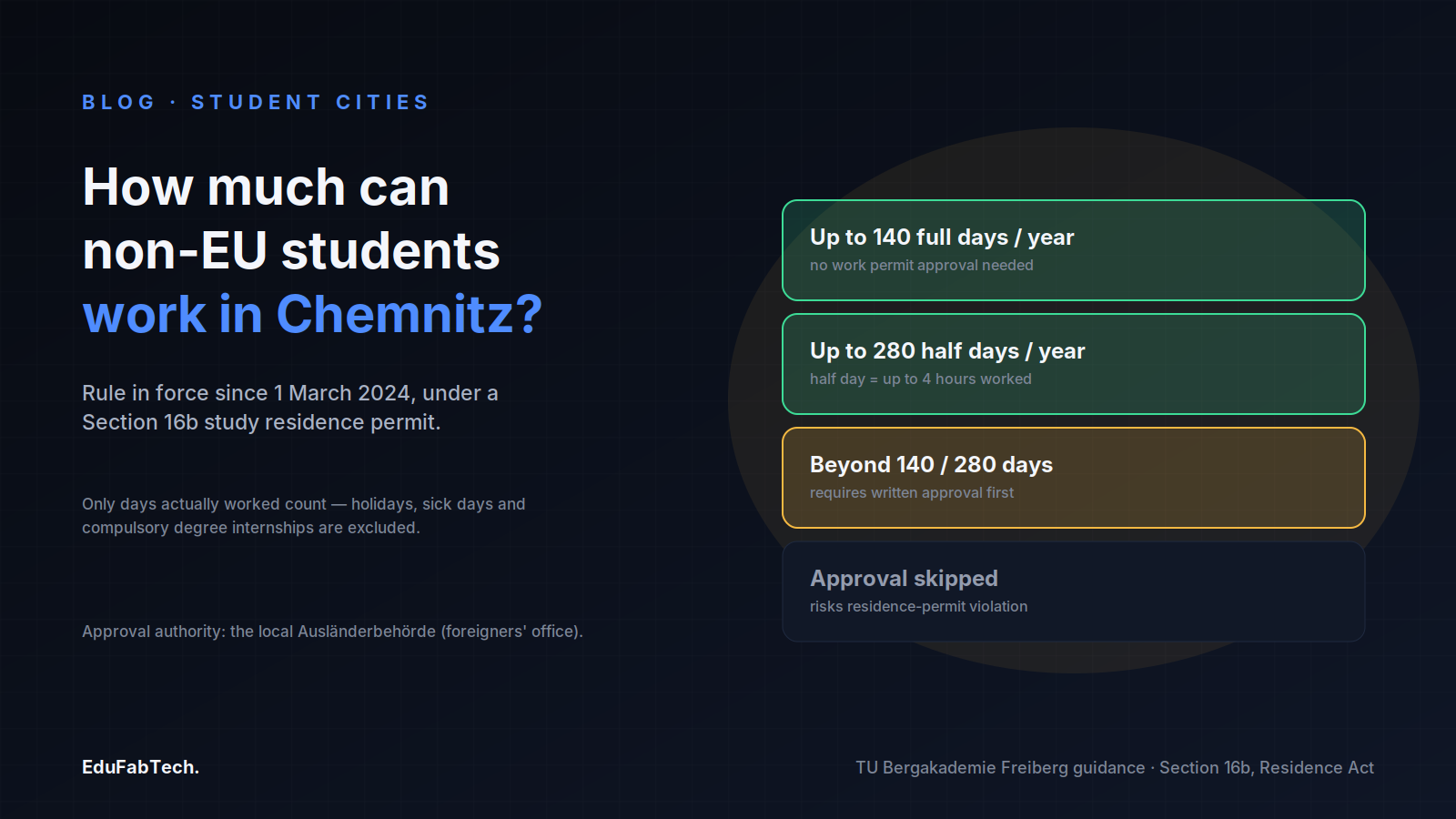
Part-time work is common and the rules depend on where you are from. EU and EEA students work on broadly the same footing as German students. For non-EU students holding a residence permit for study under Section 16b of the Residence Act, the rule since 1 March 2024 is 140 full days or 280 half days of work per calendar year without extra permission, where a half day is work of up to four hours; working more than that needs prior written approval from the local foreigners' registration office (Ausländerbehörde), as TU Bergakademie Freiberg sets out in its own guidance (tu-freiberg.de). Only days actually worked count, so holidays and sick days do not; compulsory internships that are part of your degree are treated separately. This is general information, not legal advice — confirm your own permit's conditions with the Chemnitz Ausländerbehörde before signing a contract. Student assistant ("HiWi") posts at TU Chemnitz are a common first job; local openings are collected on EduFabTech's Chemnitz jobs page.
Libraries and places to study
The centrepiece for study space is the TU Chemnitz University Library in the Alte Aktienspinnerei, a converted 19th-century cotton-spinning mill at Straße der Nationen 33. The university moved it there after a long renovation, and it holds more than a million books alongside reading rooms, group spaces and an events area; the library director stresses that it is open to the general public, not only to students (tu-chemnitz.de). It keeps long opening hours through the week into the evening, which matters in a city where few cafés stay open late. Faculty branch libraries sit out at the Reichenhainer Straße campus, closer to the engineering halls and student housing there. During exam periods the main reading rooms fill up, so arrive early for a desk; EduFabTech also lists bookable study spaces in Chemnitz for the weeks when the library is full.
Getting around, and what the Semesterticket covers
Local transport is run by the CVAG (Chemnitzer Verkehrs-AG), whose tram and bus network ties the centre to the campuses and the halls; Chemnitz also runs the unusual Chemnitz Model, where some tram-trains continue onto regional rail out into the surrounding towns. TU Chemnitz students are enrolled in a compulsory Deutschland-Semesterticket: per CVAG, it costs €37.80 a month as of 1 October 2026 — set at 60% of the price of the regular Deutschlandticket — and is issued electronically through the RIDEcampus app (cvag.de). Its reach is national: it is valid in second class on local and regional public transport across Germany during both the winter semester (1 October to 31 March) and the summer semester (1 April to 30 September), which is what makes commuting to the Freiberg, Mittweida and Glauchau campuses, or a weekend in Dresden or Leipzig, free at the point of use. The ticket is part of the semester contribution and is not something you can cancel month to month.
Costs, trade-offs, and a first-weeks checklist
The honest case for Chemnitz is money and space. A furnished, all-inclusive hall room from €264.50 a month (TU Chemnitz, 2026) and a private WG room that averaged €250 in 2022 (Moses Mendelssohn-Institut/Hochschulstädte-Scoring, via TU Chemnitz) are both far below what a room costs in bigger university cities such as Munich or Hamburg. Transport is settled by the Semesterticket, second-hand goods are plentiful, and you are rarely far from campus. For international and MINT students in particular, TU Chemnitz is visibly growing rather than shrinking.
The honest case against is quieter. Chemnitz has fewer students than Leipzig or Dresden and a smaller nightlife and cultural pull outside the Capital-of-Culture afterglow; winters in the Erzgebirge basin are cold and grey; and the city has a documented history of far-right activity that some international students weigh before coming. The abundant housing is partly a symptom of a city that lost population for decades. None of this is hidden, and much of it is exactly why the place is affordable.
A short checklist for the first weeks:
- Register your address (Anmeldung) at the Bürgeramt within the statutory window after moving in — you need the confirmation for almost everything else.
- Apply early for a Studentenwerk hall room, and if you arrive without one, view any private flat in person before paying a cent.
- Activate your Deutschland-Semesterticket through the RIDEcampus app once enrolled, so trams, buses and regional trains are covered from day one.
- Open a German bank account and sort health insurance, both normally required to complete enrolment.
- If you are a non-EU student planning to work, check your permit's day limit and, if needed, the Ausländerbehörde, before signing a job.
- Get a library card at the Alte Aktienspinnerei and furnish the room from a flea market or the local second-hand listings.
For everything current — rooms, jobs, second-hand furniture and what's on — EduFabTech keeps a running set of student listings for Chemnitz.
A quick question for readers
Do you work part-time while you study?
Many students work to pay the bills. See how common it is — and how many hours people really do.
Pick an answer, create a free account in a minute, and your vote counts. Already a member? Sign in
Comments 3
Comment-
The number that undercuts the "honest case for Chemnitz" a bit is right there in the piece: that €250 WG average is from 2022, and the hall…
-
The number doing the most unacknowledged work here is the €250 WG figure — it's from a 2022 report, and the piece places it right next to th…
-
The number that sticks out to me is the 95% jump in enrolment against only a 23% rise in new students overall - sorry, I mean 55% of this ye…
Join free to read the full comments and reply Comments are between members; an account takes a minute.
Source: Technische Universität Chemnitz
Sources (5)
- Technische Universität Chemnitz. Let's start #TUCgether: Großer Zuwachs bei Erstsemester-Studierenden an der TU Chemnitz. Technische Universität Chemnitz, 2026. tu-chemnitz.de ↗ · checked 22 Nov 2026
- Technische Universität Chemnitz. „Zimmer sucht Student:in" – Wohnheim-Event des Studentenwerks Chemnitz-Zwickau. Technische Universität Chemnitz, 2026. tu-chemnitz.de ↗ · checked 22 Nov 2026
- CVAG (Chemnitzer Verkehrs-AG). Deutschlandticket semester ticket for TUC students. Chemnitzer Verkehrs-AG, 2026. cvag.de ↗ · checked 22 Nov 2026
- TU Bergakademie Freiberg. Profile. TU Bergakademie Freiberg, 2026. tu-freiberg.de ↗ · checked 22 Nov 2026
- City of Chemnitz. Chemnitz – European Capital of Culture 2025. Stadt Chemnitz, 2025. chemnitz.de ↗ · checked 22 Nov 2026