Studying in Chicago: universities, housing and student life
A practical, sourced guide to Chicago's universities, the neighbourhoods students rent in, finding a room safely, markets, work rules, transport and the honest trade-offs of the lakefront city.
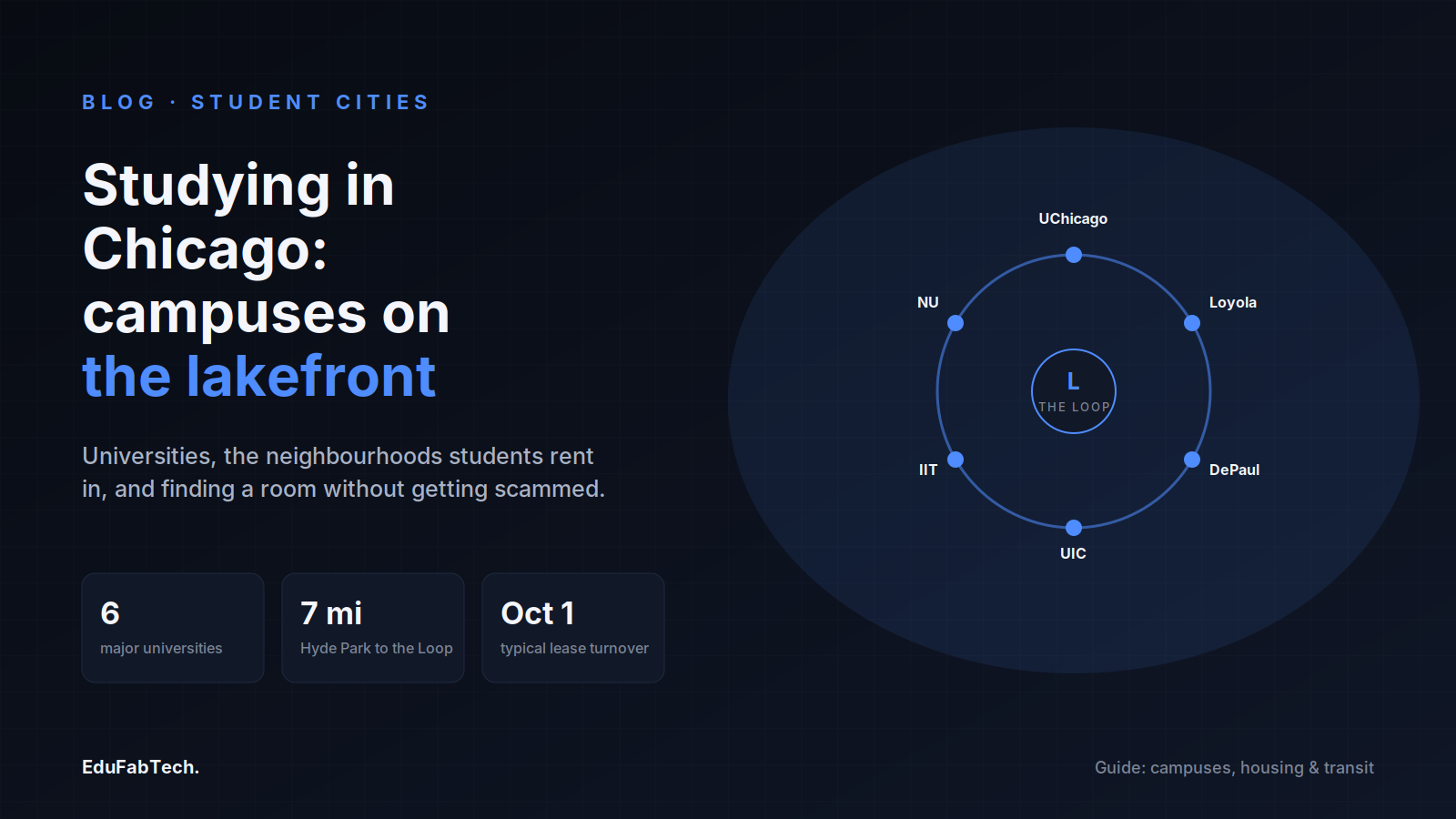
Chicago: a city of campuses on the lake
Chicago sits on the south-western shore of Lake Michigan, laid out on a near-perfect grid that makes the whole city unusually easy to read: streets are numbered outward from the intersection of State and Madison in the central Loop, and the elevated rail line — the "L" — threads the neighbourhoods together. It is a flat, broad, working city of dozens of distinct communities, and its student population is spread across a remarkable range of institutions, from world-leading research universities to small seminaries and specialist colleges. Where you study shapes which part of the lakefront you come to think of as home.
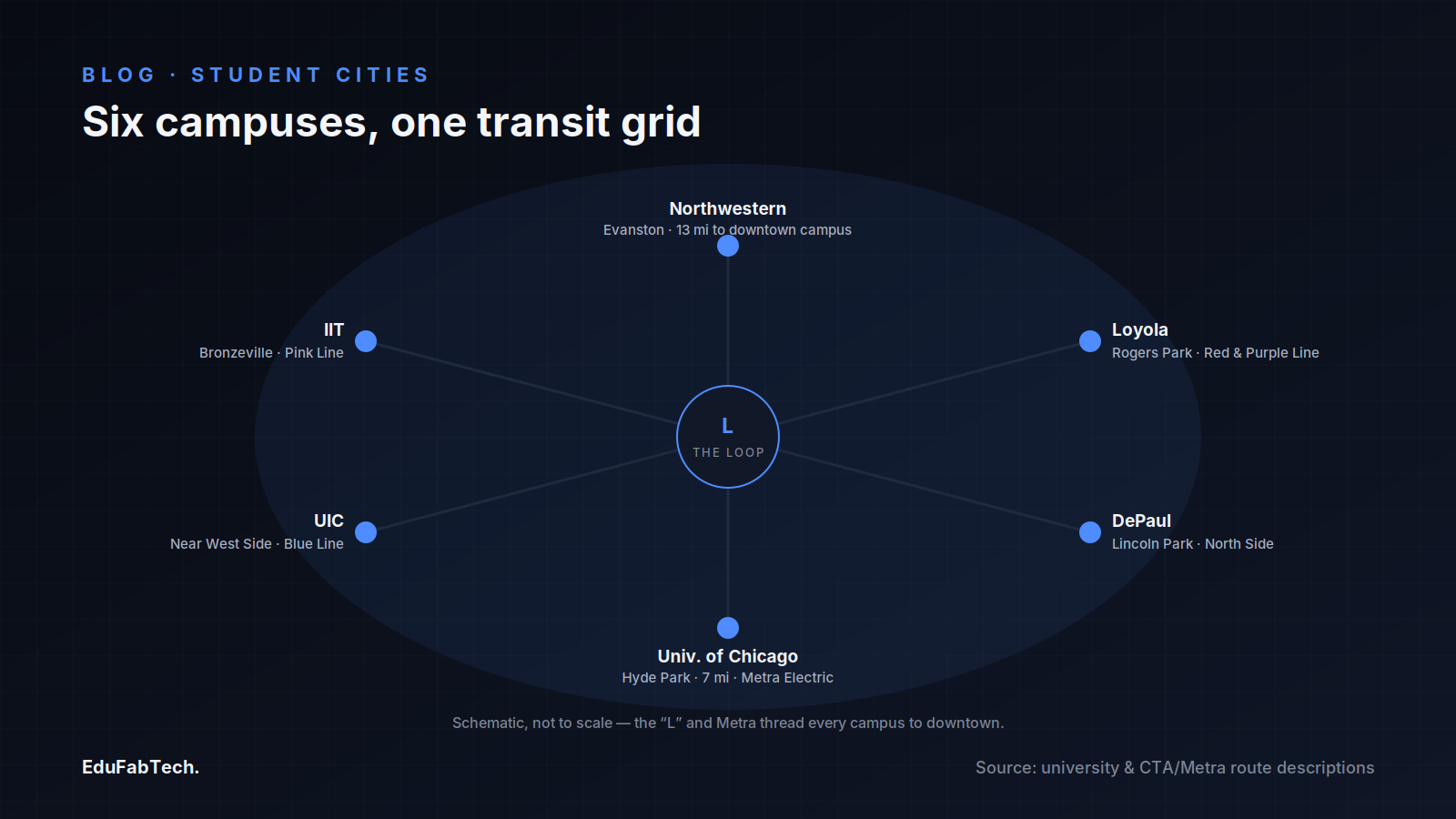
The University of Chicago occupies Hyde Park, a leafy, museum-dense neighbourhood roughly seven miles (about twenty minutes by train) south of downtown. Its Neo-Gothic quadrangles are modelled on Oxford, and the university is best known for its rigorous Core curriculum and for foundational work in economics, physics and sociology. Undergraduates study in the College of the University of Chicago; alongside it the university runs the Graham School of Continuing Liberal and Professional Studies and the University of Chicago School of Social Service Administration (renamed the Crown Family School in 2021). The independent Toyota Technological Institute at Chicago, a graduate computer-science research school, sits on its doorstep in Hyde Park.
Northwestern University is the other research heavyweight, though its main campus is not in the city at all: it lies on the Lake Michigan shore in Evanston, the suburb immediately to the north. Northwestern describes its Evanston and downtown Chicago campuses as "just 13 miles apart," and the lakefront setting — beaches, sailing, hammocks in warm weather — defines student life there. It is especially known for journalism, management and music.
University of Illinois Chicago is the city's largest public research university, built on the Near West Side just beyond the downtown expressway interchange. It anchors the Illinois Medical District, one of the largest concentrations of health-care and research institutions in the country; its health-sciences colleges include the University of Illinois at Chicago College of Dentistry, the UIC College of Pharmacy and the University of Illinois at Chicago School of Public Health, while the University of Illinois at Chicago College of Liberal Arts and Sciences carries much of the undergraduate teaching.
A few minutes south, in the historic Bronzeville neighbourhood, the Illinois Institute of Technology occupies a modernist landmark: its Mies Campus, the Illinois Institute of Technology Academic Campus, holds the world's largest collection of buildings designed by Ludwig Mies van der Rohe. The university is strong in engineering, architecture and technology, and its influential IIT Institute of Design pioneered design education in the United States.
Two large private universities round out the picture. Loyola University Chicago, a Jesuit institution, has its flagship Lake Shore Campus on the lakefront in the Rogers Park and Edgewater neighbourhoods on the far North Side. DePaul University, which describes itself as the largest Catholic university in the United States by enrolment, spreads across two campuses — a lively one in Lincoln Park and a vertical one in the downtown Loop. Downtown you will also find Roosevelt University, housed partly in the landmark Auditorium Building and home to the Chicago College of Performing Arts; Columbia College Chicago, a large arts-and-media college in the South Loop; East–West University, a small private university nearby; and Moody Bible Institute on the Near North Side.
The rest of Chicago's universities, named
Chicago's higher-education map runs far beyond the headline names, into the suburbs that ring the city and across the state line into north-west Indiana. The following are real, if smaller or more specialised, and worth knowing exist.
Other public universities: Chicago State University on the Far South Side; Northeastern Illinois University in the North Park neighbourhood; Governors State University in the far southern suburbs; and, across the Indiana line, Indiana University Northwest in Gary and Purdue University Northwest in Hammond — the latter formed in 2016 from a merger that absorbed the former Purdue University Calumet.
Faith-based and suburban universities: Dominican University and Concordia University Chicago, both in River Forest; Benedictine University in Lisle; Lewis University in the south-west suburbs, known for its aviation programmes; University of St. Francis in Joliet; Saint Xavier University in Evergreen Park; St. Augustine College, a bilingual institution in Uptown; American Islamic College, also in Uptown; Trinity Evangelical Divinity School in Bannockburn; Hyles–Anderson College, an independent Baptist college in Lake County; and National Louis University, long associated with teacher education.
Health-sciences and professional schools: Rush University, tied to its medical centre in the Illinois Medical District; Midwestern University and Chamberlain University, both in Downers Grove; National University of Health Sciences in Lombard; Illinois College of Optometry near the IIT campus; The Chicago School of Professional Psychology; and The Institute for Clinical Social Work.
Career, specialist and research institutes: DeVry University, headquartered in Oakbrook Terrace; Northwestern College, a career college in Bridgeview (not to be confused with the university in Evanston); The ORT Institute, a vocational training school in Morton Grove; McCrone Research Institute, a microscopy research and teaching centre; and Mayfair Academy of Fine Arts, a dance school in Whiting.
Historic and closed institutions you may still see named: the Old University of Chicago, the original institution that closed in 1886 before the present university was founded; Barat College in Lake Forest, which closed in 2005; Mundelein College, a former women's college that affiliated with Loyola University Chicago in 1991; Shimer College, a great-books college that spent its final years on the IIT campus before merging into North Central College in 2017; La Salle Extension University, a correspondence school that closed in 1982; the International Academy of Design and Technology in Hoffman Estates, now closed; and Tribeca Flashpoint Media Arts Academy, a media-arts college that closed in 2017.
The neighbourhoods students actually live in
Chicago is big, and "living near campus" means very different things depending on which campus. These are the areas students most commonly rent in; the character and commute matter as much as the rent.
Hyde Park (South Side). The natural home for University of Chicago students: tree-lined streets, bookshops, museums and the lake, with the university itself owning a large stock of apartment buildings within walking distance of campus. It feels like a self-contained college town but is well connected downtown by the Metra Electric commuter line and express buses. Rents are moderate by big-city standards; the trade-off is relative distance from the northern nightlife.
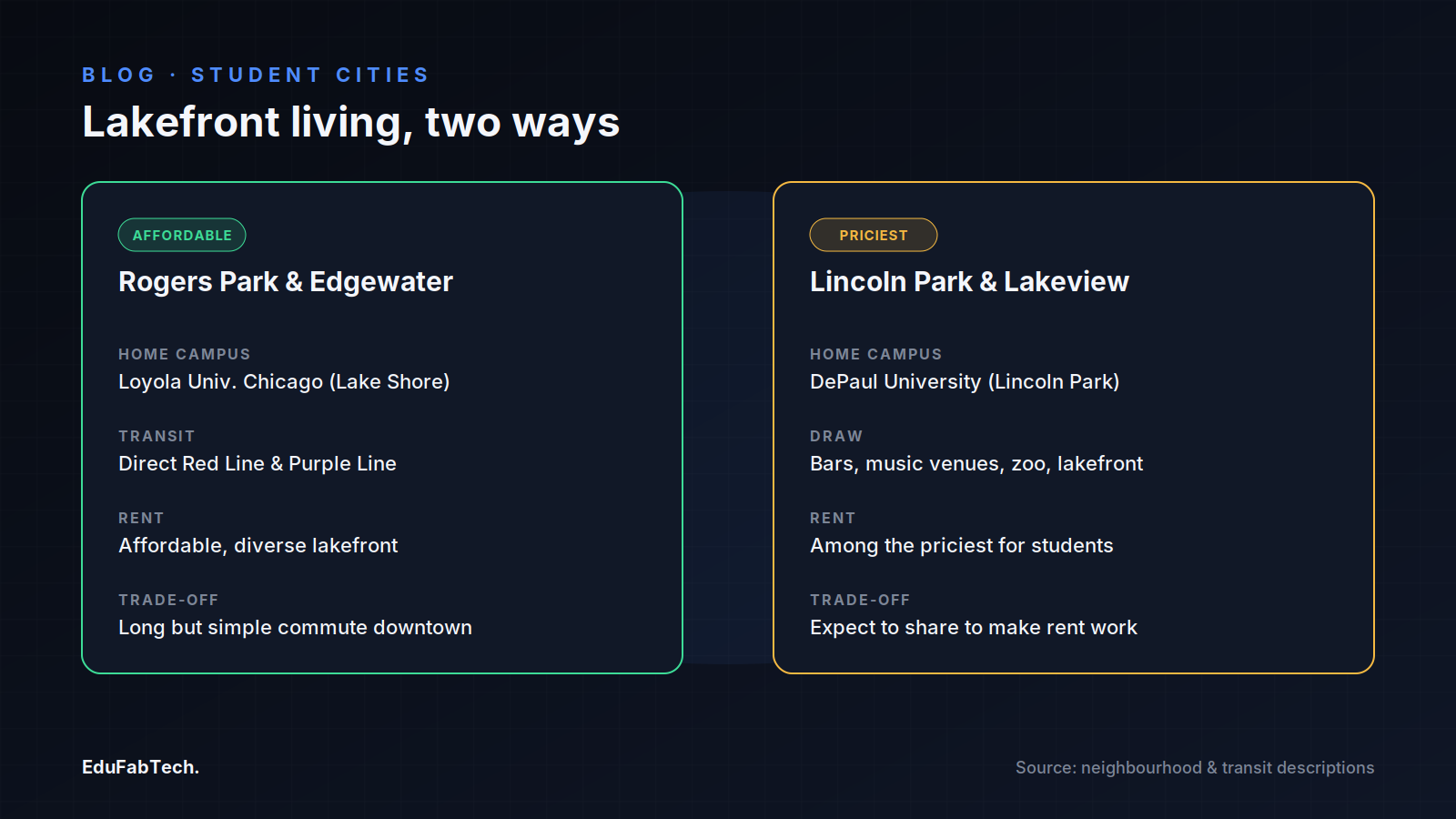
Rogers Park and Edgewater (far North Side). Loyola University Chicago's lakefront campus sits here, and the area is one of the most diverse and affordable lakeside options in the city, served directly by the Red Line and Purple Line. Beaches are a short walk away; the restaurants run the length of the world. The commute downtown is long but simple.
Lincoln Park and Lakeview (North Side). DePaul University's residential campus is in Lincoln Park, and the surrounding area is among the city's most popular — and priciest — for students who want bars, music venues, the zoo and the lakefront on their doorstep. Expect to share to make the rent work.
Pilsen and the Lower West Side. A historically Mexican-American neighbourhood known for murals, galleries and music, west of the South Loop and close to UIC and IIT via the Pink Line. It has drawn arts students for its studios and comparatively lower rents, though rising prices and questions of gentrification are a live local issue.
Near West Side and University Village. The blocks immediately around UIC and the Illinois Medical District, convenient for anyone studying or working there and well served by the Blue Line. It is practical rather than picturesque, and demand from medical and graduate students keeps rooms moving quickly.
Evanston. For Northwestern students, the suburb itself is the student district: a walkable college town with its own downtown, reached from the city on the Purple Line. Rents near the lake and campus are high; move a few blocks inland and they ease.
Finding a room without being scammed
Most students rent either a room in a shared flat or a studio, usually on a twelve-month lease that in Chicago famously turns over on 1 October or, in student areas, around the start of term. Demand peaks in late spring and midsummer, so start looking two to three months before you need to move; the best-value rooms in Hyde Park, Rogers Park and Lincoln Park go early. University housing offices and off-campus housing listings are the safest first stop, and several institutions run their own databases for enrolled students.
Before you pay anything, confirm the basics in writing: the monthly rent, what utilities and heating are included (Chicago winters make heating a real cost), the length of the lease, the deposit, and who is responsible for repairs and snow clearance. Ask whether the building has working heat and secure entry, and check the commute to campus at the actual hour you will travel, not on a map.
On scams: never send money for a room you have not seen. See the place in person, or on a live video call if you are still abroad, before you pay a cent. A listing far below the market rate, a "landlord" who is conveniently travelling and cannot show it, or any pressure to transfer a deposit quickly are all warning signs. Never pay a deposit or "holding fee" by bank wire transfer, gift card or cryptocurrency — those payments are effectively impossible to recover. Pay only after you have seen the unit and have a signed lease naming the real owner or managing agent, and get every receipt in writing. EduFabTech lists rooms and places to stay in the city.
Furnishing a room, and the markets Chicago is known for
Furnishing cheaply is straightforward in a city this size. The classic Chicago option is the Maxwell Street Market, a historic open-air market run by the City of Chicago; in the 2026 season it runs on selected Sundays from 10 a.m. to 3 p.m. with free admission, back at its original home on Maxwell Street between South Halsted Street and South Union Avenue, selling an eclectic mix of resale housewares, clothing, crafts and famous street food. Beyond it, thrift stores, charity shops and resale furniture outlets are scattered across almost every neighbourhood, and the end-of-lease turnover each autumn — especially around 1 October — fills kerbsides and online "free" boards with usable furniture as students move out.
It is worth checking local listings for second-hand goods and give-aways before buying anything new; a mattress, desk and set of pans can usually be assembled for very little if you are not in a hurry. EduFabTech keeps city listings for second-hand things and second-hand furniture in Chicago.
Work, libraries and getting around
International students should understand the work rules before they arrive and rely on the official source rather than second-hand advice. For students on a standard study visa, the national immigration authority's official guidance for international students states that on-campus employment is limited to a maximum of 20 hours per week while school is in session, and that off-campus work generally requires prior authorisation and specific eligibility. Rules change and depend on your exact status, so confirm your situation with your university's international-student office and the official pages; nothing here is legal advice. Local listings for part-time work can help once you know what you are permitted to do.
For studying, Chicago is unusually well served. The Harold Washington Library Center in the South Loop, the central branch of the free Chicago Public Library, is one of the largest public library buildings in the world and open to all, with quiet floors, study rooms and Wi-Fi; branches across the city offer the same. University libraries — the vast Regenstein and Mansueto domes at the University of Chicago, UIC's Daley Library, and the research collections at Northwestern and Loyola — are generally reserved for enrolled students but are the backbone of day-to-day study. EduFabTech also lists study spaces and desks around the city.
Getting around is done on the CTA. For enrolled students, the Ventra U-Pass — a transit card offered through participating institutions — provides, in the CTA's own words, "unlimited rides on the CTA during your enrollment as an eligible student." It covers CTA buses and trains only (Pace suburban buses and Metra commuter rail are separate). The Red and Blue Lines run 24 hours, the grid of buses fills in the rest, and the flat terrain makes cycling genuinely practical for much of the year. Commuter rail on Metra links the suburbs and reaches Hyde Park directly.
What it costs
Housing is the dominant cost, and it varies sharply by neighbourhood. For a citywide anchor, the U.S. Census Bureau's QuickFacts reports a median gross rent of US$1,440 a month across the city of Chicago, drawing on 2020–2024 American Community Survey estimates. Student rooms in shared flats typically fall below that figure, while studios in Lincoln Park or lakefront Evanston run well above it; the South and far North Sides are generally cheaper than the North-Side lakefront.
The other cost outsiders underestimate is winter. According to NOAA's National Weather Service 1991–2020 climate normals, Chicago's January averages a high of 31.6°F (about 0°C) and a low of 18.8°F (about −7°C), with 11.3 inches (roughly 29 cm) of snow. That translates into real money for heating and for warm clothing you may not already own, and it is worth budgeting for before your first winter rather than during it.
The honest trade-offs
What is good about Chicago for students is considerable. It is a genuine world city — museums, music, theatre, food from everywhere, and a lakefront with eighteen miles of public beaches and paths — at a cost of living well below the coastal giants. The transit grid is comprehensive and the U-Pass makes it nearly free to use. The sheer number of institutions means a dense, varied student culture and easy movement between campuses and ideas.
What is hard is honest too. The winter is long, grey and genuinely cold, and it tests people who have not lived through one. Commutes between the South and North Sides can swallow an hour each way, so where you live is a real decision, not a detail. Rents on the North-Side lakefront have climbed steeply, and good-value rooms disappear fast in summer. Chicago is also a segregated city with uneven safety block by block; ask current students and your housing office about specific streets rather than relying on reputation, and treat any neighbourhood as a set of blocks, not a label.
A checklist for your first weeks
- Register with your university and, if you are an international student, check in with the international-student office immediately — your status and any work permission depend on it.
- Get your Ventra card or U-Pass and learn the two or three transit lines you will actually use between home and campus.
- Sign nothing and pay nothing for housing you have not seen in person or by live video; confirm the lease names the real owner or agent.
- Open the heating conversation with your landlord before winter — know what is included and how it is controlled.
- Get a free Chicago Public Library card for study space, Wi-Fi and borrowing beyond your campus.
- Furnish from the Maxwell Street Market, thrift shops and autumn move-out give-aways before buying anything new.
- Buy a proper winter coat, boots and gloves early; do not wait for the first snow.
- Browse the city's student listings and listings near the University of Chicago to orient yourself before you arrive.
A quick question for readers
Do you work part-time while you study?
Many students work to pay the bills. See how common it is — and how many hours people really do.
Pick an answer, create a free account in a minute, and your vote counts. Already a member? Sign in
- U.S. Census Bureau. QuickFacts: Chicago city, Illinois — Median gross rent (HSG860222). U.S. Census Bureau, 2024. link
- NOAA National Weather Service. Chicago Normals (1991–2020): January Temperature, Precipitation and Snowfall. National Weather Service, Chicago/Romeoville Forecast Office, 2021. link
- U.S. Department of Homeland Security. Working in the United States — Study in the States. DHS Student and Exchange Visitor Program, 2024. link
- Chicago Transit Authority. Ventra U-Pass. Chicago Transit Authority, 2024. link
- City of Chicago. Maxwell Street Market. City of Chicago, Department of Cultural Affairs and Special Events, 2026. link
- University of Chicago. Campus, Hyde Park, Chicago. University of Chicago College Admissions, 2025. link
- Northwestern University. Evanston and Chicago. Northwestern University, 2025. link