Studying in Cincinnati: universities, housing and student life
A practical, sourced guide to Cincinnati's universities, the neighbourhoods students settle in, what a room costs, how to get around, and the honest trade-offs of studying in this river city.
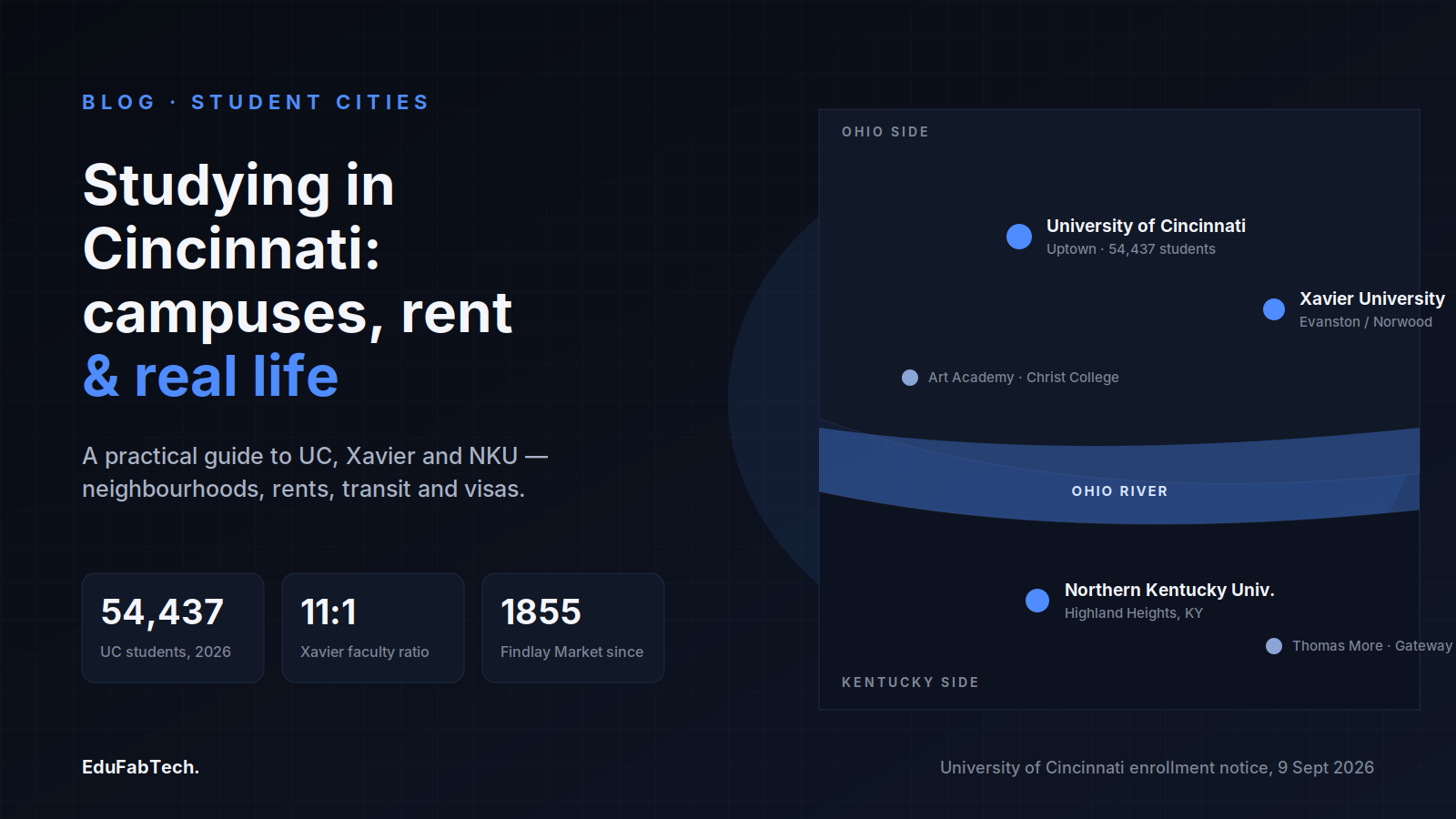
Cincinnati sits on a bend of the Ohio River, pressed between steep hillsides and the Kentucky bank on the far shore. The practical consequence for a student is that the city is not flat and not tidy: campuses sit on ridges and in valleys, neighbourhoods are divided by hills and highways rather than a neat grid, and two of the universities you might attend are in another state across the river. Getting the geography straight early saves a lot of wasted rent and commuting.
The student population is anchored by one very large public university in the Uptown hills, a mid-sized Jesuit university a few miles east, and a cluster of Kentucky institutions on the south bank. Around them are smaller art, nursing and community colleges that quietly grant real degrees. This guide names each one, then turns to the questions that decide whether a term goes smoothly: where to live, how much a room costs, how to avoid rental scams particular to this city, and how to move around without a car.
What follows leans on primary sources wherever a number appears — university fee pages, the transit operators' own fare pages, and the federal immigration authority — because in a city this spread out, a figure that is a year out of date can send you to the wrong neighbourhood. You can also browse local student listings on EduFabTech's Cincinnati page as you read.
The universities, and what studying here is like
The University of Cincinnati (UC) is the giant. Its main campus sits in the Uptown district on the hills above downtown, next to the medical campus and the hospitals. UC reported a record headcount of 54,437 students in fall 2026, including 44,207 undergraduates, in a university announcement dated 9 September 2026. It is known for its College of Design, Architecture, Art, and Planning (DAAP), its College-Conservatory of Music (CCM), and the University of Cincinnati College of Engineering and Applied Science — the home of UC's long-running cooperative-education model, which alternates paid work terms with study. Co-op means many UC students spend semesters away from campus at employers, which shapes how leases and roommates work here.
Xavier University is the other large Cincinnati institution, a few miles east in the Evanston and Norwood area. It describes itself on its own About page as a Jesuit Catholic university with a 200-year legacy, an 11:1 student-to-faculty ratio and more than 80 undergraduate majors; it is strong in business and health, and its Musketeers basketball team is a fixture of campus life. Across the river in Highland Heights, Kentucky, Northern Kentucky University is a public university best known for the Salmon P. Chase College of Law; it draws heavily from the Northern Kentucky suburbs and downtown Cincinnati alike.
Several smaller colleges grant degrees and matter to specific students. The Art Academy of Cincinnati, established in 1884 with roots in the 1869 McMicken School of Drawing and Design, is a private college of art and design at 1212 Jackson Street in Over-the-Rhine, awarding BFA and master's degrees, per its About page. The Christ College of Nursing & Health Sciences is a hospital-based college tied to The Christ Hospital, granting nursing and health-sciences degrees in Cincinnati. Across the river, Thomas More University is the Catholic liberal-arts university of the Diocese of Covington, on a campus in the Crestview Hills/Edgewood area of Northern Kentucky with about 2,350 students, according to its About page; and Gateway Community and Technical College, part of the Kentucky Community and Technical College System, offers associate degrees and certificates from campuses in Covington and Edgewood. Further west, Mount St. Joseph University in Delhi Hills is a small Catholic university worth knowing if you want a quieter campus.
Studying across these institutions feels different from a single-campus college town. UC's Uptown campus has the density and energy of a research university wedged into a residential grid; Xavier is leafier and more contained; the Kentucky schools are commuter-heavy. Pick your neighbourhood to match where you will actually spend your days — and note that the free university shuttles and transit passes below only work if you live on the right side of the river.
Neighbourhoods where students actually settle
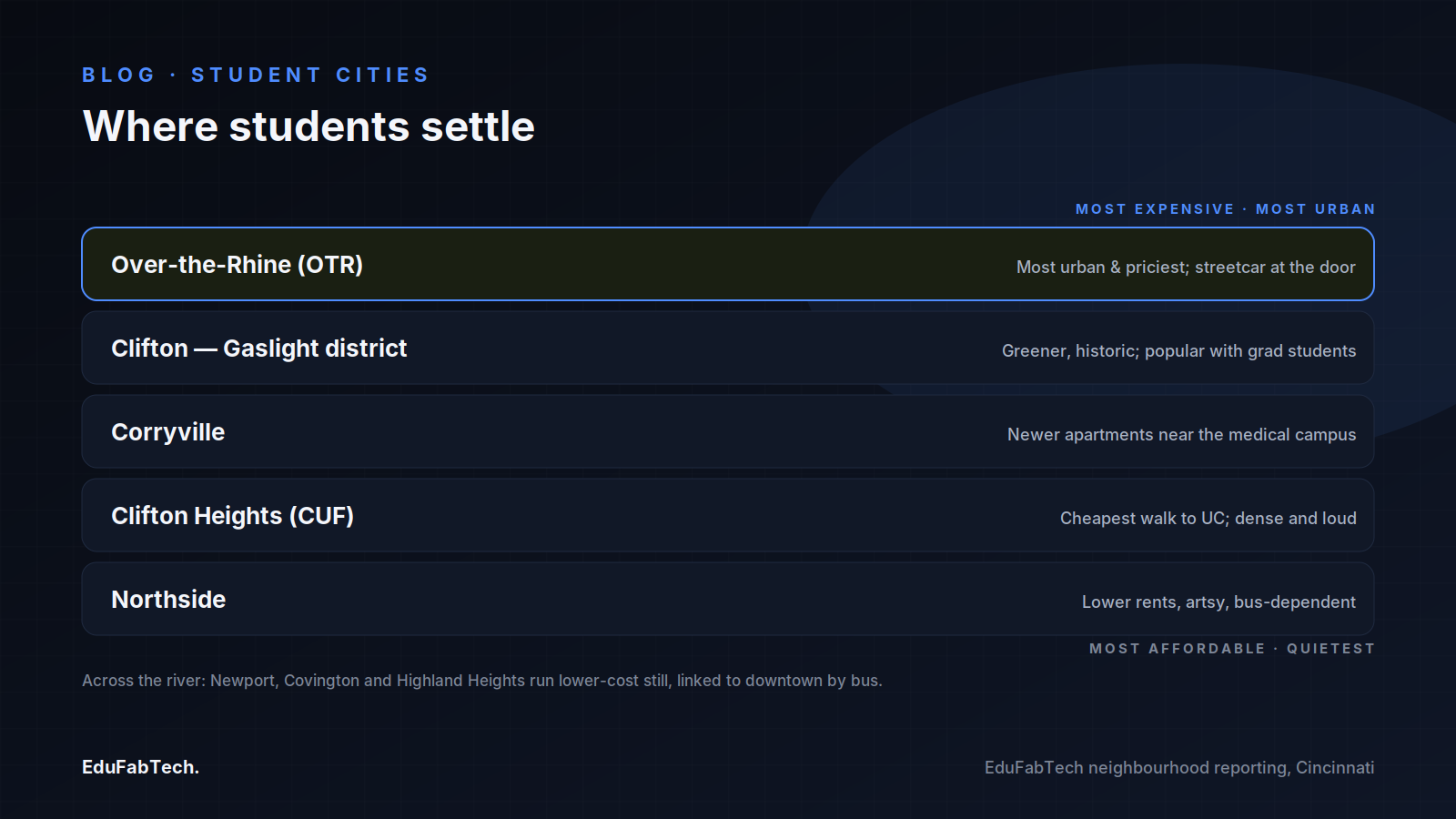
Clifton Heights (CUF) — short for Clifton-University-Fairview — is the classic UC student neighbourhood, immediately west and south of campus along the Calhoun and McMillan Street corridor. It is the cheapest place to walk to class, dense with older rental houses and student apartments, loud on weekends, and the first area to fill up. Corryville, just east of campus around the Short Vine strip and near the medical campus, is the counterpart: newer purpose-built apartments, bars and the Bogart's music venue, convenient for health-sciences and medical students.
Clifton proper, around the Ludlow Avenue "Gaslight" district, is greener and more historic, popular with graduate students and staff who want a short bus ride rather than a party scene, and generally a little pricier per room. Northside, to the northwest, is the artsy, independent-minded option — music venues, lower rents, a strong bar and café culture — but you will rely on the bus. Over-the-Rhine (OTR), the historic Italianate district between downtown and Uptown, has been heavily redeveloped; it is the most urban and the most expensive of the student-adjacent areas, with Findlay Market, nightlife and the streetcar at the door.
For Xavier students, the surrounding Norwood and Evanston streets offer affordable rentals within walking or short-driving distance; Norwood is actually a separate incorporated city entirely surrounded by Cincinnati, which occasionally matters for things like parking permits. For the Kentucky schools, students cluster in Newport and Covington on the river and in Highland Heights near NKU itself — all lower-cost than Uptown, and connected to downtown Cincinnati by bus. Browse what is currently available in each area on EduFabTech's Cincinnati rooms listings.
Finding a room, and the Cincinnati scams to watch
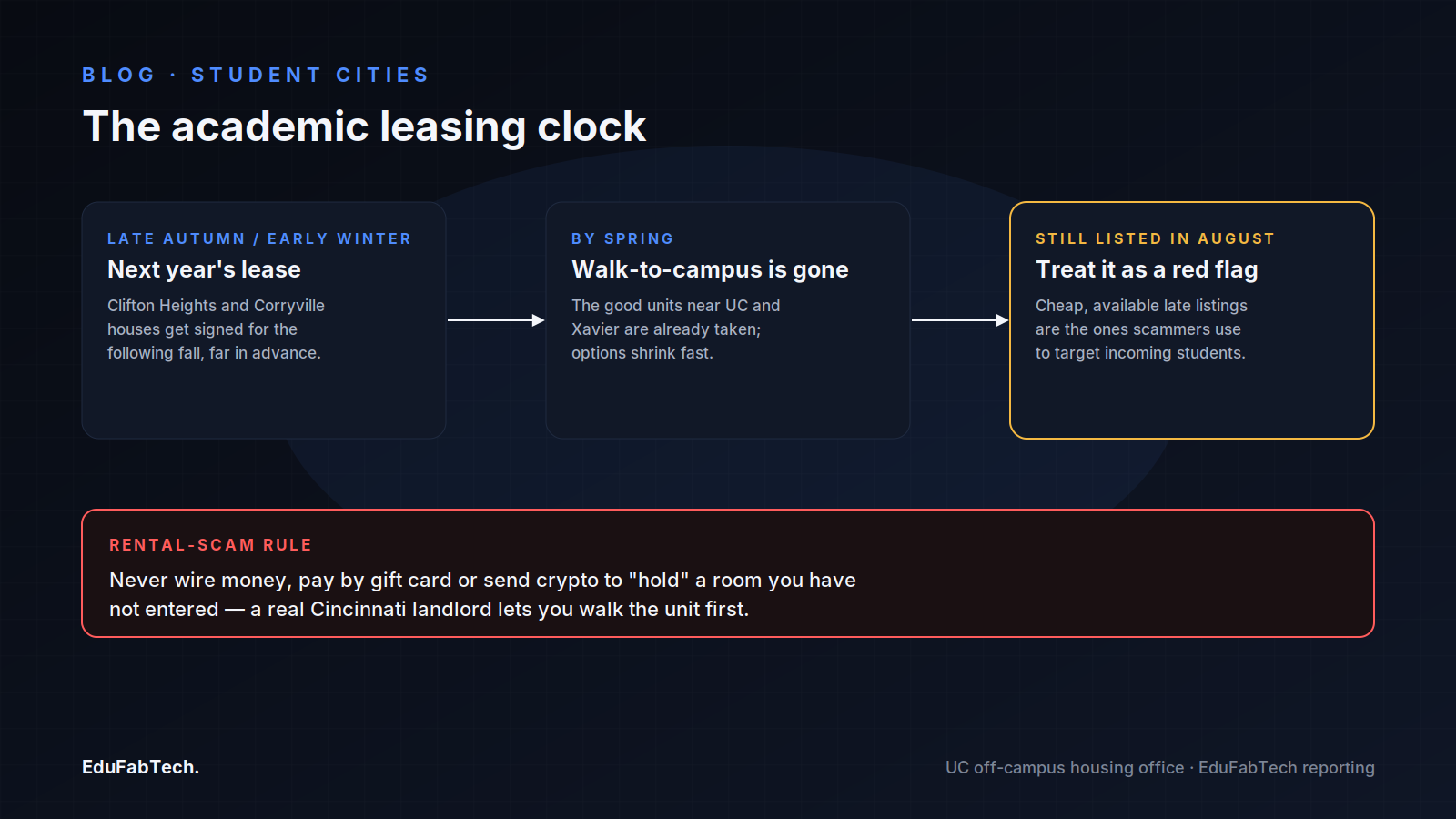
The off-campus market around UC runs on an academic clock. Leases in Clifton Heights and Corryville are often signed many months ahead — students frequently commit to the next year's house by late autumn or early winter — so the good walk-to-campus units go early, and anything still cheap and available in August is worth a second, sceptical look. UC's own housing office and the universities' off-campus listing services are the safest starting points; begin there before trusting an open-web listing.
The scams here follow a predictable shape. A "landlord" posts a Clifton Heights house or an OTR loft below the going rate, claims to be out of town — a common story near a university with so many co-op students genuinely away — and asks you to send a deposit or first month to "hold" it before you can see inside. Do not. Never send money by bank wire, gift card, payment app or cryptocurrency to secure a room you have not entered; a real Cincinnati landlord will let you walk the unit, and these payment methods are chosen precisely because they cannot be reversed. If you are abroad and cannot visit, ask a current student, a friend, or the university's off-campus office to view it for you, and insist on a signed written lease that names the actual property address before any money changes hands. A security deposit of about one month's rent is normal locally; a demand for several months up front, or for payment before a lease, is a warning sign. You can compare genuine local offers on EduFabTech's rooms page rather than chasing unverified posts.
Furnishing a room cheaply, and Findlay Market
Cincinnati's great civic institution for anyone setting up a kitchen is Findlay Market in Over-the-Rhine, which has, in its own words, operated continuously in the same iron-framed building since 1855. It is open Tuesday to Friday 9am–6pm, Saturday 8am–6pm and Sunday 10am–4pm (closed Mondays), and the weekend outdoor stalls are where you will find cheap produce, spices and the occasional second-hand seller. It is a short walk or a free streetcar ride from downtown.
For furniture and household goods, the city has a dense network of thrift stores run by the Society of St. Vincent de Paul and Goodwill, plus the move-out churn around UC: at the end of each spring semester, Clifton Heights and Corryville streets fill with discarded furniture and giveaway piles as leases turn over, which is the single cheapest way to furnish a room if your timing is right. EduFabTech keeps running local listings for second-hand things and items given away free in the city; check them in August and again in May, when supply peaks.
Part-time work, visas and the 20-hour rule
If you are an international student on an F-1 visa, the rules on working are set by federal law, not the university, and they are strict. The U.S. Department of Homeland Security's Study in the States service states plainly that "if you participate in on-campus employment, you may not work more than 20 hours per week when school is in session," and that it requires approval from your school's Designated School Official, as set out on its Working in the United States page. The same page explains that off-campus employment is tightly limited and generally requires completing at least one full academic year plus separate authorisation. Treat your DSO as the authority on your individual case; this guide is not legal advice, and the official DHS page and your international-student office are the sources to rely on. Domestic students face no such cap, and campus jobs, the hospitals in Uptown and the service economy around Findlay Market and OTR are common sources of part-time work. Local openings are collected on EduFabTech's Cincinnati jobs page.
Libraries and places to study
UC's Walter C. Langsam Library is the main study building on the Uptown campus, with subject libraries — including the DAAP, engineering/science (CEAS) and health-sciences libraries — scattered across the hill, so you are rarely far from a desk. Off campus, the public system, the Public Library of Cincinnati and Hamilton County, is unusually strong: its downtown Main Library is large and open to anyone, and branch libraries in Clifton, Norwood and across the river give you quiet, free workspace near wherever you live. These are genuinely useful for students who want to escape a crowded house or who live between campuses. For cafés, co-working desks and bookable rooms that students are currently sharing, see EduFabTech's Cincinnati study-spaces listings.
Getting around: Metro, the Connector and TANK
Buses in Cincinnati and Hamilton County are run by Cincinnati Metro (the Southwest Ohio Regional Transit Authority). Metro's fare page lists a local single ride at $2.20, payable in cash or through the Transit app with EZFare, and — importantly — it states that students at the University of Cincinnati and Cincinnati State enrolled in the University Discount Program "may ride Metro's fixed-route bus service for half fare." If you attend one of those schools, set that discount up before you buy a pass.
Within the urban core, the Cincinnati Bell Connector streetcar runs a loop linking Over-the-Rhine, downtown and The Banks, and the city's streetcar office confirms it is "fare free everyday." It is the easiest free way to move between Findlay Market, downtown jobs and the riverfront. South of the river, buses are run by the Transit Authority of Northern Kentucky (TANK). This matters a great deal if you study at NKU, Gateway or Thomas More: TANK's NKU page states that "anyone with a valid NKU All-Card or current Gateway or Thomas More ID can ride TANK routes free," swiped in the farebox when boarding, per TANK's school shuttles page. For a student without a car, choosing a Kentucky school and living near a TANK route can make transport effectively free.
What is good, and what is hard
The good: Cincinnati is comparatively affordable for a city of its size, its student neighbourhoods are walkable and dense, and the free streetcar plus free TANK rides for Kentucky students make car-free life genuinely workable in the right areas. The university housing figures are published and predictable — for the 2026-27 (TG2627) cohort, approved by UC's Board of Trustees on 23 June 2026, a traditional multiple-occupancy residence-hall room costs $4,497 per semester and an apartment-style multiple-occupancy room $5,904 per semester (room only, before any meal plan), according to UC's Housing & Meal Plan Rates page. That gives you a concrete benchmark to judge off-campus offers against.
The hard: the hills and the river fragment the city, so a cheap room in the wrong neighbourhood can mean a slow, transfer-heavy bus commute. Winters are grey and cold and summers humid, which wears on anyone used to a milder climate. The redevelopment of OTR and parts of Uptown has pushed rents up in exactly the walkable areas students want, and the earliest-leasing dynamic around UC rewards students who plan months ahead and punishes late arrivals. None of this is a reason to avoid Cincinnati — but it rewards a plan.
A checklist for the first weeks
- Confirm which campus and side of the river you are on, and choose a neighbourhood that matches — Clifton Heights/Corryville for UC, Norwood/Evanston for Xavier, Newport/Covington/Highland Heights for the Kentucky schools.
- Never pay a deposit before you (or a trusted stand-in) have walked the unit; use a written lease with the real address, and never wire money, send gift cards or pay in crypto to "hold" a room.
- Set up the right transit discount: the University Discount Program half fare on Cincinnati Metro, or free TANK rides with your NKU All-Card, Gateway or Thomas More ID.
- International students: meet your Designated School Official and confirm the on-campus 20-hours-per-week limit and any work authorisation through the official DHS Study in the States page before taking any job.
- Get a Public Library of Cincinnati and Hamilton County card for free study space, and scout your nearest campus library.
- Furnish from Findlay Market, local St. Vincent de Paul and Goodwill thrift stores, and the May move-out giveaways — and check EduFabTech's second-hand and jobs listings as you settle in.
Notes — skipped entries: School for Creative and Performing Arts (Cincinnati) — a public K–12 magnet arts school, grants no college degrees; Cincinnati Christian University (Ludlow) — closed in December 2019; Saint Gregory Seminary (Sherwood) — a Catholic seminary that permanently closed in 1980. Edgecliff College, God's Bible School and College, the Greater Cincinnati Consortium of Colleges and Universities, and the listed high schools were omitted from the main text as not useful degree-granting choices for a general student reader.
A quick question for readers
Do you work part-time while you study?
Many students work to pay the bills. See how common it is — and how many hours people really do.
Pick an answer, create a free account in a minute, and your vote counts. Already a member? Sign in
Source: University of Cincinnati
Sources (5)
- University of Cincinnati. Housing & Meal Plan Rates (TG2627 cohort, 2026-27). University of Cincinnati, 2026. uc.edu ↗ · checked 4 Oct 2026
- University of Cincinnati. Record Fall 2026 enrollment at the University of Cincinnati. University of Cincinnati, 2026. uc.edu ↗ · checked 4 Oct 2026
- Cincinnati Metro (SORTA). Fare Information. Southwest Ohio Regional Transit Authority, 2026. go-metro.com ↗ · checked 4 Oct 2026
- U.S. Department of Homeland Security. Working in the United States (Study in the States). DHS Study in the States, 2026. studyinthestates.dhs.gov ↗ · checked 4 Oct 2026
- Findlay Market. About Findlay Market. Corporation for Findlay Market, 2026. findlaymarket.org ↗ · checked 4 Oct 2026