Studying in Cleveland, United States: universities, housing and student life
Cleveland's student life runs along Euclid Avenue between downtown and University Circle — here are its universities, the neighbourhoods students rent in, how to find a room safely, and the costs you can actually check.
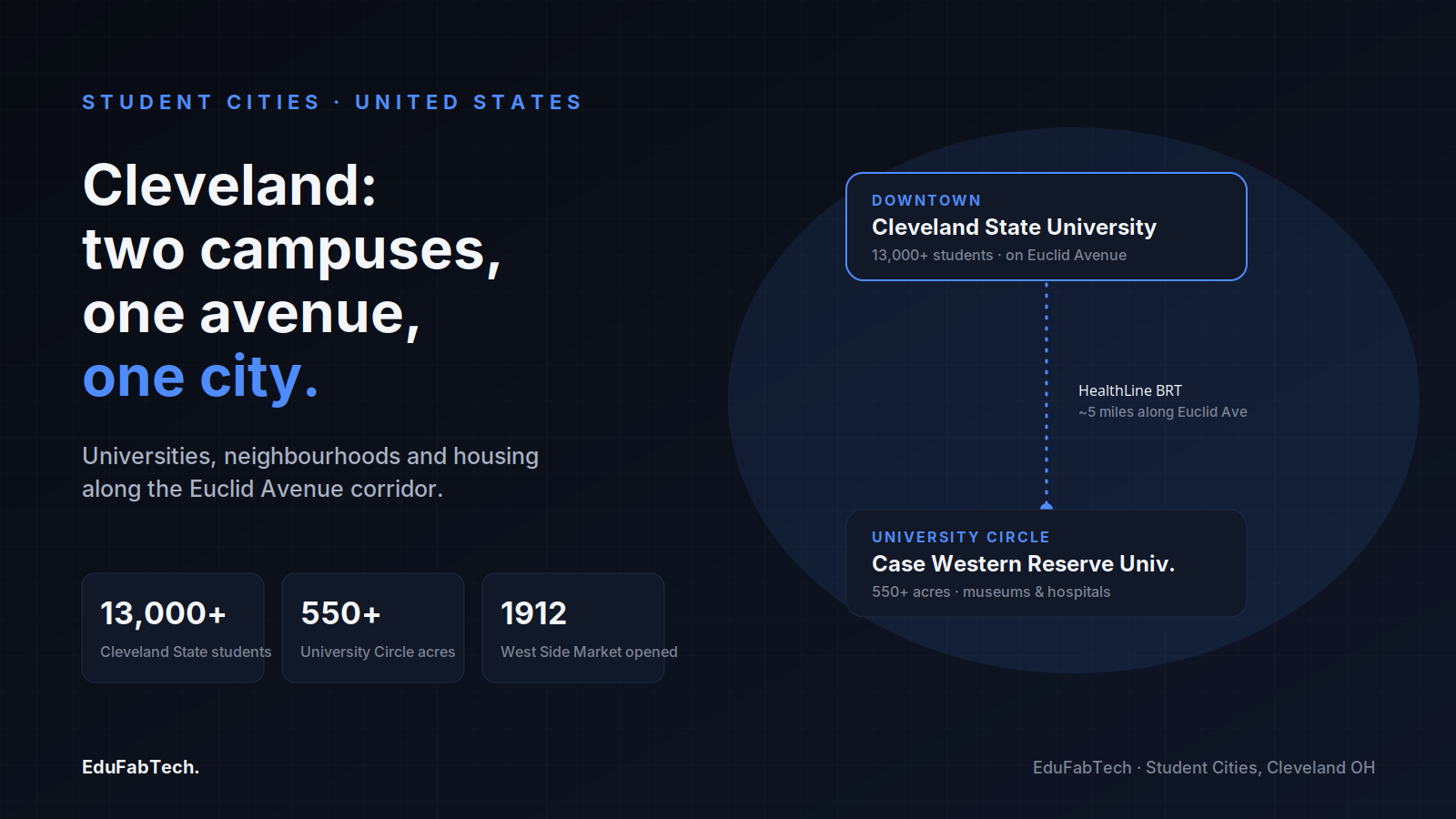
Cleveland sits on the south shore of Lake Erie, folded around the valley of the Cuyahoga River that still divides local speech into "the east side" and "the west side." For students the city has two centres of gravity rather than one. Downtown, along Euclid Avenue, holds Cleveland State University; about five miles east, in the University Circle neighbourhood, Case Western Reserve University shares a square mile with hospitals, orchestras and museums. A bus-rapid-transit line runs the length of Euclid Avenue between them, which is why so much of student life here is strung along that one street.
Those two poles do not exhaust the map. Baldwin Wallace University is twenty minutes south-west in the suburb of Berea; Ursuline College is east in Pepper Pike; trade and professional schools are scattered through the inner neighbourhoods. Where you end up living, and how long your commute is, depends heavily on which of these you attend. EduFabTech keeps the city's student listings together at /in/united-states/cleveland-oh, and this guide is meant to be read alongside them.
What follows is practical: the universities and what studying at each is like, the neighbourhoods students actually choose, how to find a room without losing money, where to furnish it, how to get around on the RTA, the rules that may apply if you want to work, and an honest account of what the city asks in return — the winters, the commutes and the costs you can actually verify.
The universities, from University Circle to Berea
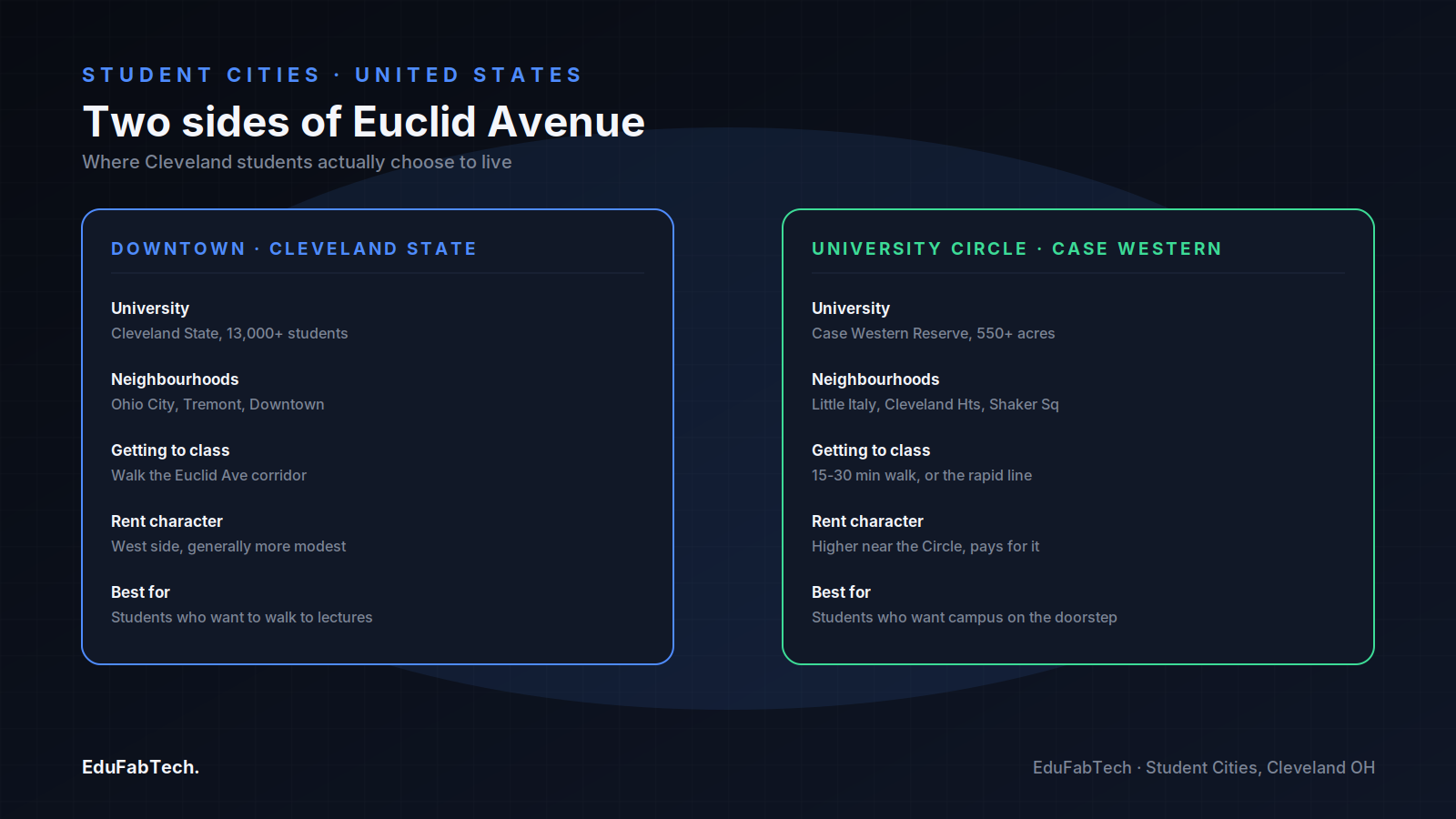
Case Western Reserve University is the city's research university, formed in 1967 when the Case Institute of Technology and Western Reserve University federated. Its own pages place it just east of downtown in University Circle, which the university describes as "over 550 park-like acres" shared with the Cleveland Museum of Art, the Cleveland Botanical Garden and Severance Music Center, home of the Cleveland Orchestra (case.edu). It is strong in engineering, medicine, nursing and the sciences, and it is tightly woven into the neighbouring Cleveland Clinic and University Hospitals. Among its graduate schools is the Jack, Joseph and Morton Mandel School of Applied Social Sciences, Case Western's social-work school, which grants the Master of Social Work, the Master of Nonprofit Organizations and a PhD in social welfare (bulletin.case.edu). Listings close to the campus are grouped at /near/case-western-reserve-university.
Cleveland State University is the downtown counterpart: a public university that, by its own count, enrols "more than 13,000" students across eight colleges on "more than 85 acres" in downtown Cleveland (csuohio.edu). Established by the Ohio legislature in 1964, it held its first classes in 1965, began as a commuter school and still draws on the region; it reports that about 85 percent of its alumni stay in the area. Its urban-affairs programme, the Maxine Goodman Levin College of Urban Affairs — now the urban-affairs school within Cleveland State's Levin College of Public Affairs and Education — is ranked third in the United States for urban policy in the 2026 U.S. News & World Report rankings (levin.csuohio.edu).
Baldwin Wallace University sits in Berea, which it describes as about "20 minutes from" Cleveland. Founded in 1845, it enrolled 2,618 students in autumn 2026 and is known for its Conservatory of Performing Arts and its business programmes (bw.edu). Ursuline College, in Pepper Pike east of the city, is a Catholic, women-focused liberal-arts college whose best-known programmes are nursing and art therapy (ursuline.edu). For the trades, Ohio Technical College on East 51st Street is a private technical college teaching automotive, diesel, collision-repair, restoration and welding programmes (ohiotech.edu).
Where students settle, across the east and west sides
Most undergraduates at Case Western live in or beside University Circle, where the university's own housing and the Uptown development put flats, cafés and the museums within a ten-minute walk. It is the most convenient address in the city if you study there, and generally the most expensive per bedroom. For a little more room and a little less rent, students spill east into the neighbourhoods below; those at Cleveland State weigh downtown against the cheaper west side.
Little Italy, immediately south-east of University Circle, is a compact grid of brick streets, Italian restaurants and galleries with its own rapid-transit station; Case Western's own guidance describes "a direct 30-minute train ride to downtown" from there (case.edu). It fills quickly with graduate students and pays for its charm in higher rents and tight parking.
Cleveland Heights — specifically the Coventry, Cedar-Fairmount and Cedar Lee pockets just uphill from University Circle — is where a large share of Case Western students rent. The same university guidance calls it "a 15- to 25-minute walk" to campus, with grocery stores, pubs and a long-standing bohemian streak. Rents are lower than inside the Circle and the housing is mostly older houses split into flats.
Shaker Square, a 1920s shopping square south of the Circle, offers flats around restaurants and a cinema and sits on the RTA's Blue and Green rapid lines, so it is a short train ride to both University Circle and downtown.
Ohio City, on the west side across the river, is built around the West Side Market and borders downtown, which makes it a realistic base for Cleveland State students who want neighbourhood life rather than a tower block. Tremont, just south, is the city's Victorian arts district — steep streets, churches, galleries and small restaurants. Both are lively and have grown more expensive as they have gentrified.
Downtown itself, around the Cleveland State campus and the Euclid corridor, suits students who want to walk to class and do not mind that the area still empties somewhat in the evenings. For Baldwin Wallace students, Berea is a separate calculation: a quiet, walkable suburb where rents are modest but a car or the RTA is needed to reach the city.
Finding a room without losing a deposit
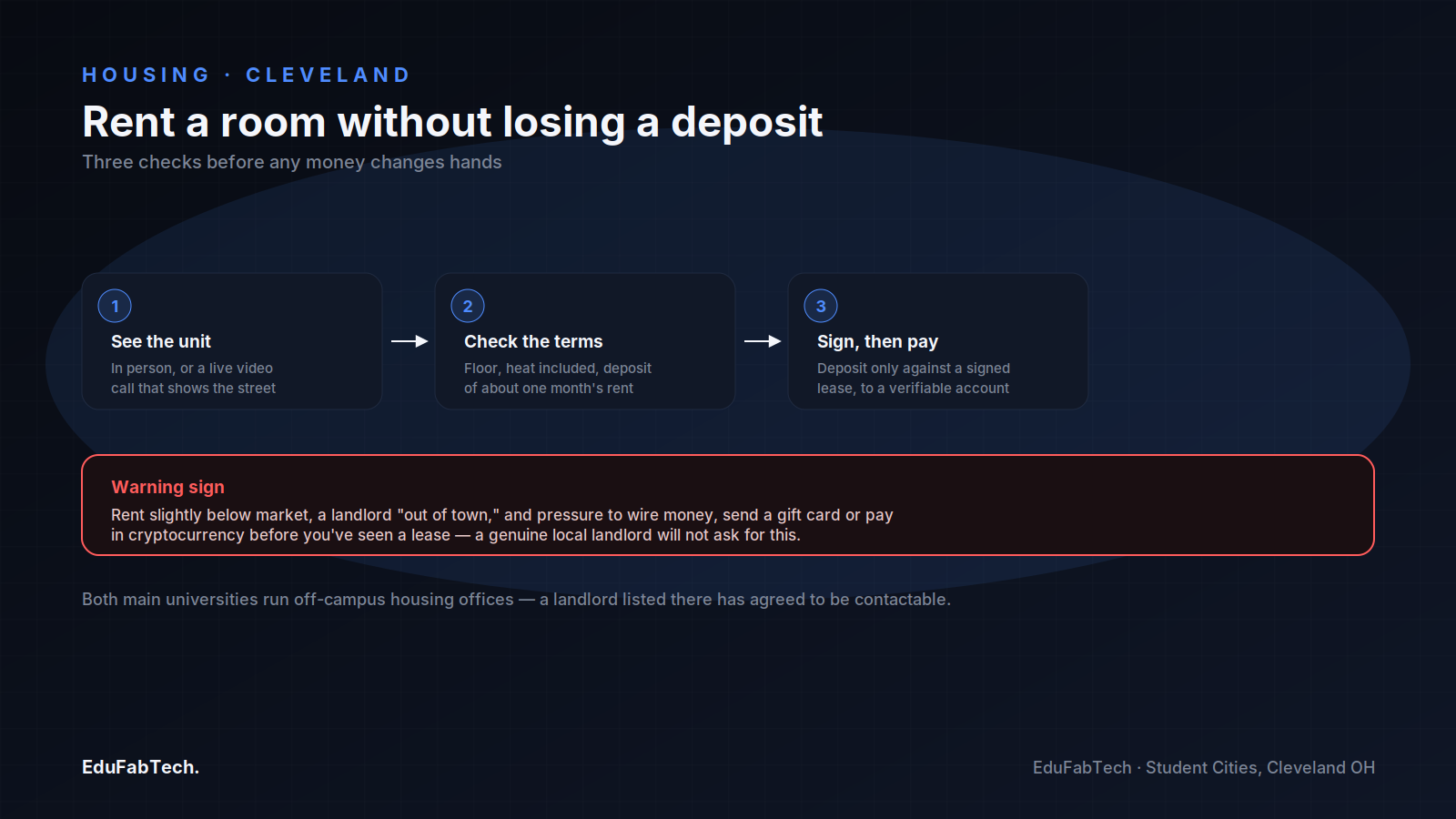
Demand runs on the academic calendar. Leases near University Circle and in Cleveland Heights turn over in summer, so the serious search starts in the late winter and spring before an autumn start; downtown and Berea are a little easier. Both main universities run off-campus housing offices and listing services — use them, because a landlord willing to be listed through a university has agreed to be contactable. EduFabTech's own rooms listings for the city are at /in/united-states/cleveland-oh/rooms.
Before you pay anything, see the actual unit — in person if you are already in Cleveland, or over a live video call with someone who can walk the rooms and show the street if you are still abroad. Many of the city's older houses are divided into flats, so confirm which floor and which entrance are yours, whether heat is included against Cleveland winters, and what the landlord expects for a deposit. In Ohio a security deposit is commonly one month's rent on top of the first month; an amount far below the market, or a request to pay before you have seen a lease, is a warning sign.
The scams that appear in Cleveland follow a pattern: a listing for a house in Ohio City, Tremont or near the Circle at a rent slightly below everything else, a "landlord" who is conveniently out of town, and pressure to send a holding deposit sight-unseen. Never send money by bank wire, gift card or cryptocurrency to hold a room — those payments cannot be recovered, and a genuine local landlord will not demand them. Pay a deposit only against a signed lease and to an account you can verify.
Furnishing a room: the West Side Market and the second-hand circuit
The anchor of everyday shopping is the West Side Market in Ohio City, at West 25th Street — the city's largest and oldest public market, open since 1912 (westsidemarket.org). Its stalls of produce, meat, bread and prepared food are open Monday, Wednesday, Friday and Saturday from 8am to 5pm and Sunday from 10am to 4pm, and the Red Line rapid stops a short walk away. It is where many students do their weekly food shop and where the west side gathers.
For the rest of a room — desk, chair, pans, a winter coat — Cleveland's turnover of students and its large housing stock keep a steady second-hand supply moving, heaviest in May and August when leases end. Rather than name shops that come and go, EduFabTech tracks what is being sold and given away locally at /in/united-states/cleveland-oh/second-hand. End-of-semester "free piles" outside residence halls and student houses are a Cleveland institution worth a walk.
Getting around: the HealthLine, the Red Line and the U-Pass
The Greater Cleveland Regional Transit Authority (RTA) runs the buses and trains. Its signature route is the HealthLine, a bus-rapid-transit line down the full length of Euclid Avenue that connects downtown to University Circle; RTA says the HealthLine cut travel time along the corridor from 46 to 34 minutes and runs every 10 minutes at peak times (riderta.com). The rail Red Line runs from University Circle and downtown out to Cleveland Hopkins International Airport, which makes arriving from abroad simple.
Cash fares, as listed by RTA in 2026, are US$2.50 for a single ride, US$5.00 for an all-day pass, US$25 for a seven-day pass and US$95 for a monthly pass (riderta.com). Students at the big universities rarely pay those directly. Case Western's U-Pass gives undergraduates free, unlimited rides on any RTA bus or train, funded by a US$50 activity fee charged each semester, while graduate and professional students pay US$70 a semester for the same (case.edu). Cleveland State and Tri-C run comparable U-Pass arrangements, so check with your own university before buying any pass.
Working while you study
Rules on employment depend on your immigration status, and they are set nationally, not by the city. For students on an F-1 visa, the U.S. government's Study in the States site states plainly that in on-campus employment "you may not work more than 20 hours per week when school is in session," and that to take such a job you must "talk to your DSO" — the Designated School Official at your university — who issues the approval (studyinthestates.dhs.gov). Off-campus work and practical training carry separate conditions. This is not legal advice: confirm your own case with your university's international-student office before you accept any work. Local part-time openings on and around campus are listed at /in/united-states/cleveland-oh/jobs.
Libraries and places to study
Beyond the campus libraries, the Cleveland Public Library is a genuine resource. Its Main Library downtown, at 325 Superior Avenue East, lends to residents and offers bookable study and meeting rooms, and is open Monday to Saturday (cpl.org). The system's branches reach into most of the neighbourhoods students live in, which matters in winter when a warm, quiet room a few streets away beats the trip to campus. Case Western and Cleveland State both keep their own libraries open long hours during term. Desks and quiet study spots posted by other students in the city are collected at /in/united-states/cleveland-oh/study-spaces.
What it costs, and the honest trade-offs
Housing is where Cleveland's relative affordability shows. On campus, Case Western's published 2026-27 rates run from US$11,540 a year for a first-year double room to US$13,150 for a single, with first-year meal plans a further US$4,130 to US$8,600 a year (case.edu). Cleveland State's Euclid Commons, downtown, listed a four-person, four-bedroom flat at US$10,404 for the 2025-26 academic year (csuohio.edu). Those are useful anchors because they are what the universities actually charge; private rents off-campus are generally lower per room, especially on the east side beyond the Circle and out in Berea, though a single reliable published figure for student rents specifically is hard to find.
What is good: by the standard of American university cities, Cleveland is cheap, and the concentration of major hospitals, museums and an orchestra within walking distance of Case Western is unusual for a city this size. The HealthLine and Red Line mean you can live without a car if you stay near the corridor. What is hard: the lake-effect winters are long, grey and snowy; the city is spread out, so living cheaply on the far east or west side can mean real commutes; parts of downtown still quieten after work; and, as across the United States, the housing search rewards those who start early. Several colleges in the area have also closed in recent years, a reminder to check that any programme you are considering is still enrolling.
A checklist for your first weeks
- Set up your university U-Pass or RTA sticker before you start paying cash fares.
- If you are on a visa, meet your DSO at the international office and confirm what work, if any, you may do.
- See any room in person or by live video, and pay a deposit only against a signed lease — never by wire, gift card or crypto.
- Time your Euclid Avenue commute: ride the HealthLine or Red Line from where you plan to live to campus before you sign.
- Get a Cleveland Public Library card for study rooms and lending beyond your campus.
- Do a first furniture run in May or August, when leases end and the second-hand supply is highest.
- Prepare for winter early: a proper coat and boots are not optional here.
A quick question for readers
Rate these parts of student life this term
Rate each one from 1 (very poor) to 5 (very good). Together the results show where students struggle most.
Rate 5 things →Source: Case Western Reserve University
Sources (5)
- Case Western Reserve University. 2026-2027 Room and Board Rates. Case Western Reserve University, 2026. case.edu ↗ · checked 6 Oct 2026
- Cleveland State University. Cleveland State University At a Glance. Cleveland State University, 2026. csuohio.edu ↗ · checked 6 Oct 2026
- Greater Cleveland Regional Transit Authority. Fares. Greater Cleveland RTA, 2026. riderta.com ↗ · checked 6 Oct 2026
- U.S. Department of Homeland Security. Working in the United States. Study in the States (DHS), 2026. studyinthestates.dhs.gov ↗ · checked 6 Oct 2026
- West Side Market. West Side Market — Public Market in Cleveland, OH. West Side Market / City of Cleveland, 2026. westsidemarket.org ↗ · checked 6 Oct 2026