Studying in College Station: universities, housing and student life
A practical, sourced guide to Texas A&M, where students live in Aggieland, what rooms and transport actually cost, and the honest trade-offs of a city built around one university.
College Station sits in the Brazos Valley of east-central Texas, roughly between Houston, Austin and Dallas but close to none of them. It exists, in a real sense, because of one institution: the twin cities of Bryan and College Station grew up around the land-grant college that opened here in the 1870s, and the rhythm of the place still follows the academic calendar. Locals call the area Aggieland, after the students and graduates of Texas A&M University, who are known as Aggies.
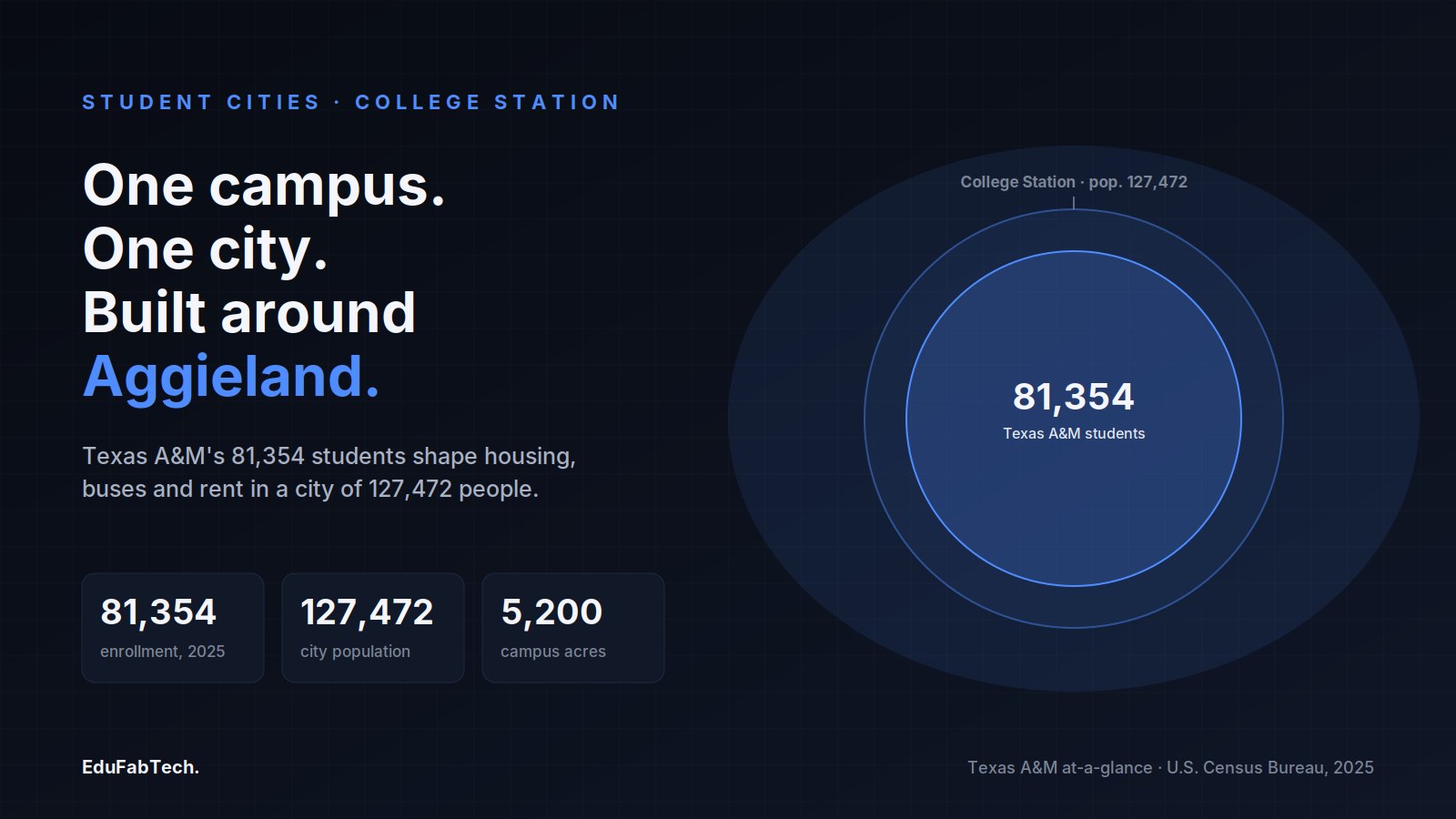
For a student, the first thing to understand is scale. Texas A&M University reports a total enrollment of 81,354 for Fall 2025, split between 62,543 undergraduates and 18,811 graduate and professional students, according to the university's at-a-glance figures. That is a very large university inside a city the U.S. Census Bureau estimated at 127,472 residents as of 1 July 2025. The ratio shapes everything — housing, buses, bars, the Saturday football crowds — more than it would in a bigger, more mixed city.
The campus itself is unusually large — the same university page lists a 5,200-acre College Station campus — and the institution has taught here since 1876. Walking from one side to the other is not realistic between back-to-back lectures, which is why the free campus bus network matters so much and why where you live is really a question of how you will get to class.
The university that is the city
Texas A&M University is the flagship of the Texas A&M University System and holds the rare combination of land-, sea- and space-grant designations; its at-a-glance page records nearly $1.4 billion in research expenditure in fiscal year 2024 and organises its academic work into 17 colleges and schools. Several of those operate at College Station: the Texas A&M College of Agriculture and Life Sciences, the Texas A&M College of Architecture (now also styled the School of Architecture), and the Texas A&M College of Education and Human Development are each large, long-established units granting their own undergraduate and graduate degrees. In 2022 the former colleges of Science, Liberal Arts and Geosciences were combined into a single College of Arts & Sciences, so the sciences and humanities are now taught under that one roof. The graduate Bush School of Government and Public Service, named for George H. W. Bush, whose presidential library sits on campus, is also here.
Health-sciences teaching is concentrated a few miles north in the city of Bryan, where Texas A&M Health Science Center — now branded Texas A&M Health — anchors the clinical campus, with degrees granted in medicine (including the MD), nursing and other health professions. If your field is clinical, assume Bryan, not the main College Station campus, for much of your coursework.
One more institution matters to student life even though it is not part of Texas A&M. Blinn College runs a large campus in Bryan, and through the Texas A&M–Blinn TEAM programme many students take some courses at each institution at once; Blinn students also ride the same off-campus buses on a Blinn ID. If you are a prospective transfer or co-enrolled student, the two campuses function almost as one commuting zone.
Which part of Aggieland to live in
Because the university is so dominant, there is no single "student quarter" — instead, distinct areas cluster around how far they sit from the Academic Building and whether you can walk, bike or need a bus.
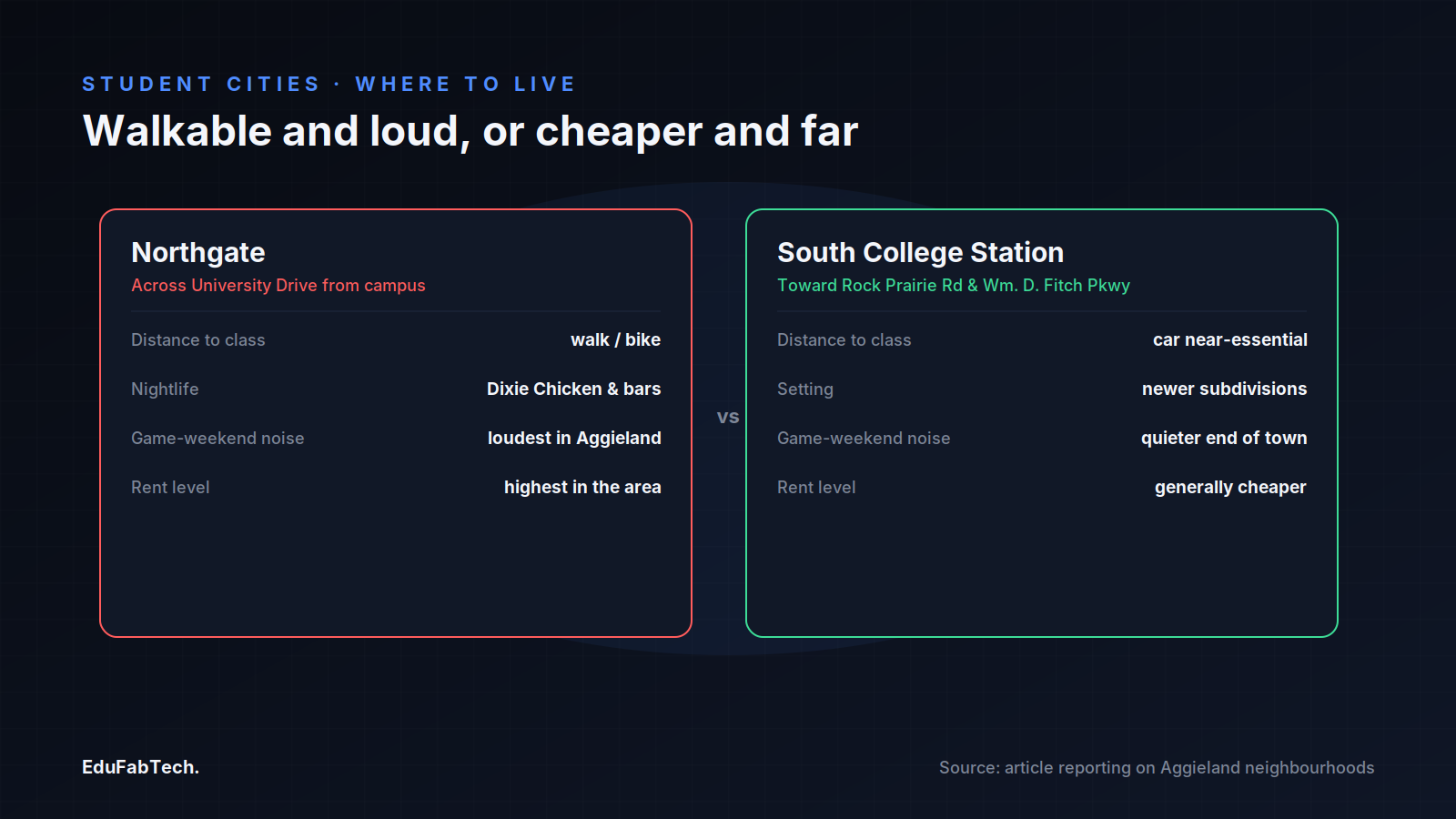
Northgate is the obvious one: a dense strip directly across University Drive from the north edge of campus, mixing older apartment blocks with the city's main nightlife (Dixie Chicken and the surrounding bars). It is the most walkable address to class and the loudest, especially on game weekends, and proximity keeps rents at the higher end.
Southside, the historic neighbourhood immediately south of campus between George Bush Drive and Holleman, is quieter — tree-lined streets of older single-family houses, some let room-by-room to students, within a short bike ride or walk of the south side of campus. It suits people who want to be close but not in the party district.
The Harvey Road and Wolf Pen Creek corridor to the east, around the Wolf Pen Creek district and Post Oak Mall, is wall-to-wall large apartment complexes aimed at students. You will usually want a bike or a bus here, but rents ease compared with Northgate and the complexes tend to be newer with pools and parking.
South College Station, stretching down Texas Avenue toward Rock Prairie Road and William D. Fitch Parkway, is further out and generally cheaper, with newer subdivisions and complexes; a car is close to essential, though it puts you near the medical district and the quieter end of town.
Across the line in Bryan, particularly around Villa Maria Road near Blinn, rents are often the lowest in the area and the commute the longest, connected to campus by the off-campus bus routes. You can browse current listings and compare areas on EduFabTech's College Station page and the listings near Texas A&M University.
Signing a lease in a town that leases a year ahead
College Station has an unusually early leasing cycle. Purpose-built student complexes often open their waiting lists for the following August as early as the previous autumn, so signing in September or October for a lease that starts eleven months later is normal here rather than a sign of a scam. That long lead time is itself the main risk: a lot of money changes hands for places people have not seen and will not occupy for the better part of a year.
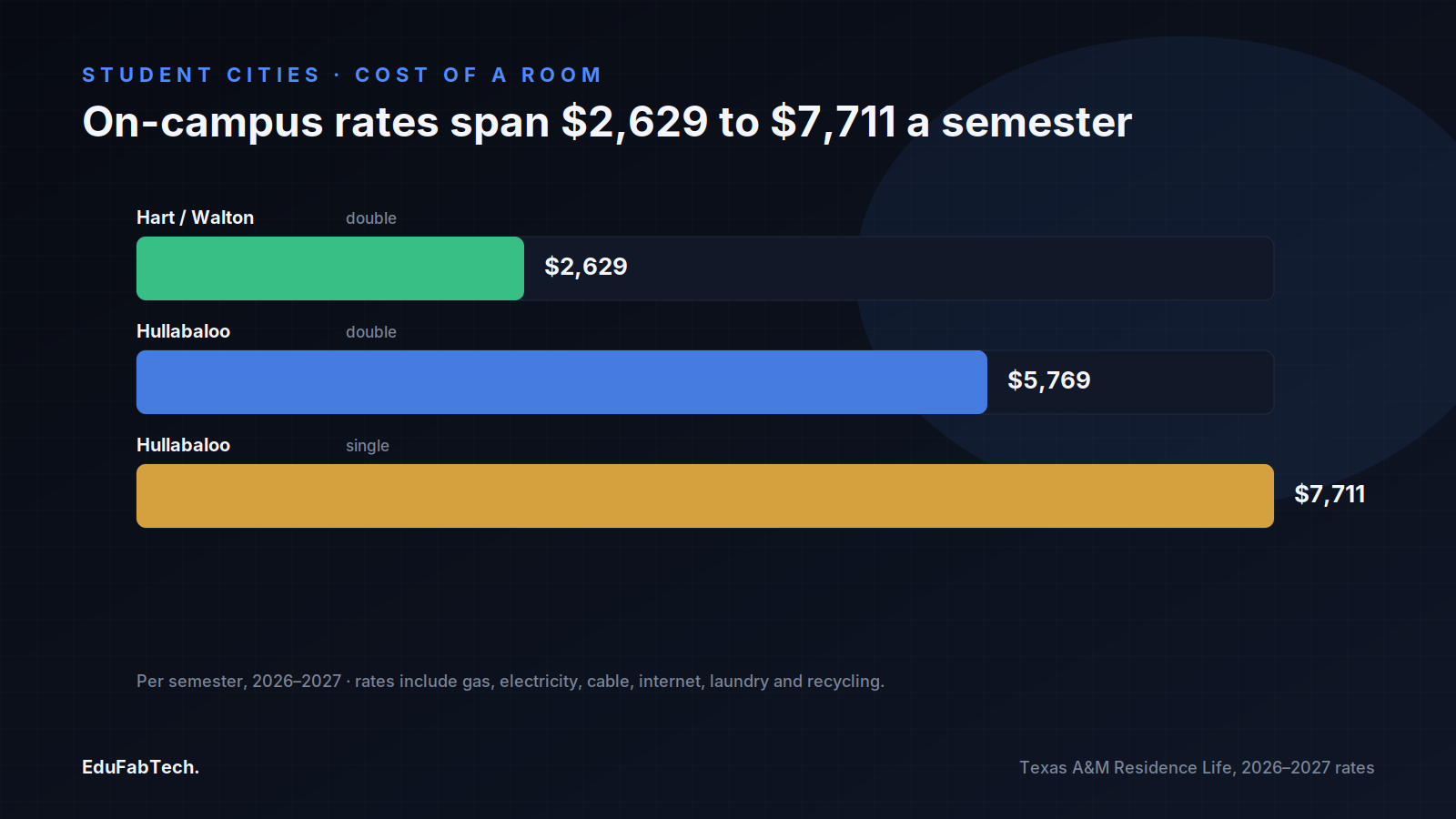
On-campus housing is handled by Residence Life, which is the safest first option for a new arrival because there is no private landlord to vet. For 2026–2027 the university's published residence-hall rates run from $2,629 per semester for a double in the oldest halls (Hart and Walton) up to $7,711 for a single in the premium Hullabaloo Hall, with a double in Hullabaloo at $5,769; those rates include natural gas, electricity, cable, internet, laundry and recycling.
For the private market, the practical rules are the same ones that protect students everywhere but worth stating in local terms. Most legitimate complaints about College Station rentals involve sublets and "roommate wanted" posts in student groups near Northgate rather than the big managed complexes. Before paying anything, see the actual unit — not just a show apartment — or have someone you trust see it; confirm the person collecting money is on the lease; and never send a deposit or "holding fee" by bank wire, gift card or cryptocurrency, none of which can be reversed. A security deposit paid by cheque or card to a named, verifiable leasing office is normal; an urgent request to wire cash to hold a room you cannot view is the classic warning sign. EduFabTech's rooms listings are a place to start comparing before you commit.
Furnishing a room for less
A city that empties and refills every August produces a lot of second-hand furniture. Move-out weeks at the end of the spring semester are the best time to pick up desks, sofas and mini-fridges cheaply or free from departing students. For a steadier supply, Second Chance Resale is a well-known local option: the City of College Station's visitor directory describes it as a resale shop whose proceeds support Twin City Mission, the Bryan–College Station homeless shelter, open Tuesday to Saturday, 9am to 5pm. Thrift and resale stores are spread across both Bryan and College Station, and large national charity shops operate in the area too. On EduFabTech you can look through local second-hand things, which are especially worth watching in late April and May when leases end and students give away what they cannot move.
Working while you study
If you are an international student, the rules on work are set by federal immigration law, not the university. The U.S. Citizenship and Immigration Services guidance on students and employment states that F-1 students may not work off-campus during their first academic year but may accept on-campus employment subject to certain conditions. The U.S. Department of Homeland Security's Study in the States guide adds the practical limits: on-campus work may not exceed 20 hours per week when school is in session, students may apply as early as 30 days before the first day of classes, and you must keep full-time enrolment and work with your school's Designated School Official. More hours are generally allowed during summer and official breaks. This is a summary, not legal advice — check with Texas A&M's International Student and Scholar Services (ISSS) and a DSO before you accept any job, and never rely on second-hand accounts of the rules.
On-campus roles — dining halls, the libraries, research labs, the rec centre — are the simplest route for international students because they sit within those rules. Current openings, on and off campus, are collected on EduFabTech's jobs listings.
Libraries and places to study
The main research library is the Sterling C. Evans Library on the central campus, with group and individual study rooms spread across several floors. Texas A&M's libraries keep long hours during term — the Evans Library and its Annex stay open late into the night — and the Medical Sciences Library's GPS Zone offers 24/7 card-swipe access to study rooms and computers, though no Texas A&M library is staffed around the clock. West Campus Library is the convenient one if your classes are on the engineering and agriculture side. Beyond the libraries, the student centre and departmental buildings hold quiet corners; EduFabTech lists additional study spaces for when term-time crowds fill the main rooms.
Getting around without a car
The single best thing about student transport here is that the bus is free. Texas A&M Transportation Services runs the Aggie Spirit system and, as its how-to-ride guide states, does not collect fares when you board any Aggie Spirit bus. The service covers both the campus and the wider city: Transportation Services describes a fleet of about 96 buses, with seven on-campus routes and twelve off-campus routes reaching apartment areas across Bryan and College Station, so there is no fare card to buy and no student-discount scheme to apply for — you simply show a Texas A&M or Blinn ID to ride.
That said, College Station is a car-oriented Texas city, and off-campus routes run far less often at night and on weekends than during the weekday class rush. Many students bike — the campus and nearby neighbourhoods are flat — but Texas Avenue and the larger roads are fast and not always cycle-friendly. If you live out toward Rock Prairie or in Bryan, assume you will eventually want a car or a reliable friend with one.
What it costs, and what is good and hard about the city
On the cost side, the anchors are the ones above: the U.S. Census Bureau's QuickFacts put the median gross rent in College Station at $1,194 per month for 2020–2024, and the university's own 2026–2027 residence-hall rates range from $2,629 to $7,711 per semester depending on hall and room type. Those are the figures you can rely on; headline apartment "from" prices advertised by complexes are not, because they usually assume shared bedrooms and omit utilities and fees.
The honest balance for a student is roughly this. In its favour, College Station is comparatively affordable next to Austin or the big coastal cities, the free bus network removes a real expense, the campus is well funded, and the town is safe and friendly in the specific way a mid-size university town can be — much of local life is built for students. Against it: the summers are long, hot and humid, which is draining if you arrive from a cooler climate; the city is spread out and hard to live in without planning around the bus or a car; the pre-leasing cycle pressures newcomers into signing early for places they have not seen; and on home-football Saturdays in autumn the town's population swells and traffic, parking and noise become serious. The university has also signalled it is trying to slow undergraduate growth after years of record intakes, so expect competition for the best-located rooms to stay intense.
A checklist for the first weeks
- Sort a bed first. If you have not secured private housing, apply for on-campus Residence Life housing early and treat it as the safe default while you learn the city.
- Get your student ID and, if you are an international student, complete your ISSS check-in before starting any campus job.
- Learn two or three Aggie Spirit routes that connect your home to campus, and note how early the last evening bus runs on your line.
- Never wire money to hold a room; view any private rental in person and confirm who is actually on the lease before paying.
- Furnish from resale shops and end-of-semester giveaways rather than buying new.
- Find your study base — Evans Library, the West Campus Library or the Medical Sciences Library GPS Zone — before the first round of deadlines.
College Station rewards students who plan around its two defining facts: a single enormous university, and a flat, spread-out Texas city that moves to its calendar. Get the room and the bus route right early, and the rest of Aggieland is comparatively easy to live in.
A quick question for readers
How did you find your current room or flat?
The answers show which ways of finding housing actually work for students.
Pick an answer, create a free account in a minute, and your vote counts. Already a member? Sign in
Source: Texas A&M University
Sources (5)
- Texas A&M University. Texas A&M at a Glance. Texas A&M University, 2025. tamu.edu ↗ · checked 7 Oct 2026
- Texas A&M University Residence Life. Residence Hall Rates 2026–2027. Texas A&M University, 2026. reslife.tamu.edu ↗ · checked 7 Oct 2026
- U.S. Census Bureau. QuickFacts: College Station city, Texas. U.S. Census Bureau, 2025. census.gov ↗ · checked 7 Oct 2026
- U.S. Department of Homeland Security. Working in the United States (Study in the States). U.S. Department of Homeland Security, 2025. studyinthestates.dhs.gov ↗ · checked 7 Oct 2026
- City of College Station. Visitor Directory: Second Chance Resale. City of College Station, 2026. visit.cstx.gov ↗ · checked 7 Oct 2026