Studying in Columbus, United States: universities, housing and student life
A sourced, practical guide to studying in Columbus, Ohio — its universities, the neighbourhoods students live in, rents, the COTA bus, part-time work rules and honest trade-offs.
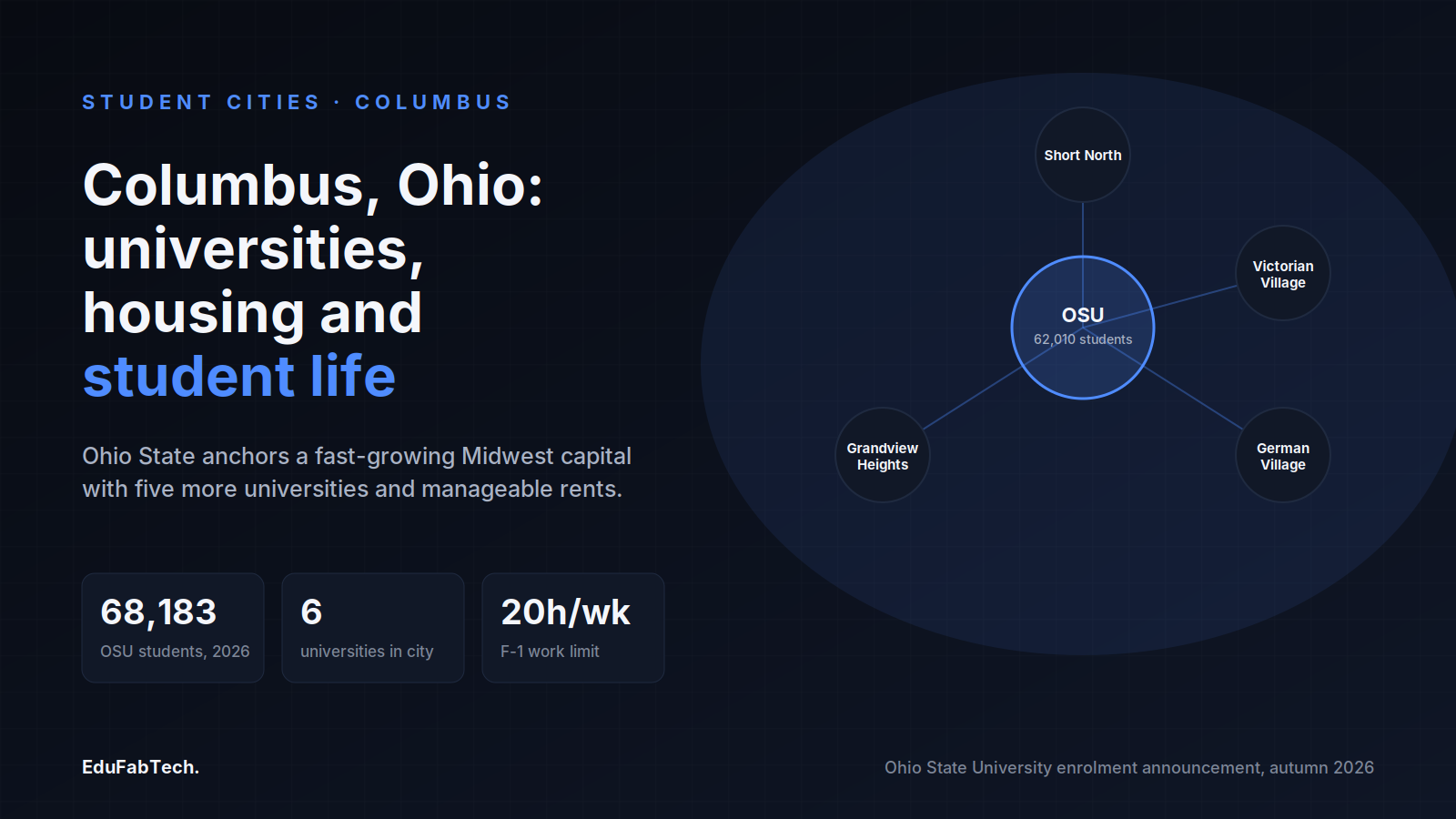
Columbus is the capital of Ohio and, for a city its size, unusually easy to misread from the outside. It is flat, laid out on a broad grid, stitched together by the Scioto and Olentangy rivers, and — unlike many American cities of comparable scale — still growing. The Ohio State University's own about page calls Columbus the fastest-growing metropolitan area in the Midwest, and the university sits close to the centre of why: a single campus large enough to set the rhythm of the whole north side of the city.
The scale is worth stating plainly. Ohio State reported a record 68,183 students across all its campuses in autumn 2026, with 62,010 of them on the Columbus campus and 47,308 undergraduates there, according to the university's own enrolment announcement. That makes the Columbus campus bigger than many whole towns, and it shapes everything a student deals with here — rents, bus routes, the queue at a coffee shop in September.
But Columbus is not only Ohio State. Franklin University runs out of downtown, Columbus College of Art & Design sits a few blocks from the statehouse, and three smaller universities ring the city in Bexley and Westerville. Winters are grey and genuinely cold, summers humid; the compensations are low-rise neighbourhoods, short commutes and some of the cheaper student rents among large US cities. If you are weighing it against other Midwest options, our city listings for Columbus collect rooms, jobs and second-hand goods in one place.
The universities, from a 60,000-student campus to a downtown art college
The Ohio State University anchors the city's University District, on the north side along North High Street. It was founded in 1870 as the Ohio Agricultural and Mechanical College under the land-grant system and renamed The Ohio State University in 1878. Today its own figures describe a university running 36 varsity sports and six campuses across the state; the Columbus campus holds the medical centre, the main research libraries and the bulk of undergraduate life. Several of its professional colleges grant their own degrees here, among them The Ohio State University College of Dentistry, which awards the DDS and a dental-hygiene degree from Postle Hall on West 12th Avenue, and the John Glenn School of Public Affairs, elevated to the John Glenn College of Public Affairs in 2015, which grants public-affairs degrees on the Columbus campus. If your listings search starts here, we keep a dedicated page for rooms and jobs near Ohio State University.
Downtown has two very different institutions. Franklin University, a private non-profit on South Grant Avenue in the Discovery District, built its reputation on adult and working learners and flexible, part-online degrees — useful to know if you are returning to study rather than arriving at eighteen. A few streets away, Columbus College of Art & Design (CCAD), founded in 1879 and now at 60 Cleveland Avenue, grants degrees in art and design and runs the makerspaces that go with them, according to its own about page.
Three smaller universities sit just outside the core. Capital University is in Bexley, an independent small city enclosed by Columbus; its about page describes it as the oldest university in central Ohio, with Lutheran roots and a law school downtown, and its campus sits beside the Capital University Historic District. Otterbein University, in Westerville to the north, highlights its integrative-studies curriculum and its history as one of the first coeducational institutions in the country on its site. Ohio Dominican University, a Catholic liberal-arts university on Sunbury Road on the city's north-east side, rounds out the set, per its about page.
The University District and where students spread out from it
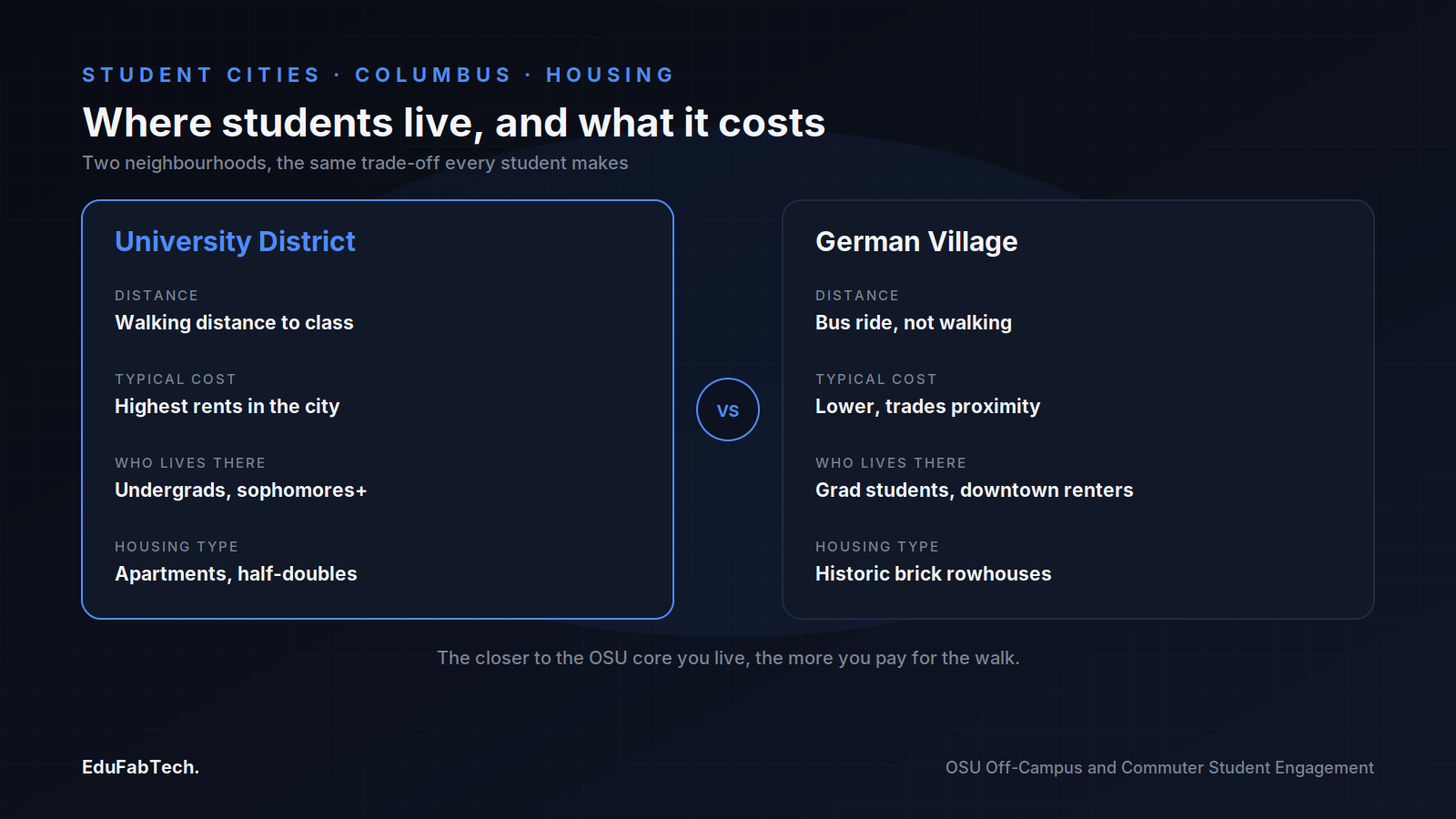
Most undergraduate life happens in the University District, which wraps around Ohio State east of High Street. The university's Off-Campus and Commuter Student Engagement office describes it as home to a large population of undergraduate and graduate students, with apartment buildings, large older homes split into flats, townhomes and "half doubles" — a Columbus term for one side of a two-unit house — much of it within walking distance of class.
Victorian Village and Italian Village, just south of campus toward downtown, draw graduate students and young professionals into old Victorian houses and newer apartments; the OSU office describes parts as walkable and others a bike or quick bus ride, and the neighbourhoods are known for summer's ComFest in Goodale Park and the autumn Columbus Italian Festival. The Short North, the stretch between campus and downtown, is the arts-and-restaurants corridor — galleries, boutiques and the monthly Gallery Hop — and prices there reflect it. Clintonville, just north along High Street and Indianola, is quieter and more residential, which is why OSU describes it as popular with young professionals, long-term residents and staff and faculty with families.
German Village, the historic brick district south of downtown with its adjoining Brewery District, trades proximity for character — a bus ride from campus rather than a walk, but close to downtown. Grandview Heights, just west of the Olentangy, mixes houses, duplexes and apartments and leans toward graduate students, young professionals and families. Students at the outlying universities mostly cluster near their own campuses: Bexley for Capital, the north-east side near Sunbury Road for Ohio Dominican, and Westerville for Otterbein. As a rule, the closer to the OSU core you live, the more you pay for the walk.
Renting off campus, and the scams that circle the University District
Ohio State requires most first-year students to live on campus for their first two years, as its residence-halls page states, so the private market in the University District is mainly a third-year-and-beyond, graduate and transfer market. That market moves early: leases for the following August are often signed in October and November, well before you have seen how a winter walk to class actually feels. Start viewing before the autumn rush if you can, and use OSU's own off-campus search tool rather than trusting the first cheap listing. Our rooms listings for Columbus are another starting point.
Scams in Columbus follow a predictable shape. They cluster around the University District's cheapest-looking doubles and half-doubles, posted by someone who says they are out of town, cannot show the place, and wants a deposit to "hold" it. Treat that as the warning it is. See the unit in person, or at least on a live video call, before committing; a normal Columbus lease is secured with the first month's rent plus a security deposit paid to an identifiable landlord with a local address, not with a wire transfer, gift cards or cryptocurrency. No legitimate landlord in this city needs a crypto deposit to reserve a room.
Furnishing a room, and the markets the city keeps
Columbus is a good city to furnish a room cheaply, largely because the student churn feeds the thrift stores. Experience Columbus, the city's tourism bureau, points shoppers to nearly a dozen Goodwill locations — including a large store on Ohio State's doorstep that restocks heavily when students clear out at semester's end — along with Volunteers of America, where everything is half-price on the last Tuesday of the month, and Ohio Thrift. Inventory is luck of the draw, so plan on visiting more than one. For furniture and household goods second-hand, our furniture pages collect local offers.
The market the city is proudest of is the North Market, which traces its heritage to 1876 and bills itself as Central Ohio's authentic public market. Its downtown hall gathers dozens of independent vendors — prepared food, produce, meat and fish, specialty goods — and runs a seasonal farmers' market; it is more a place to eat and buy ingredients than to kit out a flat, but it is where you take visiting family and where you learn the city eats well for its size.
Working while you study
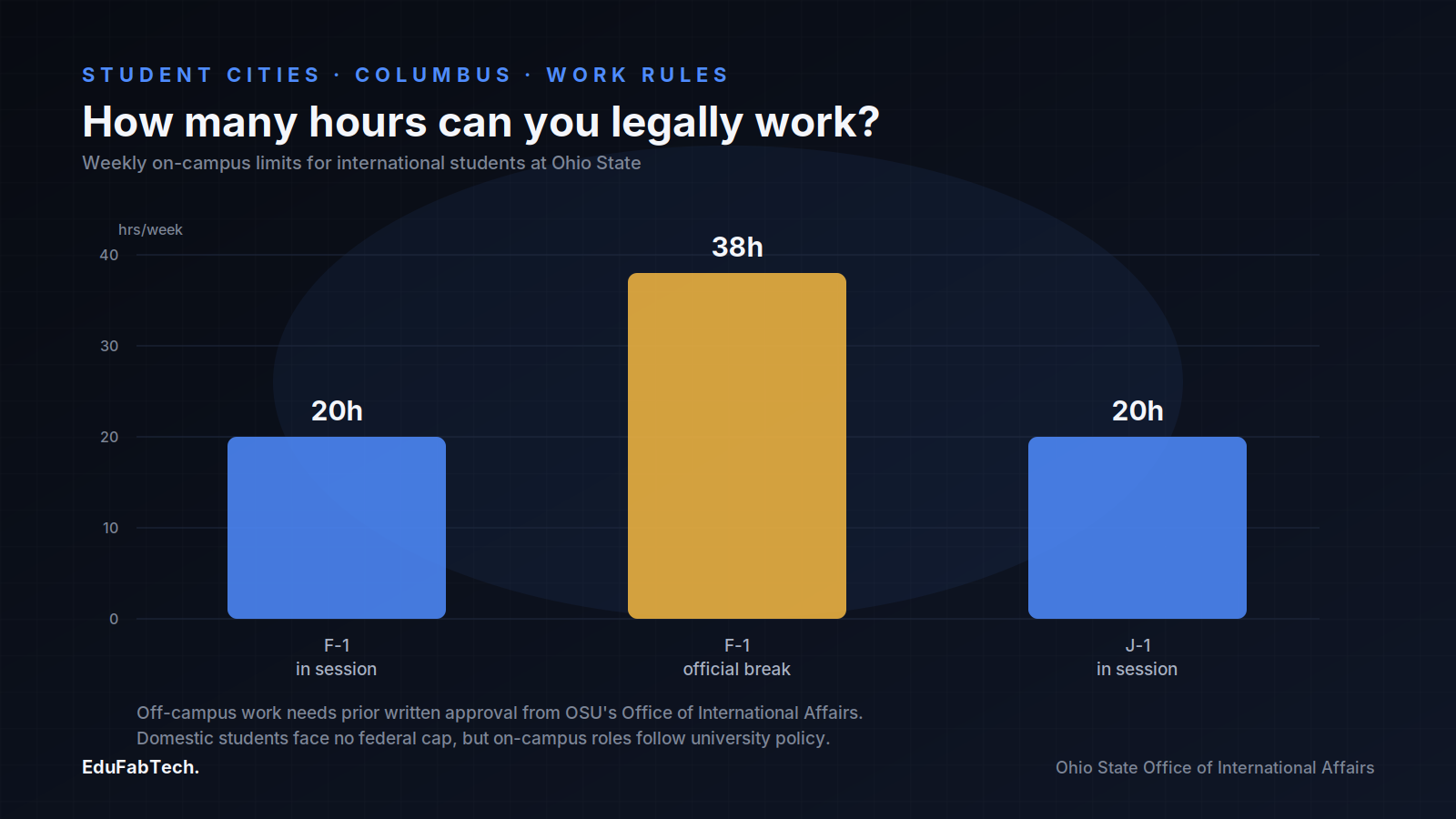
Rules differ sharply by immigration status, and you should confirm yours against the authority that governs it rather than against a guide. For international students, Ohio State's Office of International Affairs sets out the limits clearly: F-1 students may work up to 20 hours per week on campus while classes are in session and up to 38 hours per week during official breaks and the annual vacation term, while J-1 students are capped at 20 hours in session. The same page stresses that off-campus employment must be authorised in advance by an immigration coordinator in that office; do not start off-campus work before it is approved. Domestic students face no such federal cap, but on-campus jobs are limited in hours by university policy. Current campus and local openings are collected on our Columbus jobs page.
Libraries and places to read
The centre of gravity for studying is Ohio State's Thompson Library, at 1858 Neil Avenue Mall. Its own page counts more than 230 public computers and a range of study spaces, including a Grand Reading Room for silent work, alongside its research collections — the default when you need a long, quiet session. Beyond Thompson, the Columbus Metropolitan Library's Main branch downtown on South Grant Avenue is open to city residents and makes a change of scene from campus. Between the two you rarely struggle for a desk, except in the fortnight before exams. We also list informal desks and study-space offers on our study-spaces page.
Getting around a flat, bus-only city
Columbus has no rail transit; getting around without a car means the Central Ohio Transit Authority (COTA) bus network, plus walking and cycling on a largely flat grid. COTA's fare page lists a single trip at US$2.00, a day pass at US$4.50 and a 31-day pass at US$62.00, with transfers valid for two hours and fare capping so you never pay more than the day or month rate. The bargain for students is institutional: Ohio State students enrolled in at least one in-person class get unlimited COTA access by scanning a digital pass in the Ohio State app, as the university's transportation page explains, and COTA lists similar student pass programmes with Capital University and CCAD. COTA's free downtown CBUS circulator, which linked the Short North, downtown and the Brewery District, is currently suspended. If you cycle, the grid and the river trails make the city friendlier than its winters suggest.
What it costs, and the honest trade-offs
The clearest dated figure comes from Ohio State itself. Its basic-costs page for 2026–2027 puts the most common on-campus housing-and-food package at US$15,738 for the academic year, with tuition at US$14,050 for Ohio residents and US$44,271 for non-residents on the Columbus campus. For the wider rental market, the U.S. Census Bureau's QuickFacts put the median gross rent in Columbus at US$1,295 (2020–2024 five-year estimates), on its Columbus city page — low by the standards of coastal US cities, which is much of the appeal.
The honest ledger: in the plus column, Columbus offers short commutes, cheaper rents than most large American cities, a genuinely large and active campus, and a free bus pass for Ohio State students. Against that, it is a car-shaped city with no rail and a bus network that thins out in the evenings and in the suburbs; winters are long, grey and cold; the market for off-campus rooms moves early and the University District's cheapest listings are where scams concentrate; and in a metro growing this fast, rents have been rising. None of this is unmanageable, but it rewards starting your housing search early and learning the bus timetable before you need it.
A checklist for your first weeks
- Confirm your own work rules at their source — international students through the Office of International Affairs, before accepting any job.
- If you are a first- or second-year at Ohio State, sort on-campus housing through the university; if you are past the live-on requirement, start viewing rooms well before the October–November leasing rush.
- Never pay a deposit by wire, gift card or crypto, and never pay for a room you have not seen in person or on a live video call.
- Activate your COTA pass in the Ohio State app, or buy a 31-day pass, and map the routes between home, campus and the shops you will use.
- Scout the thrift stores early — Goodwill, Volunteers of America and Ohio Thrift — especially around semester change-overs, and check local second-hand listings before buying anything new.
- Find your default desk at Thompson Library or the downtown Main branch before exam season turns every seat into a contest.
- Prepare for the climate: Columbus winters are cold and grey, and a city this flat is far more pleasant on foot or by bike once you are dressed for it.
A quick question for readers
Do you work part-time while you study?
Many students work to pay the bills. See how common it is — and how many hours people really do.
Pick an answer, create a free account in a minute, and your vote counts. Already a member? Sign in
Source: The Ohio State University
Sources (5)
- The Ohio State University. Basic costs: tuition, food and housing. undergrad.osu.edu, 2026. undergrad.osu.edu ↗ · checked 4 Oct 2026
- Central Ohio Transit Authority (COTA). Fare Overview. cota.com, 2026. cota.com ↗ · checked 4 Oct 2026
- The Ohio State University, Office of International Affairs. On-Campus Employment. oia.osu.edu, 2026. oia.osu.edu ↗ · checked 4 Oct 2026
- The Ohio State University, Off-Campus and Commuter Student Engagement. Columbus Neighborhoods. offcampus.osu.edu, 2026. offcampus.osu.edu ↗ · checked 4 Oct 2026
- North Market Development Authority. About North Market. northmarket.org, 2026. northmarket.org ↗ · checked 4 Oct 2026