Studying in Cookeville: university, housing and student life
A practical, sourced guide to Tennessee Tech, where students live in this Cumberland Plateau town, what a semester in the dorms costs, how to find a room safely, and getting around.
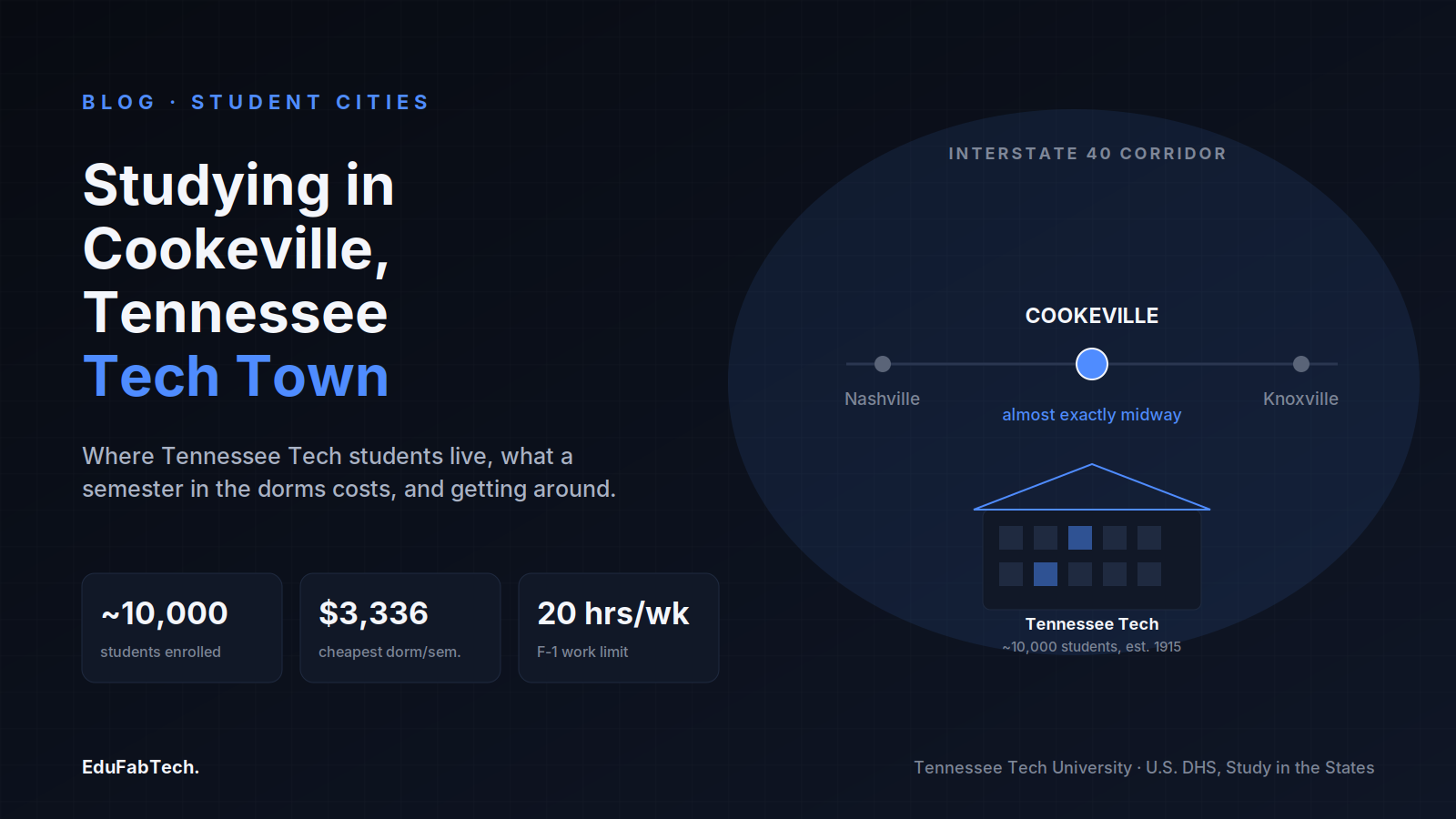
Cookeville sits almost exactly midway between Nashville and Knoxville, the county seat of Putnam County, perched on the western edge of Tennessee's Cumberland Plateau where Interstate 40 rolls through the Upper Cumberland. It is not a big place, and it has not tried to be. The rhythm of the town is set by one institution: Tennessee Technological University, whose campus and its students shape where the apartments are, when the traffic thickens, and what the Saturday morning on the north side of downtown feels like during term.
For a student, that concentration is the whole point. Cookeville is walkable in the way that a town built around a single university tends to be — the campus, the cheaper rooms, the library and the grocery runs all fall inside a few square kilometres. What follows is a practical account of studying and living here: the university, how housing works and what it costs, how to find a room without getting burned, where to buy second-hand, the rules that constrain part-time work for international students, where to study, and how to get around.
If you are weighing the city up from abroad or from another state, read the honest trade-offs near the end before you commit. Cookeville is affordable and quiet, and both of those cut in two directions.
Tennessee Tech: engineering roots and eight colleges
Tennessee Technological University was established by the state General Assembly in 1915 on grounds that had belonged to the private Dixie College, and opened to students the following year as Tennessee Polytechnic Institute, according to the university's own University History. The "Tech" in the name is not decoration: the university's About page describes it as producing practical, ready-to-work graduates and organises its degrees across eight schools and colleges — Agriculture and Human Ecology, Arts and Sciences, Business, Education and Human Sciences, Engineering, Fine Arts, Emerging and Integrative Studies, and Nursing. The same page puts enrolment at around 10,000 students (retrieved 2026).
In practice, engineering, computing and nursing are the programmes the town is best known for, and the campus reflects that — there is an Engineering Village cluster of residence halls, and the university runs the Joe L. Evins Appalachian Center for Craft near Smithville, about an hour south, for ceramics, glass, metals, fibre and wood. The main campus is compact, centred on 1 William L. Jones Drive, and most undergraduate life happens within a short walk of it. A student here spends far less time commuting between scattered faculties than they would at a sprawling flagship, which is one of the quiet advantages of a town this size.
On-campus housing and what a semester in the dorms costs
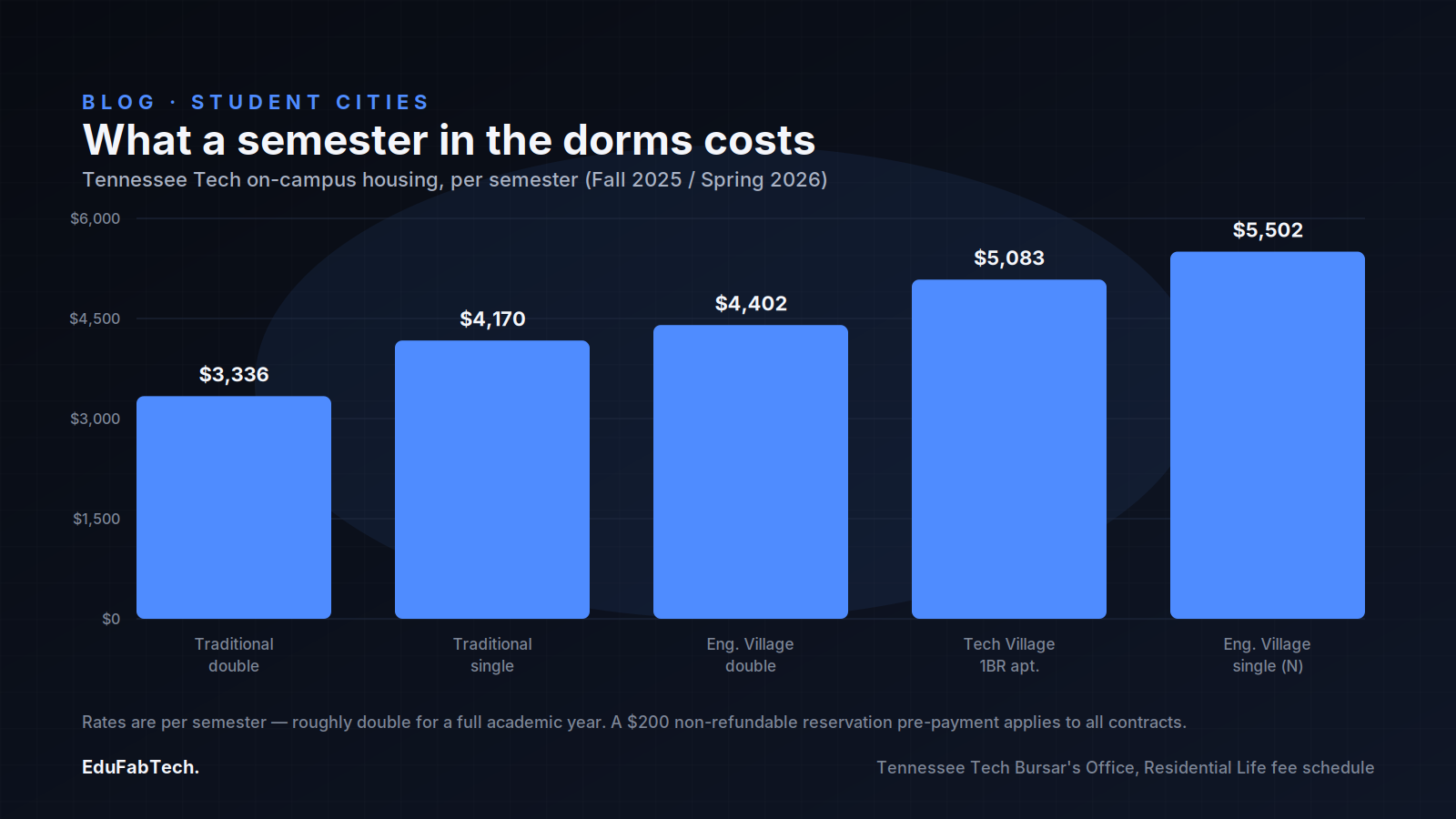
Most first-year students start in university housing, and the figures are published rather than guessed at. Tennessee Tech's Residential Life fee schedule for Fall 2025, Spring 2026 and Summer 2026, posted by the Bursar's Office, lists rents per semester — so you roughly double them for a full academic year. The range is wide enough to matter:
| Hall type | Room | Per-semester rate (Fall/Spring) |
|---|---|---|
| Traditional dorms (Browning/Evins, Cooper/Dunn and others) | Double | $3,336 |
| Traditional dorms | Single | $4,170 |
| New Residence Halls (Engineering Village) | Double | $4,402 |
| New Residence Halls (Engineering Village) | Single (North) | $5,502 |
| Tech Village Apartments, Phase 1 | One bedroom | $5,083 |
All figures are from Tennessee Tech's Residential Life fee rates for Fall 2025, Spring 2026 and Summer 2026. The same schedule sets a non-refundable Housing Reservation Contract pre-payment of $200, which secures a contract rather than a specific room. The Tech Village apartments are the option older and graduate students tend to want, since they come with kitchens and more independence; the traditional halls are the cheapest beds on campus. Whatever you choose, apply early, since the better-priced rooms fill first.
Renting off campus in Cookeville without losing a deposit
Plenty of upper-year and graduate students move off campus, where rents in a small plateau town run lower than in Tennessee's big cities. The off-campus market here is a mix of purpose-built student complexes clustered along the roads feeding the university, older houses subdivided into rooms, and ordinary flats further out toward Algood and the edges of town. Because Cookeville is small, "a short walk to campus" and "needs a car" are genuinely different worlds, so pin down the exact street before you fall for a photo.
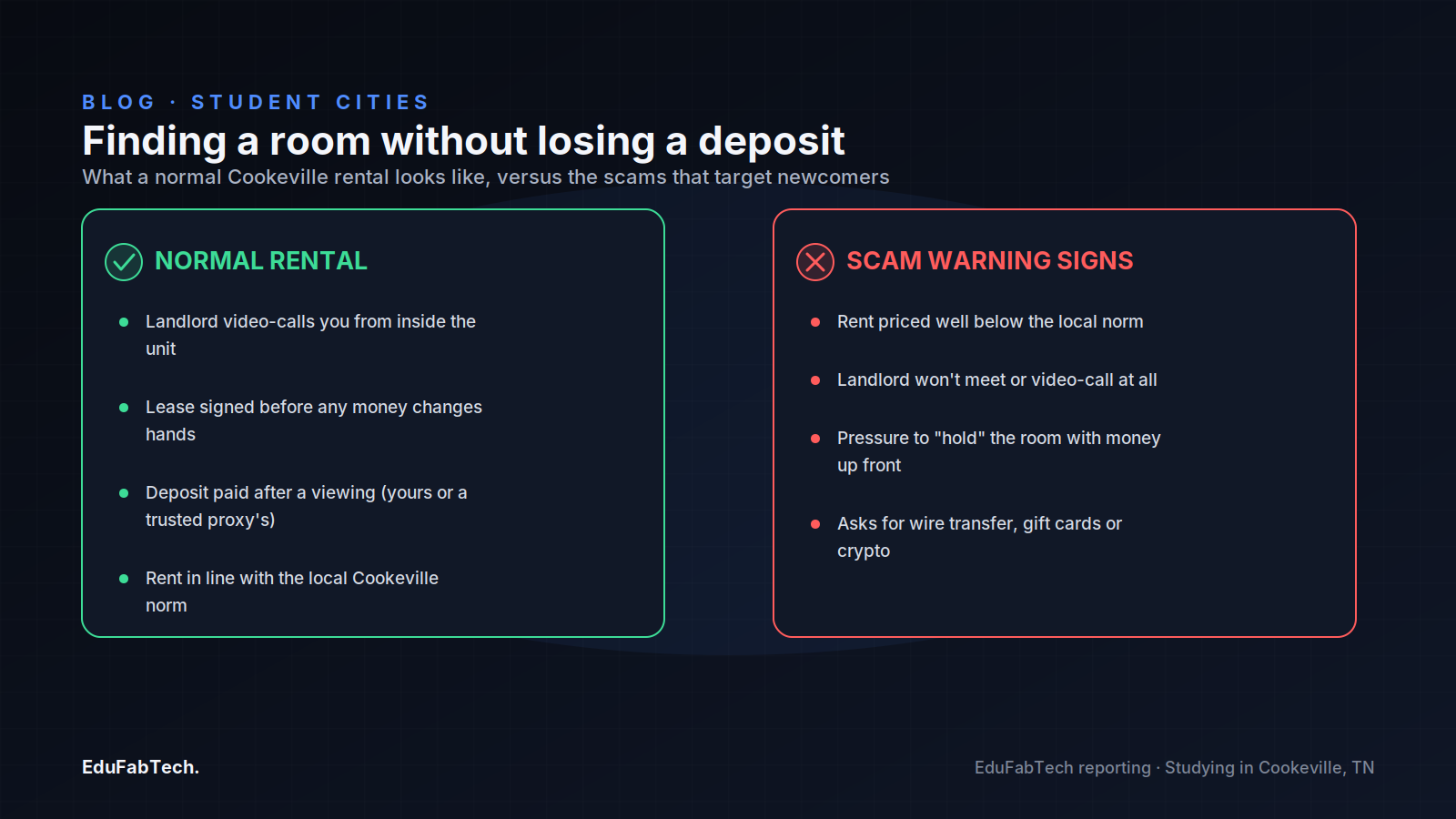
The scams that appear here are the ones that target newcomers who cannot view a place in person — most often international students and transfers arranging a room over the summer from far away. A listing with a rent well below the local norm, a landlord who will not meet or video-call you from inside the actual unit, and pressure to "hold" the room with money up front are the warning signs. The firm rule: never send a deposit by bank transfer, gift card or cryptocurrency to reserve a room you have not seen. A normal local arrangement is a signed lease and a security deposit paid once you have viewed the place or had someone you trust view it for you. If you are abroad, ask the university's housing or international office whether they can point you to vetted options, use a short stay in the dorms as a landing pad while you search in person, and browse local student listings on EduFabTech's Cookeville rooms page and the wider Cookeville listings before committing to anything sight-unseen.
Start looking earlier than feels necessary. The best-value rooms near campus turn over around the end of the spring semester for the following autumn, so a search that begins in late spring beats one that begins in August, when the leftover stock is pricier and further out.
Furnishing a room: second-hand, free piles and the Saturday market
An empty off-campus room is an expense waiting to happen, and Cookeville's small size works in your favour here — the turnover of students every May and August leaves a steady supply of cheap furniture changing hands. The end-of-semester move-out is the single best moment to furnish a room almost for free, as graduating students shed desks, mini-fridges and chairs they cannot take with them. EduFabTech's local pages for second-hand things, used furniture and free items in Cookeville are built for exactly this, and they are worth checking repeatedly in the first weeks of term rather than once.
For food and the ordinary business of stocking a kitchen, the city runs a downtown Cookeville Farmer's Market on Mahler Avenue, on the north side of the centre, during the growing season; hours vary by season and listing, so confirm the current Saturday times locally before you plan a trip around it. Beyond produce, the thrift and charity shops scattered around town are where most students assemble their crockery, lamps and bedding for a few dollars. Buying second-hand is not just thrift here; it is the default, and nobody will think twice about a desk that has clearly furnished three students before you.
Part-time work, and the rules that bind international students
Domestic students find term-time work in the usual places a university town offers — on-campus jobs, food service, retail and tutoring — and the local market is small enough that word of mouth matters. For a current picture of what is going, EduFabTech keeps a Cookeville jobs page.
For international students the rules are set by federal law, not by the employer, and getting them wrong puts your status at risk. If you are on an F-1 visa, the U.S. Department of Homeland Security's Study in the States guidance states that on-campus employment needs your Designated School Official's approval, and that you may not work more than 20 hours per week when school is in session. The U.S. Citizenship and Immigration Services policy manual adds that full-time on-campus work is permitted during school breaks, and that no separate employment authorisation from USCIS is required for on-campus jobs. Off-campus work is far more restricted and generally requires specific authorisation such as Curricular or Optional Practical Training. This is a summary, not legal advice: confirm your own case with Tennessee Tech's international office and your DSO before you accept any job, because the consequences of a mistake fall on you, not the business that hired you.
The Volpe Library and other places to put your head down
The Angelo and Jennette Volpe Library at 1100 N. Peachtree Avenue is the academic heart of the campus for study space. During the autumn and spring semesters its building hours, published on the library's hours page, run Monday to Thursday from 7 a.m. to midnight, Friday from 7 a.m. to 6 p.m., Saturday from 10 a.m. to 6 p.m., and Sunday from 1 p.m. to midnight — long enough to cover both the early risers and the people who do their best work after dark. The same building houses the Learning Center, whose tutoring service keeps its own hours.
Those long weekday hours are the main reason the library is where most serious revision happens, especially in a town where late-night cafés are thin on the ground. Beyond it, the student union, departmental lounges and the quieter corners of the Engineering buildings fill up in exam weeks. If you want desks and quiet study spots that other students have flagged, EduFabTech lists Cookeville study spaces too. In a small town the practical advice is to find two or three reliable spots early and rotate between them, because the single best table will be taken when you most need it.
Buses, bikes and the drive to Nashville
Cookeville is a car town at heart, but you can live here without one if you plan around it. Public transport is run by the Upper Cumberland Human Resource Agency, which operates the Go Upper Cumberland bus — a deviated fixed-route service that loops through Cookeville and onto the Tennessee Tech campus. According to the university's Getting Around Town page, Tennessee Tech students ride the Go bus free by showing their Eagle ID. The same agency runs Pick-Up Upper Cumberland, an on-demand service in Putnam County booked through an app, and Connect Upper Cumberland, an intercity service that reaches Nashville and Murfreesboro — useful when you need the airport or the bigger city that the local shops cannot match. Details and routes are on the agency's public transit site.
On campus, the university's Getting Around Town page describes a Bike Share programme funded through student fees, with bicycles checked out from the Fitness Center for two-week periods and several bike repair stations around campus. For a compact town, a bike covers most of what you need day to day. The honest caveat is that the bus loop is built around the campus and the main corridors; if your room is well out of town, you will still want a car or a lift, and the plateau winters bring cold snaps that make the walk to a 7 a.m. lecture feel longer than the map suggests.
What's good, what's hard, and a first-fortnight checklist
The case for Cookeville is straightforward. It is affordable by Tennessee standards, the housing numbers above are a matter of public record rather than rumour, the campus is compact enough to walk, and a university of around 10,000 in a town this size means student life is not diluted — Tech shapes the place. The engineering, computing and nursing programmes give it a clear identity, and the Upper Cumberland scenery is genuinely good for anyone who likes being outdoors.
The hard parts are the flip side of the same facts. This is a small town, not a city: nightlife, late services and the range of shops are limited, and for some the quiet tips into isolation, particularly for international students far from home. You will likely want a car or a well-planned bus habit, the off-campus rental stock near campus is competitive and fills early, and winters on the plateau are colder than Tennessee's lowland reputation suggests. None of these are dealbreakers, but they are worth knowing before you arrive rather than after.
A short checklist for the first few weeks:
- Sort housing before anything else — if you are not in the dorms, see the room (or have someone see it) before paying, and never wire a deposit to hold an unseen room.
- Get your Eagle ID early; it is your free pass on the Go bus and your library and building access.
- If you are an international student, meet your DSO at the international office and confirm the work rules before taking any job.
- Learn the Volpe Library's term-time hours and claim two or three study spots you can rely on.
- Furnish from the move-out second-hand wave, not the shops — check the local free-stuff and furniture listings in your first week.
- Work out your transport reality: bike-plus-bus if you are near campus, a car or a reliable lift if you are not.
Do that, and a term in Cookeville settles into the easy, low-cost rhythm that is the real reason students choose a plateau town over a big city in the first place.
A quick question for readers
Do you work part-time while you study?
Many students work to pay the bills. See how common it is — and how many hours people really do.
Pick an answer, create a free account in a minute, and your vote counts. Already a member? Sign in
Comments 3
Comment-
The $200 non-refundable pre-payment buried in the housing section is the detail that actually matters to a first-year family budgeting this…
-
The detail that jumps out is the $200 Housing Reservation Contract fee — non-refundable, and it explicitly buys you a contract, not a room.…
-
The number that jumps out is $200 non-refundable just to secure a contract, not a room - that's a neat little lesson in reading the fine pri…
Join free to read the full comments and reply Comments are between members; an account takes a minute.
Source: Tennessee Technological University
Sources (5)
- Tennessee Technological University. About Tennessee Tech. Tennessee Technological University, 2026. tntech.edu ↗ · checked 4 Nov 2026
- Tennessee Technological University. Residential Life Fee Rates: Fall 2025, Spring 2026, Summer 2026. Tennessee Technological University Bursar's Office, 2026. tntech.edu ↗ · checked 4 Nov 2026
- Tennessee Technological University. Parking & Transportation — Getting Around Town. Tennessee Technological University, 2026. tntech.edu ↗ · checked 4 Nov 2026
- U.S. Department of Homeland Security. Working in the United States. Study in the States, DHS, 2026. studyinthestates.dhs.gov ↗ · checked 4 Nov 2026
- Tennessee Technological University. University History. Tennessee Technological University Graduate Catalog, 2026. grad.catalog.tntech.edu ↗ · checked 4 Nov 2026