Studying in Dallas: universities, housing and student life
A practical, sourced guide to studying in Dallas, Texas — the campuses spread across the metroplex, where students live, what rooms and transit cost, work rules, and the honest trade-offs of a car-shaped city.
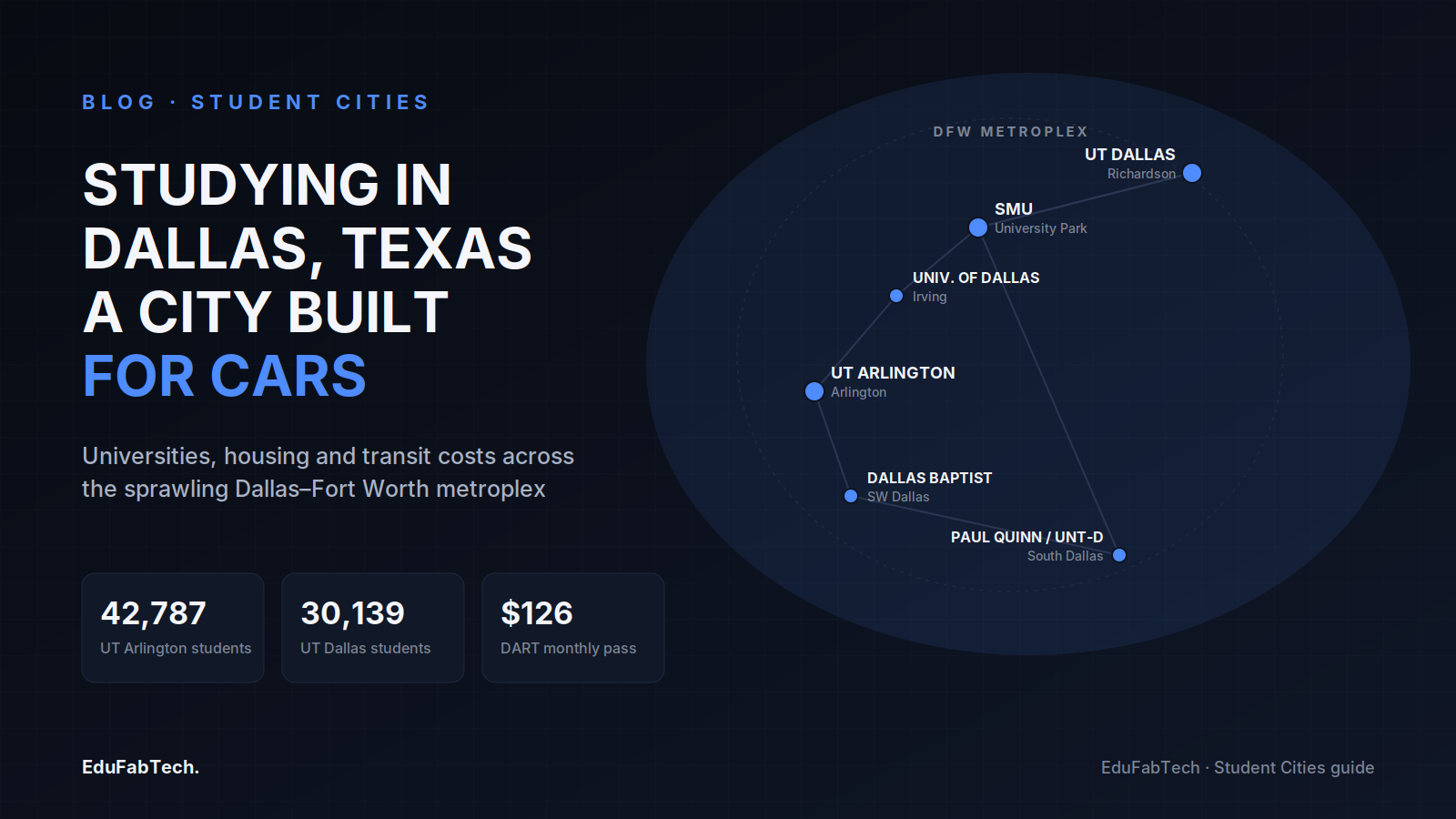
Dallas does not have a student quarter. It has a dozen campuses scattered across a metropolitan region of flat prairie, freeways and railway lines, and students sort themselves out among them. There is no single "university district" the way older and denser cities have one; a first-year at Southern Methodist University in the leafy Park Cities and a nursing student south of the Trinity River are both studying "in Dallas," and they may never cross paths. Understanding that geography is the first thing to get right.
The city sits at the heart of the Dallas–Fort Worth metroplex, and the campuses follow the sprawl outward: north into Richardson and Addison, west into Arlington and Grand Prairie, south into Oak Cliff and the former Bishop College grounds. Distances are real — a commute of twenty or thirty minutes by car is normal — and the region was built around the car, not the train. What follows is a guide to the universities, where students live, how to find a room without being cheated, what it costs, and how to get around when you may not own a vehicle.
Southern Methodist University is the campus most people picture first. Its main grounds sit on "the Hilltop" in University Park, an enclave inside the city, and the university describes itself on its about page as a research university of more than 12,500 students organised into eight degree-granting schools, among them the Cox School of Business and the Meadows School of the Arts, with the George W. Bush Presidential Center on campus. It is private, with the finances that implies, and it anchors the wealthiest stretch of the city.
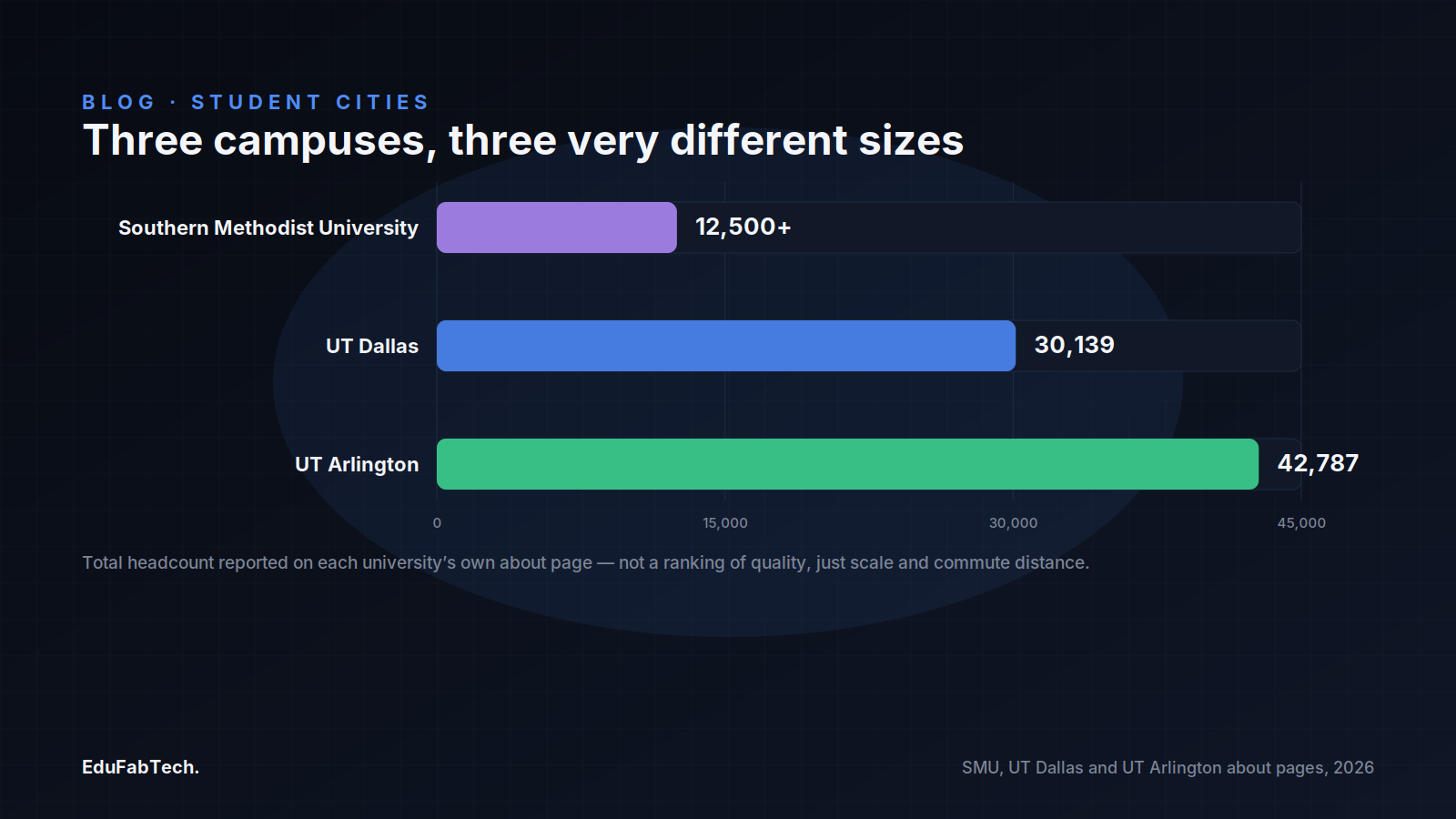
The big public universities sit on the metroplex's edges. University of Texas at Dallas, on Campbell Road in Richardson to the north, enrols more than 30,139 students across seven schools and offers more than 160 programmes, according to its own about page; it grew out of a research centre backed by the founders of Texas Instruments and is known for engineering, computer science and the natural sciences. West of the city, University of Texas at Arlington reported total enrolment of 42,787 and more than 190 degree programmes in a September 2026 release, which also notes its Carnegie R-1 research status; its University of Texas at Arlington College of Engineering and University of Texas at Arlington School of Architecture are among its best-known units. In Irving, University of Dallas is a Catholic liberal-arts university built around an interdisciplinary Core Curriculum and a sophomore campus in Rome.
Around these cluster the smaller and specialised institutions. Dallas Baptist University occupies rolling hills in southwestern Dallas above Mountain Creek Lake and is a Christ-centred university. Paul Quinn College, in southern Dallas, is a historically Black college that runs an urban work-college model and sits on the former Bishop College site. University of North Texas at Dallas serves southern Dallas County with undergraduate and graduate degrees and a downtown College of Law. Parker University, on Walnut Hill Lane in Dallas, is a health-sciences university best known for chiropractic. Amberton University in Garland is built for working adults and lists flat tuition of $325 per credit hour for 2026–2027. Dallas Christian College is a small Bible-centred college in Farmers Branch; Dallas International University in Dallas specialises in applied linguistics and language development; and the Texas Tech University Health Sciences Center Dallas Campus delivers nursing and pharmacy programmes. For two-year study and transfer, the campuses of Dallas College — including Brookhaven in Farmers Branch and the Garland campus — are spread across the suburbs.
Neighbourhoods students settle into
Where you live depends almost entirely on which campus you attend, because crossing the metroplex daily is punishing. The rule of thumb is to stay inside the arc that your campus and the DART rail lines define, and to accept that "close to Dallas" and "close to your classes" are often different things.
Around SMU, the Park Cities (University Park and Highland Park) are the immediate, expensive option; most undergraduates who want cheaper rent drift to Lower Greenville and neighbouring Lakewood just east. SMU's own neighbourhood guide places Lower Greenville about two miles from the Hilltop and calls it lively and patio-lined. These are walkable by Dallas standards and close to the Katy Trail.
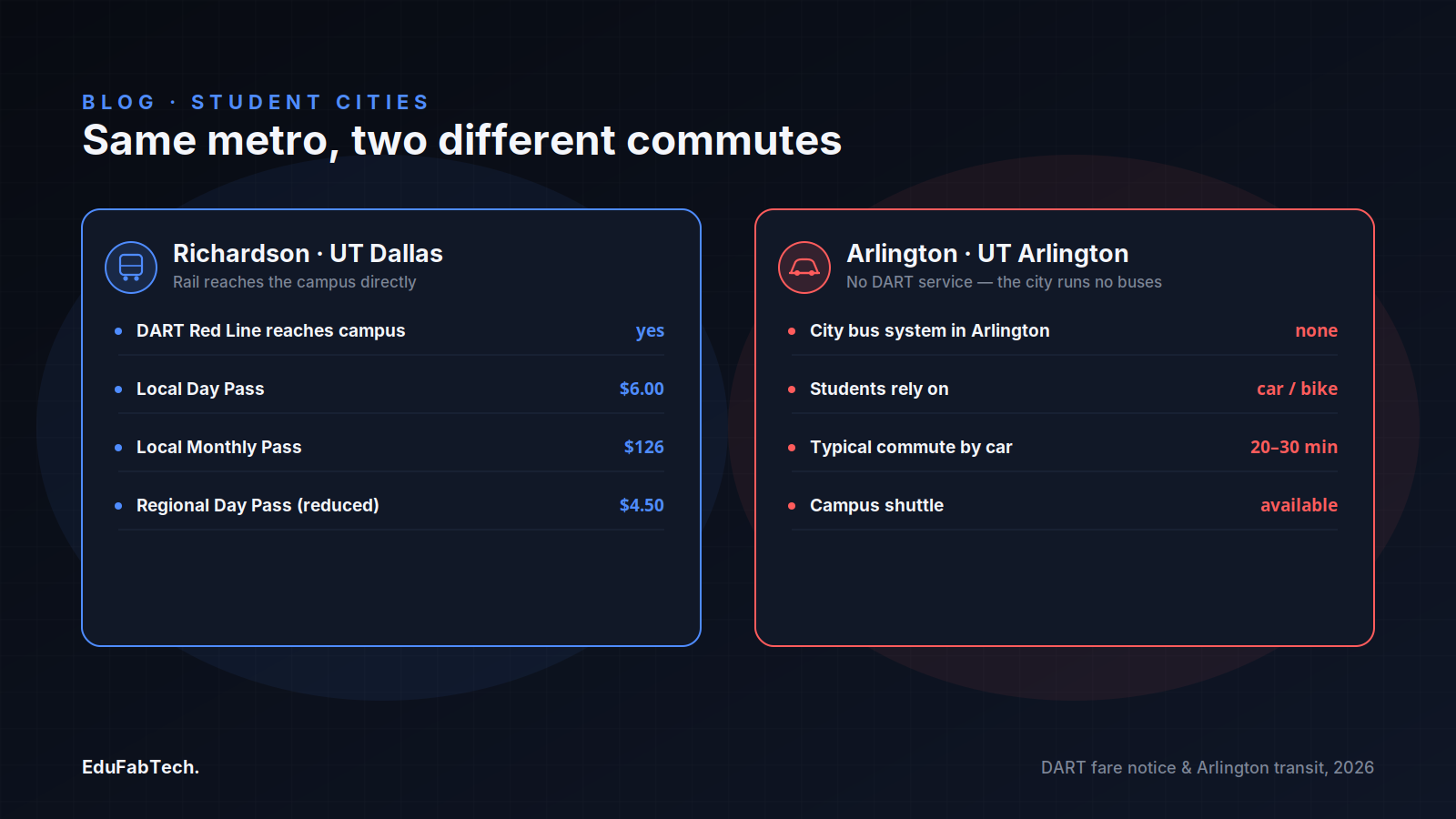
Richardson and far North Dallas are UT Dallas territory. Apartment blocks line the roads around Campbell and Coit, and the DART Red Line reaches the campus, so a car is less essential here than almost anywhere else in the region. Rents fall as you move north and east away from the Park Cities, which is why many international and graduate students concentrate here.
Arlington, between Dallas and Fort Worth, is its own city and the natural base for UT Arlington students; note that Arlington famously runs no city bus system, so students there rely on cars, cycling or campus shuttles rather than DART. Oak Lawn and Uptown, just north of downtown, are denser and pricier but central; Deep Ellum and Expo Park east of downtown draw students who want music venues and nightlife on the doorstep.
South and west of the Trinity River, Oak Cliff — especially the Bishop Arts district — offers older housing, a strong independent character and lower prices, convenient for Paul Quinn, UNT Dallas and Dallas Baptist. Vickery Meadow, north-east of SMU, is one of the most diverse and affordable rental pockets in the city and a common landing spot for newcomers on a budget. Browse what is currently listed near your campus on EduFabTech's Dallas rooms page, or by university near SMU and UT Dallas.
Finding a room and keeping your deposit
On-campus housing is the simplest start for a first year. SMU's Office of the Bursar lists 2026–2027 residence-hall rates of $6,329 per term for a double room and $7,885 per term for a single — figures charged each of the two academic terms, not per month — which gives a concrete benchmark against which to measure off-campus offers. Most students move off campus after the first year, and the private market in Dallas works on twelve-month leases with a security deposit (commonly one month's rent) plus the first month up front; application fees are normal, but they are modest and paid to the building's leasing office, not to a stranger.
Start looking six to eight weeks before term for the autumn rush, when demand around UT Dallas and SMU peaks. The hard rule in Dallas, as anywhere, is to see the unit — or have someone you trust see it — before any money changes hands. Rental scams here tend to appear as "owner is out of state" listings with below-market rent near the big campuses, and as fake sublets posted to student groups at the start of each semester. Never wire a deposit, buy gift cards, or send cryptocurrency to "hold" a room; a legitimate Dallas leasing office takes a deposit only after you have toured the property and signed a lease, and it will have a physical office you can walk into. If a listing pushes you to pay before you can view, treat that as the scam it almost always is.
Furnishing a room without overspending
Dallas is good terrain for second-hand furnishing because the region is large, car-owning and churns through apartments. Traders Village in Grand Prairie bills itself as a weekend market with over 3,500 vendors, open every Saturday and Sunday with a $6 parking fee, and it is a reliable place for household goods, tools and furniture. The Dallas Farmers Market downtown runs its outdoor Shed on weekends — Saturdays 9am–5pm and Sundays 10am–5pm — with produce from farmers within about 400 miles plus a year-round scatter of craft vendors, and its indoor Market hall is open daily.
Beyond markets, end-of-semester move-outs around SMU and UT Dallas flood the resale and giveaway market with desks, chairs and mini-fridges in May and August; that is the cheapest window of the year to furnish a room. EduFabTech lists local second-hand items, used furniture and things given away free in the city, which are worth checking before buying anything new.
Getting around a car-shaped city
Dallas Area Rapid Transit (DART) runs the buses and the light-rail network, and for students on the northern campuses it is genuinely useful; elsewhere the city assumes a car. DART's fare changes effective 1 March 2026 set the Regional Day Pass at $9.00 and its reduced version at $4.50, with the Regional 31-Day Pass at $192.00 (or $96.00 reduced), according to DART's fare-adjustment notice. On the local network, DART's fares explainer prices a single trip as a 3-Hour Pass at $3.00 ($1.50 reduced), a Local Day Pass at $6.00, and a Local Monthly Pass at $126.
Students should check the pass programme before paying full fare. DART offers a reduced fare of 50% off to qualifying riders including students, but several Dallas institutions instead take part in a contracted Higher Education Pass Program — the participants listed are Dallas College, Paul Quinn College, SMU, UNT Dallas, UT Dallas and UT Southwestern — whose students confirm eligibility with a campus representative and then load the pass through DART's GoPass app rather than buying the ordinary reduced fare. If your university is on that list, the campus programme, not the standard card, is the route to a cheaper ride.
Working while you study
Rules for paid work depend on your immigration status, and this is an area to confirm with your university, not with a guide. For students on an F-1 visa, the U.S. Department of Homeland Security's Study in the States site states plainly that on-campus work is limited to no more than 20 hours per week when school is in session, and that you should talk with your designated school official (DSO) before taking any job; it warns that a DSO who learns of unauthorised work must report it through SEVIS, which can end your record. Off-campus training such as CPT and OPT has its own authorisation process. Treat the official page and your international-student office as the only authorities here; nothing in this guide is legal advice. For local openings students actually fill, EduFabTech keeps a Dallas jobs listing.
Libraries and places to study
Each university runs its own libraries, open to its students during term, and those are your default. The city also offers the J. Erik Jonsson Central Library, the Dallas Public Library's eight-storey downtown flagship at 1515 Young Street, across from City Hall, with quiet floors, a maker-oriented Story Center and specialist collections — a free option when you want to study away from campus. Coffee houses in Lower Greenville, Deep Ellum and Bishop Arts fill with laptops on weekday afternoons, though they get loud in the evenings. EduFabTech also lists bookable study spaces and desks around the city.
What is good, and what is hard
The honest case for Dallas is cost and opportunity. Rents are lower than on either US coast: the U.S. Census Bureau's QuickFacts put the median gross rent for Dallas city at $1,472 over 2020–2024, and the regional economy is large and hiring, which matters for internships and part-time work. Texas levies no state income tax, the campuses are serious, and the food and music scenes are genuinely good.
The hard parts are equally real. The city is spread out, and without a car you are tied to the DART-served corridors; summers are long and very hot; and the housing market, while cheaper than the coasts, has risen and can feel tight around the popular campuses at the start of term. The lack of a dense student core means you build your own community rather than inheriting one. None of this is a reason to stay away — but it is worth knowing before you sign a twelve-month lease based on a map alone.
A checklist for your first weeks
- Confirm your housing and, if you are on campus, your term dates and move-in window before you arrive; compare any off-campus offer against the SMU dorm benchmark above.
- If you hold an F-1 visa, meet your DSO early and read the official work rules before accepting any job.
- Check whether your university is in DART's Higher Education Pass Program; if so, register the pass through the campus route rather than buying a standard fare.
- Open a local bank account and never pay a deposit by wire, gift card or crypto — tour first, sign a lease, then pay the leasing office.
- Furnish from Traders Village, the Dallas Farmers Market and the May/August move-out gluts rather than buying everything new.
- Map your real commute at rush hour, not just the distance, and browse current listings and student events across the city on EduFabTech's Dallas pages.
NOTES — skipped: Bishop College — closed in 1988; its southern Dallas campus is now occupied by Paul Quinn College. skipped: University of Plano — defunct liberal-arts college that closed in the 1970s; no longer operating.
A quick question for readers
Do you work part-time while you study?
Many students work to pay the bills. See how common it is — and how many hours people really do.
Pick an answer, create a free account in a minute, and your vote counts. Already a member? Sign in
Source: SMU Office of the Bursar
Sources (5)
- Southern Methodist University. 2026–2027 Housing Rates. SMU Office of the Bursar, 2026. smu.edu ↗ · checked 3 Oct 2026
- Dallas Area Rapid Transit. DART Announces Regional Fare Adjustments Effective March 1, 2026. Dallas Area Rapid Transit, 2026. dart.org ↗ · checked 3 Oct 2026
- U.S. Census Bureau. QuickFacts: Dallas city, Texas. U.S. Census Bureau, 2024. census.gov ↗ · checked 3 Oct 2026
- U.S. Department of Homeland Security. Working in the United States. Study in the States (DHS), 2025. studyinthestates.dhs.gov ↗ · checked 3 Oct 2026
- The University of Texas at Arlington. UTA sets another record for incoming students. UT Arlington News, 2026. uta.edu ↗ · checked 3 Oct 2026