Studying in Denver: universities, housing and student life
A practical, sourced guide to the Mile High City's universities, the neighbourhoods students rent in, how to find a room safely, what RTD costs, and the honest trade-offs of studying a mile above sea level.
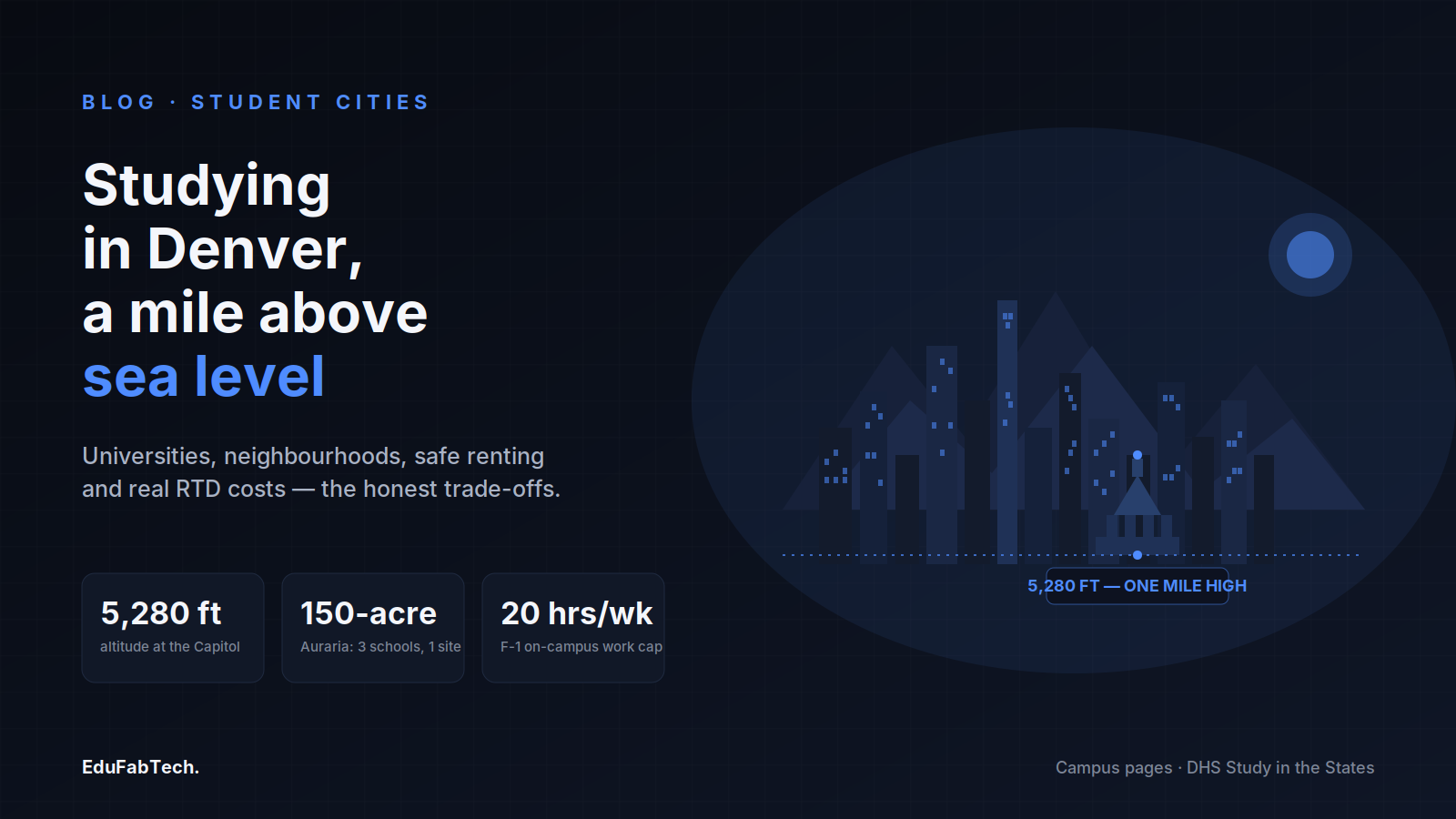
Denver sits where the High Plains run up against the Southern Rocky Mountains, and the city wears its altitude as a nickname: the Mile High City. A step on the west face of the Colorado State Capitol marks the point exactly one mile — 5,280 feet — above sea level. For a student arriving from closer to the coast, that number is not trivia. The air is thin and dry, the sun is strong, and the first week of walking to class can leave newcomers short of breath until their bodies adjust.
The other thing to understand early is that Denver is not a single college town built around one quad. Its universities are scattered across a metropolitan area that stretches from downtown out to foothill towns like Golden and, further north, Boulder. Where you study shapes where it makes sense to live, how far you commute, and how much of the city you actually see, so it helps first to know how the campuses sit on the map.
The universities, from the Auraria blocks to the foothills
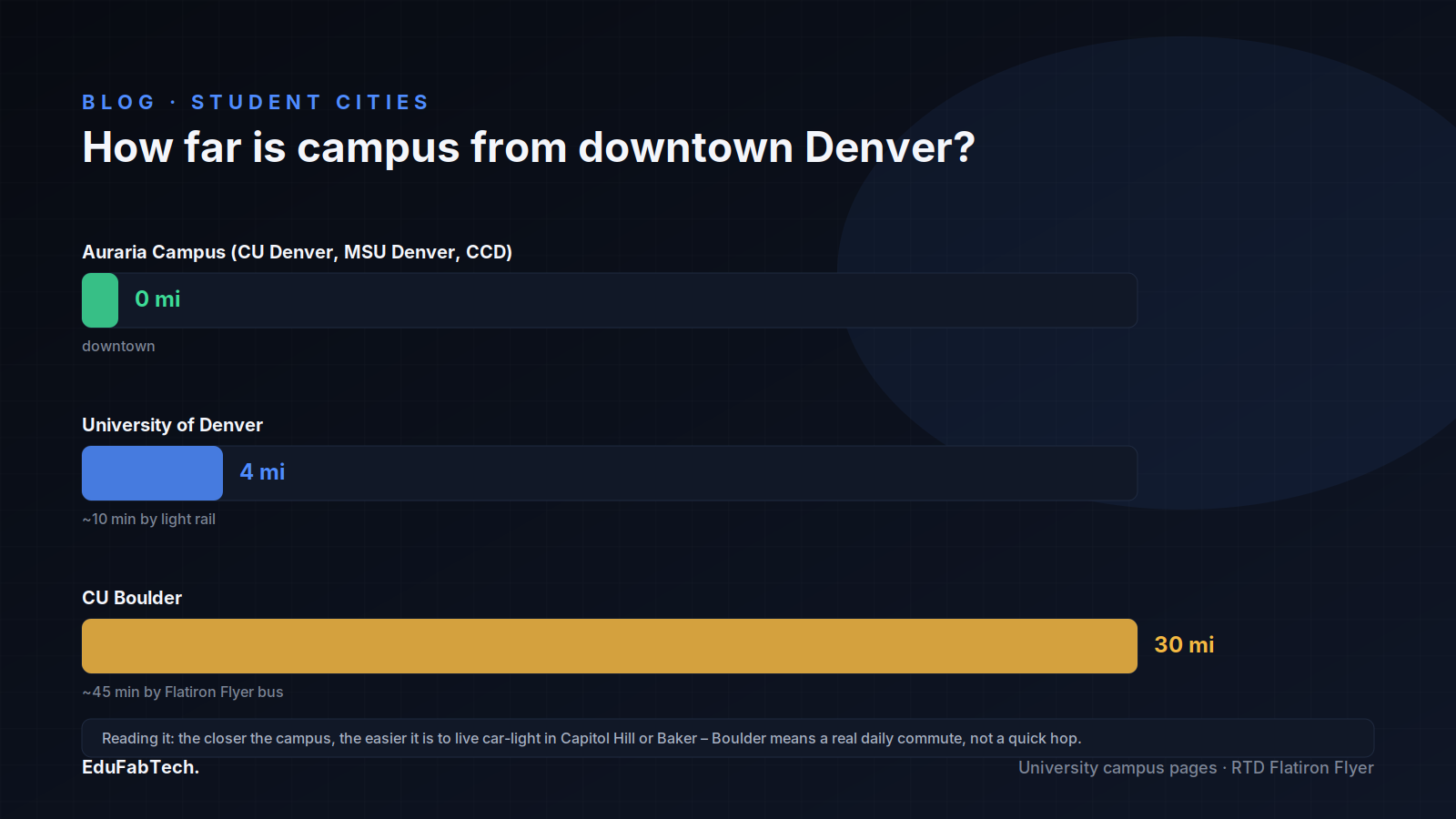
The densest cluster is downtown, on the Auraria Campus. The University of Colorado Denver states that it is part of a 150-acre tri-institutional setting it shares with Metropolitan State University of Denver and the Community College of Denver, west of Speer Boulevard, with its historic Tivoli Student Union housed in a brewery building that dates to 1866, as described on the university's own campus page. CU Denver leans toward professional and urban-focused programmes and has buildings on both sides of Speer Boulevard, reaching across into the Lower Downtown (LoDo) district. Metropolitan State University of Denver shares the same ground and is a large, largely commuter institution, which has long shaped where its students look for rooms.
Four miles or so to the south-east, in the University Park neighbourhood, is the University of Denver. By its own account the university was founded in 1864 as the Colorado Seminary, making it the oldest private university in the Rocky Mountain region, per the university's own history page. DU is a quieter, leafier, residential campus than Auraria, and it is also home to the Graduate School of Social Work at the University of Denver, housed in Craig Hall on the same University Park campus. DU's professional and continuing-education arm, University College, and the historic Colorado Women's College name both sit within the university rather than as separate institutions.
The rest of the metro's degree-granting campuses sit further out. Colorado School of Mines, in Golden to the west, is a public research university focused on engineering, applied science, and the earth, energy and resource fields. Regis University, in the Berkley area of north-west Denver, describes itself as the only Jesuit, Catholic university in the Rocky Mountains, founded in 1877, on its institutional history page. Denver College of Nursing, downtown, runs pre-licensure Associate and Bachelor of Science in Nursing programmes and states on its accreditation page that it is institutionally accredited by the Higher Learning Commission with nursing accreditation from the ACEN and CCNE. Furthest afield, in Boulder about 30 miles north-west and reachable by RTD's Flatiron Flyer bus, the University of Colorado Boulder reported 37,153 students in autumn 2023 and traces its founding to 1876, according to its published fast facts. Health-sciences students should also know the Anschutz Medical Campus in Aurora, where CU's medical, nursing and pharmacy programmes are based, and CSU Spur, Colorado State University's campus at the National Western Center in the city's north.
Neighbourhoods students actually settle in
Capitol Hill is the default for students at the Auraria schools. Dense with older brick apartment buildings, it is relatively affordable by Denver standards, walkable, and tied into the light-rail and bus network that reaches downtown in minutes. It draws a young, mixed crowd and sits beside the green expanses of Cheesman Park and Congress Park, where rents tend to climb a little as you move east.
Baker, south of downtown along South Broadway, has become a magnet for younger renters because of its strip of restaurants, record shops and bars. It is a manageable bike ride to Auraria and keeps the feel of a lower-slung residential neighbourhood behind its commercial spine.
Five Points and RiNo (the River North Art District) sit just north-east of downtown. Converted warehouses, lofts and newer builds give the area its character, along with murals and breweries, but the rebuilt housing stock generally pushes rents above Capitol Hill and Baker.
University Park and Platt Park surround the University of Denver and are correspondingly quiet and tree-lined, built mostly of single-family homes with some student rentals mixed in. Platt Park's South Pearl Street gives the area a village-like centre a short walk or tram ride from DU.
Aurora, near the Anschutz Medical Campus, is where many medical, nursing and pharmacy students look, trading a longer distance from downtown nightlife for proximity to the hospitals and generally lower rents further east.
Golden and Boulder are effectively their own towns for Mines and CU Boulder students. Living close to those campuses means a genuine college-town experience but a real commitment if you ever need to be downtown; the trip from Boulder to central Denver by Flatiron Flyer is around 45 minutes in good traffic.
Finding a room without losing your deposit
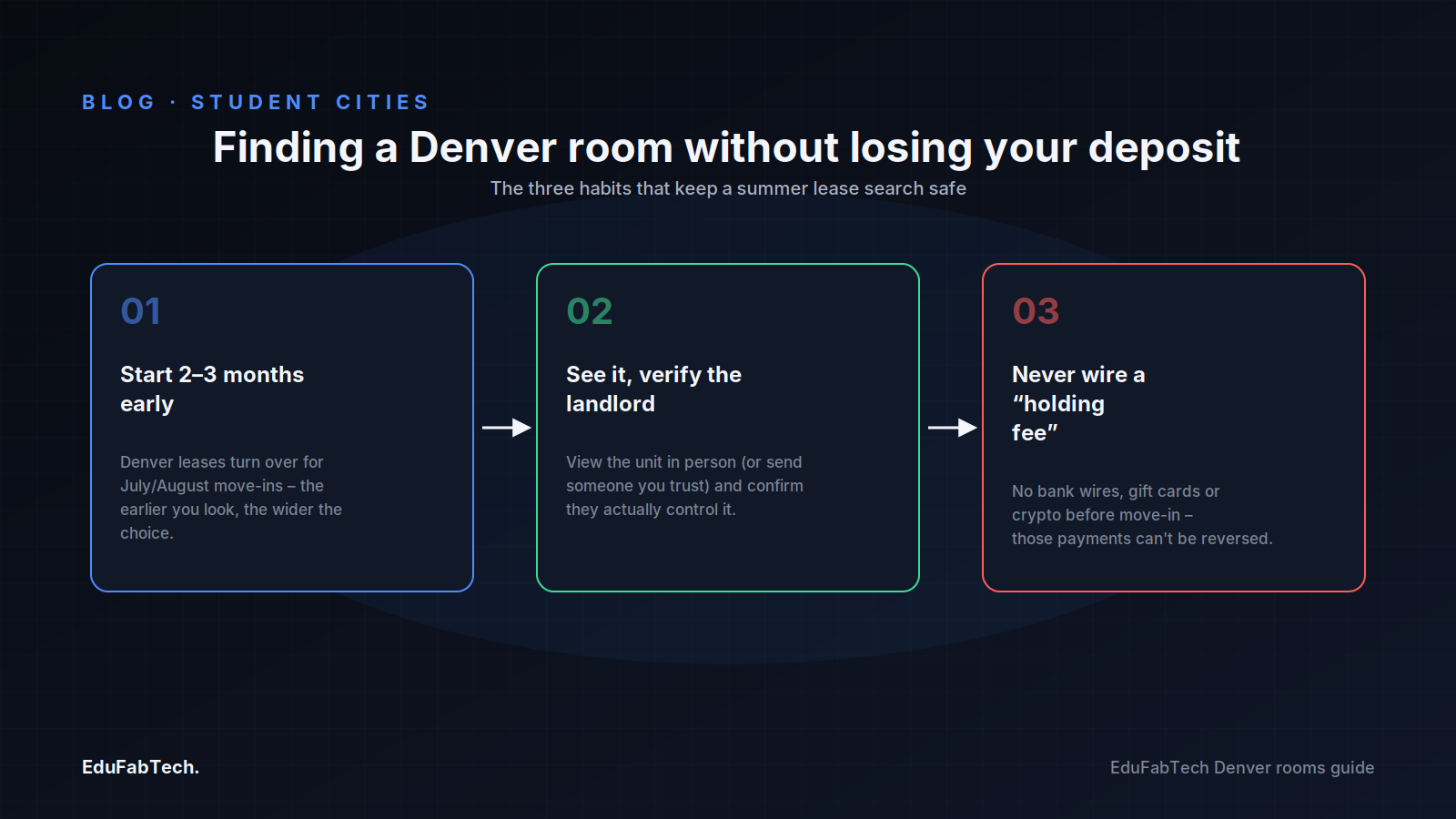
Denver's rental market runs on a summer rhythm. Demand peaks in July and August as leases turn over for the academic year, so the widest choice — and the worst competition — lands right before term starts. If you can, begin looking two to three months out; arriving in late August with nothing lined up is the hardest way to do it. You can start with rooms posted on EduFabTech's Denver rooms page and listings near the University of Denver or near CU Denver, then verify anything promising against the campus and transit map.
A standard private lease in Denver typically asks for the first month's rent plus a security deposit (often equal to one month) before you move in. That is normal. What is not normal is being asked to send money to "hold" a place you have never seen, especially to someone who will not meet you. The listings most prone to scams are exactly the ones students want most: cheap one-bedrooms in Capitol Hill, or rooms advertised a short walk from Auraria. See the unit in person, or have someone you trust see it, before you pay anything; confirm the person showing it actually controls it; and never send a deposit or "holding fee" by bank wire, gift card or cryptocurrency, because those payments cannot be reversed once they are gone. A legitimate landlord will not insist on them.
Kitting out a room: flea markets, thrift and Sunday stalls
Furnishing cheaply is very doable here. The Mile High Flea Market, just north-east of the city at 7007 E. 88th Avenue in Henderson, spans 80 paved acres and runs Friday, Saturday and Sunday from 7am to 5pm, per the Colorado Tourism Office listing — a reliable place for second-hand household goods if you can get a lift out there. Closer in, thrift chains such as ARC and Goodwill have stores across the metro for furniture, kitchenware and clothing. For fresh food and a weekend out, the South Pearl Street Farmers' Market runs on Sundays in Platt Park, a short hop from DU. Much of what you need for a first room turns up second-hand through the city's used-furniture listings, especially around the late-summer move-out dates.
Working while you study
If you are on an F-1 student visa, the rules on employment are set by the U.S. government, not the university. The Department of Homeland Security's Study in the States guidance states plainly that "if you participate in on-campus employment, you may not work more than 20 hours per week when school is in session," as published on its working-in-the-United-States page. On-campus work is usually the simplest route, and any off-campus authorisation generally requires approval from your Designated School Official and, in some cases, federal authorisation first. This is a summary, not legal advice — check your own status with your school's international-student office and the official source before you accept any job. Local part-time openings students actually take are collected on EduFabTech's Denver jobs page.
Libraries and places to study
Study space is one of Denver's quieter strengths. On Auraria, the Auraria Library serves all three downtown institutions under one roof. At the University of Denver, the Anderson Academic Commons is the main library and collaborative study building on the University Park campus. Off campus, the Denver Public Library's Central Library downtown reopened to the public on 3 November 2024 after a major renovation, according to the library's own project updates, and its branches across the city are free to use with a library card. More informal desks and study spots students share are listed on the Denver study-spaces page.
Getting around on RTD
The Regional Transportation District (RTD) runs the metro's buses and light rail. Its published fares put a Local 3-Hour Pass at $2.75 and a Day Pass at $5.50, with discounted versions at $1.35 and $2.70 for eligible riders, and it notes that "youth 19 and under and active-duty U.S. military ride free on all RTD services," on its fares page. Light rail runs straight into the Auraria campus; the A Line commuter train links Denver Union Station to Denver International Airport; and the Flatiron Flyer bus connects downtown with Boulder. Students registered at Auraria can buy an RTD CollegePass that the Auraria Campus ID office prices at $250.00 for the autumn 2026 semester, valid on trains and buses including airport trips. Lower-income riders who are not students can instead apply for RTD's income-based LiVE programme, which the agency describes as a 50% discount on fares throughout its service area on its LiVE page.
Costs, and the honest trade-offs
Housing is the largest and most variable cost. For an on-campus benchmark, the University of Denver lists a standard double residence-hall room at $3,746 per resident, per quarter, for the 2026–27 academic year, alongside required meal-plan blocks from $2,285 to $2,511 per quarter, on its room-and-meal-plan rates page. For the private market, the U.S. Department of Housing and Urban Development's Fiscal Year 2026 Fair Market Rent for a two-bedroom unit in the Denver-Aurora metropolitan area is $2,089 per month, from its FY2026 fair-market-rent schedule effective 1 October 2025 — a figure that, split between housemates, is what pushes many students toward Capitol Hill and shared leases rather than solo apartments.
What is genuinely good here is the combination of a real city and quick access to the outdoors: sun most of the year, mountains visible from campus, a transit spine that makes the downtown schools nearly car-optional, and the unusual fact of three institutions sharing one walkable campus. What is hard is also real. Rents have risen faster than many students' budgets; the metro sprawls, so anyone at Mines, Boulder or Anschutz is signing up for a meaningful commute or a move; the altitude and dry air take a week or two to shake off; and winter brings cold snaps and heavy spring snows that can disrupt travel. None of these is a reason to stay away — but they are worth planning around rather than discovering in October.
A checklist for the first weeks
- Confirm your enrolment and, if you are an international student, check in with your school's international-student office about your status and any work authorisation before taking a job.
- Do not pay a deposit on a room you or someone you trust has not seen in person; never pay by wire, gift card or crypto.
- Sort transit first: if you are at Auraria, buy the CollegePass; otherwise map your route on RTD and keep fare money on hand.
- Give yourself a week to adjust to the altitude — drink more water than feels necessary and ease into exercise.
- Get a Denver Public Library card for free study space and borrowing across the city.
- Furnish from second-hand stores, the flea market and move-out giveaways before buying anything new.
- Pack for sharp weather swings; a warm layer and sun protection both earn their place here year-round.
A quick question for readers
Do you work part-time while you study?
Many students work to pay the bills. See how common it is — and how many hours people really do.
Pick an answer, create a free account in a minute, and your vote counts. Already a member? Sign in
Source: University of Denver
Sources (5)
- University of Colorado Denver. The Auraria Campus. University of Colorado Denver, 2026. cudenver.edu ↗ · checked 2 Oct 2026
- University of Denver. Room & Meal Plan Rates. University of Denver, Housing & Residential Education, 2026. studentaffairs.du.edu ↗ · checked 2 Oct 2026
- Regional Transportation District. Fares. RTD, 2026. rtd-denver.com ↗ · checked 2 Oct 2026
- U.S. Department of Homeland Security. Working in the United States. Study in the States, 2026. studyinthestates.dhs.gov ↗ · checked 2 Oct 2026
- U.S. Department of Housing and Urban Development. FY2026 Schedule of Metropolitan & Non-Metropolitan Fair Market Rents. HUD User, 2025. huduser.gov ↗ · checked 2 Oct 2026