Studying in Diyarbakır: universities, housing and student life
A practical, honest guide to Dicle University, where students live, what things cost, and how to settle into a city on the Tigris — for local and international students alike.
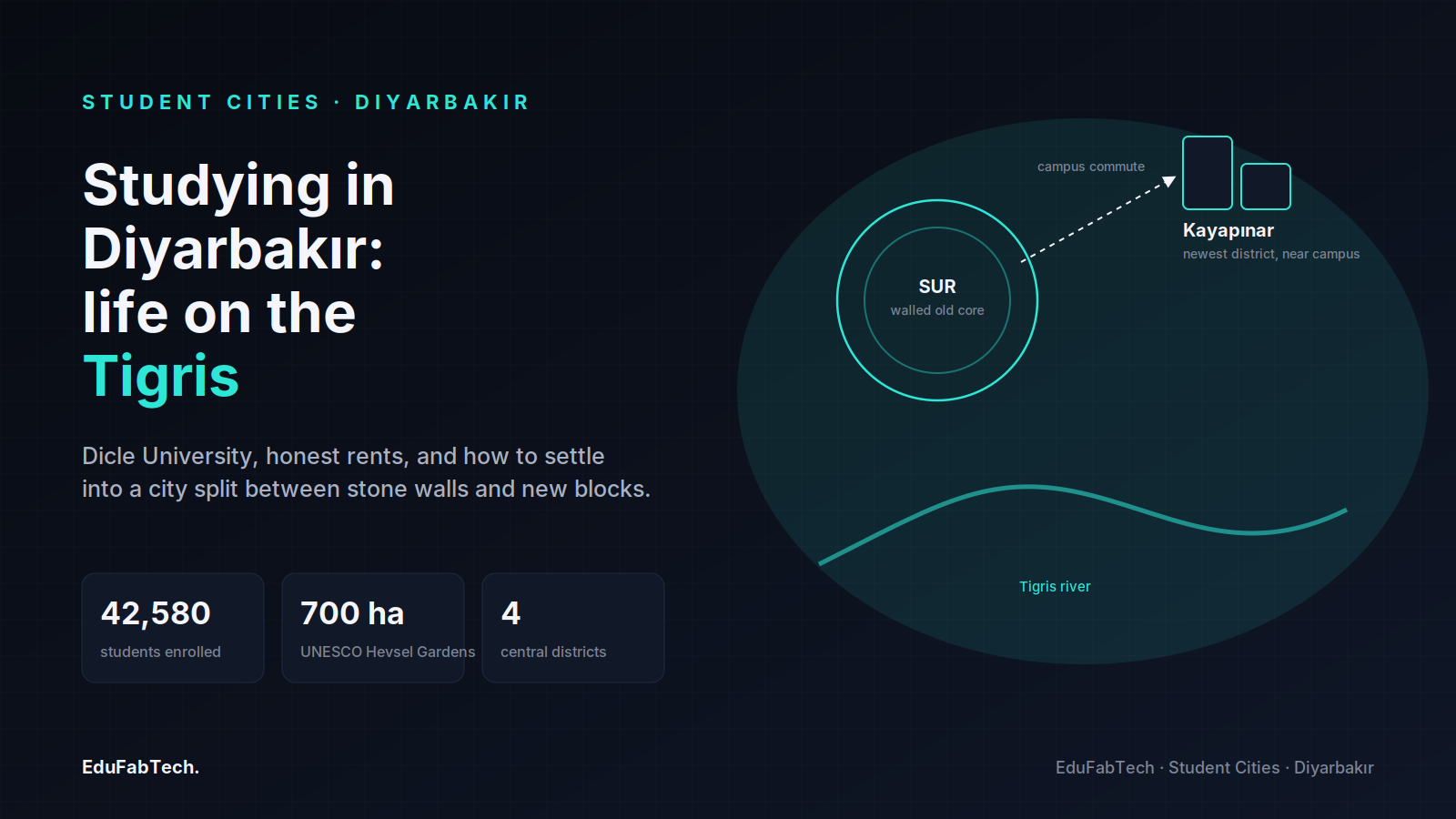
Diyarbakır sits on a basalt plateau above a bend of the Tigris in south-eastern Türkiye, wrapped in dark volcanic-stone walls that run for kilometres around its old quarter. Those walls, together with the terraced Hevsel Gardens that fall from the ramparts to the river, were added to the UNESCO World Heritage List in 2015, the gardens covering roughly 700 hectares. For a student, the first thing to grasp about the city is this split personality: a dense, historic core inside the walls — the Sur district — and a wide, fast-growing modern city of boulevards and apartment blocks spreading west and north. The province is large and the city has grown quickly over the past two decades, so the distance between the old core and the newer edges is real, and where you live shapes your day.
Higher education here is centred on one large institution. Dicle University is the city's comprehensive state university, and its main campus is in the Sur district on the Tigris side of town. The university traces its origins to a medical faculty opened in 1966, was formally established as a university in 1973, and took the name Dicle — the Turkish name for the Tigris — in 1982; it now reports around 42,580 students and about 6,300 staff. It is best known for its faculty of medicine and teaching hospital, which draw patients and trainees from across the region, alongside faculties of engineering, law, education, agriculture and theology.
Dicle University also runs two-year vocational schools in district towns around the province — among them Ergani, Bismil, Silvan, Çermik and Çüngüş — so not everyone enrolled at "the university" actually lives in Diyarbakır proper. If your programme is one of these vocational schools, confirm where it physically meets before you sign a lease in the city. For most undergraduates and postgraduates, though, student life revolves around the Sur campus and the residential districts to its west. You can browse what is currently on offer across the city on EduFabTech's Diyarbakır listings.
Where students live: Kayapınar, Bağlar, Yenişehir and Sur
The city is organised into four central districts, and each has a distinct feel. Kayapınar, to the north-west, is the newest and most planned — wide avenues, newer blocks, and the neighbourhoods of Diclekent and Peyas that sit closest to campus; it is also the most populous of the four. Yenişehir, and within it the long-established Ofis quarter, is the older middle-class centre, full of cafés, bookshops and bus routes. Bağlar, to the south, is denser, older and generally cheaper to rent in. Sur, inside and just beyond the walls, is the historic heart; parts of it were damaged and rebuilt after 2015–2016, so the housing stock there is uneven.
Most students choose between a dormitory bed and a shared flat. A state dormitory system and a number of private and foundation halls operate in the city; places in the public halls are allocated through a national application process and fill quickly, so apply early if that is your plan. For more independence, the usual route is a shared flat with a flatmate or two (an ev arkadaşı arrangement) in Kayapınar or Yenişehir, splitting rent and bills. Rooms near campus in Diclekent and Peyas tend to cost more; Bağlar and the older parts of Yenişehir are easier on a tight budget. Because reliable, source-backed figures for individual rooms are hard to pin down and move fast with inflation, treat any price you are quoted as a starting point, and compare several rooms and places to stay before committing. Listings close to campus are gathered under places near Dicle University.
Finding a room safely
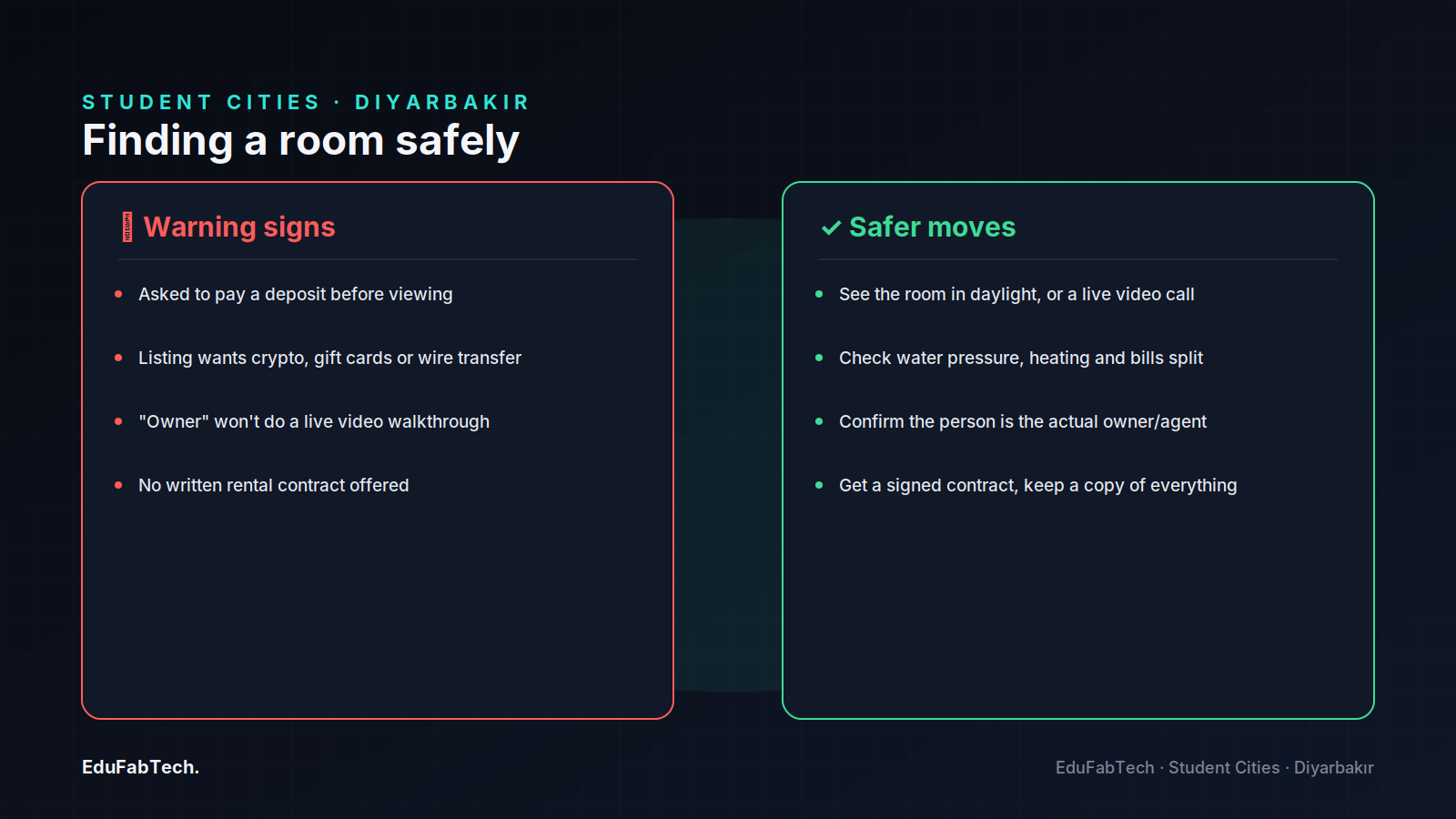
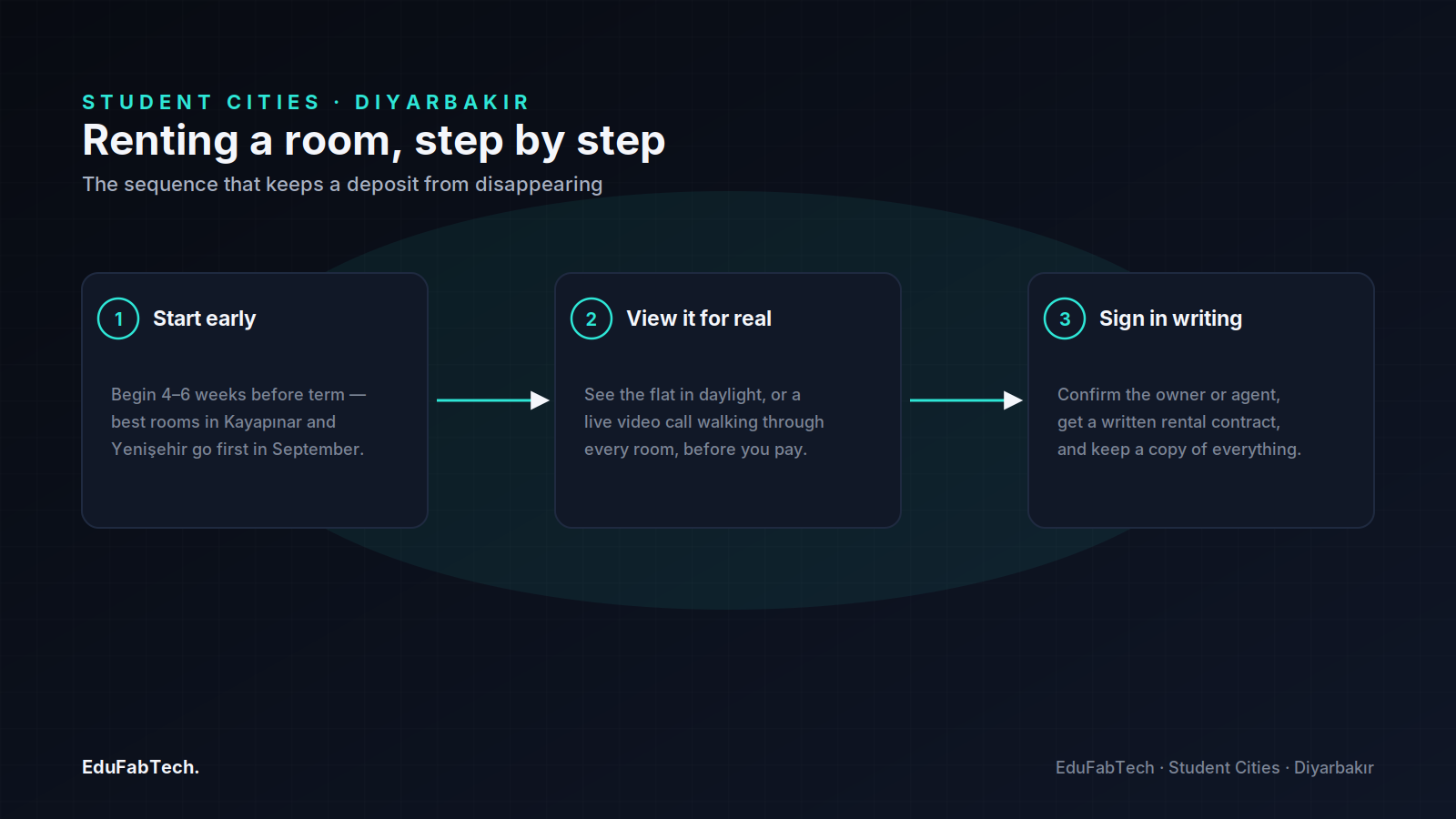
Start looking four to six weeks before term if you can. Supply tightens sharply in September, and the best-value rooms in Kayapınar and Yenişehir go first. Before you pay anything, see the place in daylight, check the water pressure and heating, ask how bills are split, look at whether the building has reliable water storage for the hot months, and find out how long the walk or bus ride to campus actually takes at a weekday morning hour rather than on a quiet afternoon. Ask to meet whoever owns the flat and get the agreement in writing.
Treat any request to pay before you have seen the place as a warning sign. View the room in person, or at the very least on a live video call where the person walks you through it in real time, before any money changes hands. Never send a deposit by bank transfer, gift card or cryptocurrency to "hold" a room for someone you have not met, however polished the listing looks — a genuine landlord does not need an untraceable payment to reserve a room sight unseen. Insist on a written rental contract, confirm that the person showing the flat is the actual owner or an authorised agent, and keep a copy of everything you sign.
Furnishing a room without overspending
A bare room is the norm when you rent privately, so budget for a bed, a desk and basic kitchen things. Diyarbakır rewards patience here. The walled old city has been a trading centre for centuries: its covered bazaars and restored caravanserais — the much-photographed Hasan Paşa Hanı, now full of tea tables, among them — cluster around the main avenue through Sur, and the surrounding lanes still hold the copper workers' market and stalls selling household goods. For furniture and appliances, second-hand and "spot" shops are concentrated in Bağlar and along the older commercial streets, where last year's student stock turns over cheaply each autumn.
The weekly neighbourhood markets (the pazar that sets up on a fixed day in each district) are where you buy fruit, vegetables, kitchenware and textiles for a fraction of shop prices; ask your flatmates which day yours runs. For furniture, bedding and small appliances handed on by departing students, it is worth watching EduFabTech's second-hand things for Diyarbakır and the jobs board for the gig work that often pays for them. Move-out season in June is the single best time to furnish a room almost for free.
Part-time work and the rules that apply
If you are an international student, do not assume you can simply take a job. A student residence permit does not by itself allow you to work; a separate work permit is required before you can be legally employed. In broad terms, undergraduates may find part-time work that fits around their timetable, while graduate students can often be paid as researchers on projects linked to their studies — but the rules are specific and change over time. Read the official guidance on work opportunities for international students before you accept anything, and ask your university's international office to confirm your situation. This is a description of where to look, not legal advice.
Local students and anyone with the right to work will find the usual campus-town openings: tutoring, retail and hospitality in Kayapınar and Ofis, and seasonal work. Diyarbakır's economy is smaller and less tourism-driven than a coastal city's, so paid student work is less abundant than in, say, a resort town — plan your budget on the assumption that study, not wages, pays the rent.
Libraries and places to study
The Dicle University central library is the obvious anchor: it offers a catalogue, bookable study rooms, computer access, inter-library loans and subscription databases, which matter most during exam weeks when flats get noisy and hot. Faculty libraries and departmental reading rooms add quieter corners closer to lectures. Beyond campus, public and youth libraries across Kayapınar and Yenişehir provide free desks, and the city's café culture — strong in Ofis and around the walls — means there is usually somewhere with a table and power socket when you need a change of scene. If you prefer a reserved desk or a quiet shared space, EduFabTech lists study spaces in Diyarbakır.
Getting around
Diyarbakır is flat and, in its modern districts, built for buses. Municipal buses and shared minibuses (dolmuş) connect the residential districts to the Sur campus, and fares are paid with the city's stored-value transport card. Students pay a reduced fare: the metropolitan municipality set the student bus fare at 10 TL per trip and a monthly student pass of 500 TL for 90 trips in May 2025, after a cost-based adjustment. You apply for the student card with a proof-of-enrolment document and a photo. Minibuses are frequent and cheap but their routes take some learning, so classmates and flatmates are the fastest way to work out which line goes where. Within the walled old city, walking is genuinely the quickest option — distances are short and streets are narrow — while a flat in Kayapınar close to campus can save you a daily commute altogether.
Costs, climate and the honest trade-offs
The honest case for Diyarbakır is value and depth of place. Rents and everyday costs are lower than in the big western metros, the food is excellent and cheap, and you study inside one of the oldest continuously inhabited cityscapes anywhere. The university's medical and health faculties give the city a serious professional pull, and the old city is a remarkable place to live as a student.
The honest case against is mostly the climate and the economy. Summers are punishing: the hottest month, July, has an average daily high near 38 °C, while January lows sit around −2 °C, so you want a room you can keep cool in summer and warm in winter, and reliable water through the driest weeks. Paid student work is thinner than in tourist cities, the airport has fewer connections than the coast, and the newer districts, built fast, can feel sprawling and car-oriented. None of this is a deal-breaker — it is simply what to plan around.
On figures more broadly: be sceptical of precise cost-of-living numbers quoted without a date, because high inflation makes them stale within months. Where this guide gives a number, it names the source and the year; for rents and groceries, compare current listings yourself rather than trusting a figure from last year.
Your first weeks: a checklist
- Sort your residence and enrolment paperwork first; several later steps — transport card, library access, any work permit — depend on it.
- If you want a public dormitory place, apply through the national system early; if you want a flat, line up viewings before term starts.
- View every room in person or on a live video call. Never pre-pay a deposit to hold a room you have not seen.
- Get your student transport card with a proof-of-enrolment document and a photo, and learn the bus and dolmuş routes between home and campus.
- Find the weekly pazar day in your district and furnish cheaply from second-hand and spot shops in Bağlar.
- Register for the central library and locate a quiet backup study spot before exam season, when flats are hot and crowded.
- If you are an international student, confirm the work rules with your international office before accepting any job.
- Prepare for the heat: a room you can cool, and a plan for water in the driest summer weeks, will matter more than you expect.
- Dicle University. Tarihçemiz (Our History). Dicle University, 2025. link
- Dicle University. Faculty of Medicine (Tıp Fakültesi). Dicle University, 2025. link
- Dicle University. Library and Documentation Department — services and contact. Dicle University, 2025. link
- Diyarbakır Metropolitan Municipality. Cost-based increase applied to public transport fares (student fares and passes). Diyarbakır Büyükşehir Belediyesi, 2025. link
- Daily Sabah. World heritage in Turkey: Mighty Diyarbakır Fortress and luscious Hevsel Gardens. Daily Sabah, 2021. link
- Study in Türkiye. Work Opportunities for international students. Study in Türkiye (official portal), 2025. link
- Cedar Lake Ventures. Average Weather in Diyarbakır, Turkey, Year Round. Weather Spark, 2025. link