Studying in Düsseldorf: universities, housing and student life
A practical, sourced guide to Düsseldorf's universities, where students live, how to rent safely, part-time work, study spaces, markets, transport and the real trade-offs.
Düsseldorf is the capital of North Rhine-Westphalia, Germany's most populous state, and it wears that status in a particular way: trade fairs, advertising and fashion houses, the luxury shop windows of the Königsallee, a working river port, and one of Europe's larger Japanese communities clustered around Immermannstraße. It is also a drinking city. The tourist board describes the Altstadt — the compact old town on the Rhine's right bank — as covering only half a square kilometre and yet known as "the longest bar in the world", with more than 260 places to eat and drink and its own dark top-fermented Altbier poured where neighbouring Köln pours Kölsch.
For a student, the useful fact about Düsseldorf is that it is small and well-connected rather than sprawling. The whole city sits inside the Rhine-Ruhr conurbation, so the campuses that matter are not only the ones within the ring road but a cluster of universities a short regional train ride away. What a newcomer trades for that density is price: this is one of Germany's more expensive places to rent, and finding a room is the hardest part of arriving.
Three institutions in the city, five more within reach
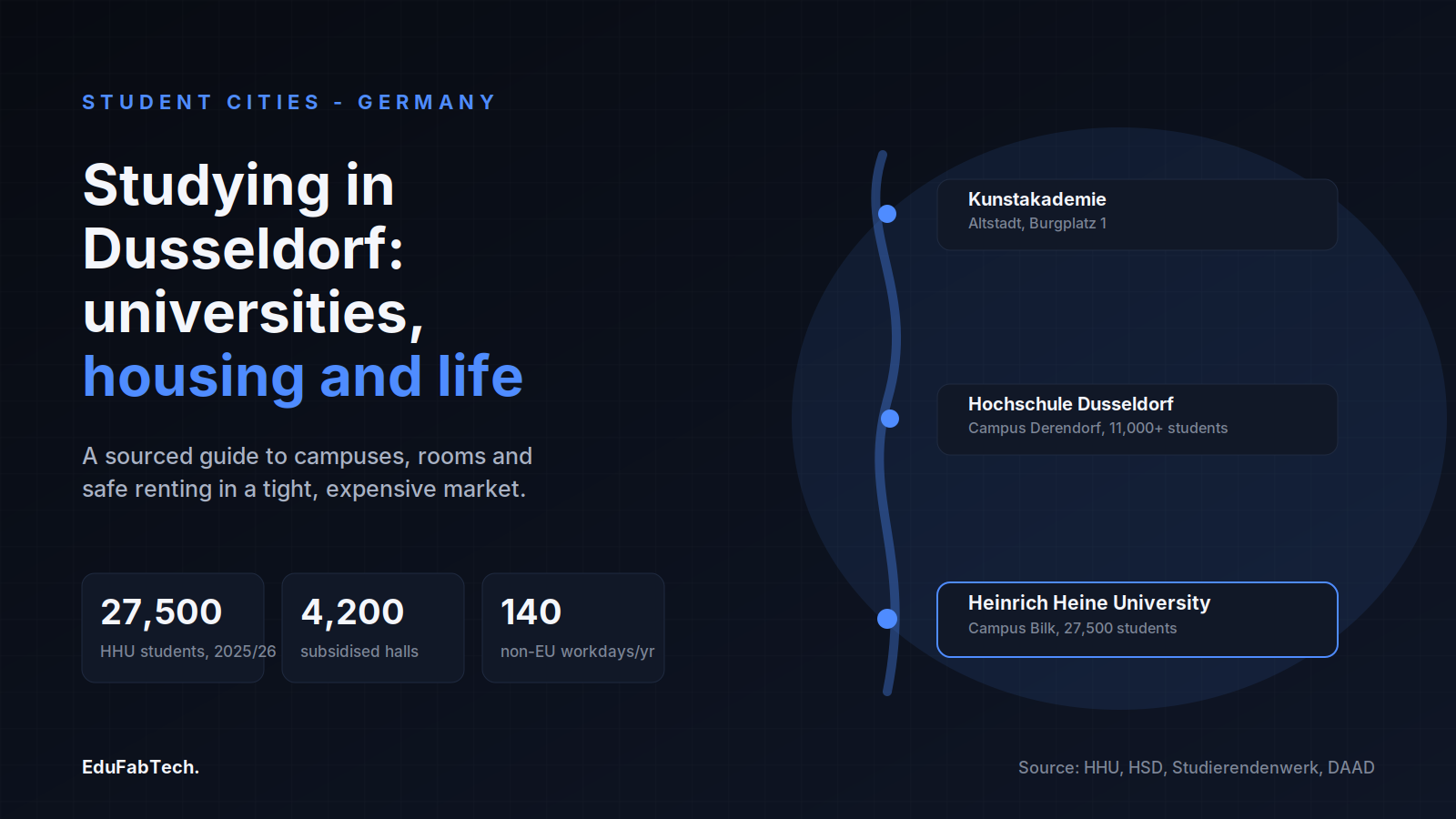
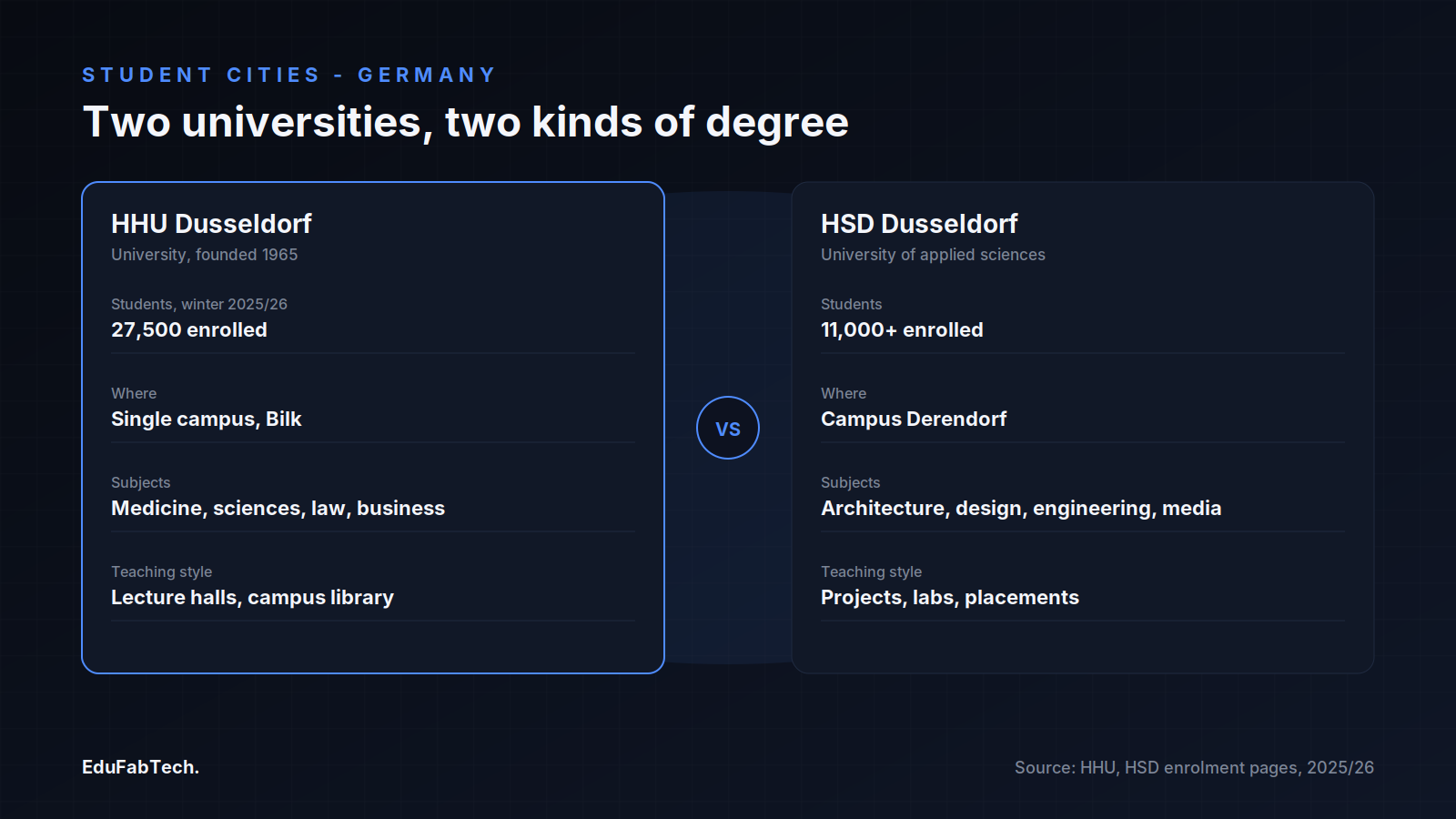
The anchor is Heinrich Heine University Düsseldorf — the University of Düsseldorf — founded in 1965 and built around a single campus in the southern district of Bilk, where medicine, the sciences, humanities, business and law share one site next to the university hospital. The university announced that around 27,500 students were enrolled for the winter semester 2025/2026, including 3,618 first-year students registered by 10 October 2025. A campus university like this concentrates everything — lecture halls, the main library, the refectory and student services — within walking distance, which makes Bilk the natural first place to look for a room.
Hochschule Düsseldorf (HSD), the city's university of applied sciences, is the more hands-on counterpart. Its profile page lists more than 11,000 students across seven departments — among them architecture, design, electrical engineering, mechanical and process engineering, media, and social and cultural sciences — on the Campus Derendorf at Münsterstraße 156, built on the grounds of a former slaughterhouse and brewery north of the centre. HSD teaching leans toward projects, labs and placements rather than large lecture-hall cohorts.
The third is the Kunstakademie Düsseldorf, the state art academy at Burgplatz 1, on the Rhine embankment at the edge of the Altstadt. Its own site lists study tracks in Freie Kunst (fine art), Baukunst (a postgraduate architecture programme) and Lehramt Kunst (art teacher training), and it opens its studios to the public twice a year in the Rundgang exhibitions — the best free way to see what students there are making.
Beyond the city limits, five more institutions are reachable on a regional ticket and worth knowing if your subject isn't taught in Düsseldorf. The University of Duisburg-Essen runs twin campuses in Essen and Duisburg and is among the largest universities in the state. The University of Wuppertal — the Bergische Universität — sits on a hillside campus in Wuppertal, the town of the suspended Schwebebahn railway. The Folkwang University of the Arts trains musicians, actors, dancers and designers, with its main home in a former abbey in Essen-Werden. The Hochschule Niederrhein is a large applied-sciences school with campuses in Krefeld and Mönchengladbach, and the Ruhr West University of Applied Sciences teaches engineering, computing and business from campuses in Bottrop and Mülheim an der Ruhr. All of them lie inside the regional transport network that your semester ticket already covers.
Which neighbourhoods students settle in
The gravity of student housing follows the two city campuses. Bilk and neighbouring Unterbilk and Friedrichstadt, around the HHU campus and the Bilker S-Bahn station, are the obvious choice for university students: dense nineteenth-century blocks, trams to everywhere, and the Südpark on the doorstep. Flingern and Oberbilk, east of the main station, have become the places people name when they talk about where Düsseldorf has got younger and more creative, with galleries and cafés filling former workshops. Derendorf and Pempelfort put you near HSD and a short ride from the centre. The addresses students generally don't rent near are the ones the city is famous for — the Königsallee and the villa streets of Oberkassel across the river.
The safest first move is the Studierendenwerk Düsseldorf, the public student-services body that runs subsidised halls. Its listings describe roughly 4,200 rooms across 25 residences in Düsseldorf and the surrounding university towns, with single apartments on its current pages priced from about €270 to €420 a month depending on size and location — well below the open market. Places are limited and contracts are typically capped at four semesters, so apply as early as you can, ideally the moment you have an admission letter, and expect a waiting list around the October and April intakes.
For the private market — shared flats (a Wohngemeinschaft, or WG) and studios — start looking weeks before you arrive, not after. Rooms turn over fastest just before each semester, and the competition is real: viewings for a decent WG room in Bilk can draw a crowd. It helps to have your documents ready in German fashion: proof of enrolment or admission, identification, and, for some landlords, a SCHUFA credit record and a guarantor. EduFabTech keeps a running list of rooms in Düsseldorf, and a wider set of student listings across the city, including places near the HHU campus.
Paying a deposit in Düsseldorf without losing it
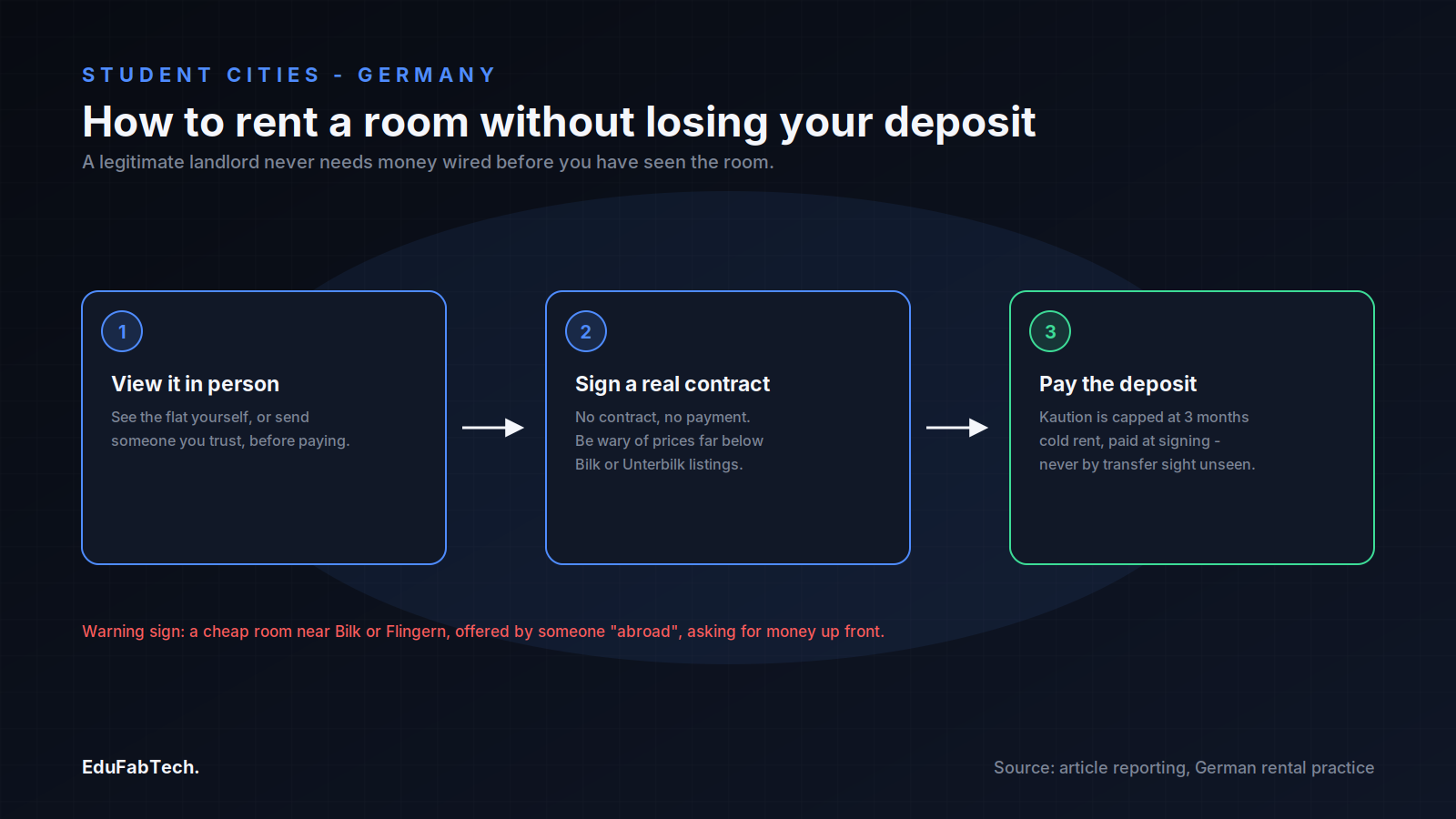
The room shortage is exactly what rental scams feed on, and in Düsseldorf they cluster where demand is tightest: cheap, photogenic flats advertised near the Bilk campus or in Flingern, often by someone who claims to be abroad and asks you to transfer a deposit to "hold" the room before any viewing. Treat that as the warning sign it is. A deposit (Kaution) in Germany is normally no more than three months' cold rent, it is handed over when you sign a real contract, and a legitimate landlord does not need it wired in advance to reserve a place you have never seen.
Practical rules for this city: view the flat in person, or send someone you trust, before paying anything; be wary of a price that undercuts everything else in Bilk or Unterbilk; and never send money by bank transfer, gift card or cryptocurrency to secure a room sight-unseen — those payments do not come back. If a private search is going nowhere, the Studierendenwerk halls and the university's own housing advice are the slower but far safer routes in.
Furnishing a room: the Saturday market in Bilk
A German room is often rented bare — sometimes without a fitted kitchen — so furnishing it cheaply is a standard part of moving in. Düsseldorf's long-running Saturday flea market (Trödelmarkt) at Aachener Platz in Bilk, a few minutes from the HHU campus, is where students hunt for desks, lamps, shelving and bikes; it runs weekly and is as much a morning out as a shopping trip. For food and everyday supplies, the Carlsplatz market in the Altstadt is the city's oldest produce market, good for a cheap lunch between its stalls.
Online, the quickest wins are usually local. EduFabTech lists second-hand things, used furniture and items people are giving away free in Düsseldorf — the last of which fills up at the end of each semester, when departing students clear their rooms. Collecting a free desk by tram costs less than a flea-market haggle, if you can carry it.
Earning money alongside your degree
Many students work part-time, and the rules depend on your nationality. The DAAD states that international students from non-EU countries may work 140 full days or 280 half days per year without further permission; students from the EU and EEA are broadly treated like German students. Those limits, and any conditions on your residence permit, are enforced by Düsseldorf's immigration authority (the Ausländerbehörde, part of the city's migration office), and the terms printed on your own permit are what count. This is general information, not legal advice — check your specific case with the authority or the university's international office before you sign a contract.
Where the work is: the trade-fair grounds (Messe Düsseldorf), hospitality in the Altstadt, retail, and the many corporate offices and agencies in the city generate the usual student jobs, plus academic assistant roles on campus. EduFabTech aggregates part-time jobs in Düsseldorf alongside the room and second-hand listings.
Reading rooms, from Bilk to Derendorf
The central study space is the University and State Library (ULB) on the HHU campus, which doubles as a regional state library. Its central building lists opening hours of Monday to Friday 8am–10pm and weekends 10am–9pm, with separate branch libraries for law and medicine keeping similarly long hours. Entry is free, and the reading rooms are the default place HHU students revise through exam weeks. HSD students have their own library on the Derendorf campus, where the seminar buildings also set aside workspaces for independent study. Seats fill around examination periods; if you need a desk at short notice, EduFabTech lists study spaces in Düsseldorf.
Trams, the U-Bahn and the semester ticket
Düsseldorf's transport operator is the Rheinbahn, which runs the U-Bahn (part of it burrowing under the centre on the Wehrhahn line), the trams and the buses; the city also sits on the regional S-Bahn and the Rhine-Ruhr tariff area, the VRR. For most students the ticket is handled automatically: the Deutschlandsemesterticket is funded through the semester contribution you pay at enrolment, and from the winter semester 2025/2026 it works out at €34.80 a month. You cannot buy it over a counter — your university issues it as an app barcode or chipcard — and it is valid on local and regional public transport across Germany, which is what makes those campuses in Essen, Wuppertal, Krefeld and Bottrop a realistic day trip.
Day to day, the city is flat and compact enough to cycle, the Rhine promenade gives a car-free spine through the middle, and the two campuses are each a few tram stops from the centre. Confirm fares and any conditions on the Rheinbahn or VRR pages before you rely on them, since prices change at the turn of the year.
What it costs, and what is hard
The honest headline is cost. Düsseldorf is an affluent, business-oriented city, and its private rental market is among the more expensive in Germany; the gap between a subsidised Studierendenwerk room at €270–420 a month and an open-market studio is wide, and the squeeze is worst at semester start. Set against that, the semester ticket removes transport from the monthly budget almost entirely, the flea markets and free-stuff listings take the sting out of furnishing, and the compactness means you rarely pay to travel far.
What else is hard: the Rhineland winter is grey and damp more than it is cold, and room-hunting can be genuinely stressful if you leave it late. What is good is specific to here — a walkable old town, a serious art scene anchored by the Kunstakademie, the Rhine itself, Karneval each winter when the city turns itself over to celebration, and Köln and the whole Ruhr within a short ride on a ticket you already hold. For students who like a city that is lively without being vast, the trade is a fair one.
A checklist for the first weeks
- Register your address (Anmeldung). Book an appointment at a city Bürgerbüro and register within the first weeks of moving in; you will need the confirmation for almost everything else.
- Complete enrolment and keep the ticket. Finish matriculation at your university, pay the semester contribution, and activate your Deutschlandsemesterticket before you start riding the trams.
- Open a bank account and sort health insurance. Both are usually required to enrol and to be paid; statutory health insurance is mandatory for most students.
- Lock down housing safely. Prefer Studierendenwerk halls or viewed-in-person rooms; never wire a deposit to hold a place you haven't seen.
- Furnish from the city. Hit the Saturday flea market at Aachener Platz and the end-of-semester giveaways before buying anything new.
- If you plan to work, check your permit. Confirm your day limit and any conditions with the Ausländerbehörde or the international office first.
- Find your desk. Get a library card for the ULB and scout the quieter branch and campus study rooms before exam season arrives.
A quick question for readers
Do you work part-time while you study?
Many students work to pay the bills. See how common it is — and how many hours people really do.
Pick an answer, create a free account in a minute, and your vote counts. Already a member? Sign in
Comments 2
Comment-
Do the arithmetic on the 'safest first move' before you plan around it. 4,200 subsidised rooms against roughly 27,500 HHU students and 11,00…
-
The deposit scam breakdown is the part worth drilling into students, specifically the "someone claims to be abroad" pattern paired with chea…
Join free to read the full comments and reply Comments are between members; an account takes a minute.
Source: Heinrich Heine University Düsseldorf
Sources (5)
- Heinrich Heine University Düsseldorf. Start of the lecture period in the winter semester 2025/2026. Heinrich Heine University Düsseldorf, 2025. hhu.de ↗ · checked 13 Nov 2026
- Hochschule Düsseldorf. Profil der Hochschule Düsseldorf. Hochschule Düsseldorf, 2026. hs-duesseldorf.de ↗ · checked 13 Nov 2026
- Rheinbahn AG. Deutschlandsemesterticket. Rheinbahn AG, 2025. rheinbahn.de ↗ · checked 13 Nov 2026
- DAAD. Side jobs. Deutscher Akademischer Austauschdienst (DAAD), 2026. daad.de ↗ · checked 13 Nov 2026
- Studierendenwerk Düsseldorf. Wohnanlagen. Studierendenwerk Düsseldorf, 2026. stw-d.de ↗ · checked 13 Nov 2026